
2026 Texas Facility Manager's HVAC Maintenance Guide
A recurring checklist can create the appearance of control while missing the conditions that actually affect system reliability. Effective office building HVAC maintenance is a documented operating program shaped by equipment condition, occupancy, operating hours, and Texas seasonal demands. When those factors are overlooked, developing issues may go unnoticed until comfort or building operations are affected.
Facility managers are right to expect planned service to reduce surprises, but a generic task list cannot account for every office building. Texas heat and humidity place substantial demands on cooling systems, while service work must also fit occupied hours and operational priorities. Clear records matter, too. Without them, it is difficult to confirm what was inspected, track recurring concerns, or plan follow-up.
This guide explains how to build a practical, site-specific maintenance plan that supports reliable operation and occupant comfort without treating every system alike. You’ll learn how to document equipment and service history, identify developing issues, coordinate maintenance around occupancy and seasonal conditions, and use service findings to make informed decisions. The result is a more deliberate approach to planned maintenance, with emergency repair recognized as a separate need when an interruption occurs.
Key Takeaways
- Build office building HVAC maintenance around equipment condition, manufacturer guidance, and facility operating priorities rather than relying on a generic checklist.
- Use a clear planning sequence to organize equipment information, assess needs, arrange site access, and record completed work.
- Evaluate service findings by urgency and planning horizon so routine observations, corrective work, and longer-term needs are easier to distinguish.
- Compare service proposals by the clarity of their scope, documentation, communication, and follow-up process.
- Understand how scheduled commercial HVAC maintenance and emergency repair address different facility needs, including the support available from J3 Mechanical Services.
Why office building HVAC maintenance requires a facility-specific plan
Office building HVAC maintenance is the planned inspection, upkeep, documentation, and corrective follow-up that help facility teams manage commercial heating, ventilation, and air conditioning systems. The appropriate scope depends on the equipment in the building, its observed condition, how it operates, and the priorities of the people who use it. A common checklist can provide a starting point, but it cannot account for every system design or operating pattern. Begin by matching each planned task to an installed system and a documented need.
Preventive work and reactive repair serve different purposes. Planned maintenance gives facility teams a structured opportunity to review system condition and address identified needs. Repair responds to a fault or interruption that has already occurred. Maintenance can support reliability, but it cannot eliminate the possibility of equipment failure. Clear findings and follow-up records help managers make informed decisions about corrective work and longer-term planning while keeping occupant comfort and operating continuity in view.
Because HVAC systems coordinate multiple functions, an issue in one part of a system can affect conditions elsewhere in a building. A general overview of Heating, ventilation, and air conditioning (HVAC) can help explain the systems involved, but maintenance decisions should be grounded in the specific equipment and conditions at the property. For a broader framework, review this commercial HVAC maintenance strategy.
How office occupancy changes maintenance priorities
Operating hours, tenant density, meeting-room use, and changing schedules all influence when service can take place and which areas deserve attention. For example, recurring comfort complaints in a heavily used meeting room may point to a distribution or controls issue that warrants investigation, rather than an assumption that the entire system needs the same response. When logging a complaint, note the affected area, when the issue occurs, and whether it recurs. That context can help guide an assessment. Planned access and communication with tenants also help coordinate work and limit avoidable disruption to employees and building operations.
Why Texas conditions belong in the maintenance plan
Heat, humidity, and seasonal transitions can place different demands on office HVAC equipment over the course of the year, but conditions vary by location and facility. A useful plan considers what the system experiences at that site, along with equipment condition and building use, instead of applying a regional assumption to every property. Review seasonal readiness alongside observed performance and service history, then adjust priorities to match actual operating needs.
What an office building HVAC maintenance program should cover
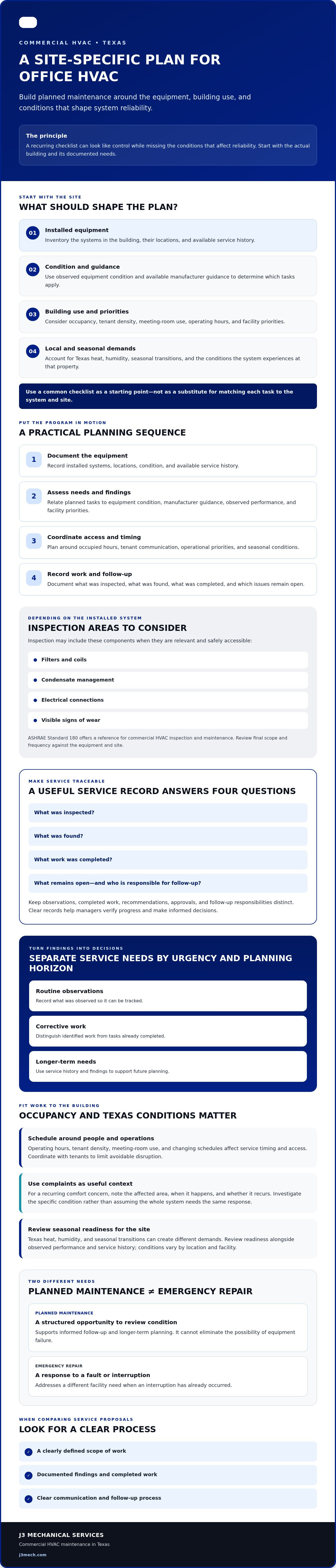
A useful office building HVAC maintenance program starts with an accurate inventory of installed equipment, its condition, available manufacturer guidance, and the facility’s operating priorities. Record equipment locations and the available service history so a maintenance provider can determine which tasks apply, rather than treating every building as though it has the same equipment or needs. ASHRAE Standard 180 offers a reference for commercial HVAC inspection and maintenance, while the final scope and frequency should still be reviewed against the specific equipment and site.
The program should make service outcomes traceable. Records need to show what was inspected, what was found, what work was completed, and which issues remain open. Separate observations from completed work and recommendations, and note any required approvals or follow-up responsibility. This gives facility managers a basis for verifying progress and making decisions without relying on informal notes or memory.
Core inspection and service categories
Depending on the installed system and what is safely accessible, inspection may include filters, coils, condensate management, electrical connections, and visible signs of wear. Operational checks can assess airflow, temperature control, and system response under the conditions present during the visit. These checks are observations, not automatic authorization to perform repairs. If a finding requires additional work, the provider should document the issue, explain its significance, and clarify any approval needed before proceeding.
Not every component will apply to every property. Use the building’s system inventory and manufacturer guidance to determine which checks belong in the plan. Then use site priorities and service findings to clarify which items need timely attention and which should remain on a monitoring list.
Controls, records, and corrective follow-up
Where controls are available, review relevant settings, alarms, and operating schedules as part of understanding how the system is configured to serve the facility. Compare those details with observed conditions and reported comfort concerns. Record discrepancies for investigation rather than changing settings without an agreed scope.
A consistent service log can capture:
- Date and equipment: Identify when the visit occurred and which systems were reviewed.
- Findings and actions: Record observations, completed work, and recommendations separately.
- Open items: Note unresolved issues, required approvals, and who is responsible for follow-up.
Over time, recurring observations can help facility teams assess whether corrective work, replacement discussions, or longer-term planning deserve attention. For commercial facilities evaluating outside support, J3 Mechanical Services provides commercial HVAC maintenance programs. Review whether a proposed scope and documentation process suit the building’s equipment and operating needs.
How to schedule HVAC maintenance around office operations in Texas
A workable service schedule connects equipment needs with the realities of an occupied building. For office building HVAC maintenance, use a repeatable planning sequence: inventory the systems, review operating needs, assess current condition, plan access, and document outcomes. This keeps scheduling grounded in facility information rather than an assumed calendar that may not fit the equipment or the people using the space.
Build a schedule from equipment and building needs
Group equipment by type, location, observed condition, and operational importance. A system serving a heavily occupied area may warrant different planning attention from equipment serving a less critical space, but the appropriate scope and timing should be verified against manufacturer recommendations and site findings. A qualified commercial HVAC provider can help review those details and identify what should be scheduled without applying a universal interval to every system.
Revisit the schedule when conditions change. A shift in tenant occupancy, extended operating hours, recurring comfort concerns, or a change in equipment condition can affect maintenance priorities. Texas seasonal transitions are useful prompts to review readiness for changing heating or cooling demand, but they do not replace an equipment-specific assessment. Local conditions, building operations, and documented service findings should guide the review.
Reduce disruption during planned service
Before confirming a visit, identify the work areas, equipment access constraints, tenant notification needs, and any operating adjustments that may be required. Coordinate the service window with facility representatives and applicable building procedures, then communicate which areas may be affected and when access is needed. For example, work near occupied offices or shared meeting spaces may require different coordination from work in a restricted mechanical area.
Use this sequence to keep planning organized:
- Inventory: Confirm the equipment, locations, and available system documentation.
- Review: Note occupancy patterns, operating schedules, access requirements, and current concerns.
- Assess: Use observed condition and manufacturer guidance to confirm suitable tasks and timing with a qualified commercial HVAC provider.
- Coordinate: Agree on access, service windows, tenant communication, and any operational considerations.
- Document: Record completed work, findings, open issues, and any schedule adjustments.
Installation decisions also shape how equipment is accessed and maintained over its service life. Facility teams reviewing those considerations can consult this overview of commercial HVAC installation planning.
How to evaluate office HVAC maintenance findings and service needs
A maintenance report is most useful when it distinguishes what was observed from what requires action. For office building HVAC maintenance, facility teams can sort findings into four categories: routine observations to monitor, recommended corrective work, urgent conditions affecting safe or reliable operation, and longer-term planning items such as equipment replacement discussions. This makes priorities clearer without treating every note as an immediate repair. Ask the provider to explain the reason for each recommendation and identify what follow-up, if any, is needed.
Scheduled maintenance reduces uncertainty by making system condition and recommendations more visible, but it cannot guarantee uninterrupted operation. Repeated emergency calls are not a complete maintenance program, either. They address failures after they occur, while planned maintenance supports review, documentation, and deliberate follow-up between interruptions.
What to ask when reviewing a maintenance provider
Ask how technicians document findings, explain priority, and track recommendations that remain unresolved. Confirm that the proposed scope reflects the building’s actual equipment, observed condition, and operating requirements, rather than relying on an unexplained standard checklist. Clarify which tasks are included in scheduled maintenance, how findings will be reported, and how repairs are presented for separate review and authorization.
When comparing proposals, assess more than the task list. Look for a defined scope, useful service records, a clear communication process for significant findings, and an identifiable method for confirming follow-up. Check whether the proposal explains who will receive the report and how open items will be tracked. A proposal that makes these responsibilities clear gives facility managers a stronger basis for evaluating service than one that leaves them unspecified.
When an issue requires repair or emergency response
New or worsening comfort problems, recurring system alarms, unusual operating behavior, or an interruption affecting occupied areas warrant timely assessment by a qualified commercial HVAC provider. These signs do not establish a specific fault, and building staff should avoid hazardous troubleshooting. Document what is happening, where it occurs, and how it affects operations, then communicate those observations to the provider.
Planned corrective work can be reviewed and scheduled according to facility priorities. By contrast, an unexpected interruption that materially affects building operations may require urgent repair. The appropriate response depends on the condition and its impact, so clarify the provider’s process for urgent service rather than assuming every recommendation carries the same priority. For additional context, see this guide to commercial HVAC repair planning.
J3 Mechanical Services provides commercial HVAC repair, including 24/7 emergency repair. For support evaluating commercial system findings or repair needs, contact J3 Mechanical Services.
How J3 Mechanical Services supports commercial HVAC maintenance in Texas
After establishing a facility-specific maintenance framework, the next step is to discuss how it can be applied to the building’s actual equipment and operations. J3 Mechanical Services provides commercial HVAC maintenance programs and 24/7 emergency repair for commercial facilities across Texas. These services address different needs: scheduled maintenance supports planned system oversight, while emergency repair responds to urgent equipment interruptions.
A clear conversation begins with the facility’s requirements, not an assumption that every office needs the same scope. Share what equipment is installed, how the building operates, and what issues have been observed so the maintenance approach can be reviewed against the site. Confirm proposed work after the facility and its mechanical systems have been reviewed, rather than relying on promises of a particular outcome or assuming that every plan includes the same tasks.
Match maintenance planning to the building
Before speaking with a commercial HVAC provider, gather an equipment list, recent service history, known concerns, and operating constraints. Note which areas are occupied most often, any schedule changes, and access requirements that could affect service coordination. This preparation gives the provider useful context for discussing which systems and priorities should be considered in the maintenance scope.
Bring forward unresolved recommendations and recurring concerns as well. A comfort issue that repeatedly appears in one area, for example, is useful context for reviewing system condition and facility needs. Confirm the scope after considering the relevant equipment and operating requirements, without assuming that a particular task, interval, or result applies to every building.
Plan the next conversation with a commercial HVAC provider
For a productive discussion, be ready to share the building’s location, system type, occupancy schedule, recent service history, and current operational concerns. Ask how proposed maintenance will be documented, how findings will be communicated, and how recommended repairs will be handled if they fall outside the agreed maintenance scope. It is also useful to discuss how planned maintenance relates to the provider’s process for urgent system issues.
These details help both sides establish a practical basis for reviewing the work, coordinating access, and clarifying responsibilities. Facility managers seeking a commercial HVAC partner can discuss commercial HVAC maintenance for your facility with J3 Mechanical Services.
Turn your maintenance plan into a clear next step
Reliable office building HVAC maintenance depends on a documented plan that reflects the building’s equipment, condition, occupancy, and operating priorities. A consistent process for scheduling service and recording findings helps facility managers distinguish routine observations from corrective needs and make more informed decisions. Planned maintenance supports system reliability, but it works alongside repair response rather than guaranteeing uninterrupted operation.
J3 Mechanical Services provides commercial HVAC maintenance programs and 24/7 emergency repair for commercial facilities across Texas. Before discussing support, confirm that the facility’s location is within its current service coverage, then prepare an equipment list, operating schedule, known issues, and recent service history. These details can help ground a conversation about the building’s maintenance needs and urgent-response procedures.
Discuss commercial HVAC maintenance for your facility with J3 Mechanical Services and take the next step toward a more deliberate, site-specific program.
Frequently Asked Questions
What does office building HVAC maintenance include?
Office building HVAC maintenance includes planned inspection, upkeep, documentation, and corrective follow-up for a building’s commercial systems. Depending on installed equipment and site condition, checks may address filters, coils, condensate management, electrical connections, visible wear, airflow, temperature control, and system response. A suitable program also records findings, completed work, recommendations, unresolved issues, and assigned follow-up. The scope should reflect manufacturer guidance, equipment condition, occupancy, and facility priorities rather than assume every office needs identical tasks.
How often should an office building HVAC system be maintained?
Maintenance timing should be set according to the equipment manufacturer’s guidance, system condition, building operations, and a qualified commercial HVAC provider’s assessment. There is no single interval that can be recommended for every office without reviewing its equipment and site requirements. Reassess the schedule when occupancy, operating hours, system condition, or facility needs change. Texas seasonal transitions can prompt a readiness review, but they do not replace equipment-specific planning.
Can HVAC maintenance prevent unexpected office building breakdowns?
Maintenance can help facility teams identify developing concerns and plan corrective work, but it cannot guarantee that equipment will not fail. Documented inspections and follow-up provide a clearer view of system condition than relying only on service after an interruption. Unexpected issues may still arise, so a practical reliability strategy includes both scheduled maintenance and a clear process for requesting repair when system performance affects building operations.
What should a commercial HVAC maintenance checklist cover?
A commercial checklist should begin with the building’s equipment inventory and manufacturer guidance, then identify applicable inspection tasks. Depending on the systems present, it may include filters, coils, condensate management, electrical connections, visible wear, airflow, temperature control, controls, alarms, and operating schedules. Record the date, equipment reviewed, observations, completed work, recommendations, and unresolved issues. Confirm the exact task scope and timing for the facility instead of applying an identical checklist to every building.
Is preventive maintenance different from HVAC repair?
Yes. Preventive maintenance is planned inspection and upkeep intended to assess system condition and identify needs for follow-up. HVAC repair addresses a specific fault or equipment interruption, whether identified during scheduled service or reported separately. Maintenance may inform repair planning, but the two are not interchangeable, and maintenance cannot eliminate failures. Facility managers should clarify which tasks belong to scheduled maintenance and how additional repair recommendations are documented, approved, and tracked.
What should I do if an office HVAC system fails during business hours?
Notify the facility representative and commercial HVAC provider promptly, and describe the affected area, observed system behavior, and impact on building operations. Follow established site procedures and avoid attempting hazardous troubleshooting. If the interruption is urgent, ask the provider about its emergency response process. J3 Mechanical Services provides 24/7 emergency repair for commercial facilities. Keep a record of the event and subsequent service findings to inform future maintenance and planning.
How can a Texas office schedule HVAC maintenance with minimal disruption?
Share the equipment list, occupancy schedule, operating hours, access requirements, and recent service history with a commercial HVAC provider before confirming a visit. Coordinate the work area, tenant notifications, and any necessary operating adjustments with facility representatives. J3 Mechanical Services lists Texas coverage including San Antonio, Selma, Seguin, Austin, Corpus Christi, Killeen, Joshua, Bandera, Beorne, New Braunfels, Edinburg, Mcallen, Rio Grand Valley, Rockport, Pleasanton, San Marcos, and Round Rock. Confirm service availability for your facility’s location.
Need a hand with your building's HVAC?
Free quotes and honest answers from licensed commercial technicians across South Texas.