
24-Hour Commercial HVAC Repair in Austin: Restoring Industrial System Integrity
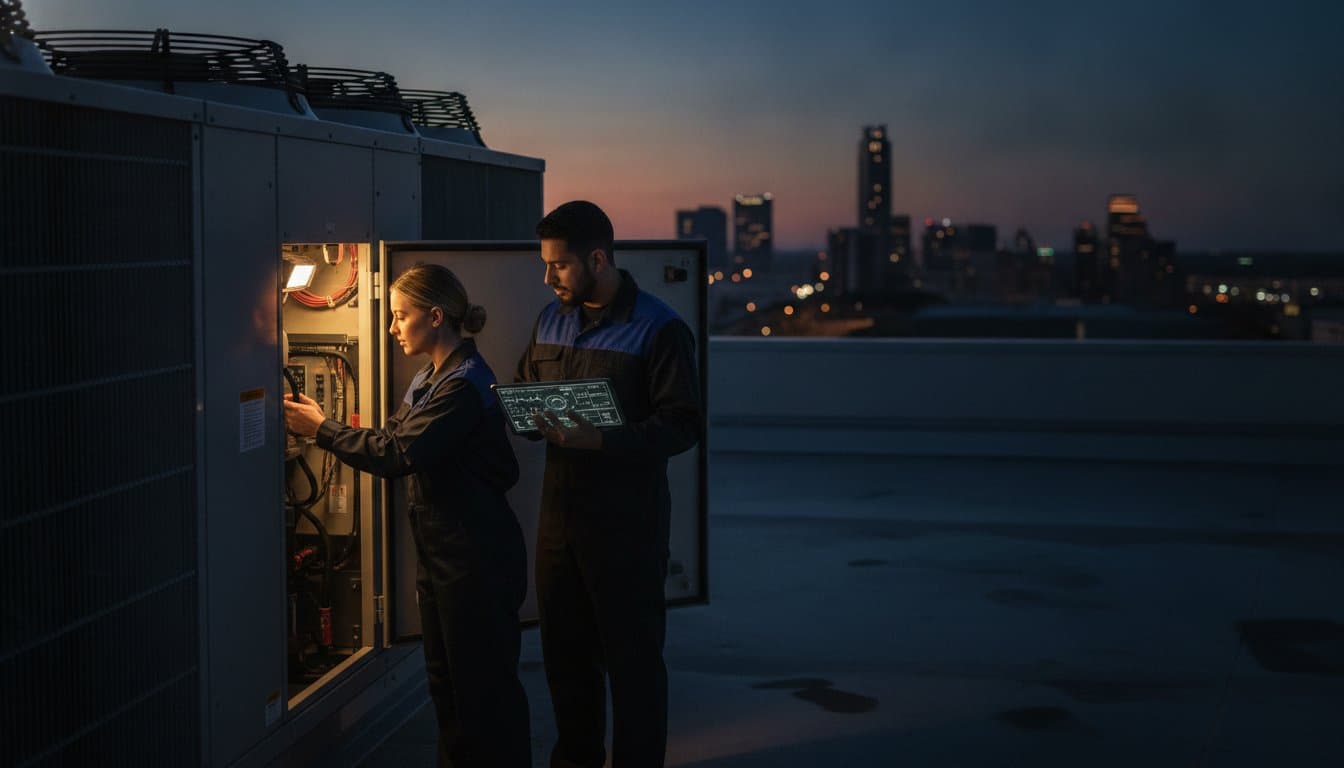
An Austin heatwave transforms a minor mechanical inefficiency into a catastrophic operational failure within hours, yet many facility managers still rely on residential-focused contractors who lack the technical depth required for complex industrial chillers and multi-stage cooling systems. When critical infrastructure fails, the resulting revenue loss is often compounded by unpredictable response times and temporary fixes that fail to address the underlying mechanical root causes. Securing reliable 24-hour commercial hvac repair austin requires a shift from reactive panic to a disciplined, engineering-led recovery strategy that prioritizes the integrity of the entire building system.
You understand that every minute of facility downtime compromises both your operational stability and your financial bottom line. This professional guide provides a framework for navigating emergency mechanical failures through a focus on technical accountability and immediate system stabilization. We will examine the critical processes involved in industrial system recovery, including the role of in-house fabrication for custom component replacement and the use of Building Information Modeling to ensure long-term reliability and predictable performance after the initial repair is complete. It's our objective to move beyond the quick fix toward a standard of excellence that secures your facility's future.
Key Takeaways
- Understand why the extreme climatic demands of Central Texas necessitate a specialized approach to 24-hour commercial hvac repair austin to prevent cascading mechanical failures and operational downtime.
- Identify the specific failure vectors within industrial chillers and Variable Refrigerant Flow (VRF) systems that require advanced diagnostic precision beyond the capabilities of general contractors.
- Learn the critical distinctions between commercial-grade mechanical services and residential models, emphasizing the necessity of OSHA compliance and high-load system expertise.
- Implement immediate stabilization protocols to mitigate risk during a system failure and streamline the communication of technical data to emergency dispatch teams.
- Explore how modern engineering tools, including Building Information Modeling (BIM) and in-house fabrication, ensure that emergency repairs result in long-term system integrity.
Table of Contents
- 24-Hour Commercial HVAC Repair in Austin: Mitigating Operational Downtime
- Critical Failure Points in Industrial Mechanical Systems
- Commercial Specialization vs. General Residential HVAC Services
- Immediate Protocols for Austin Facility Managers During Failure
- J3 Mechanical Services: Austin’s Authority in Emergency HVAC Recovery
24-Hour Commercial HVAC Repair in Austin: Mitigating Operational Downtime
Emergency recovery within high-stakes industrial environments represents more than a simple mechanical fix; it is a rigorous process of restoring structural and operational equilibrium. For facility managers in Central Texas, the requirement for 24-hour commercial hvac repair austin is driven by a climate that offers no margin for error during peak thermal cycles. When Heating, ventilation, and air conditioning (HVAC) systems fail in a commercial context, the resulting temperature spike doesn't just cause discomfort. It initiates a sequence of inventory spoilage, equipment degradation, and potential tenant litigation that can jeopardize the financial viability of an entire asset. A professional response in this sector is defined by technical accountability and a disciplined methodology that stabilizes the system before a catastrophic cascade occurs. This requires a partner who views their work through the lens of infrastructure responsibility rather than mere service tasks.
The True Cost of Mechanical Failure in Austin
The financial burden of downtime for data centers or specialized medical facilities is often measured in minutes, as these entities rely on precise thermal regulation to protect sensitive server hardware or life-saving pharmaceutical inventories. Beyond the immediate loss of revenue, prolonged exposure to Austin’s extreme heat affects the structural integrity of commercial buildings; excessive humidity levels can lead to rapid microbial growth and material warping in high-occupancy spaces. Maintaining a rapid response protocol is also essential for preserving industrial warranties. Many manufacturers require documented, expert-led intervention to keep coverage active after a major system fault, making the choice of a qualified technician a matter of long-term asset protection.
24/7 Availability as a Critical Infrastructure Requirement
Critical mechanical systems operate on a continuous cycle, which means that the concept of standard business hours is irrelevant to the health of your facility. A disciplined, on-call engineering team must be ready to deploy at any hour to ensure business continuity and protect the building’s operational mandate. Effective 24-hour commercial hvac repair austin focuses on transitioning from a state of reactive panic to one of systematic recovery through a transparent, logic-driven assessment of the mechanical failure. This methodical approach ensures that each repair phase is verified against technical standards, allowing facility managers to maintain project control even during a crisis. By treating HVAC systems as critical infrastructure, the repair process becomes a proactive strategy for mitigating future risks and ensuring the long-term reliability of the entire mechanical plant.
Critical Failure Points in Industrial Mechanical Systems
Identifying the precise vector of a mechanical failure in high-tonnage equipment requires a forensic approach that transcends basic troubleshooting. Industrial systems, such as centrifugal chillers and large-scale Rooftop Units (RTUs), operate under immense thermal and physical stress; a single component's deviation can trigger a building-wide shutdown. Unlike residential systems, these machines are integrated into complex Building Automation Systems (BAS) that may occasionally generate misleading alarms, masking the true mechanical root cause. Effective 24-hour commercial hvac repair austin depends on a technician’s ability to distinguish between a software-induced lockout and a genuine hardware failure under the pressure of escalating facility temperatures. Precision is mandatory.
Variable Refrigerant Flow (VRF) systems present an additional layer of complexity due to their sophisticated electronic expansion valves and intricate communication wiring. When these systems malfunction, the failure is rarely isolated to a single zone. It often indicates a systemic pressure imbalance or a communication fault within the inverter-driven compressor circuit. Establishing rigorous Protocols for Facility Managers ensures that these malfunctions are identified early, preventing the total loss of system integrity that often follows a neglected minor fault. Common RTU and chiller failure points include:
- Economizer Linkage Failure: Stuck dampers lead to poor indoor air quality and excessive compressor load during humid cycles.
- Fouled Condenser Coils: Accumulated debris increases head pressure, leading to frequent high-limit trips and reduced efficiency.
- Contactor Pitting: Arcing across electrical contacts can cause single-phasing, which leads to rapid motor burnout.
Compressor and Motor Failures
Austin’s persistent humidity levels pose a significant threat to industrial motor windings, as moisture ingress can lead to insulation breakdown and eventual phase-to-ground shorts. High-tonnage compressors often exhibit subtle signs of imminent seizure, such as increased vibration or elevated amperage draw, long before the system enters a hard lockout. Slugging occurs when liquid refrigerant or oil enters the compressor cylinder during the suction stroke, causing severe mechanical stress or immediate component failure because liquids cannot be compressed. Protecting these high-value assets requires a partner who can perform detailed electrical diagnostics and oil analysis in real-time. If you suspect your system is operating outside of its design parameters, engaging a specialist for a technical system assessment can prevent a total mechanical collapse.
Refrigerant Leaks and Pressure Imbalances
Commercial systems demand exact refrigerant charge levels to maintain thermodynamic efficiency and prevent oil return issues. With the industry-wide transition to low-GWP A2L refrigerants as of January 1, 2026, the safety protocols for handling mildly flammable substances have become significantly more stringent. The 2020 ban on R-22 production has also made the maintenance of older systems increasingly expensive, as reclaimed gas prices continue to rise. Emergency technicians utilize ultrasonic leak detection and thermal imaging to locate micro-fractures in copper headers or evaporator coils that traditional soap-bubble tests might miss. These advanced tools are essential for maintaining regulatory compliance and avoiding the steep environmental penalties associated with large-scale commercial leaks.
Commercial Specialization vs. General Residential HVAC Services
The assumption that industrial mechanical systems are merely scaled-up versions of residential units is a misconception that often leads to catastrophic equipment failure. While a residential technician may be proficient in servicing five-ton split systems, they lack the specialized training required to manage the thermal dynamics of a fifty-ton rooftop unit or a complex centrifugal chiller. Commercial systems involve intricate economizers, multi-stage compressors, and sophisticated Building Automation Systems (BAS) that demand a higher level of diagnostic precision. When seeking 24-hour commercial hvac repair austin, facility managers must prioritize contractors who demonstrate technical mastery over high-pressure mechanical environments rather than those who split their focus between residential comfort and industrial infrastructure.
Safety protocols and regulatory compliance represent another critical divide. Industrial sites require strict adherence to OSHA standards, including Lockout/Tagout (LOTO) procedures, fall protection for high-elevation rooftop work, and arc flash safety for high-voltage electrical diagnostics. Residential-focused contractors often lack the rigorous safety culture necessary to operate within these high-risk environments. Furthermore, quick fixes performed by under-qualified technicians can result in severe building code violations. These violations don't just create legal liability; they compromise the long-term integrity of the mechanical plant and can void manufacturer warranties. True technical accountability requires a disciplined approach that ensures every repair meets or exceeds the original engineering specifications.
The Industrial Tooling Disparity
Diagnosing large-scale mechanical failures requires an investment in specialized equipment that is rarely found in a residential service van. Technicians must utilize ultrasonic leak detectors, advanced combustion analyzers for commercial boilers, and thermal imaging cameras to identify hotspots in high-amperage electrical panels. Because commercial systems often involve custom ductwork or unique piping configurations, standard off-the-shelf parts are frequently insufficient. This is why in-house fabrication remains a cornerstone of professional emergency recovery. By producing custom components on-demand, a dedicated commercial partner can restore system functionality far faster than a contractor waiting on external supply chains. This level of preparation is a hallmark of Commercial HVAC Installation: Strategic Engineering and Precision Execution for 2026, ensuring that every repair integrates seamlessly with the existing infrastructure.
Accountability and Technical Mastery
Securing 24-hour commercial hvac repair austin from a specialized entity like J3 Mechanical Services ensures that your facility benefits from a singular focus on mechanical excellence. We intentionally exclude general plumbing services from our portfolio to maintain a deeper level of expertise in complex heating and cooling systems. This specialization allows our team to leverage advanced tools like Building Information Modeling (BIM) to coordinate repairs within the broader context of the building's design. This engineering-led approach prioritizes long-term stability over temporary solutions, ensuring that the repaired system operates at peak efficiency. By maintaining a corporate-industrial voice and a commitment to technical rigor, we provide the gravitas and predictability that Austin facility managers require for their critical infrastructure.
Just as technical rigor is essential for the longevity of industrial equipment, physical precision is vital for the professionals who manage these high-stakes environments. For professionals in the Austin area looking to maintain their own physical resilience, you can explore Introductory Private Session at Reformer Fitness Studio to experience a similar level of precision and control in your personal wellness routine.
Immediate Protocols for Austin Facility Managers During Failure
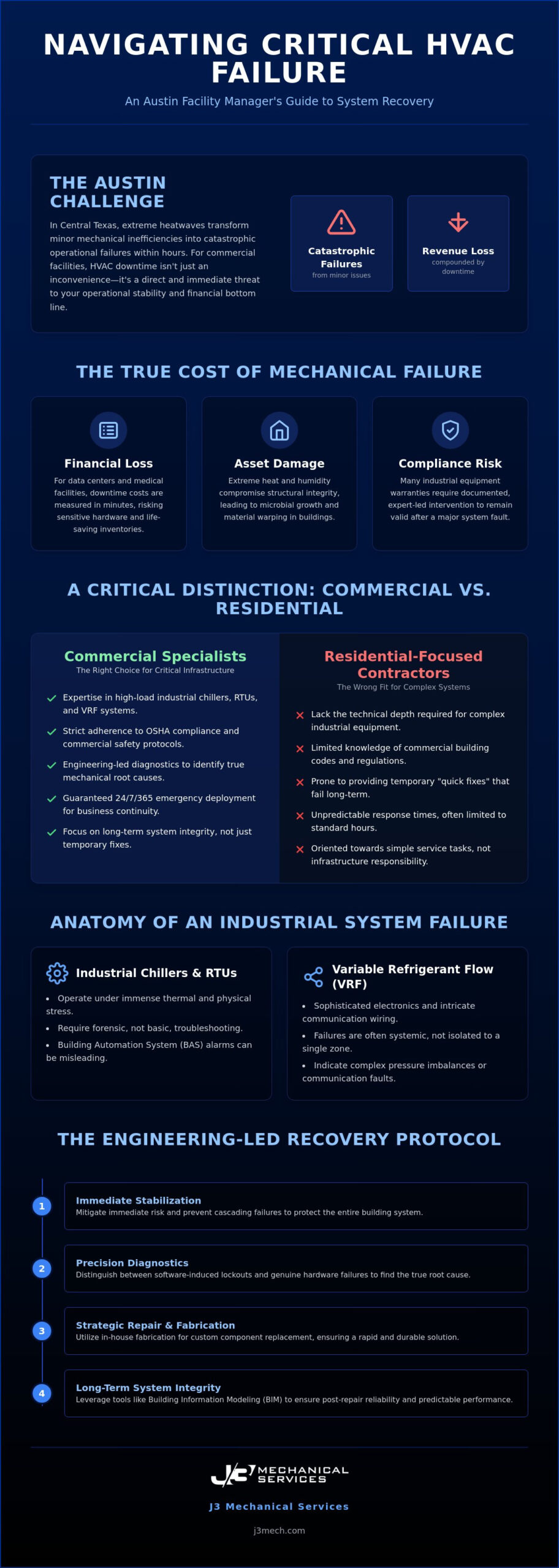
When a large-scale mechanical plant fails, the facility manager's primary responsibility shifts to risk mitigation and the prevention of a system-wide cascade. This phase of crisis management requires a disciplined adherence to safety protocols that protect both the building’s occupants and the expensive mechanical assets. Initiating a 24-hour commercial hvac repair austin call is the first step; however, the actions taken before the engineering team arrives determine the speed and efficacy of the recovery. It's essential to follow a structured sequence of isolation and documentation to ensure that the eventual repair is both precise and permanent. By maintaining a logical progression of steps, you can stabilize the environment and provide the necessary data for a successful technical intervention.
To prevent further equipment degradation or electrical hazards, facility managers should implement the following protocols immediately upon discovering a fault:
- Isolate the Malfunctioning Circuit: Utilize the designated disconnect switches to remove power from the failing unit, preventing potential short circuits from damaging integrated Building Automation System (BAS) controllers.
- Document Fault Codes: Capture high-resolution images of any error messages displayed on the unit's local interface or the BAS dashboard before power is cycled.
- Secure the Site: Ensure that all service access points, including rooftop hatches and mechanical room doors, are unlocked and free of obstructions to facilitate a rapid transition for the incoming technicians.
- Initiate Internal Load Management: Temporarily deactivate non-essential internal heat sources, such as decorative lighting or secondary server racks, to slow the rise in ambient temperature.
Initial System Stabilization
Safely cycling down non-essential loads reduces the thermal strain on the remaining operational equipment and buys critical time for the repair team to arrive. It's vital to check the BAS logs for historical error trends; these records often reveal whether the current failure was an isolated incident or the result of a long-term performance deviation. Ensuring clear, unobstructed access to rooftop units and mechanical rooms is a simple yet effective way to eliminate logistical delays. If your facility requires immediate technical intervention to restore its operational integrity, contact our emergency response team for a disciplined mechanical assessment.
Communicating with the Emergency Team
Providing the dispatch team with unit model numbers and a detailed service history allows the technicians to arrive with the specific components and diagnostic tools required for your unique system configuration. You should describe symptoms with technical clarity, distinguishing between "short cycling," where the compressor starts and stops rapidly, and a "total loss of power," which indicates a primary electrical or control board failure. Precise diagnostic communication allows the dispatch team to mobilize the specific replacement components and diagnostic tools required for your system's configuration; this directly reduces billable labor hours by eliminating redundant assessment phases. This level of technical coordination is a hallmark of a professional 24-hour commercial hvac repair austin partnership, ensuring that the recovery process is as efficient as it is thorough.
J3 Mechanical Services: Austin’s Authority in Emergency HVAC Recovery
J3 Mechanical Services operates as a disciplined strategist for Austin’s critical infrastructure, providing a level of technical rigor that general contractors cannot replicate. Our 24-hour commercial hvac repair austin services are built on a foundation of industrial mastery and ethical consistency. By focusing exclusively on complex mechanical systems and intentionally excluding general plumbing, we ensure that our engineering teams possess the deep specialization required for high-stakes environments. This commitment to precision extends to our billing practices; our faith-based operational principles dictate a transparent, logic-driven approach to emergency costs, ensuring that facility managers receive fair, predictable assessments even during a crisis. We view our work as a critical infrastructure responsibility, where accountability is the primary measure of success.
Advanced Coordination and Fabrication
In the 2026 mechanical landscape, the ability to execute rapid, custom solutions is a prerequisite for maintaining building integrity. J3 Mechanical Services utilizes an advanced in-house fabrication shop to eliminate the traditional delays associated with external supply chains for custom ductwork or specialized piping headers. By integrating Building Information Modeling (BIM) into our emergency response framework, our engineers can visualize the mechanical interdependence of your facility's cooling plant, allowing for a more accurate diagnostic process that eliminates the guesswork often associated with complex system failures. This digital coordination ensures that emergency repairs integrate perfectly with existing systems, preventing the recurring failures that often plague quick fix interventions. Precision execution isn't just about speed; it's about the systematic verification of every component's performance against the original design specifications.
Securing Your Facility’s Future
Restoring a system to operational status is only the first phase of a comprehensive lifecycle strategy. Once immediate stabilization is achieved, we provide professional consultation on system longevity and replacement strategies tailored to the specific demands of the Austin climate. Transitioning from emergency recovery to a sustainable, engineering-led maintenance program allows facility managers to mitigate risks before they manifest as catastrophic downtime. We prioritize the integrity of your mechanical plant through proactive oversight and technical accountability, ensuring that your infrastructure remains a stable asset rather than a source of constant liability. Our team is prepared to manage the complexities of your high-stakes environment without friction.
Contact J3 Mechanical Services for 24/7 Emergency Commercial HVAC Repair in Austin
Securing Industrial Resilience through Engineering-Led Recovery
The transition from mechanical failure to full system recovery demands a level of precision that transcends the capabilities of general service providers. By adhering to a rigorous diagnostic framework and leveraging the engineering-led methodologies explored in this guide, Austin facility managers can transform a crisis into an opportunity for long-term infrastructure optimization. Every repair must be viewed as a critical component of a broader asset management strategy, where technical accountability and industrial-grade standards prevent the recurrence of costly downtime. It is through this methodical approach that complex cooling plants maintain the thermal equilibrium necessary for business continuity.
When your facility's continuity is at stake, J3 Mechanical Services provides the disciplined authority required for successful 24-hour commercial hvac repair austin. Our commitment to ethical transparency and technical mastery ensures that your industrial systems are restored with precision and integrity, utilizing advanced tools to verify every phase of the recovery. By partnering with a dedicated commercial specialist, you secure the future of your building's most vital systems against the volatility of the Texas climate. Secure Your Facility’s Operations with 24/7 Emergency Repair from J3 Mechanical Services. We remain steadfast in our duty to support the mechanical resilience of the Central Texas business community.
Frequently Asked Questions
What qualifies as an HVAC emergency for an Austin commercial facility?
An HVAC emergency is defined by any mechanical failure that threatens business continuity, tenant safety, or the integrity of sensitive inventories. In the Austin climate, this typically involves a total loss of cooling in data centers, medical facilities, or high-occupancy office buildings where temperatures rise rapidly. Any malfunction triggering a critical Building Automation System (BAS) lockout or posing an immediate electrical hazard requires an urgent industrial response to prevent cascading equipment damage.
How quickly can J3 Mechanical respond to a 24-hour repair request in Austin?
Our team maintains 24/7 availability to ensure a rapid response for every 24-hour commercial hvac repair austin request we receive. We deploy disciplined, on-call engineering teams who are specifically trained to stabilize industrial systems under pressure. While specific arrival times depend on current logistical coordination and site location within the Austin metro area, our priority is always the immediate mitigation of facility downtime and the protection of your critical infrastructure.
Do you provide emergency repair for large-scale chillers and cooling towers?
Yes, we specialize in the emergency repair of high-tonnage centrifugal chillers, cooling towers, and complex hydronic systems. Our technicians possess the technical mastery required to diagnose and resolve failures in large-scale plant equipment that residential-focused contractors aren't equipped to handle. We utilize advanced diagnostic tools and in-house fabrication to ensure that these critical cooling components are restored to their original engineering specifications with minimal delay.
Can you repair commercial systems that were installed by another company?
We provide comprehensive emergency recovery services for commercial mechanical systems regardless of the original installation contractor. Our engineering-led approach allows us to quickly map existing system architectures and identify technical deviations that may've contributed to the failure. By utilizing Building Information Modeling (BIM) and detailed site assessments, we ensure that our repairs integrate seamlessly with your current infrastructure while addressing any underlying installation deficiencies.
What information should I have ready when calling for emergency HVAC service?
Facility managers should provide the specific unit model numbers, recent service history, and a clear description of the current mechanical symptoms. Distinguishing between a total system lockout and a performance degradation like short cycling helps our dispatch team mobilize the correct diagnostic tools and components. Having clear access to mechanical rooms and rooftop units ready for our team further reduces the time required to initiate the recovery process.
Are your technicians certified to work on high-pressure industrial units?
Our technicians maintain the specialized certifications and safety training required to operate on high-pressure industrial units and complex refrigerant circuits. This includes rigorous adherence to OSHA standards and Lockout/Tagout (LOTO) procedures, which are essential for maintaining safety on active commercial sites. We prioritize technical accountability, ensuring that every member of our team is qualified to manage the high-voltage electrical and mechanical loads inherent in large-scale commercial plants.
How does J3 Mechanical handle emergency repairs for new construction projects?
For new construction projects, we provide emergency support that integrates with the ongoing mechanical installation and project timeline. Our team works closely with project managers to resolve equipment failures or installation conflicts that could delay building commissioning. By leveraging our in-house fabrication and BIM capabilities, we can quickly produce custom components or coordinate system adjustments to keep the project on its critical path while maintaining structural integrity.
Why is a commercial-only contractor better for emergency repairs than a general HVAC company?
A commercial-only contractor provides the technical depth and industrial tooling necessary for 24-hour commercial hvac repair austin without the distractions of residential service models. General HVAC companies often lack the specialized diagnostics for chillers or VRF systems and may not prioritize the high-stakes downtime requirements of a corporate facility. Our exclusive focus on commercial mechanical systems ensures a more disciplined response, higher safety standards, and a deeper understanding of industrial building codes.
Need a hand with your building's HVAC?
Free quotes and honest answers from licensed commercial technicians across South Texas.