
Austin Commercial HVAC Maintenance Guide 2026
In the Austin commercial sector, an HVAC maintenance plan is not a service visit; it is a strategic risk-mitigation protocol for critical infrastructure. You've likely navigated the operational friction that occurs when mechanical systems fail during extreme thermal peaks, leading to unpredictable emergency costs and compromised facility performance. Implementing a sophisticated preventative hvac maintenance plan austin ensures that your mechanical assets are managed with the precision of a master builder, shifting the focus from frantic repairs to long-term systemic stability.
This guide provides a methodical framework for transitioning your facility from reactive maintenance to a strategic asset management model that prioritizes operational continuity and mechanical integrity. We'll explore the technical methodologies required to extend equipment lifecycles by an average of three to five years while ensuring full compliance with the 2026 low-GWP refrigerant mandates. By following this structured approach, facility managers can secure documented energy efficiency gains of up to 25 percent and eliminate the threat of unplanned downtime in their most critical environments.
Key Takeaways
- Transitioning from reactive repairs to strategic asset management mitigates operational risks during Austin's extreme heat cycles.
- A professional preventative hvac maintenance plan austin incorporates precision calibration of building automation systems and rigorous electrical inspections to ensure systemic reliability.
- Evaluating the true return on investment requires analyzing hidden contract costs and the lifecycle benefits of full-service agreements over basic inspections.
- Integrating Building Information Modeling (BIM) into your maintenance strategy allows for accurate tracking of asset history and more effective long-term capital budgeting.
- Establishing 24/7 emergency response protocols as part of a disciplined oversight strategy provides essential protection for critical facility infrastructure.
Table of Contents
- The Strategic Value of a Preventative HVAC Maintenance Plan for Austin Commercial Facilities
- Core Components of Industrial-Grade Maintenance Protocols
- Evaluating Maintenance ROI: Beyond Simple Filter Changes
- Implementing Lifecycle Asset Management for Austin Mechanical Systems
- J3 Mechanical: Precision Maintenance for Critical Austin Infrastructure
The Strategic Value of a Preventative HVAC Maintenance Plan for Austin Commercial Facilities
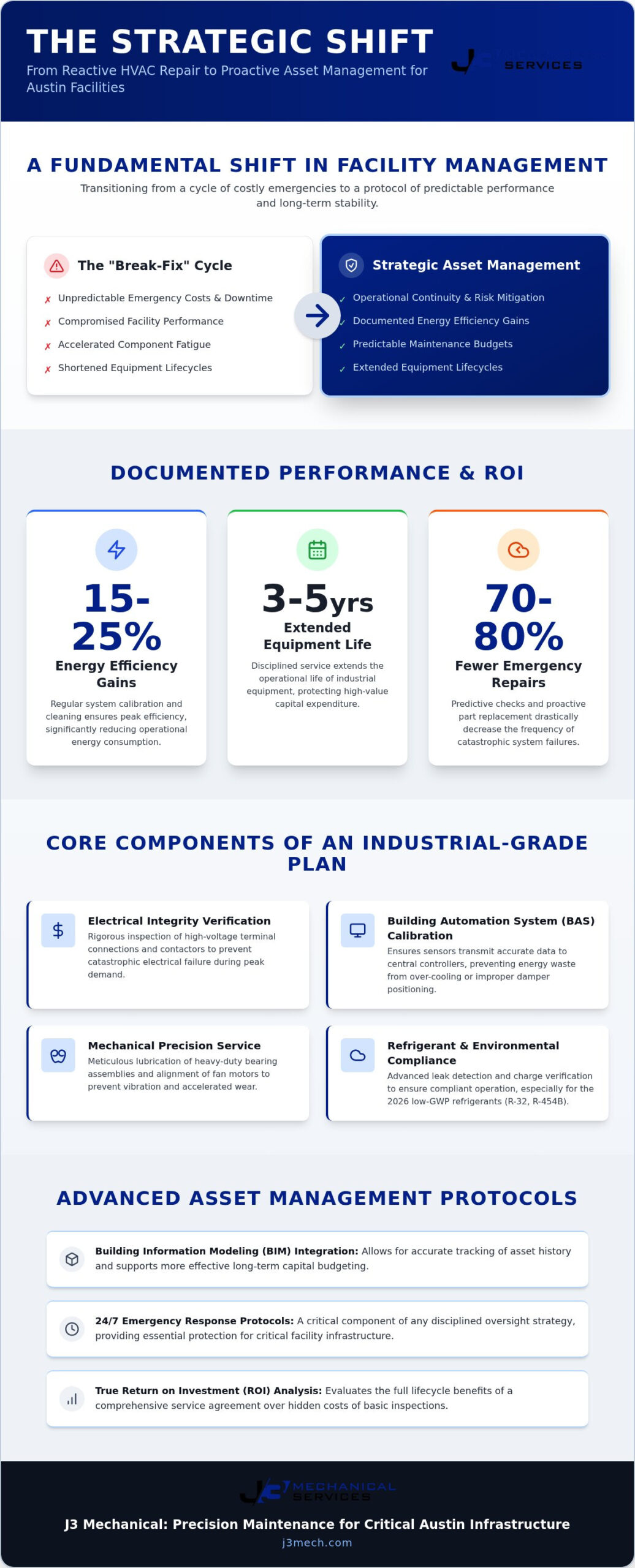
A robust preventative hvac maintenance plan austin is a systematic, scheduled protocol engineered to ensure the peak performance of commercial mechanical assets through rigorous verification and technical calibration. This methodology represents a fundamental shift from the traditional, reactive "break-fix" cycle to a proactive asset lifecycle management strategy. While residential systems might survive on basic seasonal tune-ups, Austin’s commercial infrastructure requires industrial-grade oversight to maintain systemic stability. Consistent maintenance directly supports corporate ESG goals by optimizing energy efficiency ratings and reducing the carbon footprint associated with inefficiently operated heavy machinery.
Austin’s Environmental Impact on Mechanical Systems
The Central Texas climate presents unique challenges that demand high levels of engineering discipline. High latent heat loads and persistent humidity force commercial systems to work harder to maintain indoor air quality and temperature setpoints. Without a structured maintenance protocol, dust and debris accumulation on condenser coils can lead to rapid thermal degradation. Additionally, the 2026 environmental regulations in Austin mandate the transition to low-GWP refrigerants, such as R-32 and R-454B. Managing these new technical standards requires a partner who understands the logistical coordination of updated safety sensors and leak-detection protocols to ensure compliant operation throughout the year.
Financial Justification for Facility Managers
For facility managers, the true cost of unplanned downtime often exceeds the price of a comprehensive service agreement. In critical environments like data centers or medical facilities, even a few hours of mechanical failure can result in significant revenue loss and data corruption. Documented maintenance records are also a prerequisite for preserving manufacturer warranties on large-scale rooftop units and chillers. A preventative hvac maintenance plan austin serves as a rigorous capital expenditure protection strategy that ensures the integrity of high-value mechanical assets over their intended operational lifecycle. By investing in systematic oversight, organizations can realize the following benefits:
- Energy Efficiency: Regular calibration can reduce energy consumption by 15 percent to 25 percent.
- Lifecyle Extension: Disciplined service extends the operational life of industrial equipment by an average of three to five years.
- Risk Mitigation: Predictive checks decrease the frequency of emergency repairs by 70 percent to 80 percent, protecting the building's operational budget from volatile spikes.
By treating mechanical systems as critical infrastructure rather than simple utilities, stakeholders ensure that their facilities remain resilient against Austin's environmental extremes while maintaining strict fiscal accountability.
Core Components of Industrial-Grade Maintenance Protocols
Industrial-grade maintenance transcends the checklist-based approach of residential services, focusing instead on the complex interplay between mechanical linkages and high-voltage electrical distribution. Within a comprehensive preventative hvac maintenance plan austin, technicians must verify the integrity of terminal connections and contactors to prevent catastrophic electrical failure during peak demand periods. Precision calibration of building automation systems (BAS) ensures that sensors transmit accurate data to the central controller, preventing energy waste caused by over-cooling or improper damper positioning. When these digital and physical systems aren't synchronized, the resulting operational friction leads to accelerated component fatigue.
Systematic oversight extends to the lubrication of heavy-duty bearing assemblies and the meticulous alignment of fan motors. Misalignment, even by fractions of an inch, introduces vibration that accelerates component wear and increases decibel levels within the facility. Verification of refrigerant charge levels remains a critical priority, especially as the industry transitions to A2L refrigerants in 2026. Technicians employ advanced leak detection tools to monitor industrial circuits, ensuring that systems operate within their designed pressure parameters to maintain thermal efficiency and environmental compliance.
Advanced Air Distribution and Filtration
Effective zone control relies on the functional accuracy of VAV boxes and the modulation of dampers. In high-occupancy Austin buildings, maintaining indoor air quality necessitates a strategic MERV-rated filter replacement schedule that accounts for local particulate loads. Technicians also assess ductwork integrity to identify and seal leaks that otherwise lead to conditioned air loss. This ensures that the cooling energy generated reaches its intended destination without parasitic dissipation, maintaining the comfort levels required for commercial productivity.
Hydronic and Chilled Water System Oversight
Large-scale facilities often depend on chilled water loops, which require an annual inspection of pump assemblies and cooling tower performance. Scale and corrosion are significant threats to heat exchanger efficiency; therefore, chemical water treatment monitoring is integrated into the oversight cycle. This level of detail is a hallmark of a professional commercial hvac maintenance protocol. By managing the chemical balance and mechanical health of hydronic systems, facility managers mitigate the risk of long-term pipe degradation and chiller fouling. Maintaining this level of technical mastery requires a partner who treats every inspection as a critical infrastructure audit, a standard we uphold at J3 Mechanical through our disciplined maintenance programs.
Evaluating Maintenance ROI: Beyond Simple Filter Changes
Calculating the return on investment for mechanical oversight requires a shift in perspective from immediate expense to long-term asset preservation. A standard "inspection-only" plan may appear fiscally attractive on a quarterly balance sheet, yet these low-bid contracts often obscure hidden costs such as travel surcharges, diagnostic fees, and excluded consumable parts. In contrast, a comprehensive preventative hvac maintenance plan austin provides a fixed-cost framework that internalizes these variables, allowing facility managers to maintain strict budgetary control while mitigating the risk of catastrophic failure.
Data-driven reporting is the foundation of this ROI. By tracking energy consumption trends and component wear cycles, organizations can verify the 15 percent to 25 percent reduction in energy consumption that disciplined maintenance typically yields. This rigorous approach doesn't just lower monthly utility overhead; it extends the operational life of industrial chillers and rooftop units by an average of three to five years. Deferring multi-million dollar capital replacements through systematic verification is the hallmark of a sophisticated infrastructure strategy.
The True Cost of Neglect in Austin Commercial Real Estate
Consider the financial impact of a primary compressor failure during a triple-digit July afternoon in Central Texas. The resulting operational paralysis and the premium costs of expedited parts logistics far outweigh the investment in proactive service. A structured maintenance protocol significantly reduces the frequency of emergency commercial hvac repair by identifying metallurgical fatigue and electrical anomalies before they manifest as systemic shutdowns. For our partners, 24/7 emergency response is a standard assurance, ensuring that critical facilities remain online regardless of external environmental stress.
Selecting a Contractor Based on Industrial Capacity
Vetting a mechanical partner requires looking beyond basic licensing. A contractor's role in modern facility infrastructure involves a deep understanding of NATE and EPA standards as they apply to industrial-scale systems. In-house fabrication capabilities are equally vital, as they allow for the rapid production of custom transitions or structural supports during maintenance-related repairs without the delays of third-party logistics. This level of vertical integration ensures that every repair meets the same disciplined standards as the original installation, preserving the integrity of the entire mechanical ecosystem.
Implementing Lifecycle Asset Management for Austin Mechanical Systems
Lifecycle management requires a disciplined approach to facility budgeting, moving beyond simple annual service logs to establish comprehensive five-year and ten-year mechanical capital plans. This long-term foresight allows organizations to allocate resources for major component overhauls or full-scale replacements before equipment enters the high-risk "wear-out" phase of its operational life. A professional preventative hvac maintenance plan austin serves as the primary data source for these capital forecasts, providing the empirical evidence needed to justify infrastructure investments to corporate stakeholders. By documenting "as-built" conditions through detailed fabrication records, facility managers ensure that future service teams possess the accurate technical data required for precise repairs and modifications.
BIM-Integrated Maintenance Strategies
Integrating Building Information Modeling (BIM) into the maintenance lifecycle transforms how technicians interact with complex mechanical systems. Using digital twins, our teams can simulate operational stress and predict potential failure points within intricate HVAC layouts before they manifest physically. The advantage of BIM coordination during the maintenance phase is significant; it provides a spatial roadmap that streamlines part replacement and logistical planning. When a component requires replacement, we leverage in-house fabrication data to produce exact matches, reducing the field labor hours typically wasted on manual adjustments and ensuring the continued integrity of the original design.
Strategic Replacement Planning
There eventually comes a point where the cost of ongoing maintenance and the risks of systemic failure outweigh the benefits of continued repair. Analyzing performance data allows facility managers to identify this "tipping point" with precision, evaluating whether to continue the current service cycle or pivot toward a strategic commercial hvac installation. Modern high-efficiency components often provide an ROI that justifies the early retirement of legacy systems, particularly when factoring in the 2026 refrigerant regulations and rising energy costs. The transition from maintenance to replacement is a data-driven decision based on documented mechanical performance and total cost of ownership metrics.
If your facility requires a partner who prioritizes long-term mechanical stability through advanced engineering and disciplined oversight, contact J3 Mechanical to establish a lifecycle management strategy that protects your infrastructure assets.
J3 Mechanical: Precision Maintenance for Critical Austin Infrastructure
J3 Mechanical Services approaches facility oversight with the gravitas of a master builder, viewing every mechanical system as a critical infrastructure responsibility rather than a mere series of service tasks. Our preventative hvac maintenance plan austin is built on a foundation of ethical duty and technical mastery, ensuring that your building's environment remains stable under the most demanding Central Texas conditions. We provide 24/7 emergency support as a standard provision for our contract partners, offering a layer of operational security that mitigates the risk of catastrophic failure during peak thermal loads. By anchoring our methodology in faith-based principles, we deliver a level of professional accountability and transparent reporting that ensures every stakeholder remains informed of their system's status.
Our commitment to excellence is reflected in the way we integrate advanced technical tools into our standard service cycles. We don't just react to mechanical issues; we use our deep understanding of engineering and logistical coordination to prevent them. This proactive stance allows us to maintain the integrity of complex industrial systems while providing facility managers with the quiet confidence that their mechanical assets are being managed by disciplined experts. Every inspection is conducted with the rigor of a forensic audit, identifying metallurgical fatigue or electrical anomalies before they can disrupt your facility's operations.
Tailored Maintenance Agreements for Austin Businesses
We recognize that the operational requirements of a high-density data center or a sterile medical facility differ significantly from those of a standard corporate office complex. J3 Mechanical Services offers customizable service intervals designed to align with the specific heat loads and mechanical criticalities of your unique site. Every agreement includes detailed digital asset tracking and comprehensive reporting, providing clear visibility into the health and performance history of your mechanical ecosystem. Partners gain direct access to our senior mechanical strategists, who provide the technical oversight necessary for effective five-year and ten-year capital budgeting. This collaborative approach ensures that your maintenance strategy evolves alongside your facility's needs, maximizing the lifecycle of every component.
The J3 Mechanical Services Advantage in Central Texas
Our extensive experience in new construction and large-scale mechanical replacements translates directly into superior maintenance performance for our clients. Because we maintain robust in-house fabrication capabilities, we can produce custom transitions or structural supports with a level of speed and precision that third-party reliant contractors can't match. This vertical integration reduces the duration of maintenance-related repairs and ensures that every modification adheres to the original design specifications. By leveraging our expertise in BIM and digital modeling, we provide a sophisticated roadmap for your facility's mechanical future. Secure your facility's future with a J3 Mechanical Services preventative maintenance plan.
Securing Long-Term Stability for Austin Mechanical Assets
Transitioning from reactive repair cycles to a strategic asset management model is essential for preserving the operational integrity of Austin’s commercial infrastructure. We've examined how industrial-grade protocols and lifecycle planning mitigate the inherent risks of Central Texas’s extreme climate. By leveraging data-driven reporting and BIM-coordinated service protocols, facility managers can achieve documented energy efficiency gains while ensuring compliance with the evolving 2026 environmental standards. Establishing a comprehensive preventative hvac maintenance plan austin ensures that your mechanical systems are treated as critical assets rather than recurring liabilities.
J3 Mechanical provides the disciplined oversight and specialized industrial-grade mechanical expertise required to manage high-stakes environments without friction. Our contract partners benefit from 24/7 emergency response and a commitment to transparent, logic-driven reporting. Request a Strategic Maintenance Consultation from J3 Mechanical to secure your facility's long-term stability. We look forward to engineering a more resilient future for your mechanical systems.
Frequently Asked Questions
What is the typical cost of a commercial HVAC maintenance plan in Austin?
The cost of a commercial maintenance plan depends on the tonnage of the system and the complexity of the facility's mechanical infrastructure. Professional agreements provide a fixed-cost framework that eliminates the volatility of emergency service fees and allows for predictable operational budgeting. This investment secures a disciplined oversight strategy that preserves the integrity of high-value assets while preventing the expensive utility spikes often associated with neglected or inefficiently calibrated industrial equipment.
How often should a commercial HVAC system be serviced in Central Texas?
Commercial HVAC systems in the Central Texas region should ideally be serviced on a quarterly basis to address the high thermal loads and particulate accumulation characteristic of the local climate. This frequency allows for the timely cleaning of coils and the verification of electrical contactors before they reach a failure point. Maintaining this disciplined schedule ensures that your facility remains resilient against the humidity and heat that define the Austin operational environment.
Does an HVAC maintenance plan include 24/7 emergency repairs?
Standard maintenance agreements from J3 Mechanical incorporate 24/7 emergency response to protect the operational continuity of critical facility infrastructure. This provision ensures that contract partners receive priority dispatch during system failures, regardless of the time or day. By including emergency coverage within the preventative hvac maintenance plan austin, facility managers gain the assurance that a technical recovery team is always available to resolve mechanical anomalies before they impact productivity.
Can a maintenance plan help my Austin building meet 2026 energy codes?
A structured maintenance plan is a vital tool for ensuring that your facility remains compliant with the 2026 energy codes and refrigerant regulations. Our protocols include the verification of low-GWP refrigerant systems and the precision calibration of building automation systems to maximize energy efficiency. These documented service steps provide the necessary verification for corporate reporting and local building audits, ensuring your mechanical assets meet the highest modern standards of environmental responsibility.
What is the difference between a residential tune-up and a commercial maintenance plan?
A commercial maintenance plan involves the oversight of complex industrial components such as chillers, cooling towers, and VAV systems that are absent in residential applications. Unlike a basic residential tune-up, industrial service requires a master builder's perspective to manage the intricate interplay between high-voltage connections and digital control systems. These industrial-grade protocols prioritize systemic stability and long-term asset preservation over the simple component checks found in smaller-scale residential service agreements.
How does BIM technology improve HVAC maintenance for large facilities?
Building Information Modeling (BIM) allows for the creation of a digital twin that tracks every mechanical component's location and service history with surgical precision. This technology enables technicians to visualize hidden ductwork and piping, significantly reducing the time required for diagnostics and part replacement. By integrating BIM data into the maintenance cycle, we ensure that every repair meets the original "as-built" design specifications, maintaining the long-term integrity of the building's mechanical infrastructure.
What happens if a major component fails while I am on a maintenance plan?
If a major component fails, maintenance partners receive priority recovery services and access to our in-house fabrication capabilities for rapid part production. Because your system's technical data is already documented within our asset management platform, we can expedite the replacement process with high accuracy. This structured response minimizes facility downtime and ensures that the replacement component is integrated seamlessly into the existing mechanical ecosystem without the delays of third-party logistics.
How do I transition from my current 'break-fix' model to a preventative plan?
Shifting from a reactive "break-fix" model begins with a comprehensive infrastructure audit to document the current operational health of all mechanical assets. This baseline data allows us to identify immediate risks and develop a multi-year capital plan tailored to your facility's specific requirements. By establishing a preventative hvac maintenance plan austin, you move toward a disciplined oversight model that prioritizes systemic reliability and fiscal accountability over the volatility of emergency repairs.
Need a hand with your building's HVAC?
Free quotes and honest answers from licensed commercial technicians across South Texas.