
Business HVAC Trends 2026: The Strategic Evolution of Commercial Mechanical Systems
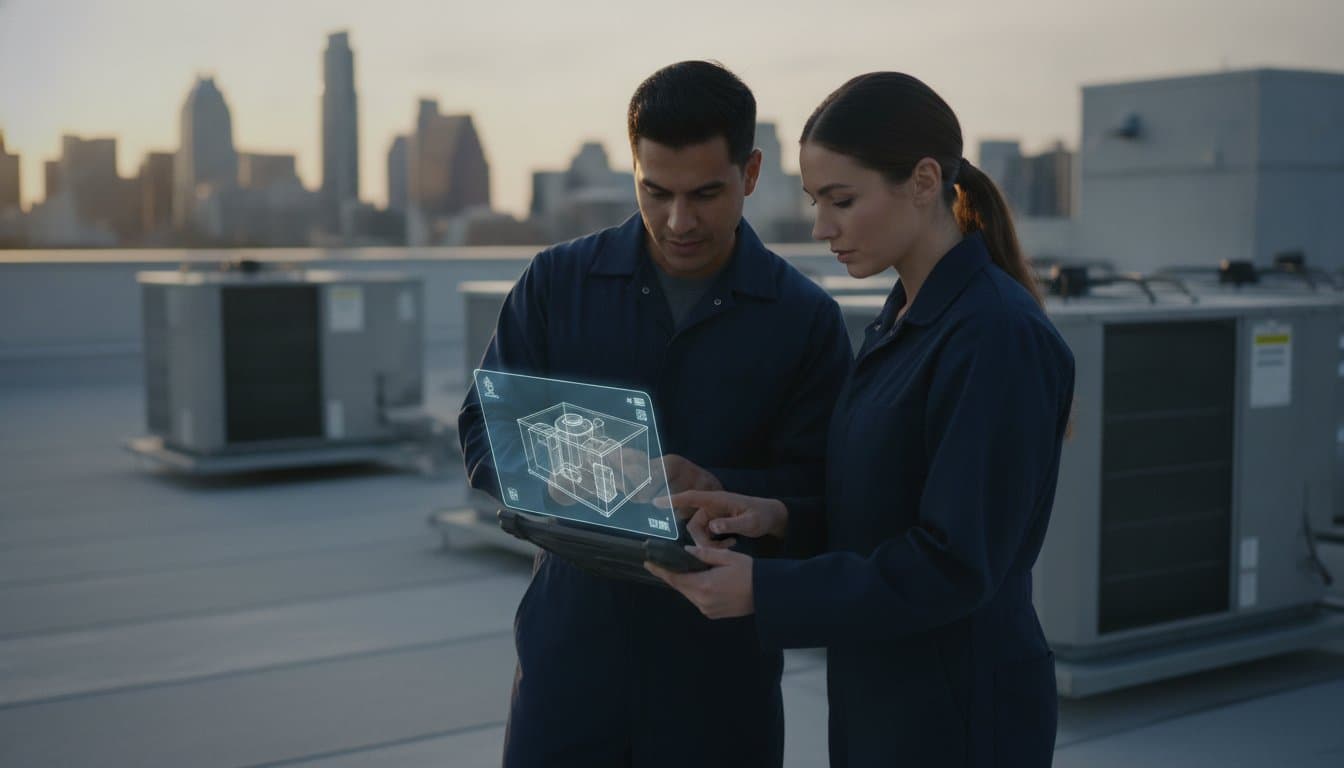
In 2026, a commercial mechanical system is no longer a peripheral utility to be managed through reactive repairs; it's a precision-engineered financial asset that dictates the operational stability of your entire enterprise. You likely recognize that legacy maintenance models are failing to keep pace with escalating energy costs and the technical demands of modern Texas facilities, where unpredictable downtime in critical environments represents an unacceptable liability. This article demonstrates how integrating digital precision, advanced in-house fabrication, and rigorous lifecycle management can transform your business hvac infrastructure into a high-performing environment that reduces operational overhead and eliminates the coordination errors typical of new construction projects. We will examine the strategic impact of the 2024 Uniform Mechanical Code effective September 1, 2026, the mandatory transition to low-GWP refrigerants like R-32 and R-454B, and the role of Building Information Modeling in securing long-term mechanical reliability. By prioritizing technical mastery and methodical planning over temporary fixes, Texas enterprises can achieve a seamless project execution that safeguards both their physical infrastructure and their fiscal health.
Key Takeaways
- Transitioning from reactive repairs to integrated infrastructure allows for real-time communication with building management systems, ensuring total environmental control.
- Assessing the total cost of ownership through lifecycle management enables phased replacements that protect capital budgets from the shock of emergency system failures.
- Leveraging Building Information Modeling (BIM) and in-house fabrication minimizes field-level coordination errors, streamlining the execution of complex business hvac projects.
- Adapting to the 2026 Texas building codes and extreme thermal loads requires a methodical approach to system design that prioritizes long-term efficiency and industrial safety.
- Selecting a mechanical partner based on technical mastery and specialized tooling ensures your facility remains a stable, high-performing asset rather than a source of operational risk.
Table of Contents
- The Strategic Evolution of Business HVAC: From Utility to Infrastructure
- Lifecycle Management: Maximizing ROI in Commercial Mechanical Systems
- The Role of Digital Precision: BIM and In-House Fabrication Trends
- Navigating Texas Building Standards and Environmental Challenges
- Selecting a Strategic Mechanical Partner for Long-Term Stability
The Strategic Evolution of Business HVAC: From Utility to Infrastructure
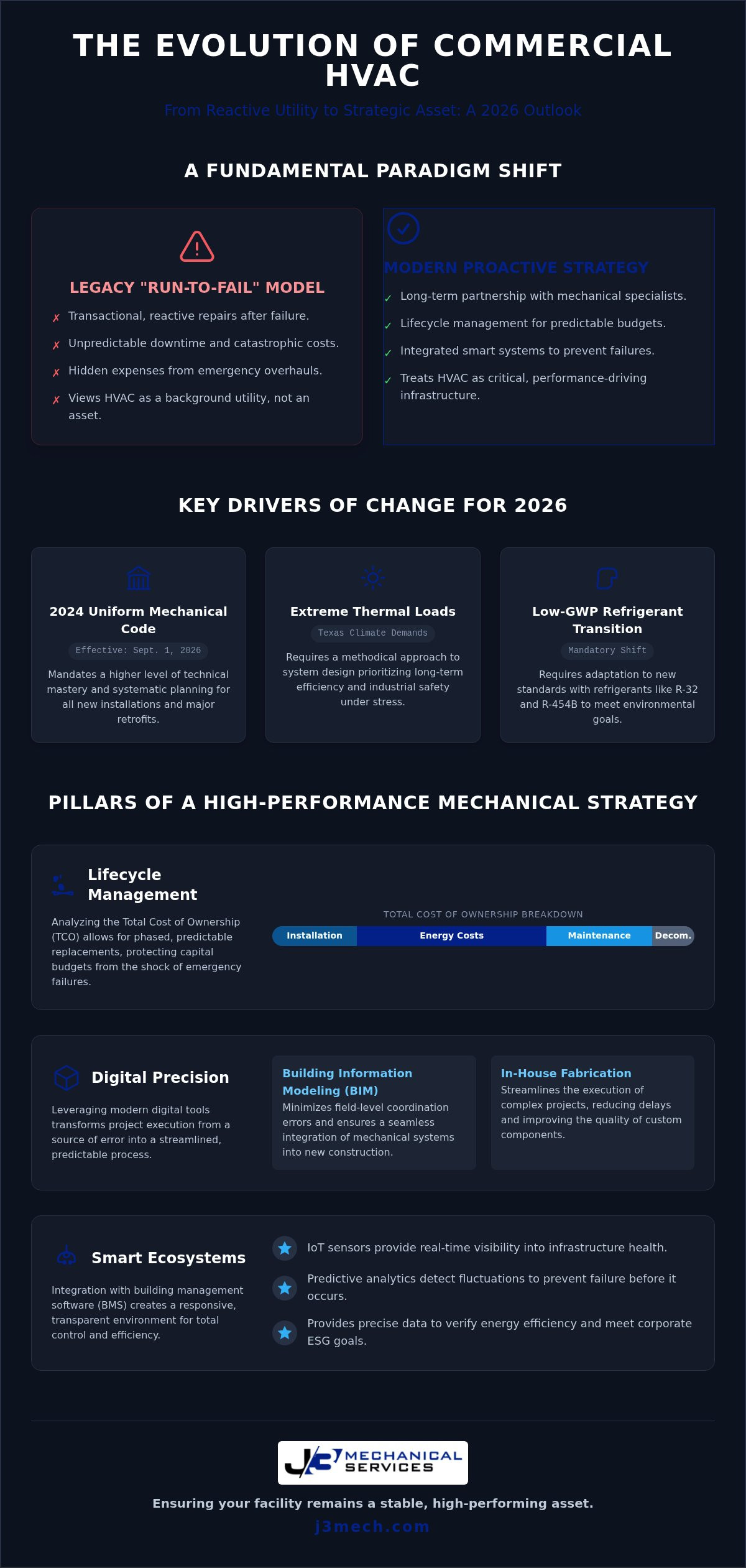
The historical perception of Heating, ventilation, and air conditioning (HVAC) as a secondary background utility is rapidly dissolving under the pressure of modern regulatory and operational demands. For Texas enterprises, 2026 represents a definitive threshold where it's clear that sophisticated mechanical systems have transitioned into critical infrastructure assets that require the same level of strategic oversight as financial or data systems. This evolution is accelerated by the adoption of the 2024 Uniform Mechanical Code, effective September 1, 2026, and the mandatory shift toward low-GWP refrigerants like R-32 and R-454B. These changes mandate a higher level of technical mastery and systematic planning. A high-performing business hvac environment now serves as a primary pillar of enterprise-level risk management, where mechanical reliability directly correlates with operational continuity and the preservation of high-value assets. Meticulous preparation is the only path to stability.
Moving Beyond the Reactive Repair Mindset
Adopting a "run-to-fail" strategy in a high-stakes commercial facility is a high-risk gamble that often results in catastrophic financial consequences. While the initial cost of deferring maintenance might appear lower on a balance sheet, the hidden expenses of emergency system overhauls and lost productivity during a Texas heatwave far exceed the investment required for proactive design. Transitioning from a transactional service-call model to a long-term partnership with mechanical specialists ensures that your facility's climate control remains stable. This disciplined approach to business hvac management mitigates the risk of sudden failures by identifying technical stressors before they manifest as critical downtime. Reliability is a choice.
The Rise of Smart Mechanical Ecosystems
Modern industrial climate control is defined by the integration of mechanical components with sophisticated building management software (BMS) to create a responsive, transparent ecosystem. By deploying IoT sensors across air handling units and critical thermal load points, facilities managers gain real-time visibility into the health of their entire mechanical infrastructure. These smart systems utilize predictive analytics to detect minute fluctuations in performance, allowing for strategic interventions that prevent mechanical failure before it impacts the bottom line. Beyond operational stability, these integrated solutions are essential for meeting corporate ESG (Environmental, Social, and Governance) goals. They provide the precise data needed to verify energy efficiency improvements and carbon footprint reductions. Precision drives performance.
Lifecycle Management: Maximizing ROI in Commercial Mechanical Systems
Managing a commercial mechanical system requires a comprehensive understanding of the Total Cost of Ownership (TCO), which extends far beyond the initial capital expenditure of installation. By analyzing the cumulative costs of energy consumption, routine maintenance, and eventual decommissioning, stakeholders can transition from a reactive stance to a proactive lifecycle strategy. This data-driven approach allows for phased replacements, where aging components are decommissioned on a predictable schedule rather than during a catastrophic failure. When you treat mechanical systems as long-term assets, you protect your capital budget from the volatility of emergency overhauls. A partner focused on strategic mechanical maintenance can provide the oversight necessary to maximize these returns.
Preventive Protocols vs. Emergency Recovery
In high-density environments like San Antonio high-rises, the logistical complexity of an emergency repair is a significant liability. Coordination for crane permits, street closures, and tenant disruptions creates a ripple effect of unforeseen costs. Rigorous maintenance protocols, such as eddy current testing for chillers and combustion analysis for boilers, serve as the primary defense against such disruptions. For facilities operating heating equipment, a structured approach to commercial boiler maintenance Texas facilities must follow in 2026 ensures that these critical assets meet mandatory inspection requirements and avoid costly regulatory penalties. Commercial maintenance demands a higher tier of technical mastery because the stakes involve critical infrastructure rather than simple occupant comfort. This systematic execution of maintenance tasks ensures that industrial components achieve or exceed their intended operational life. Effective lifecycle management for your business hvac assets is the only way to guarantee stability.
Energy Efficiency as a Revenue Driver
Modern high-efficiency units are designed to function as revenue drivers by significantly reducing monthly utility expenditures through superior thermal precision. According to Department of Energy HVAC research, the development of next-generation solutions is central to achieving long-term cost reduction goals in commercial buildings. SEER2 ratings represent the Seasonal Energy Efficiency Ratio 2, a standardized metric that quantifies cooling output relative to energy input while accounting for the increased static pressure found in modern ductwork systems. These ratings are essential for compliance with 2026 Texas industrial standards and directly impact the preservation of sensitive business assets. By prioritizing these efficiency benchmarks, enterprises can transform their business hvac systems from a cost center into a strategic advantage.
The Role of Digital Precision: BIM and In-House Fabrication Trends
Digital precision has emerged as the defining factor in the successful execution of large-scale mechanical projects. Building Information Modeling (BIM) is no longer an optional enhancement; it's a fundamental requirement for achieving the rigorous efficiency benchmarks set by ASHRAE Standard 90.1. By utilizing high-fidelity 3D modeling, engineers can identify and resolve spatial conflicts before the physical construction phase begins. This methodical approach ensures that every component of a business hvac system is integrated with surgical accuracy, effectively eliminating the expensive change orders and field-level coordination errors that frequently derail commercial budgets. When you eliminate guesswork at the design stage, you secure the financial and operational integrity of the entire facility.
BIM Coordination for Complex New Construction
The visualization of mechanical, electrical, and plumbing (MEP) overlaps allows project managers to verify clearances in a virtual environment before a single bolt is turned. This level of foresight is particularly critical in the rapidly expanding commercial corridors of Austin and San Antonio, where accelerated construction schedules leave no room for logistical friction or site-level delays. Beyond the initial build, these digital models serve as "digital twins" that provide facility managers with a comprehensive, data-rich roadmap for long-term maintenance and future system upgrades. Meticulous digital planning transforms the construction process from a series of reactive adjustments into a controlled, predictable sequence of events that prioritizes project velocity and technical excellence.
Precision Fabrication and Sheet Metal Excellence
While generic, off-the-shelf components often require extensive field modification and compromise, in-house fabrication allows for the creation of custom mechanical solutions that fit the unique parameters of a specific building. This strategic advantage ensures airtight integrity in high-velocity commercial air conditioning systems, which is vital for maintaining internal pressure and maximizing energy efficiency across the building's lifecycle. By pre-fabricating complex ductwork and mechanical assemblies in a controlled industrial environment, mechanical contractors can significantly reduce on-site labor requirements and shorten overall project timelines. Facility managers evaluating commercial HVAC fabrication San Antonio providers will find that the distinction between a standard contractor and a strategic partner lies in their BIM coordination capabilities and in-house fabrication standards. For enterprises seeking this level of technical rigor, Commercial HVAC Installation: Strategic Engineering and Precision Execution for 2026 provides the blueprint for high-performing mechanical environments. Systematic fabrication ensures that every business hvac component meets the highest industrial standards for durability, performance, and safety. This disciplined manufacturing process guarantees that the final installation is as reliable as the digital model that preceded it.
Navigating Texas Building Standards and Environmental Challenges
The transition from a digital model to a physical installation requires an acute understanding of the volatile environmental conditions found across the Central Texas corridor. While Building Information Modeling provides the roadmap, the actual execution of a business hvac strategy must account for the extreme thermal loads and aggressive humidity levels that define the region. Compliance in 2026 is governed by the 2024 Uniform Mechanical Code, which becomes effective on September 1, 2026. This updated regulatory framework introduces rigorous provisions for air filtration and the integration of low-GWP refrigerants like R-32. For enterprises operating in this landscape, technical compliance isn't just a legal requirement; it's a fundamental component of facility resilience. Secure your facility's operational continuity by consulting with our specialized mechanical strategists.
Facilities located in coastal environments such as Corpus Christi or the high-heat zones of the Rio Grande Valley face unique mechanical stressors that demand specialized load calculations. In these regions, the selection of corrosion-resistant materials and protective coatings for outdoor units is mandatory to prevent premature system degradation. Standard off-the-shelf solutions often fail to withstand the salt-laden air or sustained thermal intensity, leading to unpredictable downtime. A disciplined approach to material selection ensures that the mechanical infrastructure remains stable despite these external pressures. Every component must be verified for its ability to perform under specific regional conditions.
Humidity Control in South and Central Texas
Maintaining indoor air quality (IAQ) in high-humidity environments is a complex mechanical challenge that extends beyond simple cooling. Advanced dehumidification strategies are essential for large-scale commercial spaces to prevent mold growth and structural damage, which can compromise the integrity of the building. By utilizing precise atmospheric management tools and dedicated outdoor air systems (DOAS), facilities can maintain a stable internal environment regardless of external moisture levels. This systematic control of humidity is a critical pillar of industrial safety and occupant health.
Thermal Resilience for San Antonio and Austin Assets
Designing for thermal resilience in San Antonio and Austin requires systems that maintain peak efficiency during sustained 100-degree summers. Redundant mechanical configurations are a necessity for mission-critical business environments, ensuring that a single component failure doesn't lead to a total facility shutdown. Navigating the municipal requirements for mechanical permits in rapidly growing areas like San Marcos and New Braunfels requires a partner who understands local amendments to the 2021 International Energy Conservation Code. Meticulous preparation during the permitting phase prevents logistical delays and ensures that the final installation meets all industrial safety standards. Stability is achieved through rigorous engineering and local expertise.
Selecting a Strategic Mechanical Partner for Long-Term Stability
Choosing a mechanical partner is a high-stakes decision that determines the long-term viability of your facility's climate control. Moving beyond the "lowest bidder" mindset is essential for enterprises that view their mechanical systems as critical infrastructure rather than disposable utilities. A partner invested in lifecycle success prioritizes technical capacity and specialized tooling over short-term cost reduction. By evaluating a contractor's ability to manage the entire project lifecycle, from initial BIM coordination and in-house fabrication to 24/7 emergency service, facility managers can ensure a stable, high-performing environment. Specialization in commercial-only services provides a higher standard of industrial accountability, as the partner's expertise is not diluted by the simpler requirements of residential work.
The Master Builder Persona in Mechanical Services
The ideal mechanical partner embodies the "master builder" persona, characterized by a disciplined strategist who values meticulous preparation as much as physical labor. This role requires a transparency-driven methodology where every technical decision is justified by logic and engineering standards. Ethical duty and precision are the hallmarks of this approach, ensuring that large-scale contract work is executed with steadfast reliability. When assessing potential partners, look for those who use advanced digital tools to mitigate risks before they manifest on the job site. Understanding What Defines a Leading Commercial AC Company in 2026? is a prerequisite for any facility manager tasked with securing long-term mechanical stability.
Conclusion: The J3 Mechanical Standard
As we move through 2026, the necessity of digital precision and proactive oversight in business hvac management has never been more apparent. The strategic evolution of these systems demands a partner who can navigate complex Texas building codes while delivering custom-fabricated solutions that withstand extreme regional thermal loads. J3 Mechanical integrates Building Information Modeling, in-house fabrication, and systematic maintenance into a singular strategic offering designed for the modern industrial landscape. This holistic approach eliminates the friction of multi-vendor coordination and ensures that every component of your mechanical infrastructure is verified for performance. For Texas facility managers, the next step in future-proofing their assets is to align with a partner who views mechanical integrity as a critical responsibility. A disciplined business hvac strategy is the foundation of operational continuity in a demanding corporate environment.
Securing Your Facility's Mechanical Future
The strategic landscape of 2026 demands a definitive shift from reactive maintenance to a disciplined lifecycle management model. By integrating Building Information Modeling and in-house fabrication, Texas enterprises can eliminate the coordination errors that historically compromised large-scale mechanical projects. This methodical approach ensures that your infrastructure remains a high-performing asset capable of withstanding the region's unique environmental stressors. Transitioning your business hvac strategy into a source of long-term stability requires a partner who prioritizes technical mastery and rigorous planning over temporary fixes.
Selecting a partner with specialized commercial-only expertise is the most effective way to safeguard your facility's operational continuity. J3 Mechanical provides the technical rigor required to manage complex environments through advanced BIM modeling and precision fabrication. With a commitment to industrial accountability and 24/7 emergency response across Central and South Texas, we ensure your mechanical systems remain reliable under any conditions. Partner with J3 Mechanical for Strategic Business HVAC Solutions to elevate your facility's performance standards. We stand ready to support your facility's long-term mechanical integrity.
Frequently Asked Questions
What are the primary differences between commercial and residential HVAC systems?
Commercial systems are engineered as modular infrastructure designed to manage significantly higher thermal loads and occupancy levels than residential units. These systems require sophisticated air distribution networks and integration with building management software (BMS), demanding a level of technical mastery that exceeds the requirements of standard residential climate control.
How much does a typical commercial HVAC maintenance program cost in Texas?
The cost of a commercial maintenance program is determined by the specific square footage of the facility, the complexity of the mechanical infrastructure, and the required service intervals. Building owners should consult with a mechanical specialist to conduct a site-specific assessment, ensuring a transparent and predictable budget for their business hvac maintenance requirements.
What is BIM, and why is it necessary for business HVAC installation?
Building Information Modeling (BIM) is a data-rich digital representation of a facility's physical and functional characteristics used to coordinate mechanical, electrical, and plumbing (MEP) systems. It's necessary because it identifies spatial conflicts in a virtual environment before construction begins, effectively eliminating the expensive field-level errors and change orders that frequently derail industrial projects.
How often should a large-scale commercial AC unit be serviced in San Antonio?
Large-scale commercial units in San Antonio require comprehensive inspections and maintenance at least four times per year to account for the region's extreme seasonal shifts. This quarterly cadence allows technicians to verify system integrity before sustained 100-degree summers, providing a critical window for identifying mechanical stress before it manifests as catastrophic downtime.
What are the common failure points in Texas industrial HVAC systems?
Primary failure points include compressor burnout from sustained high-heat operation, refrigerant leaks caused by mechanical vibration, and clogged condensate lines resulting from extreme humidity. In coastal Texas regions, salt-air corrosion of condenser coils represents a major technical liability that requires the application of specialized protective coatings during the fabrication phase.
Can modern business HVAC systems really reduce energy costs by 30%?
High-efficiency business hvac systems can achieve energy reductions of 30% or more compared to legacy units by utilizing variable speed technology and advanced thermal management. These results are optimized when the system is precisely sized through rigorous load calculations and integrated with smart sensors that adjust performance based on real-time building occupancy.
What happens if our commercial HVAC system fails after hours in Corpus Christi?
Critical infrastructure failures occurring after hours require immediate intervention from a partner providing 24/7 emergency recovery services. In Corpus Christi, a disciplined mechanical team will deploy to stabilize the environment, preventing asset loss and ensuring the facility remains operational for the next business day. Reliability depends on a partner committed to constant accountability.
How do I know if my business needs a full HVAC replacement or just a repair?
The decision is based on a Total Cost of Ownership (TCO) analysis that evaluates the unit's age, the frequency of recent failures, and current energy expenditures. If a major repair exceeds 50% of the cost of a new installation, or if the system relies on phased-out refrigerants, a strategic replacement is the more fiscally responsible path to long-term stability.
Need a hand with your building's HVAC?
Free quotes and honest answers from licensed commercial technicians across South Texas.