
Commercial Boiler Installation in Texas: Precision Engineering for Industrial Infrastructure
Treating an industrial thermal system as a standard plumbing fixture is a fundamental error that compromises both facility safety and long-term operational viability. For a sophisticated commercial boiler installation Texas industrial leaders must demand a level of precision engineering that accounts for the state’s volatile environmental stressors and a rigorous regulatory framework. You recognize that unscheduled downtime in critical infrastructure is not merely an inconvenience; it is a systemic failure that impacts the bottom line and increases the total cost of ownership. This guide provides a comprehensive engineering framework for selecting, installing, and maintaining boiler systems that exceed 2026 ASME standards and ensure sustained thermal efficiency.
We will examine the strategic advantages of Building Information Modeling to mitigate installation risks and the necessity of in-house fabrication for custom piping transitions. By addressing the 2025 Texas Department of Licensing and Regulation blowdown mandates and revised carbon monoxide monitoring rules, this analysis offers the technical roadmap required for a high-performance mechanical partnership. Readers will gain the insights necessary to transition from reactive maintenance to a proactive strategy of industrial-grade reliability and disciplined project execution.
Key Takeaways
- Evaluate the fundamental engineering differences between Firetube and Watertube architectures to select a system capable of managing your facility's specific peak load demands.
- Gain technical strategies for managing thermal stress and mineral scaling caused by the unique environmental stressors and hard water profiles found across the Texas landscape.
- Apply the "50% Rule" and Remaining Useful Life assessments to make a data-driven decision between a complex repair and a new commercial boiler installation Texas project.
- Discover how Building Information Modeling and in-house fabrication reduce onsite downtime by facilitating precision coordination in high-density mechanical environments.
- Understand the necessity of partnering with a dedicated mechanical specialist to ensure total ASME compliance and long-term infrastructure stability.
Table of Contents
- Technical Specifications and Selection Criteria for Texas Facilities
- Environmental Stressors: Managing Thermal Stress and Mineral Scaling
- Strategic Assessment: The Engineering Logic of Repair vs. Installation
- Advanced Coordination: BIM and Fabrication in Mechanical Room Overhauls
- J3 Mechanical Services: Authoritative Boiler Solutions Across Central and South Texas
Technical Specifications and Selection Criteria for Texas Facilities
Selecting a system for a commercial boiler installation Texas project isn't a simple procurement task; it's a rigorous engineering exercise that determines the operational ceiling of a facility. Engineers must analyze the thermal inertia of the building alongside the specific pressure requirements of the industrial process. This phase requires a disciplined look at the 2026 ASME BPVC updated standards to ensure the pressure vessel's integrity matches the expected lifecycle of the infrastructure. Precision engineering dictates that every component, from the burner assembly to the blowdown separator, aligns with the facility's long-term strategic goals.
Firetube vs. Watertube: Industrial Applications
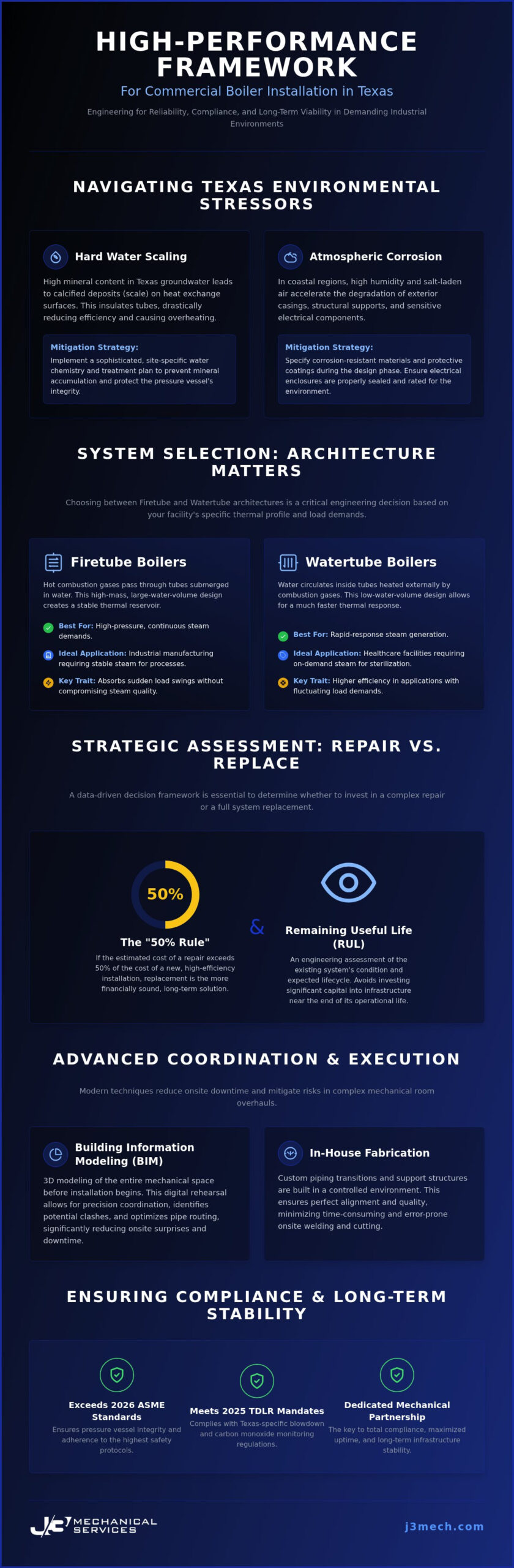
The choice between firetube and watertube architectures hinges on the specific thermal profile of the facility. Firetube boilers, where hot gases pass through tubes surrounded by water, are often the preferred choice for high-pressure steam demands in industrial manufacturing due to their large water volume and high-mass design. This configuration provides a stable thermal reservoir that can absorb sudden load swings without compromising steam quality. Conversely, watertube boilers circulate water inside the tubes, allowing for much smaller water volumes and a significantly faster thermal response. Understanding the foundational Boiler technology is critical when matching these systems to environments like healthcare facilities, where rapid-response steam for sterilization is a non-negotiable requirement. Matching the architecture to the application prevents premature mechanical fatigue and ensures the system operates within its optimal design envelope.
Load Calculation and Redundancy Planning
Precision in load calculation is paramount for facilities in San Antonio and Austin, where seasonal fluctuations can stress a poorly sized system. We utilize a methodology that prioritizes N+1 redundancy, ensuring that the facility remains fully operational even during a primary component failure or scheduled maintenance cycle. This strategy isn't just about safety; it's about eliminating the risk of unscheduled downtime in critical Texas infrastructure. Engineers must also account for local atmospheric conditions, such as altitude and air density, which directly impact the fuel-to-air ratio and overall combustion efficiency. A thorough assessment of peak load requirements prevents the inefficiencies of short-cycling during periods of lower demand.
A secondary consideration involves the choice between modular and high-mass configurations. Modular systems offer superior turndown ratios and increased efficiency during low-load periods, while high-mass boilers provide the robust durability required for continuous, heavy-duty industrial cycles. Integrating low-NOx burners is also essential to meet strict environmental regulations while maintaining a precise fuel-to-air ratio for optimal thermal transfer. By adhering to these technical criteria, a commercial boiler installation Texas facility can achieve a reduced total cost of ownership through maximized uptime and energy conservation.
Environmental Stressors: Managing Thermal Stress and Mineral Scaling
Texas geography presents a dual challenge for large-scale mechanical systems. In Central Texas, the primary threat is mineral accumulation within the pressure vessel; in coastal regions like Corpus Christi, humidity-driven atmospheric corrosion accelerates the degradation of exterior casings and sensitive electrical components. A successful commercial boiler installation Texas strategy must account for these stressors during the design phase to prevent premature system failure and ensure the infrastructure remains resilient against the local climate. Ignoring these variables leads to a rapid increase in the total cost of ownership as efficiency drops and repair frequencies climb.
Hard Water Scaling and Chemical Treatment
The high mineral content characteristic of Texas groundwater necessitates a sophisticated approach to water chemistry to prevent the accumulation of calcified deposits on heat exchange surfaces. Mineral scaling acts as an insulator, significantly impeding thermal transfer and forcing the burner to fire longer to achieve the same water temperature. According to the Federal Energy Management Program (FEMP), maintaining peak energy efficiency requires a rigorous commitment to water quality management. When calcium and magnesium precipitate out of solution at high temperatures, they form a rock-hard barrier that can lead to localized overheating and eventual tube failure. To mitigate these risks, we implement a multi-layered defense strategy:
- Industrial-Grade Softeners: Removing hardness ions before they enter the boiler loop is the first line of defense.
- Automated Chemical Feed Systems: Precise, real-time dosing of scale inhibitors and oxygen scavengers maintains consistent water chemistry.
- Advanced Blowdown Protocols: Utilizing blowdown separators, as mandated by the 2025 Texas Department of Licensing and Regulation updates, ensures that concentrated solids are effectively removed from the system.
Thermal Shock and High-Cycle Fatigue
Texas is known for "Blue Northers," rapid cold fronts that can cause ambient temperatures to plummet by 40 degrees in a matter of hours. These events create sudden, high-demand thermal stress as the system rapidly ramps up from a standby state to full firing capacity. This rapid expansion and contraction of metal components leads to high-cycle fatigue, which often manifests as hairline fractures in the boiler tubes or tubesheet. Managing this stress requires a disciplined approach to flow control and burner modulation. Integrating variable frequency drives (VFDs) into the pumping system allows for a more gradual introduction of thermal energy, protecting the integrity of the pressure vessel during volatile weather events. If you are observing frequent leaks or a decline in thermal response, a professional commercial HVAC maintenance evaluation can determine if environmental stressors are compromising your system's structural integrity.
Corrosion management in coastal environments requires additional foresight. Salt-laden air in Corpus Christi can penetrate standard mechanical room ventilation, leading to the oxidation of non-stainless components. We specify specialized coatings and enclosure materials to ensure that the external environment doesn't compromise the precision engineering inside the boiler. By addressing these Texas-specific stressors, facility managers can secure a more stable and predictable lifecycle for their critical heating infrastructure.
Strategic Assessment: The Engineering Logic of Repair vs. Installation
Deciding between a comprehensive repair and a total commercial boiler installation Texas project requires a disciplined evaluation of the system's Remaining Useful Life (RUL) and its impact on the facility's Total Cost of Ownership. While a quick fix might seem cost-effective in the short term, it often masks deep-seated structural issues within the primary pressure vessel that can lead to catastrophic failure. We apply the "50% Rule" as a primary diagnostic benchmark; if the projected repair costs exceed half the capital required for a new installation, the investment logic shifts toward replacement. This assessment must also account for the technical obsolescence of legacy control systems, which lack the precision required for modern energy management.
Lifecycle ROI Analysis
The financial justification for a new system is often rooted in the stark efficiency gap between legacy architectures and modern condensing technology. Older systems typically operate at a thermal efficiency of 70% to 80%, meaning a significant portion of fuel expenditure is lost through the flue. Modern condensing units achieve efficiencies of 95% or greater by recovering latent heat from combustion gases, a transition that drastically reduces monthly operational costs. Calculating the payback period involves a thorough analysis of these fuel savings alongside reduced maintenance requirements. By 2026, the operational lifecycle threshold for commercial boiler systems in industrial environments is established at 20 to 25 years, beyond which the risk of pressure vessel failure increases exponentially. Investing in newer technology ensures that the facility benefits from advanced modulation and reduced carbon footprints, aligning with contemporary environmental standards.
When Repair Becomes a Liability
Operational stability is the most critical metric for any industrial facility, and an aging boiler is often the weakest link in that chain. As systems exceed the two-decade mark, the risk of a catastrophic breach in the pressure vessel grows, potentially resulting in prolonged unscheduled downtime and massive liability. Sourcing non-standard replacement parts for obsolete models becomes increasingly difficult and expensive, often leading to lead times that an active facility cannot afford. This lack of reliability directly threatens business continuity, as a single day of lost production can outweigh the savings of delaying a necessary upgrade. A strategic partnership with a mechanical expert allows for a proactive replacement schedule, ensuring that new infrastructure is commissioned before the legacy system reaches a point of failure. Prioritizing long-term stability over temporary patches is the hallmark of professional infrastructure management.
Advanced Coordination: BIM and Fabrication in Mechanical Room Overhauls
Achieving a successful commercial boiler installation Texas project requires moving beyond isolated equipment placement to a model of integrated mechanical coordination. High-density mechanical rooms often present spatial constraints that make traditional installation methods prone to error and costly field adjustments. By utilizing Building Information Modeling (BIM), we create a comprehensive digital representation of the facility's existing infrastructure, allowing for the precise mapping of every pipe, valve, and conduit. This advanced coordination ensures that the boiler system integrates seamlessly with broader commercial HVAC solutions, optimizing both the physical footprint and the long-term serviceability of the equipment.
BIM-Driven Strategic Planning
The implementation of digital twins serves as a critical risk mitigation tool during the design phase. These virtual models allow engineers to identify and resolve potential spatial interferences between new boiler venting and existing ductwork or structural elements before a single component arrives onsite. This level of foresight is particularly valuable when managing the logistics of heavy component rigging in confined spaces, where clearance margins are often measured in inches. The strategic role of hvac sheet metal fabrication becomes evident when custom transitions are required to maintain laminar airflow and pressure integrity within the exhaust system. Precision modeling ensures that the installation sequence is logically paced, reducing the total duration of facility downtime.
The Precision of In-House Fabrication
Off-site, in-house fabrication represents a paradigm shift in mechanical project execution. By manufacturing custom piping assemblies and venting transitions in a controlled environment, we eliminate the lead-time delays often associated with sourcing non-standard mechanical connectors. This process guarantees airtight integrity in high-temperature flue transitions, which is essential for maintaining ASME-compliant drafting and facility safety. The quality of these fabricated components is a direct reflection of the technical standards upheld by a professional commercial hvac contractor. Custom fabrication allows for the creation of precise, pre-tested sub-assemblies that arrive at the job site ready for immediate integration, thereby minimizing the labor-intensive modifications typically required in the field. If your facility requires an infrastructure overhaul defined by engineering precision, consider the benefits of our Building Information Modeling (BIM) services to ensure a friction-less execution.
J3 Mechanical Services: Authoritative Boiler Solutions Across Central and South Texas
J3 Mechanical Services approaches each commercial boiler installation Texas project with the rigor of a seasoned mechanical consultant, prioritizing long-term infrastructure stability over the expedited timelines of less specialized contractors. Precision is our baseline. Our commitment to the ASME Boiler and Pressure Vessel Code (BPVC) standards ensures that every pressure vessel we commission meets the highest benchmarks for safety and operational integrity. By integrating a commercial hvac maintenance protocol into the post-installation lifecycle, we protect your capital investment against the degradation common in high-cycle industrial environments.
Regional Logistics and Deployment
Our service footprint extends across San Antonio, Austin, Corpus Christi, and the Rio Grande Valley, providing a localized response capability that is essential for critical facility management. Strategically positioned teams in Killeen and New Braunfels allow for rapid project execution while maintaining the technical depth required for complex mechanical room overhauls. We understand that the environmental stressors in humid coastal zones differ significantly from the arid inland regions of Central Texas, and we adjust our engineering specifications accordingly. This regional expertise, combined with our in-house fabrication capabilities, ensures that even a commercial hvac repair is executed with the same precision as a new system build. We use custom components that match the exact requirements of your existing infrastructure to ensure seamless recovery.
The Master Builder Commitment
We operate under the "master builder" persona. This philosophy demands meticulous preparation and a profound sense of ethical duty toward the final product. Every project phase is accompanied by transparent, logic-driven reporting and comprehensive engineering documentation, providing facility managers with total visibility into their system's performance. This disciplined approach is vital for any commercial boiler installation Texas enterprise, as it transitions the process from a simple equipment swap to a strategic infrastructure upgrade. Our operational principles are rooted in a faith-based commitment to accountability and excellence. We ensure our partnerships are defined by consistency and technical mastery. By choosing J3 Mechanical Services, you're securing a disciplined strategist capable of managing high-stakes environments without friction, ensuring the long-term mechanical stability of Texas's most critical facilities.
Securing Long-Term Mechanical Stability for Texas Infrastructure
Establishing a resilient thermal system requires a transition from reactive repairs to a disciplined strategy of precision engineering. A successful commercial boiler installation Texas project is defined by the rigorous application of ASME-Compliant Engineering Standards and the utilization of BIM-Coordinated Project Execution to mitigate spatial conflicts before they manifest. By prioritizing In-House Fabrication for custom mechanical solutions, you ensure that every component is optimized for the specific mineral profiles and volatile thermal swings of the Texas climate. This comprehensive approach significantly reduces the total cost of ownership while maximizing the operational uptime of your critical infrastructure.
Strategic mechanical planning ensures that your facility remains a stable asset in an increasingly complex regulatory landscape. We invite you to Secure Precision Boiler Installation Services with J3 Mechanical Services to gain a partner committed to technical mastery and ethical accountability. Our team is prepared to guide you through the lifecycle of planning, execution, and ongoing oversight with the gravitas your infrastructure deserves. We look forward to helping you build a future of industrial-grade reliability and sustained excellence.
Frequently Asked Questions
How often should a commercial boiler undergo a professional safety inspection in Texas?
All boilers operating within the state must be registered with the Texas Department of Licensing and Regulation and are subject to mandatory inspection schedules based on their specific application. As of late 2025, the TDLR enforces strict fines for late inspections, beginning at $25 per day and increasing significantly after 60 days. Adhering to these annual or biennial requirements ensures that the pressure vessel remains compliant with current safety statutes and operational standards.
What are the primary indicators that a commercial boiler requires full replacement rather than repair?
A strategic commercial boiler installation Texas project is typically justified when repair costs exceed 50% of the total capital required for a new system. Beyond the financial threshold, facility managers should evaluate the Remaining Useful Life of the pressure vessel and the availability of non-standard parts. If a legacy unit can no longer maintain efficient thermal transfer or lacks modern modulation capabilities, a full system replacement becomes the most viable path for long-term stability.
How does the hard water in Central Texas impact the lifespan of a commercial boiler?
The high mineral concentration in Central Texas groundwater creates a significant risk of internal scaling, where calcified deposits act as an insulator on heat exchange surfaces. This barrier forces the burner to fire longer to maintain output, leading to localized overheating and accelerated metal fatigue. Without disciplined water softening and automated chemical feed systems, these mineral deposits can cause premature tube failure and a drastic reduction in the system's overall energy efficiency.
What is the role of ASME BPVC standards in commercial boiler installation?
The ASME Boiler and Pressure Vessel Code provides the essential engineering framework for the safe design and fabrication of high-pressure mechanical systems. Adhering to the updated 2026 ASME standards is a legal requirement in Texas and serves as a primary safeguard against catastrophic pressure vessel failure. These protocols ensure that every weld, material choice, and safety valve configuration meets the rigorous demands of industrial infrastructure, protecting both the facility and its personnel.
Can BIM modeling reduce the cost of a complex mechanical room retrofit?
Building Information Modeling reduces total project costs by creating a high-fidelity digital twin that identifies spatial interferences before the installation phase begins. By coordinating the placement of new boiler components with existing ductwork and structural elements, we can eliminate approximately 20% of the rework costs typically associated with complex mechanical retrofits. This digital foresight allows for precision in-house fabrication of custom piping assemblies, which significantly streamlines the onsite execution process and reduces labor hours.
What is the typical lifespan of a high-demand commercial boiler in Texas?
In high-demand industrial environments, a commercial boiler typically reaches its operational threshold between 20 and 25 years. While the physical structure may remain intact, the degradation of internal components and the rising cost of maintenance often diminish the system's return on investment after two decades. Proactive facility managers use this 25 year benchmark to plan for infrastructure upgrades, ensuring that new technology is commissioned before the legacy system enters a cycle of frequent and expensive failures.
How do high-efficiency condensing boilers handle the humidity of the Texas Gulf Coast?
High-efficiency condensing boilers are specifically designed to manage moisture, but the extreme humidity of the Gulf Coast requires additional corrosion-resistant specifications. We utilize stainless steel heat exchangers and specialized exterior coatings to protect the unit from salt-laden atmospheric conditions found in regions like Corpus Christi. These systems also require advanced condensate management protocols to ensure that the increased liquid byproduct is handled safely without compromising the integrity of the mechanical room floor or drainage systems.
Does J3 Mechanical Services provide 24/7 emergency response for boiler failures in San Antonio?
J3 Mechanical Services maintains a 24/7 emergency response protocol to address critical mechanical failures across the San Antonio metropolitan area. We recognize that unscheduled downtime in industrial infrastructure represents a significant liability and requires a disciplined, rapid-response strategy. Our technical teams are equipped to perform precision recovery tasks and ASME-compliant repairs, ensuring that your facility regains its thermal capacity with minimal friction. We prioritize the restoration of business continuity through technical mastery and proactive logistical coordination.
Need a hand with your building's HVAC?
Free quotes and honest answers from licensed commercial technicians across South Texas.