
Commercial Exhaust Repair: A Guide for Texas Facilities
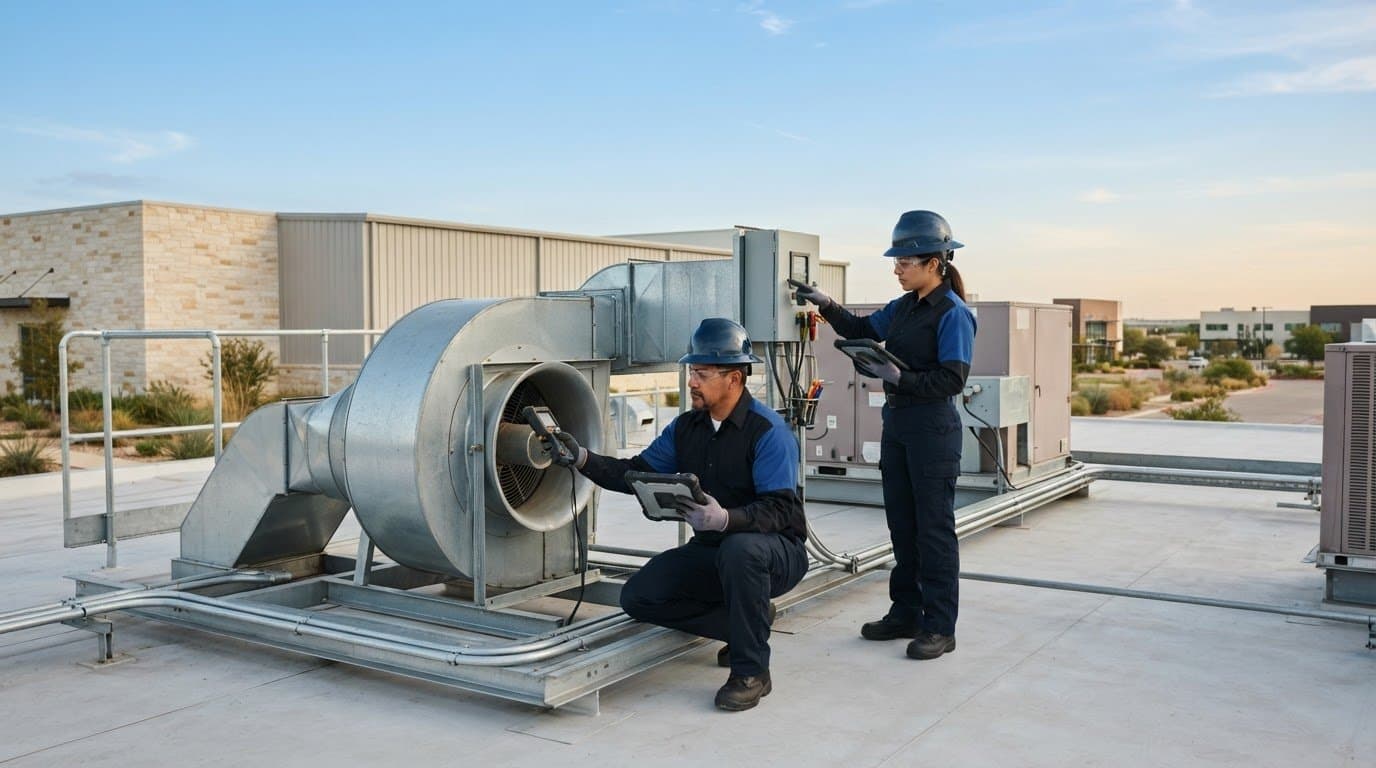
A noisy exhaust fan does not automatically mean the fan has failed. In a Texas facility, unusual vibration, persistent odors, or reduced airflow may point to a component fault, a controls issue, or a wider problem in the connected system. Effective commercial exhaust system repair starts by understanding how these elements work together, not by replacing a fan by default.
When exhaust performance changes, the impact can extend beyond the equipment itself, affecting operations and the conditions a work area depends on. Identifying warning signs is useful, but inspecting mechanical or electrical components without proper training can create additional risk. A systematic diagnosis helps distinguish a localized fault from a system-level issue and informs repair planning.
This guide explains which symptoms warrant attention, how diagnosis can account for connected mechanical and control systems, and what information to prepare for a commercial service request. You’ll also learn how to document the equipment, alarms, operating impact, and site conditions so the repair discussion can start with a clearer picture of your facility’s needs.
Key Takeaways
- Recognize when exhaust noise, vibration, odor, or airflow changes call for a structured assessment rather than an assumed component replacement.
- Commercial exhaust system repair may involve evaluating the fan assembly, airflow, and controls together to identify the source of a performance issue.
- Use observed conditions and facility requirements to guide whether repair, maintenance, or replacement is the appropriate next step.
- Prepare equipment details, alarm information, operating impacts, site access requirements, and a responsible contact for a more useful service request.
- J3 Mechanical Services’s commercial HVAC repair approach coordinates equipment, distribution, controls, fabrication, and BIM where relevant to the facility’s needs.
Commercial Exhaust System Repair: Which Warning Signs Matter First?
For a facility manager, exhaust performance is not an isolated equipment concern. It can affect occupant comfort, daily operations, and the conditions a controlled work area depends on. A change in fan sound, vibration, odor, or airflow deserves attention, particularly if it affects a specific room or process. Commercial exhaust system repair involves diagnosing and restoring exhaust equipment and related operating functions. It is not simply a decision to replace a fan whenever performance changes.
An operational warning sign is evidence that performance has changed, not a confirmed diagnosis of what caused it. Reporting observations accurately helps the service team assess the issue without staff attempting to identify or repair a fault themselves. A symptom may warrant assessment, but it does not establish whether the issue is at the fan, elsewhere in the system, or related to how the equipment is operating.
How to recognize a change in exhaust performance
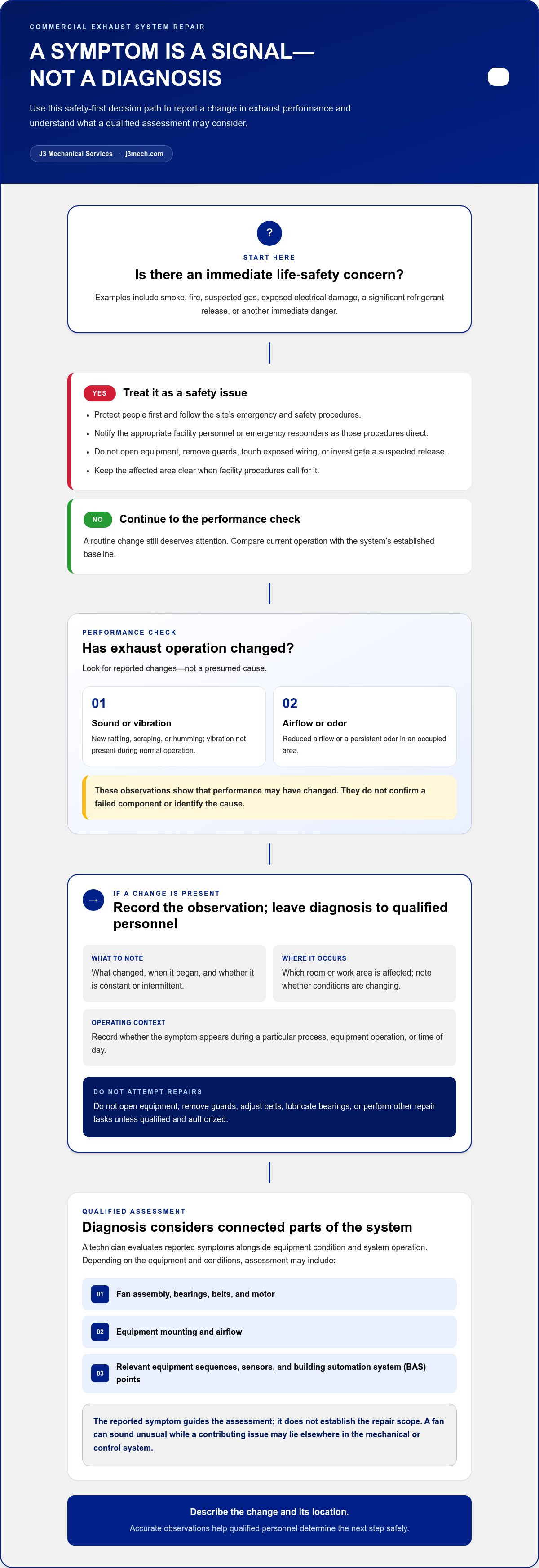
Compare current operation with the system’s established baseline. A new rattling, scraping, or humming sound, or vibration that was not present during normal operation, is useful to report. So are reduced airflow and a persistent odor in an occupied area. These observations can indicate that the exhaust system is not performing as expected, but they do not determine the cause.
Record what changed, when it began, whether it is constant or intermittent, and which rooms or work areas are affected. Note operating conditions, such as whether the symptom appears during a particular process or time of day. For kitchen facilities, Kitchen exhaust cleaning provides background on cleaning and maintenance. Cleaning needs and mechanical repair are related considerations, but they are not interchangeable.
When a facility condition becomes a safety concern
Routine concerns, such as a gradual change in sound or airflow, call for reporting and assessment through the facility’s normal procedures. Smoke, fire, suspected gas, exposed electrical damage, a significant refrigerant release, or another immediate life-safety concern requires a different response. Protect people first and follow the site’s emergency and safety procedures, including notifying the appropriate facility personnel or emergency responders as those procedures direct.
Do not open equipment, remove guards, touch exposed wiring, or investigate a suspected release. Even when a unit appears accessible, internal components may present hazards or require qualifications and controls that staff do not have. Keep the affected area clear when facility procedures call for it, and report what was observed, where it occurred, and whether conditions are changing. Clear observations help the responsible team determine the next step without turning a symptom report into an unsafe inspection.
Accurate reporting is the first useful action: describe the change and its location, then leave diagnosis and repair work to qualified personnel.
How Commercial Exhaust System Diagnosis Connects Fans, Airflow, and Controls
A reported change in exhaust performance is a starting point for diagnosis, not proof that a particular part has failed. A technician evaluates the symptom alongside equipment condition and system operation, then determines whether the issue appears localized or may involve connected components. This broader view matters because a fan can sound unusual while the underlying cause, or an additional contributing factor, lies elsewhere in the mechanical or control system.
Depending on the equipment and reported conditions, assessment may include the fan assembly, bearings, belts, motor, mounting, and airflow. These areas are considered in context. For example, vibration may prompt an evaluation of both the rotating assembly and the equipment mounting, while a change in airflow may lead to a wider review of system operation. Neither symptom, by itself, confirms a failed component or establishes the repair scope.
What fan and airflow observations can tell a technician
Specific observations help frame the assessment. A new hum, rattle, or scraping sound may be associated with a mechanical condition, while vibration could make equipment mounting or fan operation relevant areas to examine. Reduced airflow may indicate that the system is not moving air as expected, but the observation alone does not identify why.
Record what staff noticed, where they noticed it, when it occurs, and whether the condition changes with equipment operation. That context helps a technician compare the reported symptom with the equipment’s condition and performance. Facility staff should not open equipment, adjust belts, lubricate bearings, or perform other repair tasks unless they are qualified and authorized to do so.
Why controls and connected systems belong in the assessment
Mechanical operation does not occur in isolation. Equipment sequences, sensors, and building automation system (BAS) points may affect how connected equipment is commanded or reported to operate. If a fan appears to behave inconsistently, a qualified assessment may need to consider both its physical condition and relevant control behavior. This does not mean a control fault is present; it means the diagnosis should account for system relationships where they apply.
J3 Mechanical’s controls engineering scope supports a coordinated view of commercial HVAC systems alongside equipment and distribution. That perspective can inform repair planning when reported symptoms involve connected mechanical and control functions. For additional context on the restoration process, commercial HVAC repair and restoration describes the broader approach to commercial system repair.
For a facility request, provide the symptom record and relevant operating observations so the assessment starts with system context, not an assumption about a single part. J3 Mechanical provides commercial HVAC repair services for project-specific repair and restoration needs.
Repair, Maintenance, or Replacement: How to Assess the Right Exhaust-System Path
A decision about a commercial exhaust system should follow an assessment of its condition and the facility’s operating requirements. A new sound or airflow change may justify a repair evaluation, while routine maintenance can provide a structured review of equipment condition. Replacement may be a consideration when diagnosis and project requirements support that path. The symptom alone does not determine which option is appropriate.
| Observed condition | Assessment need | Possible next decision |
|---|---|---|
| A new or worsening noise, vibration, odor, or airflow change | Review equipment condition and system operation to determine what may be contributing | Repair, further assessment, or another response based on findings |
| Recurring symptoms after prior attention | Review the history and consider whether connected equipment or controls should also be assessed | Refine repair scope or evaluate broader system needs |
| No current performance complaint, with maintenance due | Review equipment condition and document observable concerns | Continue maintenance planning or address findings through a separate repair assessment |
| Equipment condition or facility requirements indicate a larger concern | Assess the system and operational requirements before selecting a path | Consider repair or replacement based on diagnosis and project needs |
When a repair assessment is the logical next step
Document a new, worsening, or recurring symptom and request a commercial assessment rather than assuming which part needs replacement. The repair scope depends on diagnosis, equipment condition, safety, and authorization. If work is indicated, completion timing and parts availability depend on factors such as the findings, required parts or tools, manufacturer support, inventory, and approval.
Repeated symptoms deserve particular attention. They do not prove that a specific component has failed, but they can indicate that a simple, isolated response may not address the full operating concern. A system review can help determine whether the condition is limited to one piece of equipment or whether related mechanical or control functions should be considered before setting the repair path.
How preventive maintenance supports informed planning
Preventive maintenance provides an opportunity to review equipment condition and note observable concerns as part of ongoing facility planning. It can inform decisions about follow-up assessment, but it cannot ensure uptime or prevent every failure. Maintenance and repair serve different purposes: maintenance supports planned review, while repair responds to a diagnosed condition that requires corrective work.
For facilities organizing broader asset planning, J3 Mechanical’s commercial HVAC preventive maintenance protocols offer related guidance. In commercial exhaust system repair, the decision between repair, maintenance, and replacement should reflect verified conditions, operational needs, and the authorized project scope.
Preparing a Commercial Exhaust Repair Request Without Disrupting Facility Safety
A well-prepared service request gives the repair team a clearer picture of the facility, reported symptoms, and operational priorities. Gather information from a safe location and use existing records rather than inspecting equipment. For commercial exhaust system repair, accurate observations help frame the request, but they are not a diagnosis or a reason for staff to attempt repairs.
What facility teams should document before requesting service
Before making a routine request, organize the available details in a consistent sequence. Keep descriptions factual: note what staff observed, not what they believe has failed. If information is unavailable or cannot be gathered safely, do not delay action to obtain it.
- Identify the site. Record the facility address and name, along with the affected building, floor, room, or work area.
- Describe the equipment. Include the equipment type and identification details available from facility records or labels that can be read safely without opening or approaching hazardous equipment.
- Report the observations. Describe the sound, vibration, odor, airflow change, or other condition, including when it began and whether it is constant or intermittent.
- Include alarms and records. Share relevant alarm information and existing service history or operating notes, if available. Report what the alarm displays rather than interpreting its cause.
- Explain facility impact and access. Note which operations or areas are affected, any access requirements, and the responsible contact who can coordinate site communication.
This sequence separates the reported condition from the repair decision, which depends on assessment, safety, and authorization. Do not remove guards, access energized equipment, open panels, or attempt repairs outside your qualifications. If staff cannot gather a detail without entering a restricted or hazardous area, mark it as unavailable and leave it to qualified personnel.
How to handle an urgent safety condition
Smoke, fire, suspected gas, exposed electrical damage, significant refrigerant release, or any immediate life-safety concern should be treated as an emergency condition, not a routine service request. Follow the facility’s emergency procedures, protect occupants from immediate hazards, and notify the designated personnel or emergency responders as those procedures direct. Do not approach or open equipment to investigate.
For an emergency call, have the address, facility, equipment details, alarms, safety condition, access requirements, operating impact, and responsible contact ready if doing so is safe. After-hours availability is confirmed by phone. Exact coverage and availability must be confirmed for every request. Coverage and next steps are confirmed after the emergency call; this does not establish arrival or completion timing. If conditions change while the call is being made, prioritize site safety procedures.
Once the facility information is organized, J3 Mechanical’s commercial HVAC repair team can receive a clear account of the request and its operational context.
Commercial Exhaust System Repair in South Texas: A Coordinated J3 Mechanical Approach
Commercial exhaust issues can involve more than the component where a symptom first appears. J3 Mechanical provides commercial HVAC Repair (Restoration) as a project-specific service, with repair planning shaped by the facility, equipment condition, and operating requirements. This keeps the decision focused on restoring system function rather than assuming a single part replacement will address the concern.
J3 Mechanical is headquartered in Selma, Texas, with operating locations in Edinburg and Joshua. These locations are part of the company’s Texas presence, but they do not establish service coverage for a particular request. Exact coverage and availability must be confirmed for every request.
How coordinated commercial HVAC work supports repair planning
Where the project scope calls for it, coordination can connect equipment, air distribution, controls, fabrication, and facility operations. Building Information Modeling (BIM) can support coordination among field conditions, the model, the shop, and control sequences before startup. Reviewing these interfaces can clarify how proposed work relates to the broader mechanical system and the facility’s requirements.
Controls engineering and in-house fabrication are relevant when the diagnosed scope requires them, rather than automatic additions to every repair. For example, a project involving affected distribution or control sequences may call for coordination beyond the equipment itself. J3 Mechanical’s BIM and HVAC fabrication coordination provides further context on how coordinated mechanical planning can inform project work.
What to expect when discussing a repair scope with J3 Mechanical
Scope development starts with understanding the facility and reported concern, then considering equipment details, site access, schedule requirements, and the wider project context. Existing records, alarm information, and operating impacts can help establish the request, while diagnosis determines what work may be appropriate. The scope and quote follow review of the facility and project requirements. No quote turnaround or repair completion timing should be assumed in advance.
Once the findings and proposed work are understood, the facility can review the scope and provide authorization before work proceeds. Parts, tools, manufacturer support, safety conditions, inventory, and authorization may affect project planning. Commercial repair is a coordinated restoration process, not an automatic commitment to a particular repair method or schedule.
For a project-specific discussion, request a commercial exhaust repair review with the facility, equipment, access, schedule, and operational requirements available.
Set a Clear Path for Your Facility’s Next Repair Decision
Once an exhaust concern is documented, the next step is to turn those observations into a repair discussion grounded in your facility’s operating priorities. A well-defined commercial exhaust system repair request can focus attention on the conditions that matter to your team, including equipment, access, and the effect on facility operations. Diagnosis and authorized scope, rather than assumptions about a single component, should guide the work ahead.
J3 Mechanical is a Texas commercial contractor, verifiable through TDLR #TACLA00116129E. Bring forward the information your team has gathered and identify the operational requirements that should inform planning. That conversation establishes a project-specific basis for assessing the work without presuming a particular repair or schedule.
Share your facility’s repair priorities with J3 Mechanical to begin a focused discussion about the scope. With clear observations and coordinated planning, your team can move toward an informed next step.
Frequently Asked Questions
What are common signs that a commercial exhaust fan needs repair?
New or worsening noise, vibration, reduced airflow, persistent odor, or a change in affected work areas can signal that the system needs assessment. For example, a sound that appears only during a particular operating period is useful context to report. These observations do not confirm a failed part. In commercial exhaust system repair, diagnosis determines whether the cause involves the fan, another connected component, or system operation.
Can a commercial exhaust system keep operating if airflow drops?
Whether operation can continue depends on the facility, the process served, the severity of the airflow change, and relevant safety requirements. Do not assume the system is safe or suitable to keep running simply because the fan still operates. Follow facility procedures, communicate the affected area and operational impact to responsible personnel, and arrange a qualified assessment. If an immediate hazard is present, prioritize emergency procedures over normal operation.
How often should commercial exhaust systems receive maintenance?
There is no single maintenance interval that fits every commercial exhaust system. Planning should account for equipment requirements, operating conditions, facility processes, and existing service records. A system supporting demanding or continuous operations may need a different maintenance plan from one used intermittently. Use equipment documentation and facility-specific requirements to establish an appropriate schedule with qualified commercial HVAC professionals, then record completed work and follow-up observations for future planning.
What information should I provide when requesting commercial exhaust repair?
Provide the facility address and name, affected area, equipment identification available from records, alarm details, when the condition began, and how operations are affected. Also explain site access requirements and identify a responsible contact who can coordinate entry and decisions. Keep the report factual, such as describing an alarm display rather than guessing at its cause. Share records or safely obtained photos if they clarify the reported condition.
Is after-hours commercial HVAC service available in South Texas?
After-hours availability is confirmed by phone; live answering, dispatch, response time, and holiday coverage are not promised. For requests connected with San Antonio, Selma, Seguin, Austin, Corpus Christi, Killeen, Joshua, Bandera, Boerne (also searched as Beorne), New Braunfels, Edinburg, McAllen (also searched as Mccallen), Rio Grande Valley (also searched as Rio Grand Valley), Rockport, Pleasanton, San Marcos, or Round Rock, Exact coverage and availability must be confirmed for every request. For emergencies, provide the address, facility, equipment, alarms, safety condition, access, operating impact, and responsible contact. Coverage and next steps are confirmed after the call.
What happens if the exhaust-system repair requires parts?
If parts are needed, the repair plan depends on the diagnosis, equipment, safety conditions, inventory, and authorization. Tools, refrigerant, or manufacturer support may also affect the work, depending on the system and findings. Review the proposed scope and relevant project factors before authorizing work. Same-visit completion is not promised, so facility teams should plan operations without assuming a specific parts or completion timeline.
Does J3 Mechanical provide residential exhaust or HVAC emergency service?
J3 Mechanical provides commercial HVAC repair and emergency commercial HVAC service for business facilities and their mechanical-system needs. For a commercial request, describe the facility and equipment involved so the discussion can focus on the relevant commercial scope.
Need a hand with your building's HVAC?
Free quotes and honest answers from licensed commercial technicians across South Texas.