
Commercial Furnace Repair in Texas: Restoring Critical Thermal Infrastructure
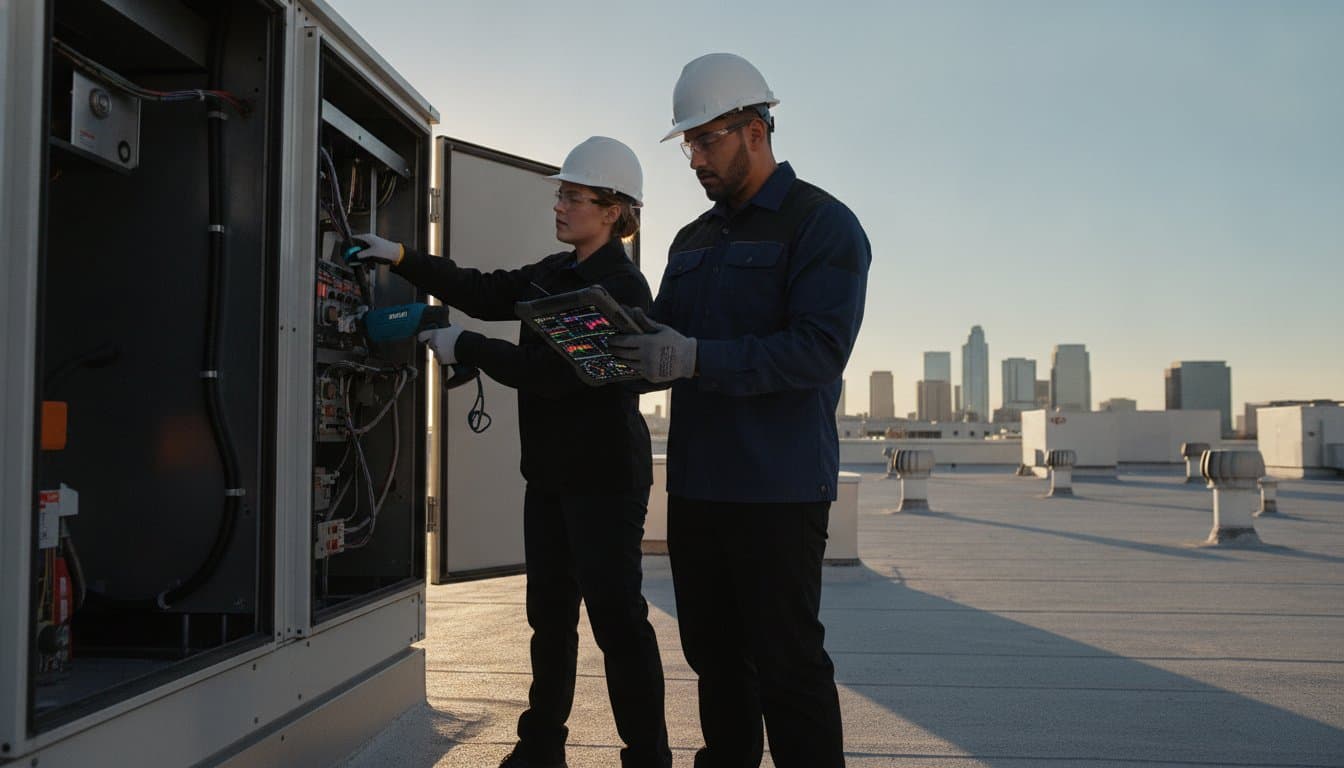
For a Texas facility manager, a furnace failure is not merely a mechanical inconvenience. It is a systemic threat to operational continuity and a direct risk to revenue stability. When the grid fluctuates or rare, severe cold snaps descend upon the state, the margin for error in your thermal infrastructure vanishes instantly. Securing reliable commercial furnace repair Texas requires more than a standard service call. It demands a disciplined, engineering-centric approach that prioritizes long-term structural integrity over the superficial fixes offered by generalist contractors who lack industrial specialization.
You likely recognize that operational downtime is an unacceptable liability, yet finding a partner with the technical mastery to handle complex mechanical systems remains a significant challenge. This article provides a comprehensive technical guide designed to help you diagnose, repair, and optimize your heating systems with verifiable precision. We will explore the logistics of rapid restoration, the application of Building Information Modeling (BIM) in system recovery, and the specific 2021 IECC energy standards that govern modern Texas facilities. By adopting a proactive strategy rooted in systematic execution, you can transform your HVAC maintenance from a reactive burden into a stable, high-performance asset.
Key Takeaways
- Identify critical failure modes in high-output burner assemblies and heat exchangers to preemptively address mechanical degradation before it results in total system failure.
- Understand the necessity of specialized commercial furnace repair Texas for managing the sophisticated control logic and industrial scale required for modern facility infrastructure.
- Establish 24/7 emergency recovery protocols and preventive maintenance schedules to mitigate the operational risks associated with Texas-specific environmental stressors and rapid temperature shifts.
- Utilize advanced engineering tools, including Building Information Modeling (BIM) and in-house fabrication, to ensure technical precision and seamless integration during complex repair or retrofit projects.
- Verify that all thermal infrastructure repairs align with the 2021 International Energy Conservation Code (IECC) and ASHRAE standards to optimize energy efficiency and long-term system reliability.
The Strategic Importance of Commercial Heating Infrastructure in Texas
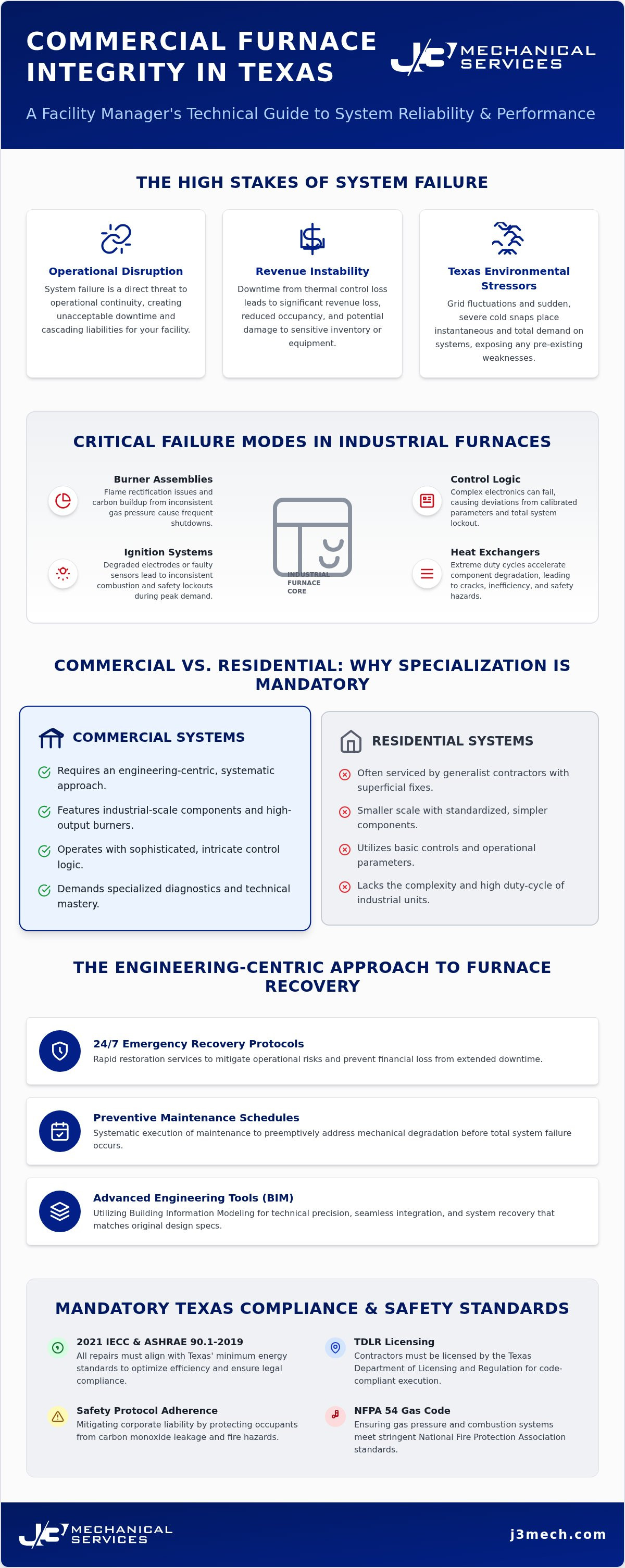
Heating systems in industrial environments aren't secondary amenities; they're core components of a building's life-support system. While many associate the state with extreme heat, the seasonal volatility experienced in regions like North Texas places immense stress on mechanical systems that remain dormant for months. When a sudden freeze occurs, the demand on high-output burner assemblies is instantaneous and total. Effective commercial furnace repair Texas involves a rigorous assessment of these systems to ensure they meet the thermal loads required for large-scale operations. Unlike residential units, these systems involve intricate control logic and high-capacity components that require an Industrial furnace overview to understand their mechanical complexity and specialized design requirements.
The Economic Impact of Heating Downtime
The financial consequences of a heating failure extend far beyond the immediate repair invoice. When a facility loses thermal control, the resulting downtime can lead to significant revenue loss through reduced occupancy or total operational suspension. For medical facilities, laboratories, or data centers, even a minor temperature deviation can jeopardize sensitive inventory, biological samples, or equipment calibration. Professional mechanical partnerships mitigate these risks by providing 24/7 emergency recovery services that restore stability before economic damage becomes irreversible. Utilizing advanced tools like Building Information Modeling (BIM) allows for precise coordination during these critical repairs, ensuring that the restored system operates with verifiable reliability and matches the original engineering specifications of the building.
Texas Regulatory Compliance and Safety Standards
Compliance with Texas state energy codes is a legal and ethical mandate for facility managers. As of August 25, 2026, the minimum energy standard for commercial buildings in Texas is the 2021 International Energy Conservation Code (IECC). Adhering to these standards, alongside ASHRAE 90.1-2019, ensures that your heating infrastructure remains efficient and legally compliant while maximizing the potential for tax benefits like the Section 179 deduction. Beyond efficiency, safety protocols in high-capacity mechanical rooms are paramount. Improperly maintained furnaces pose a severe liability, particularly regarding carbon monoxide leakage and fire hazards in public-facing spaces. All contractors must be licensed by the Texas Department of Licensing and Regulation (TDLR) to ensure that commercial furnace repair Texas meets the stringent safety requirements necessary to protect building occupants and mitigate corporate liability through documented, code-compliant execution.
Identifying Common Failure Modes in Industrial Furnace Systems
Industrial furnace systems operate under extreme duty cycles that accelerate component degradation far beyond the rates seen in residential equipment. For facility managers overseeing large-scale operations, identifying the specific vulnerabilities that necessitate commercial furnace repair Texas is the first step in maintaining infrastructure integrity. These systems rely on the precise synchronization of high-output burner assemblies, complex electronic control logic, and massive heat exchange surfaces. When one element of this sequence deviates from its calibrated parameters, it places a compounding strain on the entire thermal network, often leading to a total system lockout during peak demand periods.
Burner and Ignition System Diagnostics
High-output burner assemblies are the heart of the industrial furnace, yet they're susceptible to flame rectification issues that can trigger frequent safety shutdowns. In many Texas facilities, gas pressure fluctuations at the manifold can cause inconsistent combustion, leading to carbon buildup on flame sensors and ignition electrodes. Adhering to the NFPA 86 safety standards is critical during these diagnostic phases, as improper ignition timing or faulty pilot assemblies can create hazardous conditions in the combustion chamber. Proactive replacement of worn ignition components isn't just a maintenance task; it's a risk mitigation strategy that prevents the sudden loss of heating capacity when outdoor temperatures drop rapidly.
Heat Exchanger Integrity and Safety
The heat exchanger is perhaps the most critical failure point in high-demand commercial environments due to the relentless nature of thermal cycling. As the metal expands and contracts during each heating cycle, it experiences metal fatigue that can eventually manifest as hairline fractures. These fractures are often invisible to the naked eye but can allow combustion byproducts, such as carbon monoxide, to infiltrate the building's air supply. Utilizing advanced inspection tools, including high-resolution borescope cameras and ultrasonic testing, allows for non-invasive diagnostics that confirm the structural integrity of the steel. If you suspect your system's heat transfer efficiency has diminished, a comprehensive mechanical assessment can identify these internal fractures before they compromise occupant safety.
Electronic control system malfunctions represent another significant failure mode, often stemming from sensor inaccuracies or drift in the building automation system (BAS) interface. Precision in commercial furnace repair Texas ensures that these sensors provide accurate data for modulating gas valves and blower speeds. Additionally, airflow obstructions within large-scale ductwork, often caused by accumulated particulate matter or damaged fire dampers, can lead to localized overheating. This overheating triggers high-limit switches that disable the unit to prevent catastrophic fire damage, emphasizing the need for a systematic approach to both the mechanical and electronic components of the system.
Commercial vs. Residential Repair: Why Specialization is Mandatory
The divergence between residential and commercial mechanical systems is profound. While residential units focus on localized comfort for single families, commercial systems function as critical infrastructure for entire organizations. Attempting to apply residential service methodologies to commercial furnace repair Texas often leads to catastrophic failures in logic and execution. Commercial units involve multi-stage heating, complex variable frequency drives (VFDs), and sophisticated building automation system (BAS) integration that residential technicians rarely encounter. This gap in expertise can result in misdiagnosed faults and extended operational downtime that Texas businesses simply can't afford.
Specialized tooling is equally vital for accurate diagnostics. Industrial systems require heavy-duty equipment, such as combustion analyzers calibrated for high-output systems and precision airflow measurement tools that can handle massive static pressures. Without these, a technician is merely guessing at system performance. Understanding the role of a commercial HVAC contractor is essential for facility managers who need to ensure their service partner possesses the technical depth required for high-stakes environments.
Technical Standards and Engineering Precision
Disciplined, logic-driven troubleshooting is the hallmark of professional industrial service. In a large facility, heating isn't a binary state; it's a balanced distribution of thermal energy across multiple zones with varying airflow requirements. J3 Mechanical Services focuses exclusively on commercial HVAC infrastructure because we recognize that the precision required for these systems shouldn't be diluted by residential service models. Our engineers utilize systematic protocols to verify that every component, from the burner assembly to the ductwork fabricated in our in-house facility, meets the exact engineering specifications of your building.
Accountability and Professional Documentation
For a facility manager, verifiable results are as important as the physical repair itself. Executing commercial furnace repair Texas in industrial settings requires rigorous documentation, including detailed service logs and technical reports that satisfy corporate audit requirements. These records provide a transparent history of system performance and help in predicting future maintenance needs. Additionally, commercial sites carry strict insurance and bonding requirements that residential-focused companies often fail to meet. By maintaining a corporate-industrial voice and a commitment to ethical consistency, we provide the accountability necessary for high-capacity mechanical rooms. This methodical approach ensures that every restoration project is backed by testing data and a clear path toward long-term system stability.
Emergency Response and Preventive Protocols for Texas Facilities
Operational continuity in Texas depends on a robust, rapid response framework. When critical assets fail, the interval between detection and restoration becomes the primary driver of revenue loss and facility instability. Establishing a 24/7 recovery protocol ensures that commercial furnace repair Texas is executed with the urgency required by high-stakes industrial environments. This isn't merely about reactive fixes; it's about a disciplined logistical chain that prioritizes system stabilization and the immediate mitigation of operational risks.
The Anatomy of a 24/7 Emergency Service Call
A professional emergency response begins with immediate technical triage. Remote diagnostics allow engineers to assess control logic and sensor data before a technician even arrives on-site, facilitating a more targeted and efficient repair strategy. For facilities in San Antonio or Austin, this rapid mobilization means specialized crews arrive with the specific components identified during the initial assessment. During major mechanical failures, the focus shifts to system stabilization, which may include implementing temporary heating solutions to maintain critical climate parameters while long-term repairs are finalized through systematic execution.
Optimizing Systems for the Texas Climate
Texas presents a unique set of environmental stressors that accelerate the degradation of thermal infrastructure. In coastal regions or the RGV, high humidity levels can lead to premature corrosion of furnace controls and significant sensor inaccuracies. Conversely, industrial environments in Edinburg or North Texas face heavy dust accumulation that can obstruct airflow and cause heat exchangers to overheat. Preparing for the intensity of North Texas winters requires a proactive adjustment of combustion parameters to ensure reliable ignition during the rapid temperature shifts that characterize the region's climate volatility.
Consistent oversight is the only way to mitigate these climate-driven risks effectively. Implementing a commercial HVAC maintenance protocol allows facility managers to extend the lifecycle of their mechanical assets through systematic verification and testing. By identifying minor sensor drifts or particulate buildup early, you reduce the likelihood of a catastrophic failure during peak demand. If your facility requires immediate technical intervention to restore thermal stability, you can schedule an emergency recovery session to secure your critical infrastructure today.
Engineering Excellence: The J3 Mechanical Approach to Furnace Recovery
J3 Mechanical operates with the discipline of a seasoned strategist, viewing commercial furnace repair Texas as a critical infrastructure responsibility rather than a series of isolated tasks. Our methodology is rooted in a faith-based commitment to professional accountability, ensuring that every project is executed with ethical consistency and technical rigor. This standard of excellence is exemplified through our commercial HVAC repair protocols, which leverage advanced digital tools and in-house manufacturing to deliver superior outcomes. By maintaining a serious, corporate-industrial focus, we provide facility managers with the quiet confidence that their thermal systems are managed by authoritative experts.
BIM-Coordinated Repairs and Retrofits
Building Information Modeling (BIM) is a cornerstone of our execution strategy for complex mechanical projects. By utilizing digital modeling, we can visualize the entire system architecture before a single technician arrives on-site. This proactive planning prevents spatial conflicts during major component swaps, ensuring that new furnace units or burner assemblies align perfectly with existing facility infrastructure. Meticulous digital preparation reduces onsite labor time and minimizes the risk of unforeseen installation friction, providing a predictable timeline for system restoration. This level of precision is essential for maintaining the structural integrity of high-capacity mechanical rooms where space is often at a premium.
Custom Fabrication for Rapid System Restoration
A significant bottleneck in large-scale furnace recovery is the lead time associated with specialized parts and ductwork. J3 Mechanical eliminates this liability through our in-house fabrication capabilities. By manufacturing custom sheet metal components and ductwork internally, we maintain total control over material quality and precision standards. This vertical integration ensures that every component is engineered to maximize system efficiency and airflow integrity, meeting the exact specifications of the building's design. Our ability to produce custom solutions rapidly allows us to bypass the delays of third-party suppliers, accelerating the commercial furnace repair Texas process for facilities that cannot tolerate extended downtime.
Precision in fabrication also plays a vital role in long-term reliability. When components are manufactured to exact tolerances, it reduces vibration, prevents air leakage, and ensures that the furnace operates within its intended thermal parameters. This methodical approach reflects our identity as a master builder, dedicated to the integrity of the final product. By combining advanced digital modeling with disciplined physical craftsmanship, we mitigate risks before they manifest, ensuring that your facility's heating infrastructure remains a stable and predictable asset for years to come.
Securing Long-Term Stability for Your Thermal Infrastructure
Maintaining a high-output heating system in the volatile Texas climate requires a shift from reactive maintenance to disciplined engineering oversight. As we've explored, the complexity of industrial burner assemblies and the precision required by the 2021 IECC energy standards demand a specialized partner. Relying on residential-grade technicians for commercial furnace repair Texas introduces unacceptable risks to your operational continuity. By prioritizing systematic diagnostics and leveraging advanced tools like Building Information Modeling (BIM), you ensure that your facility remains resilient against unexpected failure.
J3 Mechanical provides the technical mastery necessary to protect your critical assets through 24/7 emergency recovery services and precision in-house sheet metal fabrication. Our BIM-coordinated engineering approach guarantees that every repair or retrofit aligns perfectly with your building's unique requirements. We invite you to Contact J3 Mechanical for Professional Commercial Furnace Repair to discuss how our methodology can enhance your facility's reliability. Entrust your infrastructure to a partner who views mechanical integrity as a serious, ethical responsibility. We look forward to helping you achieve verifiable system stability and peak operational performance.
Frequently Asked Questions
How quickly can J3 Mechanical respond to a commercial furnace failure in Texas?
We prioritize immediate technical triage for all critical furnace failures through our 24/7 emergency repair services. Our logistical framework allows for rapid mobilization of specialized technicians across our service areas, including San Antonio and Austin. By utilizing remote diagnostics, we often identify the mechanical fault before arriving on-site. This disciplined approach minimizes operational downtime, ensuring that your facility's thermal infrastructure is restored with the urgency required for high-stakes commercial environments.
Do you provide furnace repair services for commercial high-rise buildings in Austin?
Yes, we provide comprehensive furnace repair and mechanical oversight for commercial high-rise buildings throughout the Austin metropolitan area. Our engineers are trained to manage the complex control logic and multi-zone distribution requirements inherent in vertical facility infrastructure. We focus exclusively on commercial HVAC solutions, ensuring that high-occupancy buildings receive the technical rigor and engineering precision necessary to maintain consistent thermal comfort and meet local Texas building codes.
What are the most common signs that a commercial furnace requires immediate repair?
Immediate indicators of furnace degradation include frequent system lockouts, unusual ignition delays, or inconsistent thermal distribution across zones. Facility managers should also monitor for increased operational noise from blower assemblies and unexplained spikes in energy consumption. These symptoms often signal mechanical fatigue in burner assemblies or sensor inaccuracies within the building automation system. Addressing these issues early through professional commercial furnace repair Texas prevents catastrophic failure and protects the structural integrity of your heat exchangers.
Is it more cost-effective to repair or replace an industrial furnace over 15 years old?
Deciding between repair and replacement requires a detailed engineering assessment of the unit's lifecycle and current efficiency. Industrial rooftop units in Texas typically have a lifespan of 12 to 15 years. If a system exceeds this age and requires frequent, major component swaps, replacement often proves more cost-effective. Modern systems also ensure compliance with the 2021 IECC and ASHRAE 90.1-2019 standards, offering significant long-term energy savings and eligibility for Section 179 tax deductions.
Does J3 Mechanical offer 24/7 emergency heating repair in San Antonio and Corpus Christi?
We maintain a dedicated emergency response team to provide 24/7 heating repair services across San Antonio and Corpus Christi. Our logistical chain is designed to handle critical failures at any hour, ensuring that facility managers have a reliable partner during rare but severe Texas cold snaps. This commitment to availability is supported by our in-house fabrication capabilities, which allow us to manufacture custom components rapidly to stabilize and restore your heating infrastructure without third-party delays.
How does Building Information Modeling (BIM) assist in complex HVAC repairs?
Building Information Modeling (BIM) serves as a digital roadmap that prevents spatial conflicts during major mechanical repairs or retrofits. By creating a precise three-dimensional model of your facility's existing infrastructure, we can coordinate component swaps with absolute accuracy. This level of meticulous preparation reduces onsite labor time and ensures that new furnace assemblies integrate seamlessly with complex ductwork and electrical systems. It's a proactive strategy that eliminates the friction often associated with large-scale mechanical projects.
Can J3 Mechanical handle custom ductwork fabrication for specialized industrial furnaces?
Our in-house fabrication facility allows us to manufacture custom sheet metal components and specialized ductwork to meet exact engineering specifications. This vertical integration is a significant advantage for industrial furnaces that require non-standard configurations or rapid component replacement. By controlling the entire manufacturing process, we ensure higher quality standards and eliminate the long lead times associated with third-party suppliers. This capability is a core part of our commitment to engineering excellence in commercial furnace repair Texas.
What maintenance protocols are recommended to prevent furnace failure in Texas?
We recommend a disciplined preventive maintenance schedule that includes biannual inspections to address the unique environmental stressors of the Texas climate. Key protocols involve cleaning burner assemblies to prevent carbon buildup, verifying the structural integrity of heat exchangers, and calibrating sensors within the control logic. Consistent oversight through a scheduled maintenance program extends the lifecycle of your mechanical assets and identifies minor issues like particulate accumulation before they lead to costly, unplanned operational downtime.
Need a hand with your building's HVAC?
Free quotes and honest answers from licensed commercial technicians across South Texas.