
Commercial Heat Pump Replacement Cost: A 2026 Planning Guide
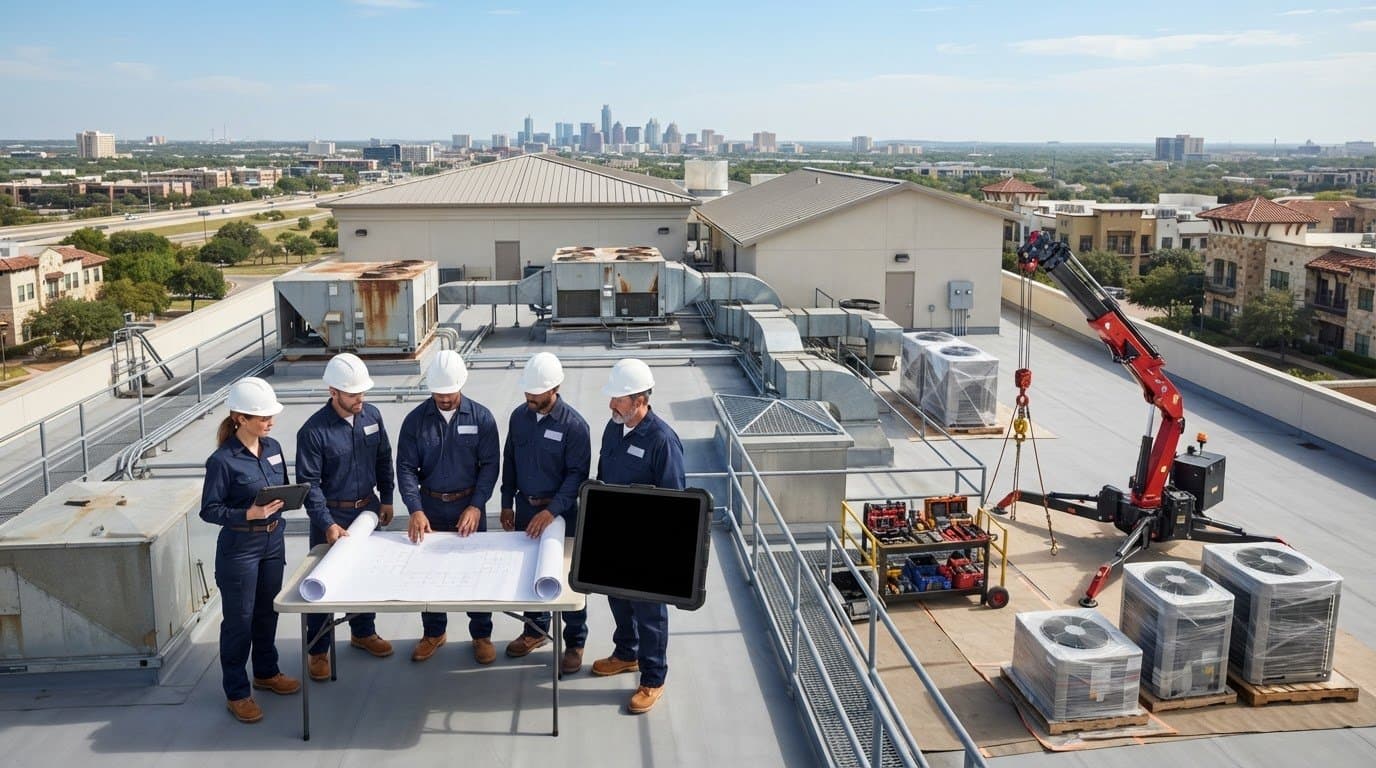
What if the biggest uncertainty in a commercial heat pump replacement isn’t the equipment, but the work left outside the proposal’s scope? Commercial heat pump replacement cost depends on system size and specifications, as well as controls, site conditions, construction work, and coordination to keep facility operations moving.
It’s reasonable to want a clear figure for capital planning, but residential estimates rarely reflect the demands of a commercial facility. Proposals can also differ in what they include, making headline totals difficult to compare. This guide explains the main cost drivers, how to develop a reliable estimate, and what to review when comparing scopes and assumptions.
J3 Mechanical Services handles commercial HVAC replacement projects across Texas, including San Antonio. Building Information Modeling (BIM) and in-house fabrication support project coordination and execution. The sections ahead cover equipment and site factors, proposal comparisons, and planning to limit disruption while supporting long-term system performance.
Key Takeaways
- Commercial heat pump replacement cost reflects the full project scope, not just equipment selection. Account for controls, labor, access, removal, and commissioning.
- Document existing system conditions, equipment location, rigging needs, and work-area constraints to clarify the replacement scope.
- Compare proposals side by side, separating included work from exclusions, allowances, and owner responsibilities.
- Build a more defensible budget and schedule by gathering facility data, recording operating priorities, and reviewing project assumptions before work begins.
- J3 Mechanical Services uses BIM and in-house fabrication to coordinate commercial replacement projects across Texas.
What Determines Commercial Heat Pump Replacement Cost?
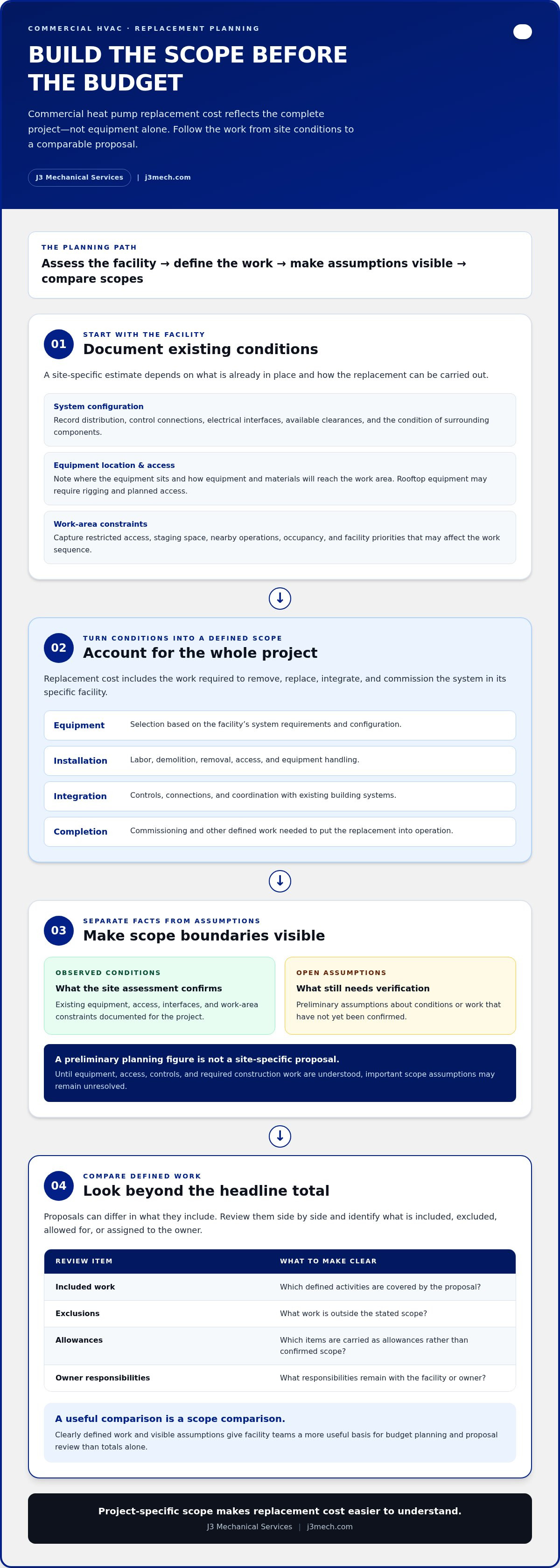
Commercial heat pump replacement cost reflects the complete work required to remove, replace, and commission a system in a specific facility, not just the equipment price. Capacity and configuration matter, along with labor, controls, removal, access, and coordination with the building’s existing systems.
Two facilities choosing similar equipment can still need different scopes. A unit in an accessible mechanical room has different handling requirements from rooftop equipment that needs rigging and carefully planned access. Existing ductwork, electrical connections, control integration, and the condition of surrounding components can also affect the work. Commissioning belongs in the project scope because the replacement needs to be tested and integrated with the building’s operating systems.
Occupancy adds another planning consideration. The work sequence may need to account for facility priorities and the effect of interruptions on building use. That is why a universal equipment figure is a poor budgeting tool.
Why residential heat pump estimates do not translate directly
Residential estimates generally reflect the needs of a single home. Commercial projects must also account for facility size, occupancy, system configuration, and building controls. A commercial system may serve distinct areas or connect to existing mechanical infrastructure, so a home-sized unit comparison cannot define the replacement scope. Residential brand rankings are not a sound basis for commercial procurement either. Equipment selection needs to match the building and project requirements.
Heat pumps transfer heat rather than generating it through the same process as conventional heating equipment. The Heat pump technology overview describes common system types and operating principles. For a commercial replacement, the practical question is how the selected system fits the facility’s existing configuration and intended operation.
What a commercial replacement estimate represents
A preliminary planning figure can help frame a capital discussion, but it is not the same as a site-specific proposal. Until the existing equipment, access, controls, and required construction work are understood, important scope assumptions may remain unresolved. A useful proposal makes those assumptions visible so facility teams can compare defined work instead of relying on totals alone.
Commercial replacement cost is the project-specific cost of equipment, labor, coordination, and defined installation work needed to remove and replace a heat pump, not the equipment price by itself.
- Equipment: Selection based on the facility’s system requirements.
- Installation: Labor, demolition, removal, access, and equipment handling.
- Integration: Controls, connections, and coordination with existing systems.
- Completion: Commissioning and other defined work needed to put the replacement into operation.
Use this breakdown as a first-pass scope check when reviewing an estimate. If a proposal groups several activities under one line item, its assumptions may be hard to see. A clearly defined scope gives decision-makers a more useful basis for budget planning and proposal comparison.
Which Texas Facility Conditions Drive Commercial Heat Pump Costs?
Existing building conditions can change the replacement scope before equipment is selected. A system with compatible distribution and controls may need different work from one whose interfaces require modification. The condition of electrical connections, equipment supports, and surrounding components can also affect the project. An estimate becomes more reliable when it distinguishes observed site conditions from assumptions made before assessment.
How building systems and site access affect project scope
Document the existing system configuration, including distribution, control connections, electrical interfaces, and available clearances. Then consider how equipment and materials will reach the work area. For example, a rooftop unit above a constrained loading area may need more access and lifting coordination than equipment near a suitable service route. These requirements depend on the project. A site assessment helps establish what the replacement entails.
Work-area limits matter, too. Nearby operations, restricted access points, and staging space can shape installation sequencing. Record known constraints and identify details that still need verification, so preliminary budget assumptions are not mistaken for confirmed scope.
Why Texas operating conditions matter to replacement planning
Texas facilities may face extended periods of cooling demand, and humidity management can be important to indoor conditions. Neither factor dictates one standard heat pump configuration for every property. The appropriate design depends on facility use, the existing system, operating requirements, and the conditions the replacement must serve. Equipment selection should reflect those needs, not a broad regional assumption or a residential comparison.
Tax references also need careful interpretation during budgeting. The IRS Energy Efficient Home Improvement Credit concerns residential improvements, so it should not be treated as evidence that a commercial project qualifies for the same credit. Keep incentive assumptions separate from the mechanical scope and verify their current applicability before including them in a capital plan.
Plan around occupancy and acceptable disruption
Plan the replacement around how the building operates, not just where the equipment sits. Identify occupied areas, critical operating periods, and the interruption the facility can accommodate. A site with continuous activity may require a different work sequence from a space that can be cleared during installation. Document these priorities early and use them to guide access planning, phasing, and coordination with facility stakeholders.
- Record existing equipment configuration and known condition.
- Map access routes, clearances, staging areas, and lifting constraints.
- Describe building operating priorities and acceptable disruption.
- Separate verified site findings from assumptions that still need review.
These details turn a general budget allowance into a scope grounded in the facility. J3 Mechanical provides commercial HVAC replacement services for Texas facilities, including those in San Antonio, Selma, Seguin, Austin, Corpus Christi, Killeen, Joshua, Bandera, Beorne, New Braunfels, Edinburg, Mccallen, Rio Grand Valley, Rockport, Pleasanton, San Marcos, and Round Rock. Its project coordination practices address site conditions before installation.
How to Compare Commercial Heat Pump Replacement Proposals
Start with a shared scope, not the bottom-line total. Create a comparison matrix with one row for each major project component and one column for each proposal. Record the stated work, assumptions, exclusions, allowances, and tasks assigned to the facility owner. This makes differences visible before price becomes the deciding factor.
For each proposal, capture:
- Equipment: Proposed configuration and the stated basis for selecting it.
- Removal and installation: Existing equipment removal, disposal, labor, and installation activities.
- Controls and interfaces: Control work and connections to existing building systems.
- Access and sequencing: Access routes, lifting or rigging assumptions, work hours, and any phasing.
- Testing and closeout: Commissioning, system testing, operating documentation, and handover activities.
Mark each item as included, excluded, allowance-based, or requiring owner action. An allowance is not the same as a fully defined scope. An owner responsibility can also create coordination needs even if it does not appear as a contractor line item. If one proposal assumes clear access while another accounts for restricted access, the totals do not represent equivalent work.
Which scope items belong in a like-for-like comparison?
Compare equipment, removal, installation, controls, testing, and documented closeout on consistent terms. Check whether proposals describe the same access conditions, operating schedule, and installation phasing. Undefined exclusions can make two offers look similar while leaving different tasks unresolved. Note each difference in the matrix, then separate true scope variations from details that still need clarification.
Pay particular attention to commissioning. Confirm what testing and operational checks are described, what documentation is included, and how the completed work will be handed over to facility staff. A proposal that names equipment but leaves these activities vague may not describe the same completed project as one that defines them. Review installation sequencing as well, because facility operating priorities can shape how the work is coordinated.
How coordination reduces uncertainty before installation
Building Information Modeling (BIM) can help teams identify spatial relationships and potential trade coordination issues before installation. In-house fabrication can help coordinate custom components with the project’s defined requirements. These methods do not replace a clear written scope. They support preparation around the proposed work and the constraints that need to be addressed.
Proposals are meaningfully comparable only when they define the same equipment, project work, assumptions, and completion requirements. Use that principle to interpret differences in commercial heat pump replacement cost instead of treating the lowest headline total as a like-for-like result. A consistent scope also gives facility teams a clearer basis for capital review and project planning.
How to Build a Defensible Replacement Budget and Schedule
Build a defensible plan in sequence: establish what the facility needs, define the work, then review how each proposal addresses that scope. This helps decision-makers separate confirmed project requirements from assumptions that could affect the budget or schedule. It also creates a record for capital review and operational planning.
A practical sequence for developing a project estimate
Start with available facility information, then compare it with current site conditions. Drawings and equipment records provide a baseline, but may not capture later modifications or access constraints. Involve facilities and operations stakeholders in defining the scope so the estimate reflects both mechanical work and building requirements.
- Gather facility data. Assemble drawings, existing equipment information, system history, and records of prior modifications. Note operating requirements, areas served, and known control or interface conditions.
- Document operating priorities. Identify occupied spaces, sensitive operating periods, and the disruption the facility can accommodate. Record important sequencing constraints.
- Assess the site. Review equipment location, access routes, clearances, staging areas, and other known installation constraints with project stakeholders. Separate observed conditions from items that still need verification.
- Define the replacement scope. Specify equipment work, removal, installation, coordination, testing, and closeout expectations. Identify work that remains an owner responsibility.
- Review proposals against the scope. Compare inclusions, exclusions, allowances, assumptions, and sequencing on the same basis. Resolve unclear items before treating a proposal total as a firm planning input.
This process makes commercial heat pump replacement cost easier to evaluate because it ties the budget to a documented scope rather than an isolated figure. It also gives the schedule a practical foundation: access, stakeholder needs, and unresolved assumptions are visible before execution planning advances.
How to plan around operations and project risk
Project timing should reflect how the facility functions. Identify periods when certain spaces or systems are especially important to occupants or business activity, then consider how work sequencing could affect them. Phasing may suit some facilities, but it is a project-specific decision based on system configuration, scope, and operating priorities, not a standard promise or fixed approach.
Keep a short assumption register with the budget. Record unresolved site details, owner-provided tasks, access requirements, and dependencies that could influence planning. The commercial HVAC replacement indicators guide can help evaluate replacement needs, while this budget process stays focused on defining and reviewing project scope.
For project-specific commercial HVAC replacement planning, work with J3 Mechanical on your facility replacement scope.
How J3 Mechanical Manages Commercial Heat Pump Replacement in Texas
J3 Mechanical Services specializes in commercial HVAC installation and replacement across Texas. Each facility has its own equipment configuration, access conditions, and operating priorities. That commercial focus means replacement planning addresses the full project scope and the building, rather than treating the work as an equipment change alone. Clear scope and planning help facility decision-makers understand what the project must address.
Planning starts with information about the existing system and facility requirements. Equipment details, building conditions, access limitations, and operating priorities inform how the replacement is coordinated. This groundwork identifies conditions to account for before installation and keeps project discussions specific to the facility.
From coordinated planning to installation
Building Information Modeling (BIM) helps teams consider how mechanical work relates to building conditions. For a replacement, project information can help identify spatial constraints and coordination needs as planning develops. In-house fabrication offers another way to align custom components with project requirements. Together, these capabilities support preparation and execution tailored to the facility.
Facility teams interested in these methods can also explore J3 Mechanical’s commercial HVAC fabrication and BIM coordination guide for related context on coordination and fabrication in commercial mechanical work.
This planning discipline gives stakeholders a clearer basis for discussing assumptions, constraints, and priorities before installation. The project can then be coordinated around the facility’s requirements instead of relying on a generic sequence that may not suit the building or its operations.
Plan the next step for your facility
J3 Mechanical serves commercial facilities in San Antonio, Austin, and other Texas communities. Start project planning with the existing system, operating objectives, known site constraints, and any concerns about coordinating work with building activity. These details help frame the replacement around the property and its occupants.
Replacement planning also connects with ongoing asset planning. The commercial HVAC maintenance guide explains how maintenance fits into broader system oversight, while replacement planning remains focused on the project’s own scope and requirements.
For commercial heat pump replacement, J3 Mechanical brings commercial HVAC expertise, BIM, and in-house fabrication to project planning and execution. Discuss your facility’s replacement objectives and constraints with the J3 Mechanical team to begin planning.
Turn Replacement Planning Into a Clear Next Step
A replacement decision can shape facility operations well beyond installation. Treat commercial heat pump replacement cost as part of a broader capital decision: establish what the building needs, identify assumptions that still need resolution, and align the project with operating priorities. That preparation gives your team a stronger basis for moving from preliminary planning to a defined scope.
J3 Mechanical supports commercial HVAC replacement planning and execution across Texas, bringing commercial specialization, BIM coordination, and in-house fabrication to project work in San Antonio, Austin, and other Texas communities. These capabilities connect planning decisions with the facility’s conditions and requirements.
When your team is ready to discuss requirements, constraints, and replacement objectives, discuss your commercial heat pump replacement project with J3 Mechanical. A focused conversation can help set a practical direction for the next stage of facility planning.
Frequently Asked Questions
How much does it cost to replace a commercial heat pump?
There is no dependable universal figure. Commercial heat pump replacement cost depends on the defined scope and site conditions. Use an early budget allowance for planning, then refine it after documenting key assumptions and owner responsibilities. J3 Mechanical Services provides commercial replacement services in San Antonio, Selma, Seguin, Austin, Corpus Christi, Killeen, Joshua, Bandera, Beorne, New Braunfels, Edinburg, Mccallen, Rio Grand Valley, Rockport, Pleasanton, San Marcos, and Round Rock.
Is a commercial heat pump suitable for a Texas facility?
A commercial heat pump can suit a Texas facility when its design aligns with building loads, existing distribution, operating schedules, and indoor conditions. A warehouse with intermittent occupancy, for example, may have different zone requirements from a continuously occupied office. Evaluate how the system will serve actual spaces and operating hours. The state climate alone cannot establish suitability or predict performance.
Can a commercial heat pump work with an existing building system?
It can, depending on the condition and compatibility of existing ductwork, hydronic distribution, controls, and electrical connections. Some components may be retained, while others may need modification or replacement. For example, controls that cannot communicate with the proposed system may require integration work. Document interface points and identify which existing components are intended to remain. Base that decision on technical review, not assumption.
What information should I gather before planning a commercial heat pump replacement?
Gather available equipment details, controls documentation, building plans, prior service reports, and notes about recurring comfort or operating issues. Mark when records were last updated and identify renovations that may have changed room use or system connections. Also note spaces that must remain operational. This information gives the project team useful context and helps identify details for further evaluation during a site review.
Does a commercial heat pump replacement require the business to shut down?
A full shutdown is not automatic. Operational impact depends on the equipment arrangement and work sequence. If separate systems serve different building zones, for example, teams may be able to plan work around affected areas, depending on site conditions. Identify critical functions, occupant communication needs, and acceptable interruption windows early. Develop any phasing strategy for the facility rather than assuming it will guarantee zero downtime.
Are there tax credits or utility incentives for commercial heat pump replacement in Texas?
Incentives may be available, but eligibility depends on the project and program, and requirements can change. Do not include a projected credit or rebate in an approved budget until the responsible government agency or utility confirms current details. Then have a qualified tax professional assess the tax treatment. Distinguish commercial programs from residential incentives, since a home improvement credit should not be assumed to apply to a business property.
Why can two commercial heat pump replacement proposals differ so much?
The proposals may not cover the same work. One could include controls integration and commissioning, while another assumes those tasks are handled separately. Access planning, removal, closeout, and owner-provided work can differ, too. Mark each item as included, excluded, or unresolved, then compare the defined scope and assumptions. A lower total alone does not show that proposals offer equivalent value or address the facility’s requirements.
Need a hand with your building's HVAC?
Free quotes and honest answers from licensed commercial technicians across South Texas.