
Commercial HVAC Asset Management: The Strategic Engineering Approach for Texas Facilities in 2026
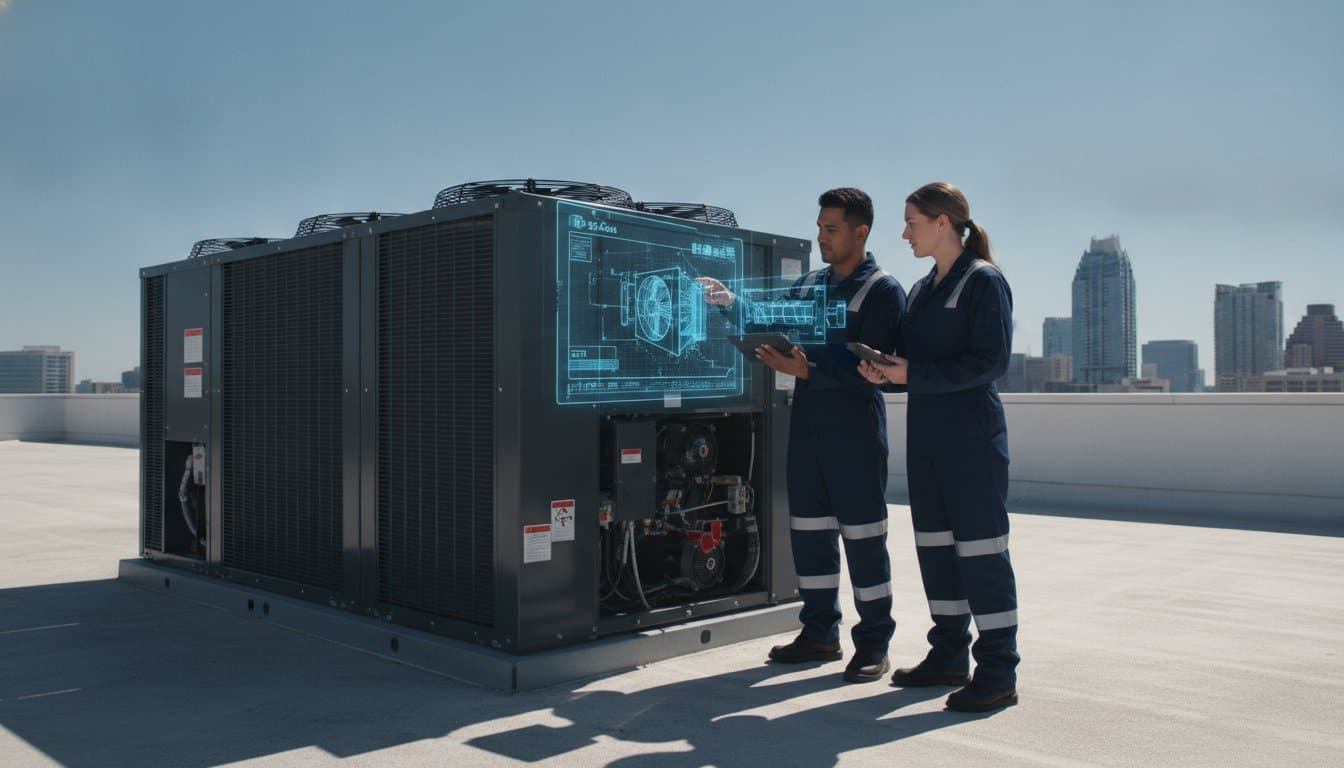
A commercial HVAC system isn't a utility to be serviced. It's a critical infrastructure asset that requires the same disciplined engineering oversight as the building's structural foundation. In the high-stakes environment of Texas facilities, treating mechanical systems as mere maintenance items often leads to catastrophic failures during peak summer loads. You've likely experienced the frustration of unpredictable downtime or the lack of long-term visibility into your equipment's lifecycle. It's a cycle of reactive repairs that drains budgets and compromises operational continuity.
This article shows you how to break that cycle by implementing a sophisticated commercial HVAC asset management strategy rooted in engineering precision. You'll learn how to transition from emergency fixes to a proactive, master-builder approach that secures your infrastructure's longevity. We'll explore the strategic integration of Building Information Modeling, the impact of 2026 A2L refrigerant transitions, and how to build a reliable 10-year CapEx plan that ensures performance even in extreme humidity. By the end, you'll have the framework to manage your mechanical assets with absolute technical mastery and fiduciary accountability.
Key Takeaways
- Transition from a reactive repair model to a sophisticated commercial HVAC asset management strategy that prioritizes engineering-led protocols over simple maintenance tasks.
- Utilize advanced diagnostic tools such as vibration analysis and thermal imaging to detect emerging faults before they manifest as critical infrastructure failures.
- Mitigate regional climatic risks by aligning system performance with the extreme thermal loads and high latent heat unique to the Texas environment.
- Establish a proactive roadmap through comprehensive asset inventory and risk-based prioritization to secure long-term budget predictability and equipment longevity.
- Leverage Building Information Modeling (BIM) and in-house fabrication to maintain a digital twin of your facility for precise, rapid component replacement.
Table of Contents
- The Evolution of Commercial Mechanical Asset Management
- Engineering-Led Protocols: Decoding 'AC Mechanical' Standards
- Regional Risk Mitigation: Navigating the Texas Climate
- Implementing a Proactive Asset Management Roadmap
- The J3 Advantage: BIM and Fabrication in Asset Oversight
The Evolution of Commercial Mechanical Asset Management
Commercial HVAC asset management represents a fundamental departure from the traditional, task-oriented maintenance model. It functions as a disciplined engineering protocol that treats mechanical systems as high-value capital investments rather than recurring expenses. This approach integrates technical mastery with long-term financial planning to ensure that every component, from central chillers to air handling units, operates within its optimal design parameters. It's a systematic process of developing, operating, maintaining, and upgrading mechanical infrastructure to maximize performance while mitigating the risks of catastrophic failure.
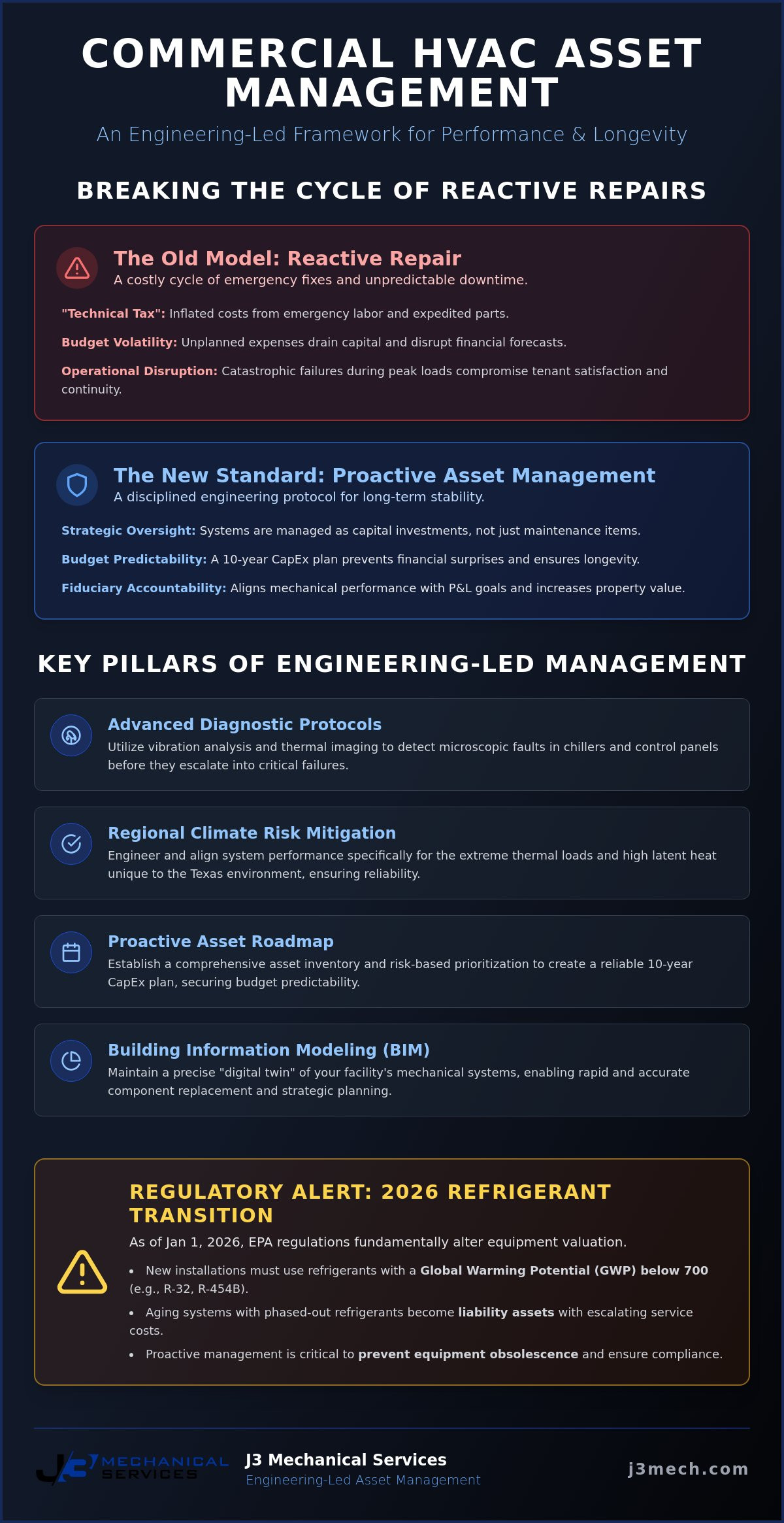
The transition to this strategic model is no longer optional for Texas facilities. As of January 1, 2026, new regulatory standards have fundamentally altered the landscape of equipment valuation. Under the EPA's Technology Transitions Rule, new installations must utilize refrigerants with a Global Warming Potential below 700, such as R-32 or R-454B. These shifts mean that aging systems using phased-out refrigerants are becoming liability assets with rising service costs. Disciplined oversight ensures these regulatory transitions are managed proactively, protecting the building's critical infrastructure from obsolescence.
From Reactive Repair to Strategic Lifecycle Oversight
Reactive repairs carry a hidden "Technical Tax" that manifests as inflated emergency labor rates, expedited shipping fees for parts, and the high cost of operational downtime. Traditional maintenance often fails because it focuses on a checklist of tasks rather than the holistic health of the asset. Engineering-led data changes this dynamic. By analyzing equipment through the lens of its entire lifecycle, facility managers can make informed repair versus replace decisions. In 2026, with the cost of a full 3-ton system replacement in Texas ranging from $8,500 to $16,500, a strategic approach allows for the planned retirement of assets before they reach the point of diminishing returns. This foresight prevents the budget volatility that occurs when systems fail during the peak thermal loads of a Texas summer.
The Fiduciary Responsibility of Mechanical Management
Effective management of mechanical assets is a matter of fiduciary duty. It requires transparent performance reporting that holds contractors accountable for the long-term stability of the facility. When mechanical performance aligns with the building's P&L goals, the results are visible in both reduced energy consumption and increased property value. The updated ASTM E2018-24 standard for Property Condition Assessments now demands more rigorous evaluation protocols for HVAC systems. Professional oversight ensures that these assessments don't uncover "Physical Deficiencies" that could derail a real estate transaction or lead to immediate capital costs. Ultimately, a reliable system is a prerequisite for tenant retention; a building that cannot maintain climate control in extreme humidity will struggle to maintain its occupancy rates and market position.
Engineering-Led Protocols: Decoding 'AC Mechanical' Standards
Disciplined engineering protocols distinguish high-tier commercial HVAC asset management from standard service contracts. By utilizing vibration analysis, technicians can identify microscopic bearing wear in centrifugal chillers before it manifests as a mechanical seizure. Similarly, thermal imaging identifies high-resistance electrical connections in control panels that would otherwise go unnoticed until a system-wide shutdown occurs. These diagnostic tools aren't optional luxuries; they're essential for maintaining the integrity of industrial-scale infrastructure with absolute precision.
Precise airflow balancing is another critical pillar of system longevity. When static pressure is out of alignment, the mechanical strain on blower motors and fan assemblies increases exponentially, leading to premature failure and inflated energy costs. Industrial-scale chillers and boilers require a level of specialized expertise that residential or generalist contractors simply cannot provide. Integrating these assets into a Building Automation System (BAS) allows for continuous performance tracking, creating a data-driven environment where every adjustment is verified by real-time mechanical feedback.
Predictive vs. Preventative: The Technical Divide
Predictive maintenance identifies impending failure by monitoring deviations in compressor amperage draw and discharge superheat against established baseline performance curves. While preventative maintenance follows a static schedule, predictive protocols rely on IoT sensors to provide a continuous stream of operational data for analysis. This shift from "fixing what's broken" to "anticipating what's failing" provides a significant return on investment by eliminating the collateral damage caused by catastrophic component failure. When facility managers focus on Implementing a Proactive Asset Management Roadmap, they move beyond the limitations of calendar-based service. Establishing this level of sophisticated mechanical oversight ensures that your facility's critical infrastructure remains stable under the most demanding conditions.
Industrial Standards for Air Quality and Efficiency
Maintaining Indoor Air Quality (IAQ) is a technical challenge that grows more complex in high-occupancy commercial environments. Engineering-led coil cleaning is not merely a cosmetic task; it's a thermodynamic necessity that restores heat transfer efficiency and reduces the load on the entire refrigeration cycle. This level of precision is equally vital during commercial hvac installation, where the initial configuration dictates the asset's lifetime efficiency. By adhering to rigorous industrial standards, facility owners can ensure that their mechanical systems deliver reliable performance while minimizing the long-term cost of ownership.
Regional Risk Mitigation: Navigating the Texas Climate
Texas facilities operate within a diverse array of environmental stressors that demand a localized approach to commercial HVAC asset management. In San Antonio and Austin, systems must contend with extreme sensible heat loads that frequently exceed design specifications during the summer months. Conversely, facilities in Corpus Christi and the Rio Grande Valley face the relentless challenge of high latent heat, where humidity management is as critical as temperature control. A disciplined engineering strategy recognizes that a maintenance protocol effective in the high desert of West Texas will fail in the salt-heavy air of Corpus Christi or Rockport. Managing these regional risks requires adjusting asset oversight intervals to account for increased mechanical wear and atmospheric corrosion.
Coastal facilities require specific corrosion protection protocols to prevent the premature degradation of condenser coils and structural housing. Without specialized coatings and sacrificial anodes, the lifecycle of a rooftop unit in a coastal environment can be reduced by half compared to an inland asset. Proactive management involves the systematic verification of these protective measures and the implementation of more frequent wash-down cycles to remove salt deposits. By acknowledging these environmental stressors, facility managers can ensure that their mechanical infrastructure remains resilient regardless of geographic location.
Humidity and Microbial Control in Texas Facilities
Large-volume spaces in high-humidity regions present unique engineering challenges for dehumidification. When systems fail to manage latent loads, the resulting moisture accumulation leads to microbial growth and systemic mechanical wear within the air distribution network. Strategic asset management includes the precise calibration of reheat coils and the optimization of chilled water temperatures to maximize moisture removal. In Central Texas, filtration strategies must also be customized to address high concentrations of cedar pollen and limestone dust, ensuring that indoor air quality standards are met without placing undue strain on blower motors.
Supply Chain Resilience and Lead Time Strategy
The transition to A2L refrigerants and ongoing global logistics shifts have fundamentally altered equipment availability. In 2026, lead times for industrial-scale chillers and custom air handlers often necessitate a 12-month proactive planning window to avoid the pitfalls of a "crisis purchase." Relying on emergency replacements during a peak Texas summer is a failure of strategy that results in inflated costs and extended downtime. Engaging with J3 Mechanical Services that prioritize long-term mechanical partnerships allows facility owners to secure their supply chain well in advance of a projected asset failure. This forward-thinking approach ensures that equipment is staged and ready for installation before the existing system reaches its point of critical exhaustion.
Implementing a Proactive Asset Management Roadmap
A sophisticated commercial HVAC asset management program functions as a chronological guide for infrastructure stability. It begins with a comprehensive asset inventory that moves beyond basic serial number tracking to include a baseline condition assessment of every mechanical component. By establishing this technical foundation, facility managers can categorize assets based on their operational criticality and current state of wear. This data-driven inventory serves as the primary source of truth for all subsequent engineering decisions, ensuring your commercial HVAC asset management strategy remains fiscally sound over the long term.
- Step 1: Baseline Assessment. Conduct an exhaustive audit to document equipment age, service history, and current efficiency levels against original design specifications.
- Step 2: Risk-Based Prioritization. Rank mechanical components by their impact on building operations, focusing resources on high-criticality assets such as central chillers and primary air handlers.
- Step 3: Engineering-Led Maintenance. Establish specific auditing intervals that reflect the technical requirements of the equipment and the environmental stressors of the Texas climate.
- Step 4: CapEx Integration. Use real-time performance data to build a dynamic budget forecast that accounts for the 15-year mechanical lifecycle of modern systems.
The Mechanical Audit: Beyond the Visual Inspection
A rigorous mechanical audit requires the verification of safety controls and electrical integrity while the system is operating under full load. It's not enough to confirm that a unit is running; technicians must measure amperage draw and calibrate high-torque industrial parts to ensure they meet precise technical standards. Proper lubrication of bearings and the verification of sensor accuracy are essential tasks that prevent the friction-related wear that leads to systemic failure. Documenting this detailed service history builds a defensible asset narrative, providing the transparency required for fiduciary oversight and long-term planning.
Forecasting CapEx: The 5-Year Mechanical Plan
Effective asset management utilizes health scores to predict the Remaining Useful Life (RUL) of critical equipment. This predictive capability allows facility owners to align replacement schedules with their broader facility budget cycles, eliminating the financial shock of emergency capital outlays. J3 Mechanical's disciplined approach to execution ensures that these forecasts are rooted in technical reality rather than optimistic estimates. By maintaining a clear 5-year mechanical plan, you can navigate the rising costs of A2L-compliant equipment and ensure your facility remains a high-performing asset. To begin securing your facility's operational future, consider the benefits of disciplined commercial air conditioning management strategies tailored to the demands of the Texas climate.
The J3 Advantage: BIM and Fabrication in Asset Oversight
A sophisticated commercial HVAC asset management strategy reaches its peak efficacy when it's supported by advanced digital modeling and in-house manufacturing capabilities. These tools move beyond simple record-keeping; they provide a level of technical mastery that ensures every mechanical intervention is precise, verified, and permanent. By integrating Building Information Modeling (BIM) and specialized fabrication into the lifecycle of a facility, the "master builder" persona transitions from construction into long-term infrastructure stewardship. This approach provides facility owners with a transparent, logic-driven methodology for maintaining total project control through every phase of operation.
BIM: The Digital Foundation of Asset Management
Building Information Modeling functions as a high-fidelity digital twin that mirrors the physical reality of your mechanical rooms. In complex environments where space is at a premium, these digital models accelerate troubleshooting by allowing engineers to visualize hidden ductwork and piping configurations without invasive inspections. Integrating BIM data into the asset lifecycle ensures that critical dimensions and spatial constraints are verified before a single technician arrives on-site, significantly reducing downtime during major system retrofits. This level of 'as-built' precision is invaluable for long-term oversight, as it provides an accurate roadmap for future upgrades and prevents the logistical friction often associated with aging facilities.
Precision Fabrication: Eliminating Supply Chain Friction
In-house sheet metal fabrication provides a decisive speed advantage when custom repairs or legacy system upgrades are required. Instead of relying on third-party manufacturers with unpredictable lead times, a disciplined mechanical partner can produce high-tolerance components that fit the exact specifications of the existing infrastructure. This capability is especially critical for South Texas facilities where coastal corrosion or extreme heat may have degraded original housing or transitions. By eliminating the reliance on external supply chains for custom parts, the recovery time for critical facility systems is drastically reduced, ensuring that operational continuity remains undisturbed. It's a proactive measure that mitigates the risks of component obsolescence in older commercial buildings.
The foundation of this strategic partnership is a faith-based commitment to discipline and ethical accountability. Every reporting metric and fiduciary recommendation is delivered with the quiet confidence of an authoritative expert who prioritizes the integrity of the final product over short-term fixes. Maintenance is not viewed as a series of isolated tasks; it's the bedrock of a long-term infrastructure partnership that values meticulous preparation and technical excellence. This steadfast reliability ensures that your mechanical assets aren't just serviced, but are strategically managed to deliver peak performance throughout their entire operational life.
Securing the Future of Your Mechanical Infrastructure
The transition from reactive repairs to a disciplined engineering protocol is the only sustainable path for Texas facilities facing extreme thermal loads and evolving regulatory standards. By implementing a sophisticated commercial HVAC asset management strategy, you replace the volatility of emergency failure with a predictable, data-driven roadmap for long-term operational continuity. This approach ensures that every mechanical component is tracked, analyzed, and managed as a high-value capital asset rather than a recurring fiscal burden.
J3 Mechanical delivers this level of professional oversight through our Texas-specific environmental expertise and BIM-integrated lifecycle tracking. Our in-house fabrication facility ensures that custom repairs are executed with a degree of precision and speed that third-party suppliers cannot match. We invite you to move beyond basic service contracts and embrace a partnership rooted in technical mastery and ethical accountability. It's time to treat your mechanical systems with the same rigor as your building's structural foundation.
Request a Strategic Mechanical Asset Assessment from J3 Mechanical to establish a secure foundation for your facility's mechanical future. We look forward to helping you achieve absolute control over your infrastructure investments.
Frequently Asked Questions
What is the difference between HVAC maintenance and asset management?
HVAC maintenance focuses on recurring, task-oriented actions such as filter changes and belt inspections. In contrast, commercial HVAC asset management is a comprehensive engineering strategy that prioritizes the entire lifecycle of the equipment. It integrates technical performance data with financial forecasting to maximize the return on your mechanical investments. This disciplined approach ensures that every maintenance action serves the long-term goal of infrastructure stability rather than just fulfilling a service checklist.
How often should commercial mechanical assets in Texas be audited?
Commercial mechanical assets in Texas should undergo a comprehensive audit at least once per year, supplemented by quarterly performance verification. The extreme thermal loads and high latent heat of the region accelerate component wear, making frequent inspections a thermodynamic necessity. These audits should include vibration analysis and thermal imaging to detect microscopic faults before they manifest as systemic failures. Adhering to these intervals ensures that your facility remains resilient against the environmental stressors unique to the South Texas climate.
Can a proactive asset management plan reduce my building's energy costs?
A proactive asset management plan reduces energy costs by ensuring that mechanical systems operate at their peak design efficiency. When components like blowers and compressors are precisely calibrated, they consume less amperage and reduce the overall electrical load on the facility. Strategic oversight also includes engineering-led coil cleaning and airflow balancing, which are essential for maintaining heat transfer efficiency. These technical optimizations result in measurable energy savings and a significant reduction in the total cost of ownership.
What are the risks of ignoring humidity control in South Texas facilities?
Ignoring humidity control in South Texas leads to moisture accumulation that triggers microbial growth and accelerates the corrosion of mechanical components. High latent heat environments place an immense strain on dehumidification cycles, which can cause systemic wear within the air distribution network if not managed correctly. This neglect often results in poor indoor air quality and premature equipment failure. Maintaining precise moisture control is critical for protecting the building's structural integrity and ensuring the comfort of high-occupancy commercial spaces.
How does BIM technology assist in the maintenance of mechanical systems?
BIM technology provides a digital twin that allows engineers to visualize and troubleshoot complex mechanical systems without invasive physical inspections. By maintaining an accurate "as-built" model, technicians can verify spatial constraints and component configurations before performing repairs or retrofits. This digital foundation reduces the risk of logistical friction and minimizes downtime during major system interventions. It serves as a permanent record of the facility's mechanical infrastructure, facilitating more informed decisions throughout the equipment's lifecycle.
Why should I choose a commercial-only contractor for asset management?
Commercial-only contractors possess the specialized technical mastery required to manage industrial-scale chillers, boilers, and complex building automation systems. Residential or generalist providers often lack the advanced diagnostic tools and engineering protocols necessary for high-stakes mechanical environments. Choosing a dedicated commercial partner ensures that your asset management strategy is executed with a level of precision that matches the complexity of your infrastructure. This exclusive focus guarantees accountability and a deeper understanding of large-scale mechanical requirements.
What key metrics should be included in a commercial HVAC asset report?
A comprehensive commercial HVAC asset report should include critical performance metrics such as compressor amperage draw, discharge superheat, and baseline efficiency comparisons. It must also feature asset health scores that predict the Remaining Useful Life (RUL) of each mechanical component. These data points allow facility managers to build accurate 5-year CapEx budget forecasts and prioritize high-criticality repairs. Transparent reporting ensures fiduciary oversight and provides a defensible narrative for all strategic infrastructure investments.
Does J3 Mechanical provide 24/7 emergency support for asset management clients?
J3 Mechanical provides 24/7 emergency response for all asset management clients to ensure the continuous operation of critical mechanical systems. We recognize that mechanical failures during peak thermal loads represent a significant risk to facility continuity and building value. Our technicians are prepared to execute rapid, precise repairs at any hour, utilizing our in-house fabrication capabilities for custom component replacement. This steadfast reliability is a core pillar of our commitment to professional excellence and industrial accountability.
Need a hand with your building's HVAC?
Free quotes and honest answers from licensed commercial technicians across South Texas.