
Commercial HVAC Design Build San Antonio: Strategic Engineering and Precision Coordination
The traditional bid-spec model frequently collapses under the weight of South Texas's extreme environmental demands, creating a fragmented workflow where architects and mechanical contractors operate in isolation. You've likely experienced the professional friction of discovering ductwork conflicts or equipment sizing errors only after construction has commenced, leading to cascading delays and expensive change orders that erode project margins. It's a systemic failure that prioritizes short-term bidding over the long-term mechanical integrity of the facility.
Adopting a comprehensive commercial HVAC design build San Antonio strategy provides a single point of accountability that bridges the gap between digital engineering and physical execution. This article explores how Building Information Modeling (BIM) and in-house fabrication allow for concurrent design and manufacturing, ensuring that every component meets the rigorous 2024 International Mechanical Code standards before it reaches the job site. We'll examine the technical methodologies that eliminate field-level conflicts, reduce lead times for specialized components, and deliver systems engineered specifically for the unique humidity and thermal loads of the San Antonio region.
Key Takeaways
- Understand why the integrated design-build model is superior to traditional bid-spec methods by providing a single point of professional accountability for your mechanical infrastructure.
- Learn how a BIM-integrated commercial HVAC design build San Antonio strategy utilizes advanced digital modeling to identify and resolve spatial conflicts before they manifest on the job site.
- Discover the logistical advantages of in-house fabrication, which allows for precision ductwork manufacturing and protects your project timeline from external supply chain disruptions.
- Gain insights into navigating the latest 2024 International Mechanical Code requirements and ASHRAE energy standards specific to the demanding South Texas climate.
- Explore how disciplined engineering and technical transparency lead to a significant reduction in change orders and improved lifecycle performance for commercial facilities.
The Evolution of Commercial HVAC Design Build in San Antonio
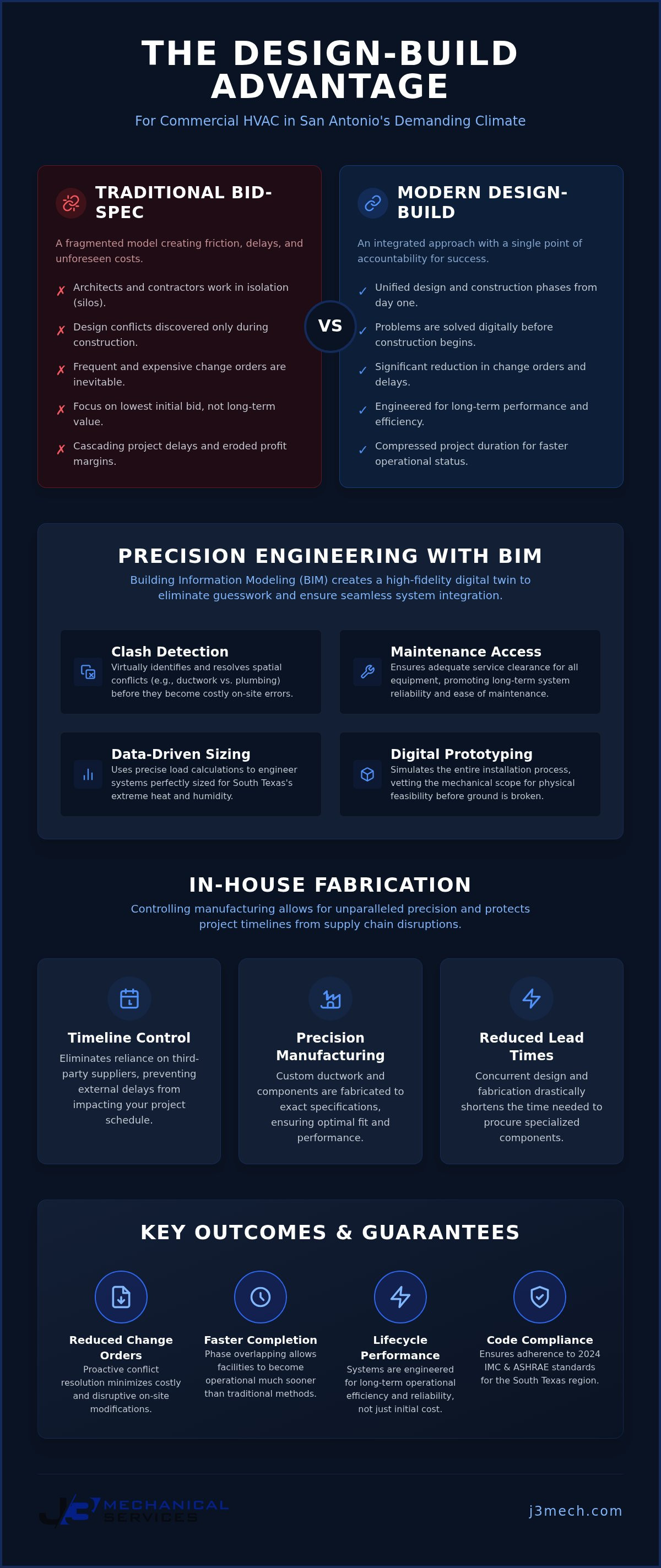
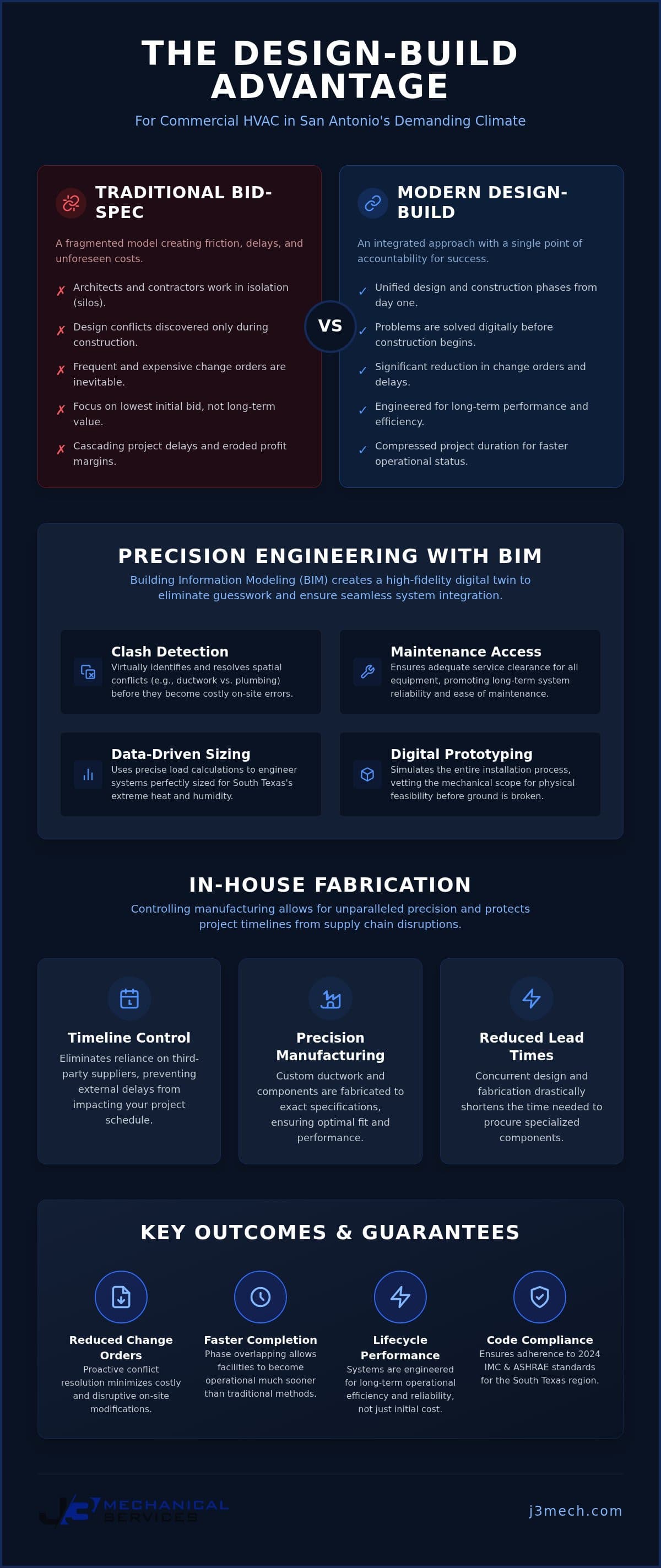
The rapid expansion of San Antonio’s commercial sector requires a shift from fragmented procurement methods toward a more cohesive, engineering-led framework. For decades, the industry relied on the design-bid-build model, a process where architects and mechanical contractors operated in silos, often resulting in conflicting plans and delayed execution. The modern design-build project delivery system addresses these systemic failures by integrating the design and construction phases into a single, unified contract. This evolution in commercial HVAC design build San Antonio ensures that mechanical systems are not just an afterthought but a central pillar of the facility’s structural integrity from day one.
Why Design-Build is Replacing Traditional Bid-Spec
Traditional bid-spec models prioritize the lowest initial cost, yet they frequently incur significant financial penalties through change orders. When mechanical designs are finalized without the input of the installing contractor, on-site conflicts are inevitable. In large-scale Texas construction, these errors can extend lead times for specialized components by weeks. Design-build eliminates this friction by facilitating concurrent engineering and fabrication. By the time ground is broken, the mechanical scope has already been vetted for physical feasibility and code compliance. This overlap of phases significantly compresses the total project duration, allowing facility owners to reach operational status much faster than traditional methods allow.
The Strategic Advantage for San Antonio Facility Owners
Facilities in Central Texas face unique environmental pressures, particularly regarding extreme thermal loads and humidity management. A commercial HVAC design build San Antonio approach allows for the engineering of systems that specifically address these variables while staying within defined budget constraints. Owners benefit from a single point of accountability for the entire mechanical lifecycle. You don't have to mediate disputes between an engineer and a contractor because the responsibility for system performance rests with one entity. This alignment ensures that high-efficiency equipment is selected based on long-term operational costs rather than just the cheapest available unit. It's a disciplined strategy that prioritizes the stability of the building's critical infrastructure and ensures compliance with the 2024 International Mechanical Code, which became effective locally on May 1, 2025.
Precision Engineering: The Role of BIM in Design-Build
The success of a commercial HVAC design build San Antonio project relies on the transition from conceptual drawings to a high-fidelity digital twin. Building Information Modeling (BIM) serves as this foundational 3D digital representation; it provides a comprehensive data environment where every mechanical component is spatialized with mathematical precision. This isn't merely a visual aid. It's a strategic engineering tool that allows our team to simulate the entire installation process before any materials arrive at the facility. By creating this digital prototype, we ensure that the mechanical scope integrates seamlessly with the structural and electrical systems. This eliminates the guesswork that often plagues traditional construction methods.
Clash Detection and Conflict Resolution
Digital coordination enables rigorous clash detection, which is a process where specialized software identifies physical overlaps between HVAC ductwork and other building elements like plumbing or steel girders. Resolving these conflicts in the virtual environment prevents the costly field modifications that typically drive up labor expenses. Beyond immediate installation, BIM allows us to verify that there's adequate service clearance for long-term commercial hvac maintenance. When equipment is positioned with spatial foresight, technicians can access critical components without obstruction, ensuring the system remains reliable throughout its lifecycle.
Data-Driven Load Calculations and System Sizing
Precise engineering also dictates how we size equipment to handle the rigorous South Texas climate. We leverage BIM data to perform exact load calculations aligned with the 2025 ASHRAE 62.1 and 90.1 standards. This level of detail is necessary to maintain good indoor air quality and prevent the common pitfall of over-sizing. In San Antonio, an over-sized unit often fails to dehumidify effectively, which leads to moisture issues and compromised occupant comfort. By integrating energy modeling into the design-build phase, we predict lifecycle operational costs with high accuracy. This allows facility owners to make informed capital decisions. If you're seeking to optimize your facility's mechanical performance, investing in professional BIM coordination ensures technical standards are met without compromise.
In-House Fabrication: Controlling the Supply Chain
The transition from a digital model to physical infrastructure represents a primary point of failure for many mechanical projects, particularly when contractors rely on external vendors for ductwork production. Within a sophisticated commercial HVAC design build San Antonio framework, owning the fabrication process is a strategic necessity that ensures logistical certainty. By maintaining an in-house facility, we eliminate the communication gaps that often exist between the engineer's intent and the fabricator's output. This level of vertical integration aligns with the MCAA's Innovative Technologies Initiative, which advocates for advanced manufacturing processes to improve mechanical project outcomes. Our hvac sheet metal fabrication shop translates BIM data directly into high-precision components, ensuring that every galvanized or stainless steel fitting aligns perfectly with the digital twin before it arrives on-site.
Eliminating Lead-Time Bottlenecks
Dependence on third-party manufacturers often introduces unpredictable lead times, especially for specialized fittings required in large-scale industrial installations. Our ability to produce custom components locally allows us to pivot quickly if site conditions change or if a project requires a fast-track schedule. This internal control over the supply chain protects the project timeline from the volatility of the broader construction market. It ensures that material consistency is maintained across the entire facility, as every piece of ductwork is manufactured under a unified set of quality control standards that exceed the minimum requirements of the 2024 International Mechanical Code. We don't just wait for the supply chain to deliver; we manage it directly.
Custom Solutions for Industrial Mechanical Systems
Industrial facilities, such as data centers and manufacturing plants, demand high-velocity ductwork and specialized exhaust systems that standard off-the-shelf components can't accommodate. We engineer and fabricate these precision air distribution systems to handle extreme thermal loads while maintaining the structural integrity required for long-term operation. This capability is integrated into our broader commercial hvac installation protocol, where custom-built components are verified against the BIM model for exact fitment. By controlling the manufacturing phase, we reduce field labor hours and eliminate the need for on-site modifications, resulting in a more disciplined and predictable execution of the mechanical scope.
Critical Success Factors for San Antonio Mechanical Projects
Selecting a qualified commercial hvac contractor requires a rigorous vetting process that extends beyond the initial bid price. In a commercial HVAC design build San Antonio project, the contractor’s technical mastery is as critical as their financial stability and safety record. You should evaluate their Experience Modification Rate (EMR) as a primary indicator of operational discipline; a rating below 1.0 demonstrates a commitment to site safety that minimizes project disruptions. Additionally, ensuring the firm possesses the bonding capacity necessary for large-scale industrial scopes provides essential risk mitigation. These institutional benchmarks, combined with a deep understanding of local municipal codes, specifically the 2024 International Mechanical Code effective as of May 1, 2025, form the foundation of a successful mechanical partnership.
Engineering for the South Texas Environment
San Antonio’s environmental profile, characterized by high latent heat and humidity, necessitates specific engineering strategies to prevent microbial growth and maintain indoor air quality. In Bexar County, industrial spaces must adhere to stringent ventilation requirements that balance fresh air intake with energy efficiency. We prioritize equipment with high SEER2 and EER ratings to ensure peak performance during extreme summer temperatures. This technical focus prevents the common failure of systems that struggle to maintain setpoints when ambient temperatures exceed 100 degrees. Designing for this climate isn't about general cooling; it's about managing the specific psychrometric challenges of the region.
Lifecycle Management and Asset Protection
A disciplined design-build approach views the mechanical system as a long-term asset rather than a one-time installation. We engineer for serviceability, ensuring that filters, coils, and compressors remain easily accessible for future technicians. This foresight reduces the labor hours required for routine maintenance and extends the equipment’s operational life. The transition from construction to occupancy must include a robust preventive maintenance protocol to protect your capital investment. Should a critical failure occur, the reliability of a commercial hvac repair partner with 24/7 emergency infrastructure becomes the final line of defense for your facility infrastructure. If you require a partner who prioritizes technical stability and long-term performance, consult with J3 Mechanical Services to discuss your project requirements.
The J3 Mechanical Approach: Disciplined Execution
J3 Mechanical Services operates on a foundation of technical mastery and ethical transparency, positioning our firm as a specialized authority in commercial mechanical infrastructure. Our methodology is defined by a rigorous integration of Building Information Modeling, in-house fabrication, and field expertise into a single, seamless workflow. This unified approach ensures that the strategic engineering established during the design phase is preserved through to the final installation. We view our work as a critical infrastructure responsibility, where our faith-based principles translate into a higher standard of accountability and project transparency for our partners. This commitment to industrial excellence results in a zero-defect handover process, establishing a stable baseline for the facility’s long-term operational performance.
A Single Point of Project Accountability
In a traditional construction environment, the gap between engineering intent and field execution is often where project margins are lost. Our project managers serve as the vital link in this process, bridging the technical complexities of the digital model with the practical realities of the job site. By intentionally excluding general plumbing services from our portfolio, we maintain an absolute focus on the mechanical scope. This specialization allows our team to master the nuances of commercial HVAC design build San Antonio without the distractions of adjacent trades. We've demonstrated the efficacy of this model through numerous successful design-build outcomes across Central Texas, where our disciplined oversight has consistently reduced project timelines and eliminated the communication failures that plague less integrated firms.
24/7 Support and Critical System Recovery
The responsibility of a mechanical partner doesn't terminate upon the completion of construction. For mission-critical facilities, such as data centers and healthcare environments, maintaining uptime is a non-negotiable requirement. Our strategic emergency response protocols are designed to provide rapid recovery for industrial and commercial clients, ensuring that critical infrastructure remains resilient against the extreme environmental pressures of the San Antonio region. We offer a 24/7 infrastructure for emergency support, providing our partners with the quiet confidence that their mechanical assets are protected by the same team that engineered and installed them. This lifecycle approach to facility management ensures that your mechanical systems continue to perform at their engineered specifications for years to come. If you are prepared to elevate the reliability of your facility infrastructure, we invite you to request a consultation for your San Antonio design-build project today.
Securing the Future of Your Mechanical Infrastructure
The transition to an integrated commercial HVAC design build San Antonio model represents a fundamental shift toward project transparency and technical stability. By leveraging advanced BIM coordination and a local in-house fabrication facility, facility owners can effectively eliminate the mechanical conflicts that traditionally compromise construction schedules. This disciplined approach ensures that every system is engineered for the specific thermal demands of Central Texas while maintaining a single point of accountability for the entire mechanical scope. Beyond the initial handover, a robust 24/7 emergency service infrastructure provides the ongoing support necessary to protect your critical assets against unforeseen disruptions.
Choosing a partner who prioritizes precision engineering and logistical control isn't just a construction decision; it's a commitment to the long-term integrity of your facility. We invite you to Partner with San Antonio’s Commercial HVAC Design-Build Experts to ensure your next project meets the highest standards of industrial excellence. Your facility deserves a mechanical system built for reliability and performance.
Frequently Asked Questions
What are the main advantages of design-build over design-bid-build for HVAC?
The primary advantage is a single point of accountability for the entire mechanical scope. Unlike the fragmented design-bid-build model, where architects and contractors operate in silos, design-build integrates engineering and construction. This collaboration eliminates the professional friction that causes costly change orders. It allows for concurrent phases, significantly compressing the project timeline while ensuring the mechanical design aligns with the owner’s operational budget and long-term performance requirements.
How does BIM modeling reduce the overall cost of commercial mechanical projects?
BIM modeling reduces costs by identifying physical overlaps in the digital twin before construction begins. This proactive clash detection prevents the expensive field modifications that typically drive up labor expenses. Additionally, digital precision allows for exact material procurement and precise in-house fabrication. By solving engineering problems in the office rather than on the job site, we minimize waste and ensure a more predictable financial outcome for the facility owner.
Can design-build be used for HVAC retrofits in existing San Antonio buildings?
Design-build is an ideal delivery method for complex HVAC retrofits in existing San Antonio facilities. Replacing legacy systems requires a high level of coordination to minimize operational downtime. We use digital modeling to map existing structural constraints and engineer a replacement system that integrates seamlessly with the current infrastructure. This approach ensures that the new equipment meets current 2024 International Mechanical Code standards while optimizing energy efficiency for the building’s specific occupancy needs.
What is the typical timeline for the design phase of a commercial HVAC project?
The design phase timeline varies based on project complexity, but the design-build model is inherently more efficient. Initial conceptual engineering and digital modeling usually occur over several weeks. Because fabrication can begin while final details are refined, the total lead time is reduced. This streamlined commercial HVAC design build San Antonio process allows us to bypass the lengthy bidding cycles associated with traditional procurement, moving the project into the execution phase with greater speed.
How does in-house fabrication improve the quality of ductwork installation?
In-house fabrication ensures that every piece of ductwork is manufactured to the exact specifications of the digital model. By controlling the production environment, we maintain rigorous quality standards for galvanized and stainless steel components. This eliminates the variability of third-party vendors and ensures a precise fit during field installation. High-precision manufacturing reduces air leakage and improves the overall structural integrity of the air distribution system, leading to superior long-term performance and efficiency.
Is design-build more expensive than traditional bidding for commercial HVAC?
While the initial proposal may appear different than a low-bid scenario, design-build typically results in a lower total project cost. Traditional bidding often leads to cascading expenses through change orders and schedule delays caused by design errors. The design-build model provides cost certainty by identifying risks during the engineering phase. By integrating commercial HVAC design build San Antonio services, owners avoid the financial penalties of fragmented communication and uncoordinated mechanical plans.
What specific San Antonio climate factors should influence HVAC design?
San Antonio’s climate requires a disciplined focus on latent heat and humidity management. Systems must be engineered to handle extreme summer temperatures while maintaining indoor air quality and preventing moisture accumulation. We prioritize high-efficiency equipment that meets 2025 ASHRAE standards for ventilation and energy performance. Proper equipment sizing is critical; over-sized units often fail to dehumidify effectively in the South Texas environment, leading to compromised occupant comfort and potential microbial growth issues.
How does J3 Mechanical handle project coordination with other trades?
We facilitate trade coordination through the use of a unified BIM environment where electrical and structural data are integrated with the mechanical model. Our project managers maintain a disciplined communication cadence with all stakeholders to ensure that spatial requirements are respected. This proactive approach prevents field-level conflicts and ensures that the mechanical installation doesn't obstruct other critical building systems. By mastering the mechanical scope, we provide a stable framework for the entire construction team.
Need a hand with your building's HVAC?
Free quotes and honest answers from licensed commercial technicians across South Texas.