
Commercial HVAC Maintenance in Cibolo, TX: A Facility Manager’s Guide
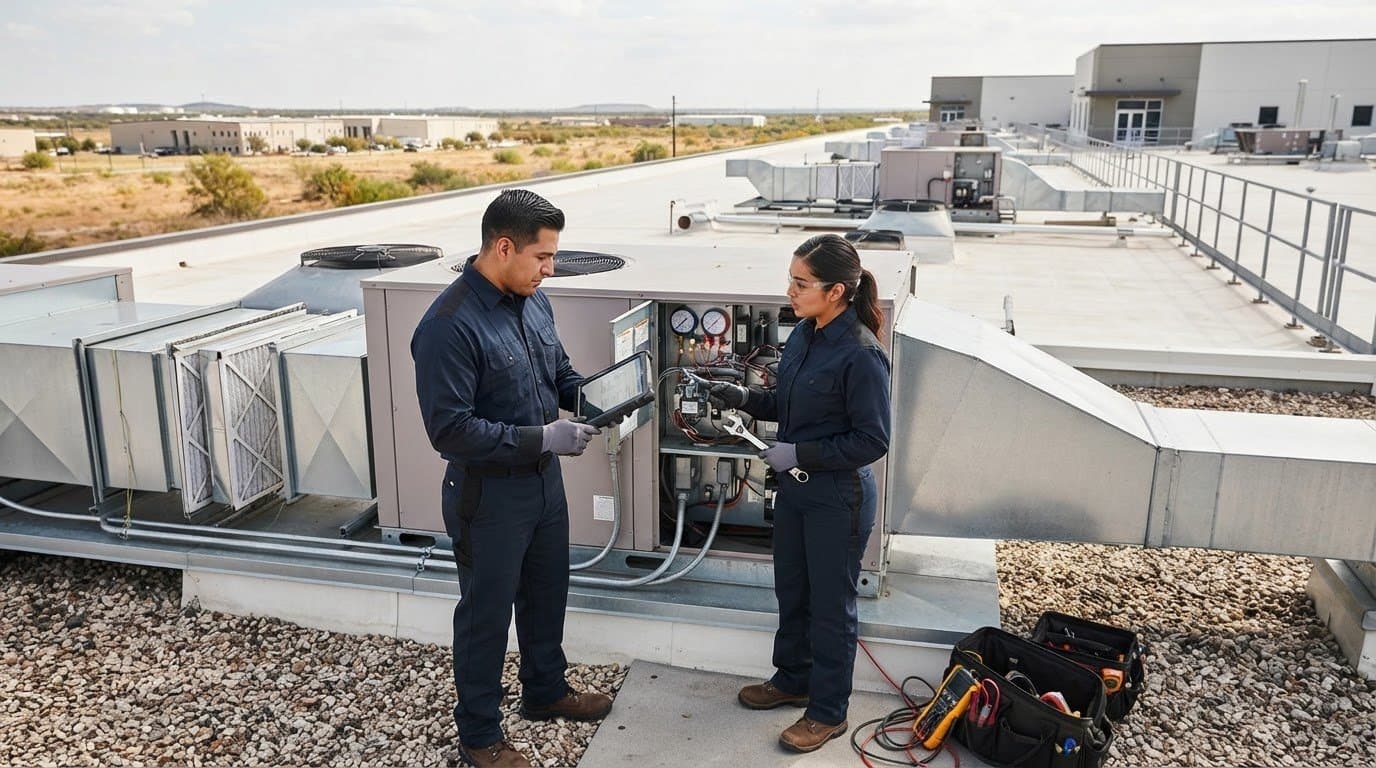
What makes a maintenance plan useful is not simply how often service is scheduled, but how well it fits the facility. For managers considering commercial HVAC maintenance Cibolo, seasonal cooling demand and the consequences of an unexpected interruption make it important to plan around the building’s actual equipment and operations.
Scheduled maintenance gives facility teams a way to plan system oversight proactively instead of relying only on repairs after a problem appears. A practical approach accounts for equipment, building use, operating hours, and the needs of occupied spaces, while arranging work to fit business activity as closely as possible.
This guide explains what a commercial HVAC maintenance program should address, how to plan one for a Cibolo facility, and how maintenance connects with repair and installation. J3 Mechanical Services provides scheduled commercial maintenance and 24/7 emergency repairs, alongside commercial HVAC installation and replacement.
Key Takeaways
- Commercial HVAC maintenance Cibolo should reflect a facility’s equipment, operating hours, occupancy, and seasonal cooling needs.
- Define the program’s scope by identifying what system conditions and operations will be reviewed and how findings will be documented.
- When comparing planned maintenance with reactive-only service, consider operational readiness, records, and the risk of work disrupting facility schedules.
- Use a practical planning sequence: inventory equipment, identify operational priorities, establish the maintenance scope, and record findings.
- J3 Mechanical Services provides scheduled commercial maintenance and 24/7 emergency repairs as part of its commercial HVAC support.
Why Commercial HVAC Maintenance Matters for Cibolo Facilities
Commercial HVAC maintenance is planned oversight of a building’s heating, ventilation, and air conditioning systems. It helps facility teams review equipment condition, consider how systems are being used, and keep relevant findings in view. The scope should reflect the building and its operations, rather than applying a generic checklist without regard for the property’s function.
For facilities in Cibolo, planning also means accounting for seasonal cooling demand. As warm weather makes air conditioning more important to daily operations, a system issue can affect building use, occupants, and schedules. Commercial HVAC maintenance Cibolo planning should consider when the building is occupied, which spaces have the greatest operational importance, and how heavily equipment is expected to run.
How HVAC reliability affects daily facility operations
Temperature control supports the people and activities inside a building, from staff carrying out daily work to tenants, customers, or visitors using occupied spaces. If equipment is disrupted, the effects may go beyond comfort: schedules can shift, areas may become harder to use, and facility teams may need to coordinate around repair work.
The impact depends on the building’s function, occupancy, and activities. A disruption in one facility may affect a limited area; in another, it may complicate closely timed operations. Maintenance gives managers a structured opportunity to review system needs, but it cannot guarantee that equipment will never fail.
Why Cibolo conditions belong in the maintenance plan
Seasonal cooling demand in Cibolo and the greater San Antonio area makes it useful to plan system oversight before cooling becomes central to daily operations. Timing and scope depend on the facility’s actual conditions, including occupancy patterns, operating hours, equipment use, and the role cooled spaces play in business activity.
Preventive maintenance means planned attention to equipment and operating needs before a breakdown. Reactive service begins after a problem disrupts normal operation. This distinction matters because facility planning is about managing operational risk, not assuming that a service visit eliminates it. A defined plan helps managers discuss equipment condition and facility priorities while leaving room to respond when system conditions or building needs change.
Start with the building’s own demands. Consider when spaces are occupied, whether operating schedules change by season, and which areas are most sensitive to temperature changes. A facility that runs extended hours may have different priorities from one with predictable daytime use. Equipment serving high-occupancy spaces may also warrant different attention from systems supporting areas used intermittently. These details help shape a practical maintenance discussion without assuming that every building requires the same schedule.
For Cibolo facility managers, connecting seasonal cooling expectations with actual building use makes it easier to plan system oversight as part of facility operations, rather than treating maintenance as an isolated service task. Bring a clear picture of how the building runs to the planning conversation, including changes in occupancy and any recurring operational concerns.
What a Commercial HVAC Maintenance Program Should Address
A commercial HVAC maintenance program should establish how system condition and operating needs will be reviewed over time. Equipment configuration, operating hours, occupancy, and facility priorities affect what deserves attention and how planned service fits into daily operations.
For commercial HVAC maintenance Cibolo facilities, begin by defining three parts of the program: what condition information will be reviewed, what operational checks suit the equipment, and how findings will be recorded. The building’s systems and needs should guide the scope and schedule. A fixed task list or service frequency is not automatically right for every property.
Match maintenance planning to equipment and building use
Two buildings can have similar equipment but different maintenance priorities. One may operate for extended hours, while another has predictable occupancy or spaces used only intermittently. Make planning discussions more specific by recording equipment details, operating schedules, areas with particular temperature-control needs, and recurring operational concerns.
These notes give context for reviewing system condition and deciding what checks and documentation belong in the program. A strategic approach to commercial HVAC maintenance also frames system oversight as part of broader facility planning, rather than an isolated appointment. The objective is a scope that reflects the equipment and how the building uses it.
Connect HVAC upkeep with indoor environmental priorities
HVAC operation contributes to the indoor environment by supporting temperature control and ventilation. Facility priorities may include how occupied areas are served, how building schedules affect system operation, and what concerns staff or occupants have reported. These considerations can inform maintenance planning, but they do not amount to a complete indoor-air-quality assessment or a guarantee of specific conditions.
Bring practical information to the discussion: which areas are occupied at different times, where comfort concerns recur, and whether operating schedules have changed. School-focused resources from the U.S. Environmental Protection Agency offer background on indoor air quality as a facility concern. For a commercial building, its equipment and operating needs should still guide the HVAC maintenance scope.
Documentation should make findings understandable to the people responsible for facility decisions. Records can note the condition reviewed, operational observations, and items identified for follow-up, giving managers a useful reference for future planning. The format and level of detail should suit the facility’s equipment and oversight needs. A standard report or task list can miss what matters to a particular building.
J3 Mechanical Services provides scheduled commercial HVAC maintenance, commercial repair, and installation. Facility managers developing a maintenance approach can explore J3 Mechanical Services and its commercial HVAC support.
How to Evaluate Commercial HVAC Maintenance for a Cibolo Building
Choose an approach by matching system oversight to the building’s function, equipment, and operational priorities. A facility with spaces that need to remain usable throughout the day may have different needs from a building with limited or variable occupancy. For commercial HVAC maintenance Cibolo, compare more than service timing. Consider whether the scope, records, and communication will fit facility operations.
Planned maintenance or repair after a problem?
Reactive-only service addresses a fault after it affects system operation. Planned maintenance creates opportunities to review equipment condition and discuss developing concerns before they become immediate repair issues. Neither approach guarantees uninterrupted operation, but planned oversight gives facility managers a more structured view of system needs. Maintenance and corrective work are distinct parts of a broader reliability plan, as explained in this guide to commercial HVAC repair planning.
| Facility need | Maintenance priority | Discussion point |
|---|---|---|
| Spaces with steady occupancy | Align planned oversight with building use and operating schedules | How will the program account for occupied hours and facility priorities? |
| Equipment with known operational concerns | Review condition and document observations for follow-up | How will findings and unresolved concerns be recorded? |
| Variable or seasonal use | Consider how changes in occupancy and equipment use affect the scope | How can the maintenance approach reflect shifts in building operations? |
Assess scope, communication, and operational fit
Use the comparison to frame a program discussion, not to assume that every building needs the same visit schedule or task list. J3 Mechanical Services focuses on commercial HVAC and provides scheduled maintenance programs and commercial repair. The maintenance scope should reflect the specific equipment and operating requirements of the facility.
Clear communication is central to evaluating a program. Establish how observations will be shared, what information will appear in service records, and how the facility team can distinguish an item to monitor from a concern requiring further attention. Organized records also help managers bring useful context into later maintenance or repair discussions, rather than relying on informal recollection.
Before establishing a program, prepare a concise operating profile: building function, occupied hours, equipment serving priority spaces, known system concerns, and scheduling constraints that could affect service coordination. This information keeps the discussion grounded in actual building requirements.
Let operational priorities guide the level of planning. Consider what a disruption would mean for occupants, schedules, and core facility activities, then weigh that against the equipment and records available to the team. A smaller or intermittently occupied building may have different priorities from a continuously used facility, even if both rely on commercial HVAC. The aim is not to predict or prevent every fault. It is to choose an oversight approach that fits the building and makes system condition easier to discuss and manage.
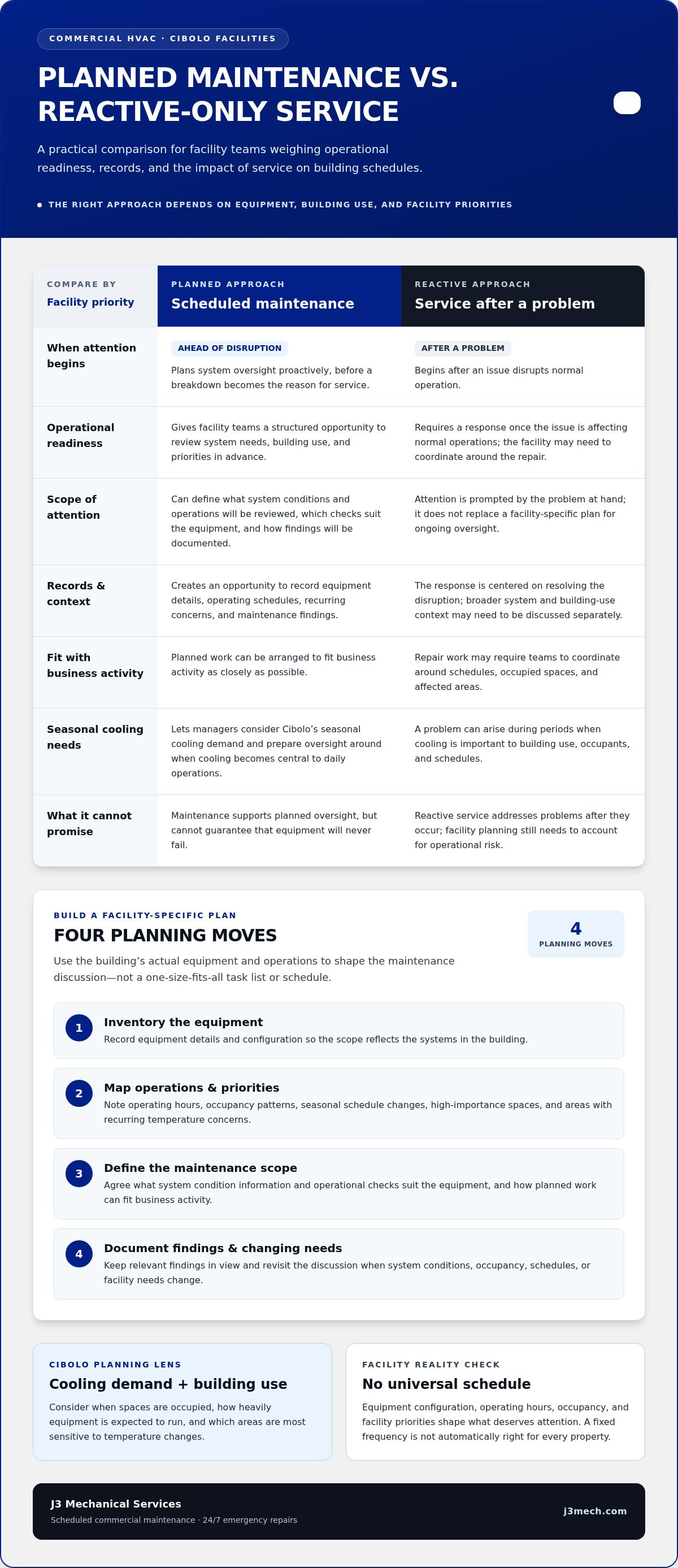
A Practical Maintenance Planning Process for Cibolo Facility Managers
A maintenance plan is more useful when it starts with facility records and moves through clear operational decisions. For commercial HVAC maintenance Cibolo, organize the process around the equipment in place, how the building is used, the scope of planned oversight, and a consistent record of findings. This framework makes maintenance discussions specific without assuming that every site needs the same schedule or work.
Build a facility-level equipment and priority record
Start with an inventory that identifies each system, its location, the areas it serves, and the hours those areas are typically occupied. Note spaces where a service interruption would have a greater operational impact, along with recurring comfort or performance concerns. These observations help guide maintenance planning, but they are not a diagnosis of the equipment.
- Inventory equipment. Record system types, locations, and the building areas they serve. Gather available equipment records that may help clarify system history.
- Identify operational priorities. Map occupied hours, customer-facing areas, and functions that depend on temperature control. Include seasonal schedule changes where relevant.
- Establish maintenance scope. Use the inventory and priorities to define appropriate condition reviews, operational checks, and documentation for the equipment and site.
- Document findings. Keep a record of observations, follow-up items, and changes to building use that may affect future planning.
Coordinate maintenance around business operations
Plan service around the facility’s working rhythm. For occupied offices or customer-facing areas, access, noise, and coordination with daily activity may affect how work is arranged. Identify who receives service findings, how questions or observed issues are communicated, and how the facility team prioritizes follow-up. Clear expectations support an orderly process without assuming every visit can happen without operational impact.
In Cibolo, consider seasonal cooling preparation alongside actual business schedules, rather than treating it as a calendar rule that applies equally to every building. A site with extended hours, changing occupancy, or different cooling needs across zones may call for a different planning discussion from a facility with more consistent use. Share known operational concerns and recent changes in use so the maintenance scope can be considered in context.
For work that may involve site-specific permitting, inspections, or other requirements, verify applicable requirements with the responsible local authority. Avoid relying on assumptions based on another property or jurisdiction. Equipment decisions should likewise follow a review of the actual system and facility needs.
If existing equipment needs broader project consideration beyond routine upkeep, J3 Mechanical Services also provides commercial installation and replacement. Its commercial HVAC installation guide offers context for planning that work. For help organizing a facility’s commercial maintenance approach, discuss your commercial HVAC maintenance needs with J3 Mechanical Services.
Commercial HVAC Maintenance in Cibolo: Working with J3 Mechanical Services
Working with a commercial HVAC provider begins with a clear account of how the building operates and what its mechanical systems support. J3 Mechanical Services provides scheduled commercial HVAC maintenance programs and 24/7 emergency repairs, supporting discussions about system oversight and facility priorities. For commercial HVAC maintenance Cibolo, connect equipment needs with the building’s operating requirements instead of assuming a standard approach will suit every site.
Facility managers can prepare by gathering available equipment information, outlining occupied hours, noting operational priorities, and describing recurring concerns. This context helps define a useful maintenance scope and clarify how findings will inform future decisions. The service plan should reflect the facility’s actual systems and site conditions, rather than assume a guaranteed outcome or a fixed frequency for every building.
What facility managers can expect from a maintenance discussion
A maintenance discussion can clarify the building’s equipment, operating patterns, and the spaces or activities with the highest priority. The facility team can then define a suitable scope for planned oversight and decide what information should be recorded and communicated. Recommendations should be tailored to the property’s mechanical systems, not treated as a universal task list for every commercial building.
Before the discussion, assemble system records, identify who coordinates building access, and summarize changes in occupancy or operating hours. Clear points of contact and reporting expectations help facility teams understand what was observed and what may warrant follow-up. This preparation also helps separate routine maintenance planning from decisions that require a broader assessment.
When maintenance needs point to repair or replacement
Maintenance is planned oversight; repair addresses a fault or specific system issue, while replacement involves broader planning for equipment renewal. Recurring concerns or changing facility requirements may call for an assessment beyond routine maintenance. J3 Mechanical Services provides commercial HVAC repair, installation, and replacement to support consideration of appropriate next steps without presuming that any particular system requires corrective work.
As you evaluate commercial HVAC maintenance in Cibolo, keep the discussion grounded in your facility’s needs: which systems support priority spaces, how operating schedules shape service planning, and what information will help track observed issues. These points provide a practical basis for ongoing coordination without implying that maintenance can eliminate breakdowns or interruptions.
J3 Mechanical Services works with commercial HVAC systems and offers scheduled maintenance alongside emergency repair service. To discuss your facility’s maintenance needs and equipment, contact J3 Mechanical Services.
Make Your Next HVAC Decision Proactive
Turn your facility’s equipment information and operating priorities into a clear maintenance discussion. That gives your team a practical basis for deciding what oversight fits the building now and what changes may call for a revised plan later. Commercial HVAC maintenance Cibolo should support informed facility decisions, not rely on assumptions about how every property operates.
J3 Mechanical Services focuses on commercial HVAC installation, maintenance, and repair, with scheduled maintenance programs and 24/7 emergency repair service for commercial facilities. Bring equipment details, operating schedules, and current concerns to the conversation so it stays grounded in your building’s needs.
Discuss commercial HVAC maintenance for your facility with J3 Mechanical Services. A deliberate planning conversation is a constructive step toward managing your building’s mechanical needs with greater clarity.
Frequently Asked Questions
How often should commercial HVAC systems be maintained in Cibolo?
There is no single service interval that suits every commercial system. The schedule should reflect equipment type and condition, operating hours, occupancy, and seasonal demand. A facility that runs for extended hours may need a different plan from one with limited or changing use. For commercial HVAC maintenance Cibolo, consider the equipment’s operating history and applicable manufacturer guidance when setting a schedule.
What does commercial HVAC maintenance typically include?
A commercial maintenance program generally defines a review of equipment condition, operational checks, and a record of findings, with the specific scope tailored to the systems on site. For example, a facility manager can provide equipment records and note areas where staff have reported recurring comfort concerns. Those details help shape what is reviewed and documented instead of relying on an assumed checklist for every building.
Is preventive maintenance worth it for a commercial building?
Preventive maintenance gives facility teams planned opportunities to review system condition and consider observations before they become urgent decisions. It can also support more deliberate maintenance planning by making equipment concerns easier to track. Its value depends on the facility’s systems and operational priorities. Maintenance does not guarantee lower costs, prevent every fault, or deliver a particular financial return.
Can a maintenance program reduce commercial HVAC downtime?
A maintenance program can create planned opportunities to identify and discuss equipment concerns, which may help limit avoidable disruption. It also gives facility teams a clearer basis for coordinating follow-up around building operations. No program can guarantee uninterrupted HVAC service, since equipment can still fail unexpectedly. Plan how concerns will be communicated and how the facility will coordinate corrective repair if an issue affects operations.
What happens if a commercial HVAC system is not maintained?
Without planned oversight, developing equipment concerns may receive attention only after they affect system operation. An interruption could affect occupant comfort, use of particular spaces, or business schedules, depending on the building’s function and the issue. Effects differ across facilities, and a system’s condition cannot be determined from its maintenance history alone. Available records can help inform an assessment.
How should a Cibolo business prepare its HVAC system for summer?
Before the cooling season, review expected operating hours, occupancy changes, and areas where temperature control is especially important. Share recurring performance or comfort concerns and available system records as part of maintenance planning. Arrange the work with facility access and business activity in mind. The appropriate scope depends on the equipment and site conditions, so avoid assuming that one set of tasks applies to every property.
Does J3 Mechanical Services provide 24/7 commercial HVAC emergency repair?
Yes. J3 Mechanical Services provides 24/7 emergency repair for commercial HVAC systems. Its Texas markets include San Antonio, Selma, Seguin, Austin, Corpus Christi, Killeen, Joshua, Bandera, Beorne, New Braunfels, Edinburg, Mccallen, Rio Grand Valley, Rockport, Pleasanton, San Marcos, and Round Rock.
Need a hand with your building's HVAC?
Free quotes and honest answers from licensed commercial technicians across South Texas.