
Commercial HVAC Repair: Precision Recovery for Critical Mechanical Infrastructure
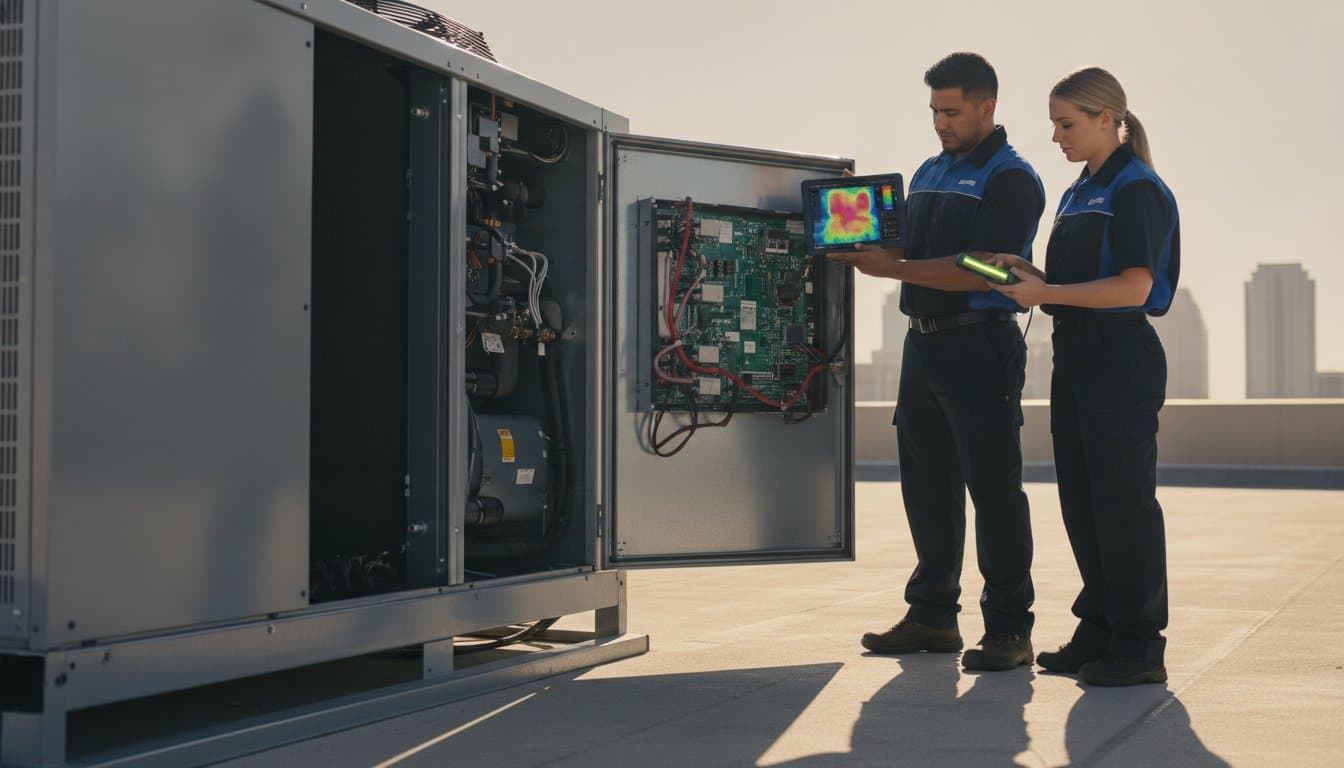
A mechanical failure in a high-capacity cooling system is not merely a maintenance hurdle; it is a direct threat to the operational continuity and fiscal health of a Texas enterprise. When critical infrastructure falters, the resulting downtime translates immediately into lost revenue and compromised industrial output. Precision commercial hvac repair requires more than a reactive fix; it demands a disciplined, engineering-led restoration that addresses the root cause of systemic inefficiency. Facility managers often struggle with the mounting pressure of high energy costs and inconsistent environmental control, yet they recognize that a superficial repair only delays an inevitable and more costly system collapse.
This guide provides a comprehensive framework for diagnosing and managing technical repairs within large-scale mechanical environments. You will learn how to leverage advanced methodologies, such as Building Information Modeling and in-house fabrication, to achieve rapid system recovery while adhering to the 2026 Department of Energy efficiency standards. We will examine the strategic transition from emergency stabilization to long-term lifecycle optimization, ensuring your infrastructure remains a reliable asset rather than a recurring liability.
Key Takeaways
- Identify the critical threshold between minor component wear and catastrophic failure using modern industrial diagnostics such as vibration analysis and thermography.
- Apply the "50% Rule" and evaluate the regulatory impact of R-22 phase-outs to make data-driven decisions regarding equipment restoration versus asset replacement.
- Master the logistical complexities of commercial hvac repair by coordinating municipal permitting and specialized equipment deployment for minimal site disruption.
- Execute restoration protocols that align with ASHRAE technical standards to ensure the mechanical integrity of large-scale industrial blower assemblies.
- Leverage a disciplined, 24/7 emergency response strategy designed specifically for the unique demands of high-capacity commercial mechanical infrastructure.
Table of Contents
- Critical Failure Diagnostics in Commercial Mechanical Systems
- Technical Restoration Protocols for Industrial HVAC Units
- Strategic Evaluation: Repairing vs. Replacing Commercial HVAC Assets
- Navigating the Logistics of Large-Scale Commercial Repairs
- J3 Mechanical: 24/7 Emergency Recovery and Long-Term Reliability
Critical Failure Diagnostics in Commercial Mechanical Systems
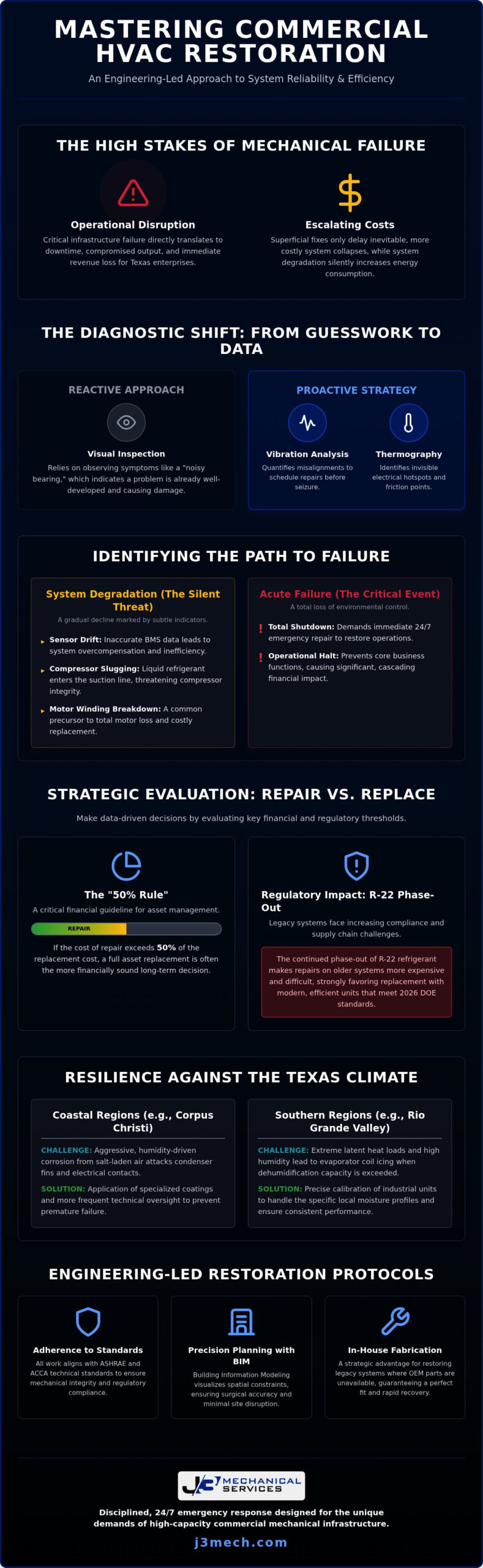
Effective commercial hvac repair begins with a transition from visual inspection to data-driven verification. In high-capacity industrial environments, we define critical infrastructure as the mechanical assemblies whose failure directly compromises life safety, data integrity, or core business operations. Identifying the threshold between minor component wear and catastrophic system failure requires a disciplined diagnostic methodology. While a technician might observe a noisy bearing, a strategist utilizes vibration analysis to quantify the specific frequency of the misalignment, allowing for a scheduled restoration before a total seizure occurs. This proactive approach ensures that mechanical assets are managed as long-term investments rather than recurring liabilities.
Modern diagnostics rely heavily on non-invasive technologies to maintain the integrity of a running system. Thermography allows our engineers to identify electrical hotspots in control panels or friction points in motor assemblies that are invisible to the naked eye. By integrating these findings with a foundational understanding of Heating, ventilation, and air conditioning (HVAC) principles, we can isolate systemic weaknesses before they manifest as service interruptions. Additionally, the structural integrity of the building itself plays a vital role in mechanical performance. Settling foundations or compromised roof curbs can lead to ductwork misalignment and refrigerant line stress, forcing the equipment to operate outside its designed parameters and accelerating component degradation.
Identifying System Degradation vs. Acute Failure
System degradation is often a silent process marked by subtle indicators like sensor drift in automated building management systems (BMS). When sensors provide inaccurate data, the system may overcompensate, leading to compressor slugging where liquid refrigerant enters the suction line and threatens the mechanical integrity of the compressor. Motor winding breakdown is another common precursor to total loss. We define acute failure as a total loss of environmental control. While degradation reduces efficiency and increases costs, acute failure demands immediate commercial hvac repair to prevent total operational shutdown. Facility managers facing an acute cooling crisis should consult a structured commercial ac repair near me emergency recovery checklist to ensure a disciplined, engineering-led response rather than a reactive selection of the first available technician.
The Impact of Central Texas Humidity on Industrial Components
The geographic diversity of Texas introduces specific stressors that dictate the repair strategy. In coastal regions like Corpus Christi, humidity-driven corrosion targets condenser fins and electrical contacts with aggressive speed. This salt-laden air requires specialized coatings and more frequent technical oversight to prevent premature failure. Further south, in the Rio Grande Valley, the primary challenge is the management of extreme latent heat loads. High humidity levels often lead to evaporator coil icing when the system's dehumidification capacity is exceeded. We address these regional variables by calibrating industrial units to handle the specific moisture profiles of the local environment, ensuring that the mechanical restoration is resilient against the Texas climate.
Technical Restoration Protocols for Industrial HVAC Units
The execution of a technical restoration within a high-stakes industrial environment requires a departure from standard maintenance practices, moving instead toward a disciplined engineering framework. Adherence to ASHRAE and ACCA standards ensures that every adjustment serves the system's design intent while maintaining compliance with evolving efficiency regulations. Precision alignment for large-scale blower assemblies is a critical phase of this process; even a minor deviation in shaft concentricity can lead to premature bearing failure and catastrophic vibration. By utilizing Building Information Modeling (BIM) data, we can visualize the spatial constraints of complex mechanical rooms before the physical work begins, ensuring that commercial hvac repair is executed with surgical accuracy and minimal field interference.
Precision Component Replacement and Fabrication
In-house fabrication serves as a strategic advantage when restoring legacy systems where original equipment manufacturer (OEM) parts are no longer available or carry prohibitive lead times. When we encounter degraded ductwork in high-pressure environments, custom-engineered sheet metal components are fabricated to exact specifications to ensure structural integrity and optimal static pressure. Facilities that require SMACNA-compliant components benefit significantly from integrated hvac sheet metal fabrication processes that coordinate digital design and manufacturing to eliminate costly field errors. This level of customization is particularly vital for commercial boiler repairs, where metallurgical compatibility between new and existing components must be verified to prevent galvanic corrosion. Facilities in the region seeking to evaluate fabrication partners should consult a resource like the commercial HVAC fabrication San Antonio buying guide to identify providers with the BIM coordination and in-house capabilities necessary to eliminate costly field errors. Our ability to produce these components internally eliminates the logistical delays that often extend operational downtime, allowing for a more predictable restoration timeline.
Restoring Refrigerant Cycles and Airflow Dynamics
Restoring the thermodynamic integrity of a system involves advanced leak detection protocols that go beyond traditional methods. We utilize ultrasonic and electronic sensors to identify microscopic apertures in high-capacity refrigerant lines that could otherwise lead to gradual charge loss and compressor strain. In multi-story commercial high-rises, the science of balancing airflow is equally critical; it requires a methodical approach to damper adjustment and fan speed calibration to ensure consistent environmental control across all zones. This precision is a hallmark of Commercial Heating and Cooling Repair, where the goal is to return the system to its peak performance curve. If your facility is experiencing inconsistent cooling or rising operational costs, coordinating a professional assessment can identify the specific commercial hvac repair strategies needed to stabilize your infrastructure.
Strategic Evaluation: Repairing vs. Replacing Commercial HVAC Assets
The decision to authorize a complex commercial hvac repair or pivot toward a full-scale asset replacement is a strategic junction that dictates a facility's long-term fiscal health. A primary benchmark in this evaluation is the "50% Rule," which suggests that if the projected cost of restoration exceeds half the value of a new system, the capital expenditure for replacement is often the more prudent path. This calculation must account for more than just the immediate invoice. It must include the regulatory reality of the R-22 refrigerant phase-out, which has rendered many legacy systems technically obsolete and prohibitively expensive to maintain. Consultation with professional HVACR trade organizations and engineering experts helps clarify these thresholds before a crisis forces a reactive decision.
Operational downtime is a significant hidden cost that often tips the scales during this evaluation. While a precision commercial hvac repair might restore environmental control within a short window, a full replacement involves logistical complexities, including crane rentals and municipal permitting, that can extend the recovery timeline. However, the efficiency gains inherent in modern equipment often justify this temporary disruption. The 2026 Department of Energy standards require an approximate 15% increase in efficiency over 2018 baselines for rooftop units. These gains, coupled with the Section 179 tax deduction which allows for a full cost deduction of up to $1,220,000 in the year of purchase, significantly accelerate the payback period for new infrastructure.
Calculating ROI on Mechanical System Life Extension
Determining the return on investment for a major mechanical restoration requires a granular analysis of energy consumption deltas. By comparing current utility expenditures against the projected performance of a restored system, facility managers can quantify the direct financial benefit of the intervention. We define the total cost of ownership for a commercial chiller as the sum of the initial purchase price, cumulative maintenance expenses, and the aggregate energy costs over its operational lifespan. Proactive maintenance remains the most effective strategy for deferring these capital costs, as it prevents the compound wear that leads to systemic failure.
Indicators for Full-Scale System Replacement
Chronic failure patterns, such as repeated breaches in heat exchangers or a series of failures across compressor banks, indicate that a system has reached its mechanical limit. If a building undergoes expansion or a significant change in occupancy density, the existing HVAC capacity may become obsolete regardless of its current state of repair. When these indicators manifest, the focus shifts from restoration to the standards outlined in our Commercial HVAC Installation framework. Upgrading to Energy Star level equipment can reduce heating and cooling energy use by up to 30%, providing a compelling case for a strategic replacement over a temporary fix.
Navigating the Logistics of Large-Scale Commercial Repairs
The successful execution of a commercial hvac repair within a dense urban environment like San Antonio or Dallas requires a level of logistical coordination that matches the technical complexity of the mechanical work itself. Securing municipal permits for crane placement is a primary hurdle that demands early intervention in the project lifecycle, as local regulations governing right-of-way and public safety are stringent. These permits, which often range from $500 to $1,500 depending on the municipality, are essential for the safe deployment of heavy lifting equipment. Beyond the paperwork, the physical deployment of a crane, which typically carries a cost between $1,500 and $5,000, necessitates a comprehensive site plan that accounts for high-voltage electrical lines and rooftop structural integrity. Managing these variables requires a strategist who understands that the physical repair is only one component of a successful infrastructure recovery.
Coordinating Crane Services and Site Safety Protocols
Safety is the cornerstone of any industrial mechanical lift, particularly when navigating the high-density areas of major Texas cities. Before any heavy component is hoisted, we conduct rigorous structural load calculations to ensure the roof curb and building frame can support the weight of the new or repaired assembly. Traffic control and pedestrian safety management are equally vital; they involve coordinated street closures and the deployment of safety marshals to mitigate risks during the lift sequence. Our disciplined approach to site management follows strict industrial safety standards, ensuring that high-voltage electrical work and rooftop maneuvers are executed without incident. This methodical preparation reflects our commitment to ethical duty and precision, protecting both the client's assets and the public at large.
Minimizing Operational Downtime for Tenants and Facilities
Operational continuity is a non-negotiable requirement for retail centers and corporate office spaces. To mitigate the impact of extensive mechanical overhauls, we coordinate after-hours repairs and implement temporary cooling solutions to maintain environmental stability for tenants. Effective communication is essential during this lifecycle; property managers receive transparent, logic-driven updates that outline the timeline and expected outcomes of the intervention. We leverage Building Information Modeling (BIM) to reduce on-site trial and error, allowing our teams to visualize the repair sequence before arriving at the facility. This proactive logistical planning ensures that commercial hvac repair is completed with maximum efficiency and minimal disruption to daily operations. If your facility requires a coordinated recovery plan, contact our team for professional commercial hvac repair services that prioritize site safety and logistical precision.
J3 Mechanical: 24/7 Emergency Recovery and Long-Term Reliability
J3 Mechanical operates with the discipline of a strategic partner, recognizing that a mechanical failure in a critical environment requires immediate stabilization followed by a comprehensive restoration plan. Our response protocol begins at the moment of emergency dispatch, where technical data is gathered to ensure the arriving team is equipped with the specific components and tools required for the task. By focusing exclusively on commercial and industrial systems, we maintain a level of technical mastery that generalists cannot replicate. This specialization ensures that every commercial hvac repair is executed with a deep understanding of complex load requirements and industrial-grade hardware. Our faith-based principles serve as the foundation of our ethical framework, ensuring that every repair estimate is transparent, logic-driven, and rooted in accountability.
The transition from reactive repair to a proactive maintenance framework is essential for minimizing the total cost of ownership. While we're prepared to handle acute failures, our primary objective is to restore system integrity so that future disruptions are mitigated through systematic oversight. This strategy prioritizes long-term stability over temporary fixes, positioning our team as a consultant for your facility's mechanical health. We view our work as a critical infrastructure responsibility, ensuring that your systems operate within their designed parameters to avoid the compounding wear that leads to catastrophic loss.
Rapid Response Protocols for Critical Infrastructure
Critical facilities, including hospitals, data centers, and industrial manufacturing plants, require a partner capable of managing high-stakes environments without friction. We provide 24/7 emergency availability across the state of Texas, supporting enterprises from the tech hubs of Austin to the industrial corridors of Edinburg. This geographic reach is backed by a logistical network that prioritizes rapid recovery to minimize revenue loss and operational risk. For facilities requiring specialized heating solutions, our expertise extends to Commercial Boiler Installation and repair, ensuring that all aspects of the thermal cycle are managed with engineering precision.
The J3 Advantage: In-House Fabrication and BIM
Our "Master Builder" persona is realized through the integration of advanced digital tools and localized manufacturing. By utilizing Building Information Modeling (BIM), we coordinate commercial hvac repair with surgical accuracy, identifying potential conflicts within the mechanical room before they impact the project timeline. This digital foresight is paired with our in-house fabrication capabilities, which allow us to produce custom ductwork and components that eliminate the delays associated with third-party vendors. Our approach to precision hvac sheet metal fabrication and BIM coordination ensures that every duct section is digitally verified before manufacturing, preventing the costly field corrections that arise when design and production are disconnected. It's this end-to-end control over the repair process that ensures the integrity of the final product and reinforces our commitment to reliability. We invite facility managers to schedule a comprehensive facility audit to identify and mitigate mechanical risks before they manifest as failures.
Optimizing Mechanical Integrity for Sustained Operational Excellence
Sustaining the mechanical integrity of a facility requires a transition from reactive troubleshooting to a disciplined, engineering-led restoration strategy. By integrating advanced diagnostic tools and adhering to rigorous technical standards, enterprises can transform their HVAC systems from high-risk liabilities into stable, high-performance assets. Successful commercial hvac repair is defined by this meticulous attention to detail, ensuring that every component replacement and logistical maneuver serves the long-term stability of the building's critical infrastructure.
J3 Mechanical remains committed to this standard of excellence through our specialized commercial-only expertise and advanced technical capabilities. Our utilization of Building Information Modeling and in-house fabrication ensures that every restoration is executed with surgical precision and minimal field interference. Whether you're navigating a complex regulatory upgrade or managing an acute system failure, our team provides the strategic oversight necessary to protect your operational continuity. Secure Your Critical Infrastructure with J3 Mechanical Emergency Repair Services and leverage our 24/7 emergency availability to maintain total project control. Investing in precision today ensures a resilient and efficient environment for years to come.
Frequently Asked Questions
What are the most common causes of commercial HVAC failure in Texas?
The primary causes of mechanical failure in Texas include extreme thermal stress from prolonged heat cycles and humidity-driven corrosion of critical components. High latent heat loads often lead to evaporator coil icing and compressor strain, particularly in regions like the Rio Grande Valley. Additionally, the lack of disciplined maintenance in high-capacity environments allows minor wear in blower assemblies to escalate into catastrophic systemic failures.
How quickly can J3 Mechanical respond to a 24/7 emergency repair call?
J3 Mechanical maintains a 24/7 emergency response protocol specifically designed for critical infrastructure such as hospitals, data centers, and industrial plants. While specific arrival times depend on logistical variables and the facility's location within our Texas service area, our dispatch team prioritizes immediate system stabilization. This rapid intervention is essential for mitigating revenue loss and protecting sensitive industrial equipment from environmental damage.
Is it better to repair or replace a commercial AC unit that is over 10 years old?
The decision to authorize a commercial hvac repair or pursue replacement depends on the "50% Rule" and the unit's alignment with current efficiency standards. Since rooftop units in hot climates typically last 12 to 15 years, a 10-year-old system is often nearing the end of its reliable lifecycle. New 2026 DOE regulations require a 15% efficiency increase over 2018 baselines, making replacement a more fiscally responsible long-term investment. Facility managers evaluating this decision can benefit from reviewing a structured facility manager's emergency recovery checklist for commercial ac repair near me to ensure the evaluation process is systematic and accounts for all engineering and operational variables.
Does J3 Mechanical coordinate crane services for rooftop unit repairs?
We coordinate all logistical aspects of rooftop mechanical lifts, including the procurement of municipal permits and the management of crane rentals. Our engineers conduct structural load calculations and site safety assessments to ensure the facility can support the weight of the equipment during the lift. This comprehensive oversight eliminates the need for facility managers to manage multiple vendors, ensuring a disciplined and safe execution of the repair project.
How does BIM coordination help reduce the cost of commercial HVAC repairs?
Building Information Modeling (BIM) reduces repair costs by identifying spatial conflicts and mechanical interferences before the physical work begins. This digital coordination allows our teams to visualize the repair sequence within complex mechanical rooms, significantly reducing on-site trial and error. By streamlining the execution phase and ensuring the accuracy of fabricated components, BIM minimizes labor hours and prevents the need for costly field adjustments.
What is the difference between commercial HVAC repair and residential service?
Commercial systems differ from residential units in their scale, technical complexity, and the critical nature of their operational environments. Industrial systems utilize high-capacity chillers, cooling towers, and advanced building automation systems that require a specialized engineering approach. While residential services focus on individual comfort, commercial hvac repair prioritizes the stability of large-scale infrastructure and the mitigation of significant fiscal risks associated with downtime.
Can J3 Mechanical handle industrial boiler repairs for large facilities?
J3 Mechanical possesses the technical mastery required to manage industrial boiler repairs for large-scale manufacturing and healthcare facilities. Our expertise includes the restoration of high-pressure steam systems and the verification of metallurgical compatibility during component replacement. We treat these heating assets as critical infrastructure, applying the same rigorous engineering standards used in our cooling and ventilation projects to ensure long-term mechanical reliability.
Why should businesses avoid general plumbing companies for HVAC repairs?
Businesses should avoid general plumbing companies because commercial HVAC systems require specialized knowledge of thermodynamics, refrigerant cycles, and complex electrical controls. J3 Mechanical explicitly focuses on mechanical systems to ensure a high level of professional competence without the distraction of adjacent services. Utilizing a dedicated HVAC specialist ensures that the restoration is led by an authoritative expert who understands the unique engineering requirements of industrial equipment.
Need a hand with your building's HVAC?
Free quotes and honest answers from licensed commercial technicians across South Texas.