
Commercial HVAC Replacement in Texas: 2026 Strategic Guide
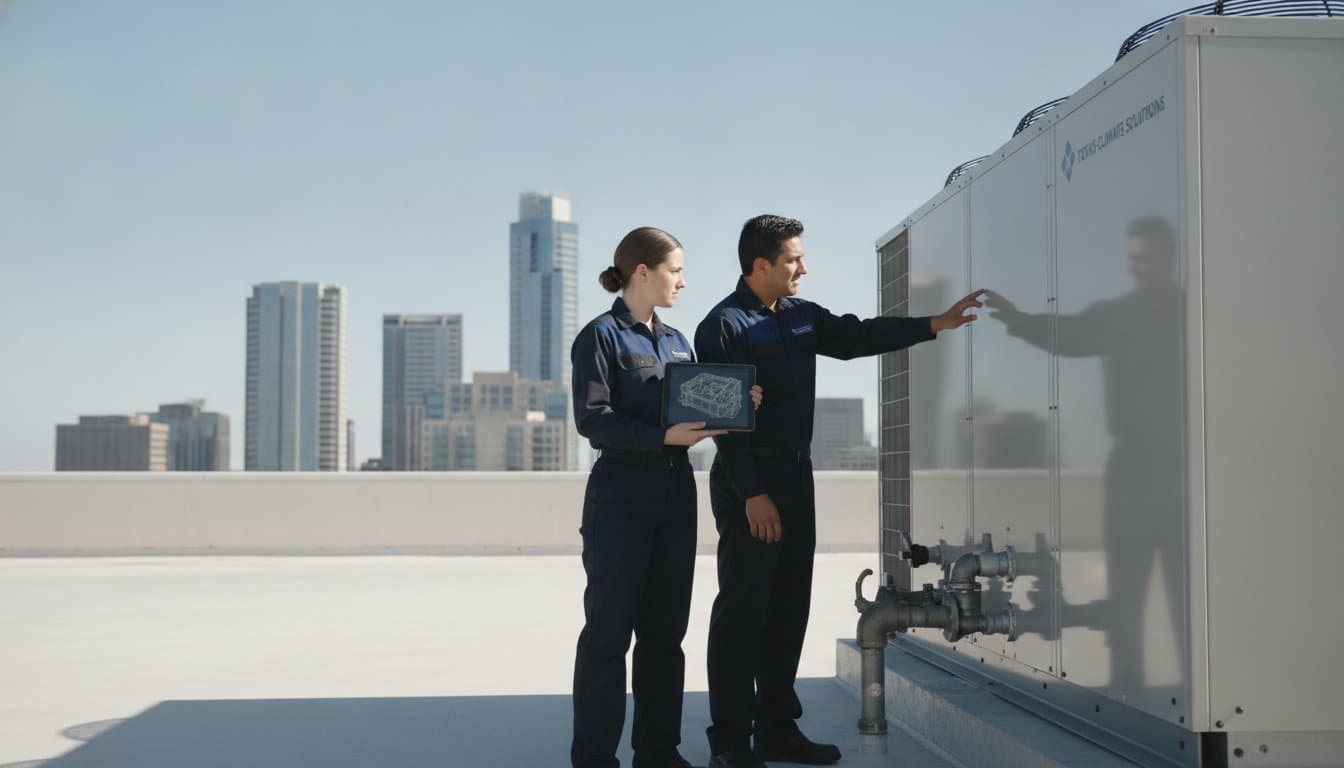
Is your current mechanical infrastructure prepared to withstand the 2026 regulatory shift, or is it a liability waiting to fail during the next record-breaking heatwave? For Texas facility owners, the transition to lower-GWP refrigerants like R-32 and R-454B isn't merely a compliance hurdle; it represents a critical juncture for long-term operational stability. Executing a successful commercial HVAC system replacement in Texas requires more than just swapping units; it demands a disciplined, strategic approach that accounts for the state’s unique thermal demands while leveraging advanced digital modeling to eliminate the risk of costly change orders.
We understand that excessive downtime and escalating energy costs are unacceptable risks to your bottom line. This guide provides a comprehensive framework for navigating large-scale mechanical transitions, offering expert guidance on Building Information Modeling (BIM) coordination and the logistical advantages of in-house fabrication. You'll learn how to secure a high-efficiency system that ensures minimal disruption to your daily operations through precision engineering and proactive project management. By following this methodical lifecycle of planning and oversight, you can transform a complex infrastructure challenge into a predictable, high-performance asset that serves your facility for decades.
Key Takeaways
- Identify the critical threshold where escalating repair costs and efficiency losses necessitate a full mechanical upgrade to protect your facility’s operational integrity.
- Engineer a commercial HVAC system replacement in Texas that is specifically designed to manage the unique latent heat loads and extreme thermal stress found in the state's diverse climate zones.
- Leverage the precision of Building Information Modeling (BIM) and in-house fabrication to eliminate field interference, reduce lead times, and prevent costly change orders.
- Maximize your capital investment by utilizing 2026 federal tax credits and localized energy incentives to accelerate the return on investment through reduced utility expenditures.
- Establish disciplined vetting standards to select industrial-grade contractors who possess the technical mastery and emergency recovery resources required for large-scale infrastructure projects.
Strategic Indicators for Commercial HVAC System Replacement
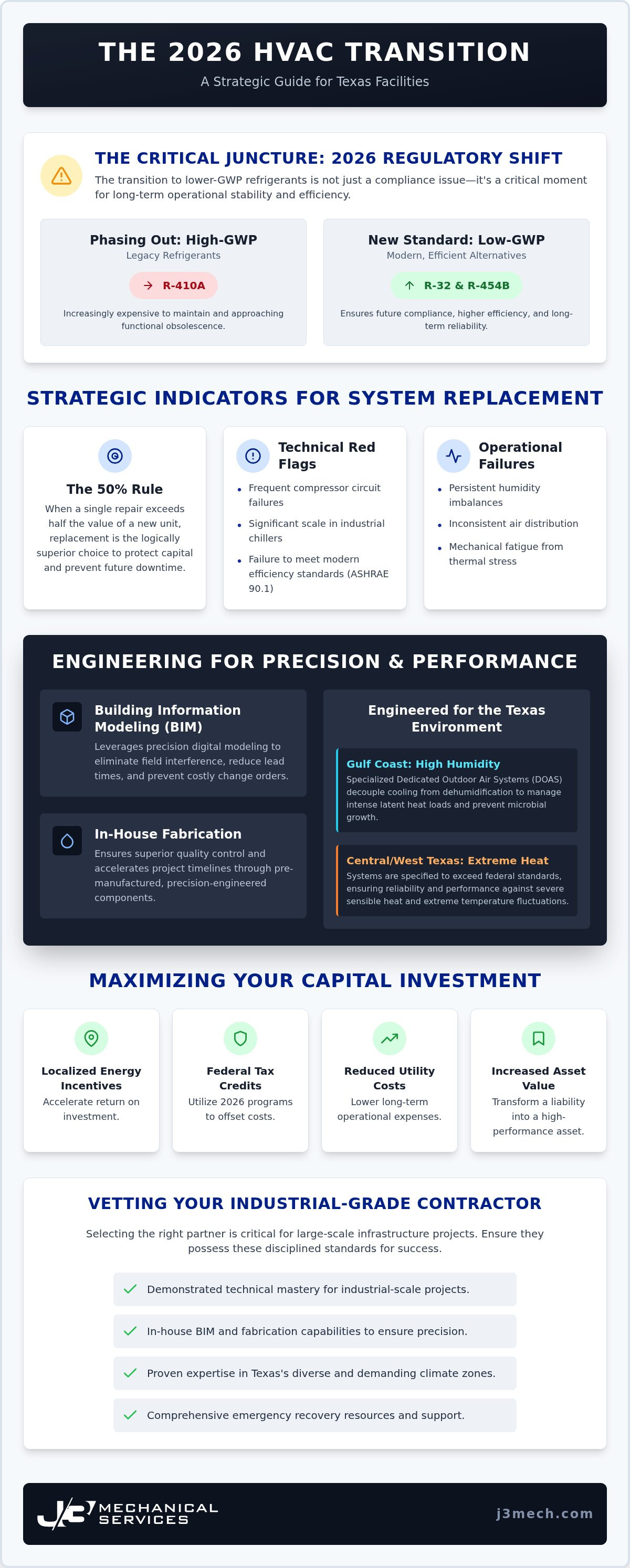
Facilities managers often encounter a point of diminishing returns where reactive maintenance no longer preserves the integrity of the building’s environmental control. A strategic commercial HVAC system replacement in Texas is not a mere purchase; it is a critical infrastructure overhaul necessitated by the convergence of aging equipment and evolving regulatory mandates. In 2026, the transition away from high-GWP refrigerants like R-410A means that legacy systems are not only becoming more expensive to maintain but are also approaching functional obsolescence. Technical indicators, such as frequent compressor circuit failures or significant scale accumulation in industrial chillers, signal that the asset's lifecycle has reached its terminal phase. Evaluating these indicators against modern 2026 efficiency benchmarks, including the 2021 International Energy Conservation Code (IECC) and ASHRAE 90.1-2019 standards, allows stakeholders to identify where legacy systems are draining capital through excessive utility consumption.
The Repair vs. Replace Financial Threshold
Determining the precise moment to transition from repair to replacement involves a rigorous application of the "50% Rule," which dictates that when a single repair exceeds half the value of the unit, capital reinvestment is the logically superior choice. This calculation must incorporate the hidden costs of operational downtime, as an unplanned failure during a Texas summer can result in catastrophic revenue loss or tenant dissatisfaction. A comprehensive lifecycle cost analysis justifies 2026 infrastructure upgrades by weighing the immediate capital expenditure against the long-term reduction in service calls and the 24/7 reliability required for industrial-grade performance. By utilizing this data-driven approach, organizations can move from a reactive posture to a proactive strategy that secures the facility's future.
Operational Red Flags in Large-Scale Facilities
In regions like the Rio Grande Valley or Corpus Christi, persistent humidity imbalances often indicate that existing equipment can no longer manage the intense latent heat loads characteristic of the Gulf Coast. Similarly, multi-zone commercial high-rises in Austin or San Antonio frequently exhibit inconsistent air distribution as dampers and actuators succumb to mechanical fatigue. Mechanical fatigue in the context of Texas heat loads is the progressive structural and functional degradation of system components caused by the relentless thermal expansion and contraction cycles inherent to extreme regional temperature fluctuations. When these red flags manifest across a portfolio, a commercial HVAC system replacement in Texas becomes the only viable method to restore precision environmental control and prevent future systemic failure points.
Engineering for the Texas Environment: Climate-Specific Requirements
Engineering a commercial HVAC system replacement in Texas requires a granular understanding of the state's disparate climate zones, as a one-size-fits-all specification inevitably leads to premature mechanical failure. While the Austin-San Antonio corridor faces extreme sensible heat, coastal regions like Corpus Christi and the Rio Grande Valley must contend with relentless latent heat loads that challenge standard dehumidification capacities. Adhering to Federal energy efficiency standards is a baseline requirement, but true reliability stems from equipment selection that exceeds these minimums to handle the specific stressors of the 2026 Texas environment.
Humidity Control Protocols for the Gulf Coast
In humid coastal environments, precision moisture removal is paramount to maintaining indoor air quality and structural integrity. Engineering Dedicated Outdoor Air Systems (DOAS) allows for the decoupling of latent and sensible cooling loads, ensuring that fresh air is thoroughly dehumidified before it enters the building envelope. This strategy is essential for facilities in Rockport or Edinburg, where inadequate moisture control often results in microbial growth on cooling coils and ductwork surfaces. By prioritizing precision coil management, engineers can mitigate these biological risks while optimizing the system's overall energy profile and ensuring long-term asset health.
High-Ambient Temperature Resilience
For inland corridors, systems must be rated for sustained operation in temperatures exceeding 100°F without succumbing to high-pressure trips or compressor burnout. Selecting compressors with high-ambient ratings is a critical step in preventing catastrophic failure during peak summer months. Optimizing condenser airflow is particularly vital in dense urban centers like San Antonio, where heat island effects can elevate ambient temperatures significantly above regional averages. Integrating commercial air conditioning best practices for load balancing into the initial design phase ensures that the system remains stable even during the most demanding thermal events.
Industrial and tech-heavy environments require specialized filtration to protect sensitive equipment and personnel from airborne contaminants. In 2026, executing a commercial HVAC system replacement in Texas involves more than just equipment procurement; it requires a verification of component compatibility with new low-GWP refrigerants like R-32 or R-454B. These refrigerants are now mandated under the EPA’s Technology Transitions Rule, necessitating a sophisticated approach to system design and safety protocols. For organizations seeking to navigate these technical complexities, partnering with a disciplined mechanical strategist ensures that every component is verified for regional resilience and rigorous compliance standards.
Utilizing BIM and In-House Fabrication for Precision Replacement
Executing a high-stakes commercial HVAC system replacement in Texas requires a transition from traditional field-measured methods to a more disciplined, technology-driven workflow. In 2026, the complexity of modern mechanical assets necessitates a level of precision that only Building Information Modeling (BIM) and in-house fabrication can provide. By creating a high-fidelity digital twin of the facility before any equipment arrives on-site, mechanical strategists can verify every clearance and connection point against actual field conditions. This methodical preparation ensures that technical mastery is established in the virtual environment, allowing for a seamless transition during the physical installation phase where every millimeter of clearance is accounted for and verified before a single crane pick occurs.
The Logistics of In-House HVAC Fabrication
The strategic advantage of maintaining internal manufacturing capabilities lies in the total control over the project timeline and component integrity. By utilizing hvac sheet metal fabrication, a contractor eliminates the unpredictability of third-party lead times and ensures that every custom transition or ductwork section meets rigorous shop standards. This vertical integration is particularly critical during complex retrofits where legacy building footprints don't accommodate off-the-shelf solutions. Quality control is maintained through industrial-grade standards that align with ASHRAE Standard 90.1, ensuring that every fabricated piece contributes to the overall efficiency and airtightness of the new system. This level of oversight ensures that the finished product isn't just a functional replacement, but a precision-engineered upgrade that enhances the entire mechanical ecosystem.
BIM Coordination in Replacement Logistics
In dense urban corridors or historic Texas assets, mapping existing utility conflicts is a prerequisite for any successful mechanical overhaul. Building Information Modeling allows for the comprehensive identification of structural or electrical interferences that often remain hidden during a standard site survey. Building Information Modeling reduces clash detection errors by 90% in mechanical replacements, providing a level of accuracy that virtually eliminates the need for field modifications and expensive change orders. This digital foresight is also applied to the logistical staging of the project, where crane picks and equipment deliveries are coordinated with mathematical precision. For an urban high-rise project, this means that every mechanical component is pre-coordinated to fit within the designated staging window, significantly reducing facility downtime and ensuring a predictable, friction-free execution. By verifying the logistical path of every unit through virtual simulations, contractors can guarantee that the installation phase proceeds without the interruptions that typically plague less-prepared projects.
Financial and Operational Planning for System Upgrades
A successful commercial HVAC system replacement in Texas is as much a financial maneuver as it is an engineering feat. In 2026, stakeholders must move beyond simple capital expenditure analysis to a more sophisticated model that accounts for the total cost of ownership and aggressive federal incentives. By aligning mechanical upgrades with fiscal cycles, organizations can offset the initial investment while simultaneously insulating themselves from the volatile energy costs associated with legacy, inefficient systems. This strategic approach ensures that the replacement isn't merely a necessary expense, but a calculated investment in the facility's long-term viability.
Tax Incentives and Energy Rebates in 2026
The current fiscal year offers significant advantages for those executing a commercial HVAC system replacement in Texas. Under Section 179 of the tax code, businesses can deduct the full purchase price of qualifying equipment up to $1,220,000 in the year it’s placed in service, provided the assets are operational by the end of 2026. Additionally, the Section 179D deduction provides a per-square-foot tax benefit for buildings that achieve superior energy performance relative to ASHRAE standards. Localized utility rebates in San Antonio, Austin, and Round Rock further incentivize the adoption of high-efficiency (HE) equipment, often covering a significant portion of the cost delta between standard and premium units. Property Assessed Clean Energy (PACE) financing remains a robust option; in the first half of 2026 alone, $64.8 million in PACE financing was facilitated across six major Texas projects, demonstrating a strong institutional appetite for sustainable infrastructure.
Minimizing Business Interruption
Operational continuity is a non-negotiable requirement for high-stakes facilities, necessitating a disciplined scheduling protocol that prioritizes off-peak or weekend mechanical cut-overs. For multi-building campuses, a phased replacement strategy allows for the systematic modernization of assets without overwhelming the facility’s internal logistics or maintenance staff. Temporary cooling solutions must be integrated into the project lifecycle to maintain environmental stability during the critical transition period between the decommissioning of old units and the commissioning of new ones. Clear communication protocols ensure that all facility stakeholders are informed of progress and potential disruptions, maintaining a sense of order throughout the installation. This meticulous planning prevents the logistical friction that often leads to unplanned downtime.
Navigating the procurement process requires a strategist who understands the nuances between new construction and complex retrofits. For those ready to initiate a high-performance mechanical transition that balances technical mastery with fiscal precision, J3 Mechanical Services provides the industrial-grade expertise required to execute your project with accountability. By integrating financial forecasting with precision engineering, we help you secure a mechanical future that is both reliable and cost-effective.
Selecting a Texas Commercial HVAC Contractor: Disciplined Standards
The final phase of a successful commercial HVAC system replacement in Texas involves the selection of a mechanical partner who mirrors the discipline and technical rigor of your own organization. Large-scale infrastructure projects are too complex for generalist firms that lack a dedicated industrial focus. A true master builder prioritizes long-term stability over the convenience of a quick fix, ensuring that every verification step is completed with ethical consistency. This selection process must move beyond surface-level qualifications to evaluate the contractor’s ability to manage high-stakes environments without friction or logistical delays.
Specialization Over Generalization
Engaging a dedicated commercial hvac contractor is essential because industrial systems operate under thermal loads and pressures that residential-crossover firms simply aren't equipped to handle. Many generalists split their operational focus between plumbing and HVAC services, which often dilutes the specialized engineering expertise required for sophisticated chiller plants or complex RTU configurations. You should prioritize partners who maintain high industrial insurance bonding capacities and exemplary safety records, as these metrics serve as objective evidence of professional competence. Vetting a contractor for their specific experience with 2026 refrigerant transitions and BIM coordination ensures they can navigate the technical standards required for modern compliance.
The J3 Mechanical Accountability Model
J3 Mechanical Services operates as a disciplined strategist, providing an accountable partnership rooted in faith-based principles and transparent project delivery. We view our work as a critical infrastructure responsibility, which is why we maintain 24/7 emergency recovery capabilities to protect Texas assets from unplanned downtime. Our methodology is defined by a commitment to technical mastery, from the initial digital modeling phase to the final commissioning of the equipment. By adhering to our rigorous commercial hvac installation standards, we ensure that every project is executed with the precision required to prevent future failure points. This master builder approach provides facility owners with the quiet confidence that their commercial HVAC system replacement in Texas is managed by experts who value meticulous preparation as much as physical labor. We don't just install equipment; we engineer reliability into the very core of your facility’s mechanical ecosystem.
Securing Your Facility’s Mechanical Future
Transitioning your facility’s infrastructure through a commercial HVAC system replacement in Texas is a high-stakes undertaking. It demands a shift from reactive maintenance to proactive, precision engineering. By leveraging Building Information Modeling (BIM) and in-house fabrication, you eliminate the logistical friction and technical inaccuracies that often lead to project overruns. This methodical approach ensures that your new mechanical assets aren't just compliant with 2026 refrigerant regulations; they're also specifically engineered to withstand the relentless thermal stress of the Texas climate.
A successful replacement lifecycle combines fiscal foresight with industrial-grade execution. This synergy ensures that your capital investment delivers measurable returns through reduced utility consumption and operational stability. When you partner with an entity that prioritizes accountability and technical mastery, you secure a mechanical ecosystem that's both resilient and efficient. We invite you to Consult with a Disciplined Strategist for Your Texas HVAC Replacement to experience the benefits of BIM-coordinated precision and our Texas-wide industrial expertise. With our commitment to 24/7 emergency mechanical recovery, your facility’s critical infrastructure remains in capable, expert hands. Your facility is ready for its next era of high-performance operation.
Frequently Asked Questions
What is the typical lifespan of a commercial HVAC system in the Texas climate?
The typical lifespan for a commercial mechanical asset in Texas ranges from 12 to 15 years, which is often shorter than the national average due to relentless thermal stress. While well-maintained systems can reach 20 years, the humidity of the Gulf Coast and extreme heat of Central Texas lead to faster component degradation. Monitoring for mechanical fatigue is essential to ensure your commercial HVAC system replacement in Texas occurs before a catastrophic failure happens.
How much can a new commercial HVAC system save on energy costs in 2026?
Modern high-efficiency systems installed in 2026 can reduce facility energy expenditures by 25% to 40% when compared to legacy equipment from the previous decade. These savings are achieved through advanced variable-speed technology and superior SEER2 ratings that align with current ASHRAE standards. By prioritizing industrial-grade efficiency, facility owners can achieve a faster return on investment while insulating their operational budgets against the rising cost of utility services in major Texas corridors.
Is BIM coordination necessary for a simple unit replacement?
BIM coordination is a strategic necessity for any replacement project where field interference or logistical complexity poses a risk to the project timeline. Even for seemingly simple unit swaps, digital modeling verifies that new equipment footprints and connection points align perfectly with existing infrastructure. Utilizing this technology prevents the change orders and field modifications that often arise when contractors rely on outdated 2D drawings or manual site measurements during the installation phase.
What are the current SEER2 requirements for commercial AC units in Texas?
Commercial AC units in Texas must comply with the 2021 International Energy Conservation Code (IECC) and ASHRAE 90.1-2019 benchmarks as of 2026. These regulations mandate specific SEER2 and EER2 efficiency levels that vary based on equipment tonnage and building type. Ensuring your commercial HVAC system replacement in Texas meets these rigorous standards is critical for both legal compliance and the maximization of available federal tax incentives like the Section 179D deduction.
How long does a full commercial HVAC system replacement usually take?
The duration of a replacement project depends on the mechanical complexity and logistical staging required for your specific facility. A standard rooftop unit replacement can often be completed within 24 to 48 hours to minimize business interruption. However, large-scale chiller plants or multi-zone systems require a phased approach that may span several weeks. Disciplined planning ensures that each stage of the transition is executed with minimal impact on your daily business operations.
Does J3 Mechanical provide emergency repair if the replacement is not yet scheduled?
J3 Mechanical provides comprehensive 24/7 emergency recovery services to maintain critical infrastructure stability, regardless of your current replacement schedule. We understand that mechanical failures don't adhere to business hours, especially during peak Texas summers. Our team is equipped to stabilize your environment and provide technical assessments that help determine if a repair is viable or if an immediate transition to a full replacement is the more responsible and cost-effective course of action.
Can in-house fabrication really speed up my project timeline?
In-house fabrication significantly accelerates project timelines by eliminating the unpredictability associated with third-party sheet metal vendors. By manufacturing custom ductwork and transitions internally, we maintain total control over quality standards and lead times. This vertical integration allows for the immediate adjustment of components during the installation phase, ensuring the project proceeds without the delays typically caused by waiting for external deliveries or corrected field fitments that don't match the original specifications.
Are there specific incentives for commercial HVAC replacement in San Antonio or Austin?
Significant incentives are available through local utility providers like CPS Energy in San Antonio and Austin Energy for high-efficiency mechanical upgrades. These rebates are designed to offset the initial capital expenditure of equipment that exceeds federal minimums. When combined with federal tax deductions, these localized programs make a strategic system replacement a fiscally responsible decision that enhances long-term facility value while reducing ongoing maintenance costs for the life of the asset.
Need a hand with your building's HVAC?
Free quotes and honest answers from licensed commercial technicians across South Texas.