
Commercial HVAC Service Agreement Texas: A 2026 Strategic Buying Guide
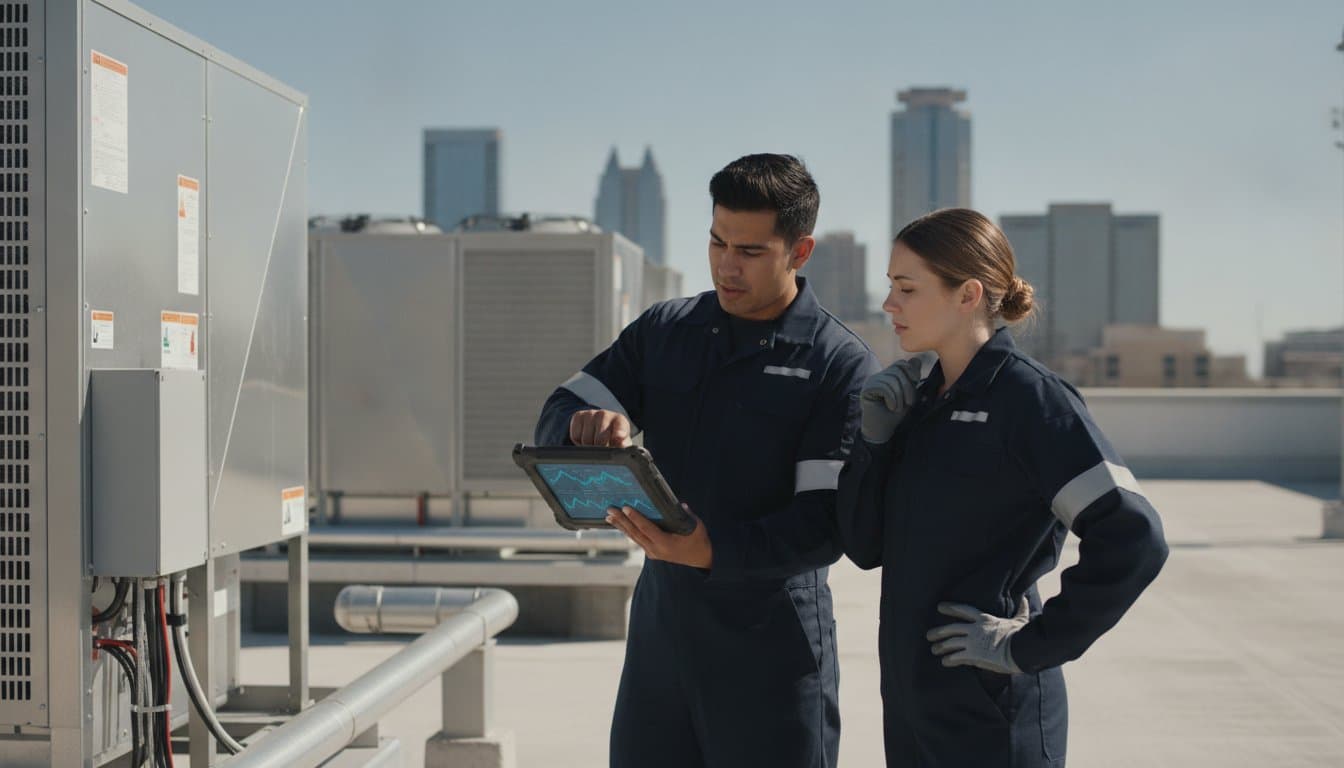
With the Texas HVAC market reaching a $13.1 billion valuation in 2026, the management of large-scale mechanical assets has shifted from a routine task to a high-stakes financial strategy. You likely understand the frustration of unpredictable downtime during a record-breaking summer or the drain of escalating energy costs caused by inefficient system performance. It's a common challenge for facility managers who require more than just a reactive repair service to maintain operational continuity. This guide provides the technical roadmap required to secure your facility's critical infrastructure through a specialized commercial hvac service agreement texas that prioritizes asset reliability and total system integrity. We'll examine the 2026 regulatory transition toward low-GWP refrigerants like R-32 and R-454B, the strategic application of Section 179 tax deductions, and the precise technical benchmarks necessary to mitigate risk. By aligning with a partner who values technical mastery and proactive digital modeling, you can ensure your equipment lifecycle is extended while your maintenance budget remains predictable and compliant with evolving state standards.
Key Takeaways
- Understand the "Texas Thermal Load" and how proactive mechanical stewardship prevents the accelerated equipment fatigue caused by extreme regional heat cycles.
- Identify the essential deliverables of a high-performance commercial hvac service agreement texas, ranging from precision tuning to customized inspection frequencies tailored to your facility's specific usage.
- Learn to vet potential partners based on engineering depth and specialized commercial expertise rather than basic residential-grade maintenance capabilities.
- Analyze the financial logic of preventive care through the lens of energy cost reduction and the long-term mitigation of large-scale operational risks.
- Discover the strategic onboarding process required to baseline system performance and ensure a seamless transition from initial installation to ongoing asset management.
Table of Contents
- The Strategic Necessity of Commercial HVAC Service Agreements in Texas
- Essential Components of a High-Performance Service Contract
- Vetting Texas HVAC Contractors: Beyond the Basic Tune-Up
- Calculating ROI: The Financial Logic of Preventive Care
- Implementing Your Service Agreement with J3 Mechanical
The Strategic Necessity of Commercial HVAC Service Agreements in Texas
A commercial hvac service agreement texas represents far more than a simple recurring maintenance checklist; it's a rigorous program of mechanical stewardship designed to preserve the integrity of complex industrial systems. In high-stakes environments where climate control is tied directly to operational viability, a structured agreement serves as a protective barrier against the volatility of the Texas environment. The primary objective is to secure the operational continuity of your facility by shifting from a reactive, high-friction repair model to a disciplined, proactive management strategy. This transition ensures that critical infrastructure remains stable, even when external conditions reach extreme thresholds.
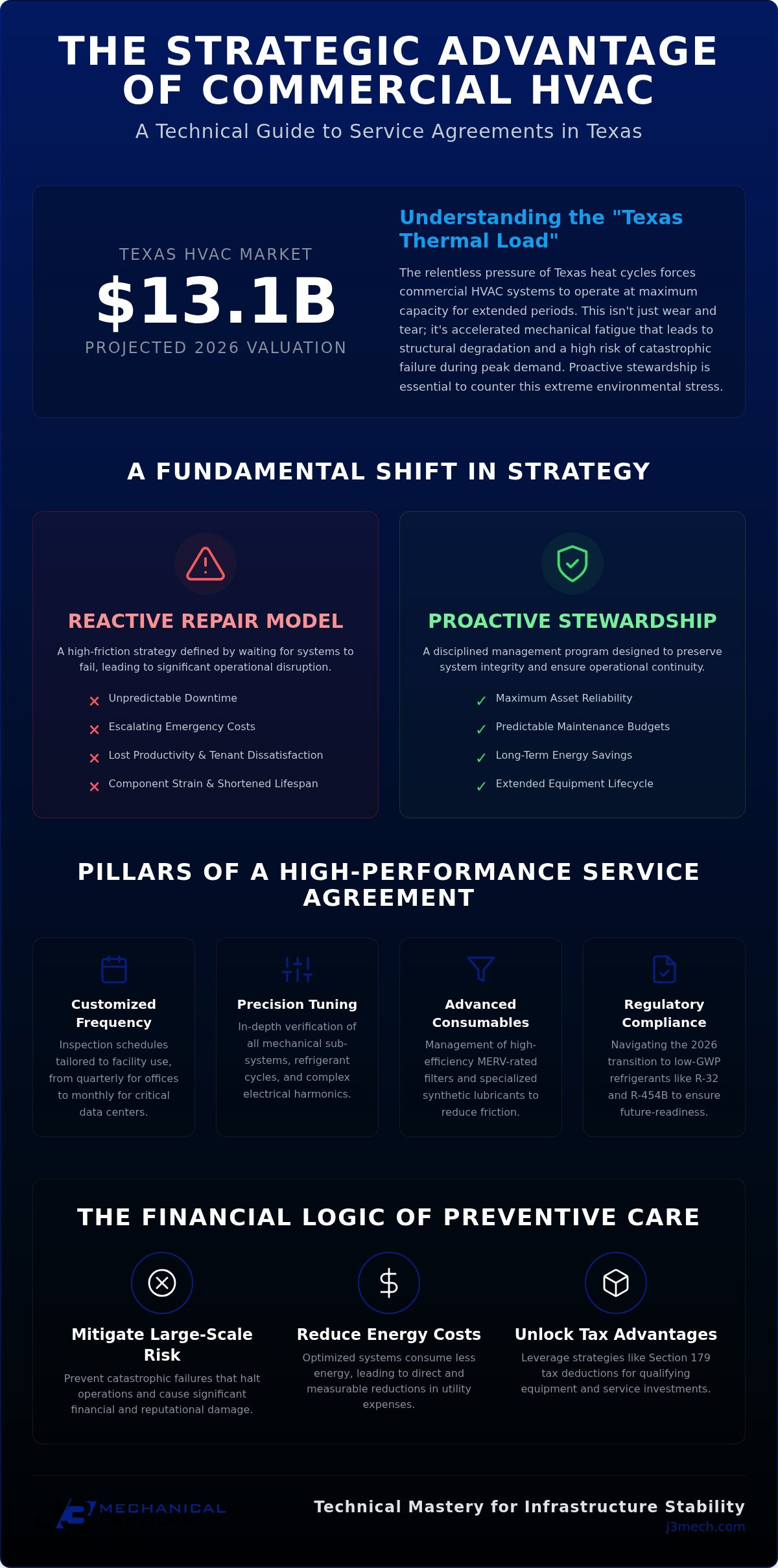
The "Texas Thermal Load" describes the relentless atmospheric pressure placed on cooling systems during prolonged heat cycles in cities like San Antonio and Austin. These regions experience temperature spikes that force mechanical components to operate at maximum capacity for months at a time, which significantly accelerates mechanical fatigue. Without a dedicated stewardship program, the internal components of a chiller or rooftop unit don't just wear down; they undergo rapid structural degradation that can lead to catastrophic failure during peak demand periods. Adopting a Master Builder approach allows facility managers to anticipate these stress points through planned intervention rather than waiting for the system to fail under pressure.
Mitigating Climate-Induced Mechanical Stress
South Texas humidity presents a specific set of challenges for commercial systems, particularly regarding coil integrity and air filtration efficiency. High moisture levels encourage the accumulation of biological growth and corrosive particulates on evaporator coils, which restricts airflow and forces the system to consume more energy to achieve the same cooling output. When temperatures exceed 100 degrees, compressor duty cycles extend, causing lubricants to break down faster and increasing the risk of mechanical seizure. Standard residential-grade maintenance protocols are insufficient in these industrial-scale environments because they lack the technical depth required to monitor high-pressure refrigerant cycles and complex electrical harmonics. A sophisticated commercial hvac service agreement texas addresses these stressors through precision verification of every mechanical sub-system.
Infrastructure Stability vs. Reactive Repair
Reactive repair is a fundamentally flawed strategy that introduces significant hidden costs into a facility's budget. When a system fails unexpectedly, the fallout includes tenant dissatisfaction, lost employee productivity, and the financial burden of expedited shipping fees for critical components. A structured service agreement replaces this chaos with a logic-driven roadmap for reliability. By prioritizing technical mastery, a dedicated service partner can identify minor calibration issues before they manifest as systemic failures. This methodical oversight provides a predictable framework for maintenance budgeting, ensuring that your mechanical assets contribute to the facility's long-term stability rather than becoming a source of constant operational risk.
Essential Components of a High-Performance Service Contract
A high-performance commercial hvac service agreement texas must be founded on measurable deliverables rather than vague promises of care. It functions as a technical specification that dictates the frequency of inspections, the precision of system tuning, and the depth of analytical reporting. For facility managers, this document is the primary tool for translating mechanical needs into predictable financial outcomes. It ensures that every Rooftop Unit (RTU), chiller, and air handler receives the exact level of technical intervention required to sustain peak performance during the most demanding Texas heat cycles.
Customized service frequency is a critical variable in these contracts. While a standard office building might maintain stability with quarterly visits, high-utilization environments like data centers or industrial manufacturing plants often require monthly oversight to manage higher heat loads and continuous duty cycles. A sophisticated agreement also includes the management of high-efficiency consumables, such as MERV-rated filtration and specialized synthetic lubricants, which are essential for maintaining system hygiene and reducing internal friction. Priority 24/7 emergency access serves as the final layer of infrastructure security, providing a guaranteed recovery path should a critical component fail outside of standard operating hours.
Preventive Maintenance Protocols and Asset Lifecycle
The core of any robust agreement is a systematic verification process that includes measuring electrical amp draws, analyzing refrigerant superheat and subcooling levels, and adjusting belt tensions with precision gauges. Consistent commercial hvac maintenance doesn't just prevent immediate breakdowns; it fundamentally alters the wear-profile of your equipment. By maintaining these tight tolerances, you can significantly extend the operational life of expensive assets like chillers and large-scale cooling towers. Lifecycle Asset Management is the process of maximizing ROI through technical rigor. Securing a partnership that offers 24/7 emergency service ensures your facility remains operational during unforeseen mechanical crises.
Regulatory Compliance and Refrigerant Management
Modern service agreements must address the increasing complexity of environmental regulations, particularly regarding EPA Section 608 requirements and the 2026 transition toward low-GWP refrigerants. A professional contract simplifies this burden by providing automated leak rate tracking and comprehensive refrigerant reclamation logs that are ready for audit at any time. Maintaining compliance with the Texas Department of Licensing and Regulation (TDLR) is also mandatory for any commercial entity. A disciplined service partner ensures that all work is performed by licensed professionals and that all documentation meets state-mandated standards for safety and environmental responsibility. This level of oversight protects the facility from legal liabilities while promoting a culture of ethical mechanical management.
Vetting Texas HVAC Contractors: Beyond the Basic Tune-Up
Selecting a provider for a commercial hvac service agreement texas isn't merely about finding the lowest bidder; it's about identifying a strategic partner with the engineering depth to manage critical infrastructure. A true "Master Builder" contractor operates with a sense of ethical duty, ensuring that every mechanical intervention is rooted in technical accuracy rather than superficial speed. Facility managers must prioritize firms that specialize exclusively in commercial mechanical systems. Residential contractors often lack the specialized tools and logistical coordination required to manage high-tonnage chillers or complex building automation systems found in industrial environments.
When a system failure occurs, the contractor's ability to execute a commercial hvac repair on a large-scale industrial level is paramount. Vetting should include an assessment of "capacity," specifically whether the firm maintains a fleet and manpower sufficient to service multiple Texas locations simultaneously. A partner with limited resources can quickly become a liability during a regional heatwave when service calls peak across the state. A disciplined partner provides clear technical justifications for every action taken, ensuring that facility managers can make informed decisions based on data rather than urgency.
The Role of In-House Fabrication and BIM Coordination
One of the most significant differentiators in contractor vetting is the presence of internal manufacturing capabilities. Utilizing hvac sheet metal fabrication ensures faster repair times because it eliminates the delays associated with third-party lead times. When a custom transition or ductwork component is required for an emergency replacement, an in-house shop can produce the part in hours rather than weeks. Additionally, contractors who utilize Building Information Modeling (BIM) data from the installation phase provide a higher level of maintenance accuracy. This digital modeling allows technicians to visualize the internal layout of complex systems before arriving on-site, leading to fewer change orders and a higher degree of system integrity.
Assessing Emergency Response and Technical Capacity
In a commercial context, a "true" 24/7 emergency response is defined by the availability of specialized technicians who understand the engineering of high-rise and industrial HVAC systems. It isn't enough to have an answering service; the provider must have the logistical infrastructure to deploy heavy equipment and specialized diagnostic tools at any hour. This level of professional competence is what separates a strategic service partner from a traditional maintenance vendor. By maintaining a steady, methodical communication flow, the contractor reinforces their image as a stable partner capable of managing high-stakes environments without friction.
Calculating ROI: The Financial Logic of Preventive Care
A commercial hvac service agreement texas serves as a sophisticated instrument for financial predictability, shifting mechanical maintenance from an unpredictable expense into a controlled strategic investment. By establishing a rigorous protocol for precision tuning, facility managers can mitigate the high-stakes risks associated with operational volatility. This logic-driven approach focuses on reducing measurable energy consumption while simultaneously insulating the organization from the catastrophic costs of systemic failure. In large-scale Texas facilities, where cooling loads are constant, the financial delta between a neglected system and a precision-calibrated one is substantial.
Beyond the immediate utility bills, facility managers must account for the soft costs of HVAC failure, which include brand reputation damage, increased tenant turnover, and significant health and safety liabilities. A single failure during a peak summer cycle can result in lost productivity that far exceeds the cost of an annual service agreement. Additionally, maintaining detailed, verified maintenance logs creates a transparent record of mechanical stewardship. This documentation is invaluable during asset sales or financial audits, as it directly increases the property's valuation by demonstrating a commitment to long-term infrastructure integrity.
Energy Efficiency and Operational Cost Reduction
The correlation between mechanical hygiene and energy spend is undeniable. A 10% drop in system efficiency due to neglected maintenance, such as fouled filters or uncalibrated sensors, can result in thousands of dollars in excess energy expenditures for a typical commercial facility. In the humid Texas climate, evaporator coil cleanliness is especially critical; even a thin layer of particulate matter significantly inhibits heat transfer efficiency, forcing the compressor to run longer cycles to meet setpoint requirements. Peak demand management is a key financial benefit of a well-maintained system. By ensuring that components operate at their designed specifications, facilities can avoid the expensive surcharges associated with high-demand power usage periods.
Capital Expenditure (CapEx) Planning
A structured commercial hvac service agreement texas provides the empirical data necessary for long-term commercial hvac installation and replacement budgeting. Rather than relying on guesswork, stakeholders can use detailed maintenance reports to identify the exact point of diminishing returns for aging equipment. This technical rigor allows for a strategic choice between 'Planned Obsolescence' and 'Extended Asset Life,' ensuring that capital is deployed only when necessary. To begin securing your facility's financial future through professional mechanical oversight, you can review our comprehensive service protocols. Using these reports to justify equipment upgrades to stakeholders ensures that infrastructure investments are backed by transparent, logic-driven data.
Implementing Your Service Agreement with J3 Mechanical
Implementing a commercial hvac service agreement texas with J3 Mechanical Services is a methodical process rooted in technical precision and operational accountability. Our onboarding protocol begins with a comprehensive site audit to establish a performance baseline for every mechanical component within your facility. This data-driven phase allows our team to design a custom service protocol that addresses the specific engineering requirements of your infrastructure. We don't believe in generic maintenance; instead, we provide a disciplined roadmap that ensures long-term stability and system integrity through rigorous verification.
The transition from being your commercial hvac contractor during the construction phase to becoming your long-term service partner is a seamless evolution of our master builder philosophy. This continuity of care ensures that the technical nuances of your system are preserved throughout its entire lifecycle. Our faith-based commitment to ethical transparency means that every diagnostic report and repair recommendation is presented with absolute honesty and technical justification. We currently provide this level of specialized oversight across San Antonio, Austin, Corpus Christi, and the Rio Grande Valley, ensuring critical infrastructure remains resilient across South and Central Texas.
Customizing Plans for Central and South Texas Facilities
J3 Mechanical Services recognizes that different industries carry unique mechanical risks. We tailor our agreements to meet the rigorous demands of healthcare environments, educational institutions, and industrial manufacturing plants. For instance, a medical facility requires stricter air filtration and humidity control than a standard retail space. By integrating 24/7 emergency recovery as a standard layer of protection, we provide facility managers with a single point of accountability. This streamlined approach eliminates the logistical friction often found when managing multiple vendors for installation, maintenance, and repair.
Seamless Transition from Installation to Oversight
Our ability to leverage in-house fabrication and BIM data allows us to create a digital twin of your system. This digital record improves maintenance accuracy by providing technicians with a precise map of internal components and fabrication-ready specifications. The process to initiate a partnership is straightforward: it begins with a professional contact, followed by a detailed site evaluation and a strategic proposal tailored to your facility's specific operational needs. Contact J3 Mechanical Services to secure your facility's service agreement today.
Securing the Future of Your Mechanical Infrastructure
Strategic management of high-stakes mechanical assets requires a shift from viewing maintenance as a commodity to recognizing it as a critical pillar of facility stability. By formalizing a commercial hvac service agreement texas, you effectively mitigate the operational risks posed by extreme climate cycles and evolving 2026 regulatory standards. This guide has detailed the necessity of technical mastery, the financial logic of preventive care, and the importance of selecting a partner with the capacity for industrial-scale recovery. It's about ensuring that your facility's climate control remains a predictable asset rather than a liability during peak demand periods.
J3 Mechanical delivers this stability through 24/7 Emergency Recovery and BIM-Coordinated Maintenance, ensuring your systems are managed with the precision of a master builder. Our faith-based ethical accountability provides the transparency needed for long-term partnership and infrastructure integrity. As you navigate the complexities of modern mechanical management, choosing a partner with deep engineering roots is the most effective way to protect your equipment lifecycle. Secure your facility's infrastructure with a J3 Mechanical Service Agreement and experience the confidence of total project control. We look forward to supporting your facility's ongoing operational excellence.
Frequently Asked Questions
What is typically included in a commercial HVAC service agreement in Texas?
A comprehensive agreement incorporates the systematic verification of electrical harmonics, refrigerant subcooling levels, and mechanical belt tensions. It also includes high-efficiency filtration management and the precision tuning of building automation sensors to ensure the entire infrastructure operates within designed tolerances. These protocols are designed to maintain system hygiene and prevent the structural degradation of expensive mechanical components during peak usage periods.
How much does a commercial HVAC maintenance contract cost for a large facility?
The financial commitment for a maintenance contract is determined by the total tonnage of the equipment and the specific technical requirements of the facility. Factors such as the complexity of the mechanical assets and the required frequency of inspections influence the final valuation. Most professional providers offer tiered structures that allow facility managers to align their maintenance spend with their specific operational risk profile.
Can a service agreement help reduce energy bills for my business?
Precision calibration directly correlates with reduced utility expenditures by ensuring that compressors and fan motors operate at peak efficiency. When coils are maintained at maximum cleanliness, heat transfer occurs more effectively, which prevents the system from running extended cycles. This technical rigor is a core component of a commercial hvac service agreement texas designed to mitigate the high costs associated with the Texas power grid.
Is 24/7 emergency service included in a standard HVAC maintenance plan?
While many basic plans focus exclusively on scheduled inspections, high-performance agreements often integrate 24/7 emergency recovery as a standard protective layer. This ensures that critical mechanical failures are addressed with immediate technical intervention, regardless of the hour. Facility managers should verify that their contract guarantees priority response times to minimize the duration of any operational downtime and protect their critical infrastructure.
How does a service agreement impact the warranty of my commercial HVAC unit?
Most manufacturers mandate documented proof of professional maintenance to maintain the validity of equipment warranties. Failure to provide systematic service records can result in the denial of claims for expensive components like compressors or heat exchangers. A structured agreement provides the necessary verification logs to ensure that your capital investments remain protected under manufacturer terms throughout their entire operational lifecycle.
Why should I choose a local Texas contractor over a national service provider?
Local contractors possess a specialized understanding of the Texas Thermal Load and the unique humidity challenges prevalent in San Antonio and Austin. Unlike national providers who may rely on third-party subcontractors, a local partner maintains direct accountability and possesses the logistical infrastructure to deploy specialized tools quickly. This proximity ensures a faster, more precise response to the specific mechanical stressors of the region.
What is the difference between preventive maintenance and a full-service agreement?
Preventive maintenance focuses on scheduled inspections and precision adjustments to prevent failure, whereas a full-service agreement typically incorporates the cost of parts and labor for necessary repairs. The choice between these models depends on the facility's tolerance for financial volatility. A full-service approach provides maximum budget predictability by shifting the risk of mechanical failure from the owner to the service provider.
How often should commercial HVAC systems be serviced in the San Antonio area?
For most commercial environments in San Antonio, a quarterly service cadence is the baseline requirement to manage the transition between extreme seasonal shifts. However, high-utilization facilities such as data centers or healthcare institutions often require monthly oversight to ensure continuous reliability. This customized frequency allows for the early detection of mechanical fatigue caused by the relentless cooling demands of the South Texas climate.
Need a hand with your building's HVAC?
Free quotes and honest answers from licensed commercial technicians across South Texas.