
Commercial HVAC Solutions: Navigating the 2026 Industrial Landscape
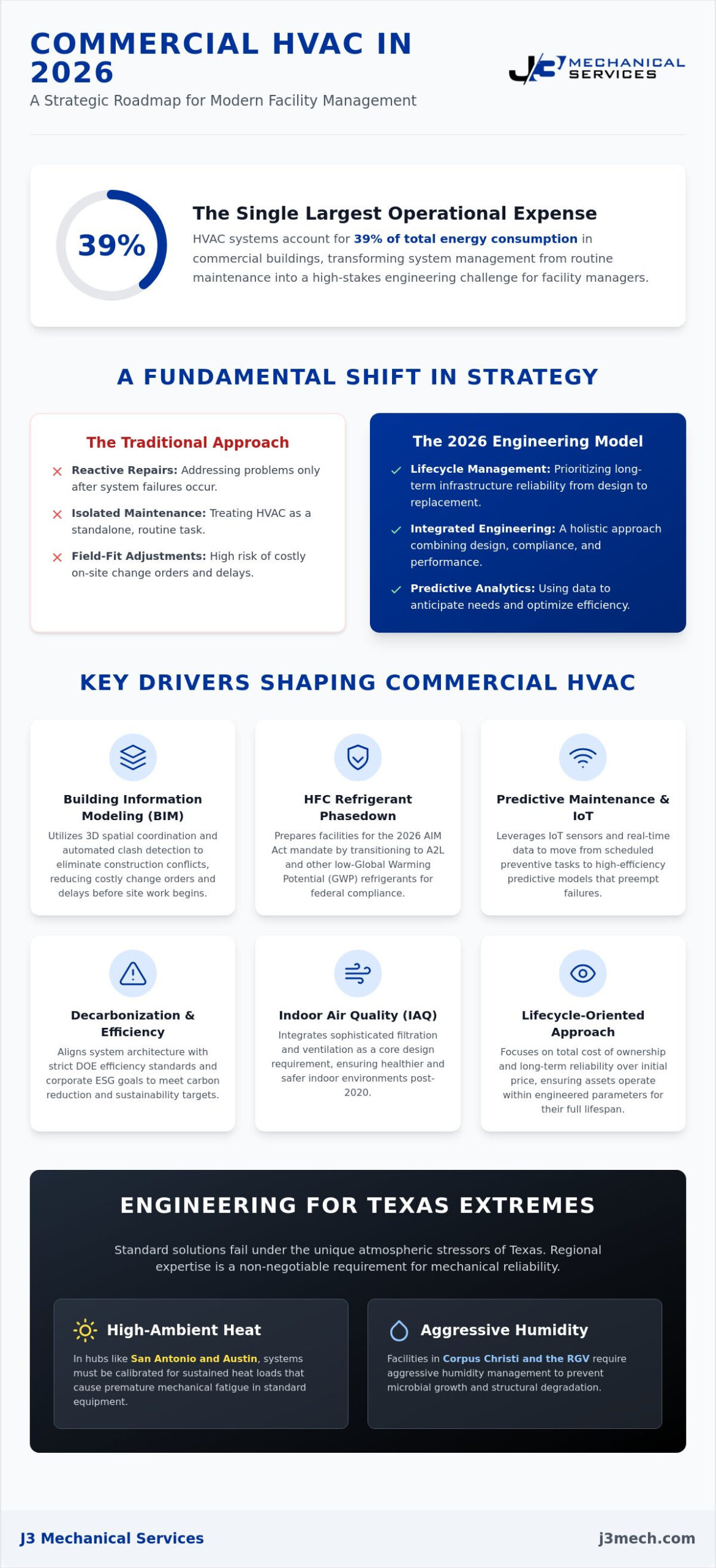
HVAC systems currently account for 39% of the total energy consumed in commercial buildings, representing the single largest operational expense for most Texas facilities. You likely recognize that managing these systems has transitioned from a routine maintenance task into a high-stakes engineering challenge, especially as extreme Texas climates continue to strain infrastructure and operational budgets. This analysis provides the technical clarity required to implement effective commercial hvac solutions that align with the 2026 industrial landscape, specifically addressing the HFC refrigerant phasedown and the integration of Building Information Modeling (BIM).
By examining decarbonization mandates and advanced mechanical coordination strategies, we will demonstrate how a disciplined approach to system design minimizes construction change orders and secures long-term operational stability. This guide serves as a strategic roadmap for facility managers who prioritize precision, ethical duty, and technical mastery in the oversight of their critical mechanical infrastructure.
Key Takeaways
- Understand how 3D spatial coordination via Building Information Modeling (BIM) mitigates construction risks and eliminates costly change orders before site work begins.
- Prepare for the 2026 HFC phasedown by transitioning to A2L and other low-GWP refrigerants as mandated by the federal AIM Act.
- Learn to leverage IoT sensors and real-time data to transition from traditional preventive maintenance to high-efficiency predictive models.
- Discover how integrated commercial hvac solutions provide the technical mastery needed to manage complex Texas facility requirements and rising energy costs.
- Shift your facility strategy from reactive repairs to a lifecycle-oriented mechanical engineering approach that prioritizes long-term infrastructure reliability.
Table of Contents
- The Evolution of Commercial HVAC Solutions in 2026
- Digital Coordination: The Role of BIM in Modern Mechanical Systems
- Navigating the Regulatory Shift: HFC Phasedown and Efficiency
- Strategic Lifecycle Management: Beyond Traditional Maintenance
- Engineering Reliability: Integrated Mechanical Solutions for Texas
The Evolution of Commercial HVAC Solutions in 2026
The discipline of Heating, ventilation, and air conditioning (HVAC) has undergone a fundamental transformation, moving away from isolated mechanical repairs toward a model of integrated mechanical engineering. Modern commercial hvac solutions now encompass the entire lifecycle of a facility, requiring a level of technical mastery that ensures operational stability from the initial design phase through decades of service. This shift is largely driven by the necessity for decarbonization, which has forced a total re-evaluation of system architecture to meet carbon reduction targets. Additionally, the heightened focus on Indoor Air Quality (IAQ) following the 2020 global health crisis has integrated sophisticated filtration and ventilation requirements into the core of building design rather than treating them as secondary considerations.
Drivers of Change: Efficiency and Compliance
Compliance in 2026 requires more than a simple checklist; it demands a proactive alignment with Department of Energy (DOE) efficiency standards that have redefined the selection criteria for rooftop units (RTUs). Facility managers now face the dual pressure of meeting these federal benchmarks while also satisfying corporate ESG goals that prioritize sustainable infrastructure. Standard maintenance protocols often don't meet the requirements for modern industrial compliance because they fail to account for the precise calibration required by high-efficiency mechanical systems. Adopting a comprehensive lifecycle approach ensures that every component operates within its engineered parameters, preserving both the warranty and the long-term viability of the asset.
The Texas Heat Factor: Engineering for Extremes
Engineering for the Texas climate requires a specialized understanding of regional atmospheric variables that standard equipment profiles often overlook. In high-growth hubs like San Antonio and Austin, systems must be calibrated for high-ambient temperature environments where sustained heat loads can cause premature mechanical fatigue. Conversely, facilities in Corpus Christi and the Rio Grande Valley require aggressive humidity management strategies to prevent microbial growth and structural degradation. Regional expertise is a non-negotiable requirement for large-scale mechanical reliability. Without a partner who understands these local stressors, even the most advanced commercial hvac solutions can fail under the weight of the Texas sun. This level of meticulous preparation distinguishes a master builder from a mere service provider who lacks the foresight to engineer for environmental extremes.
Digital Coordination: The Role of BIM in Modern Mechanical Systems
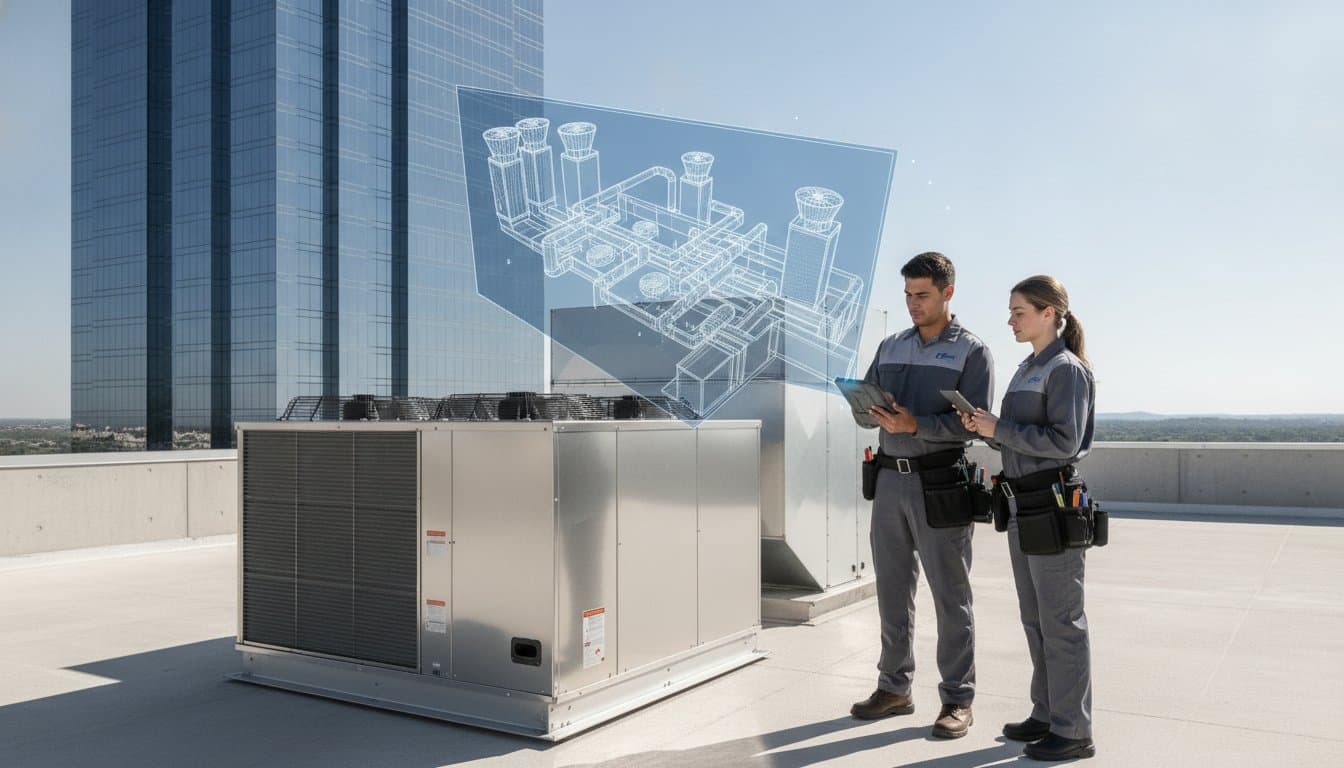
Building Information Modeling (BIM) has transitioned from a high-tech luxury to a non-negotiable prerequisite for complex new construction projects. As commercial hvac solutions evolve into digitally engineered infrastructure, the ability to coordinate mechanical systems within a virtual environment ensures that the physical installation proceeds without the friction of unforeseen structural conflicts. This methodology allows for the precise mapping of every component, from massive chillers to the smallest conduit, before a single technician arrives on the job site. By utilizing 3D spatial coordination, developers can effectively eliminate the traditional reliance on field-fit adjustments that frequently lead to budget overruns and schedule delays.
Visualizing Precision: The BIM Workflow
The core utility of BIM lies in its capacity for automated clash detection, which identifies trade interference between mechanical, electrical, and structural systems during the pre-construction phase. This proactive verification process ensures that a commercial ac unit installation is perfectly integrated into the building's architectural envelope, even in high-density builds where ceiling space is at a premium. Beyond simple geometry, these data-rich models serve as a permanent digital record that informs future maintenance and equipment replacement cycles. For instance, as facilities adapt to evolving HFC phasedown regulations, the BIM model provides exact specifications for refrigerant volumes and piping requirements, allowing for seamless upgrades. Building Information Modeling acts as a primary risk-mitigation tool that protects the financial and structural integrity of commercial developments.
In-House Fabrication: From Model to Reality
The synergy between digital modeling and in-house fabrication represents the pinnacle of modern mechanical precision. When the BIM model is finalized, the data is transmitted directly to fabrication facilities where custom sheet metal is manufactured to exact tolerances. This process is particularly advantageous for non-standard industrial spaces in Texas, where unique structural constraints often demand bespoke ductwork configurations. By maintaining local Texas fabrication capabilities, project teams can significantly reduce lead times and logistical friction that often plague national supply chains. These integrated commercial hvac solutions ensure that every piece of custom ductwork maintains airtight integrity and maximum thermal efficiency, directly contributing to lower operational costs over the system's lifecycle. Precision in the shop translates to speed on the roof, reinforcing the master builder's commitment to disciplined execution. If your project requires this level of logistical oversight, consider how a partner with advanced mechanical coordination capabilities can safeguard your investment.
Navigating the Regulatory Shift: HFC Phasedown and Efficiency
The regulatory environment surrounding commercial mechanical systems has reached a critical inflection point as the 2026 deadlines for the American Innovation and Manufacturing (AIM) Act take effect. Facility managers must now move beyond a basic understanding of equipment operation to master the complexities of the EPA's HFC Phasedown Program. This federal mandate directs an 85% reduction in HFC production and consumption by 2036, which is driving a mandatory transition to A2L and other low-GWP refrigerants like R-454B and R-32. Implementing modern commercial hvac solutions requires a technical understanding of these "mildly flammable" refrigerants, which necessitate specific safety protocols and handling procedures that differ significantly from legacy R-410A standards. It's no longer just an option to ignore these shifts; it's a requirement for maintaining the operational integrity of critical infrastructure like chillers and industrial boilers.
The Cost of Inaction: Refrigerant Scarcity
Refrigerant scarcity is a documented market reality that facility managers can't afford to overlook. With HFC production already restricted to 60% of the 2011-2013 baseline and a further drop to 30% scheduled for 2029, the price volatility of phased-out refrigerants will likely render legacy system repairs financially unsustainable. Facility owners must utilize a strategic decision framework to determine whether retrofitting existing units or pursuing full replacement is the most responsible course of action. Compliance audits have become essential, particularly as the leak repair and recordkeeping threshold drops on January 1, 2026, from 50 pounds to just 15 pounds for systems using HFCs with a GWP greater than 53. Adhering to ASHRAE 180 standards provides the necessary benchmark for maintenance, ensuring that infrastructure remains both efficient and legally compliant.
High-Efficiency Technologies: VRF and Beyond
The adoption of Variable Refrigerant Flow (VRF) systems has surged in multi-use commercial properties because they offer superior part-load efficiency and precise thermal control. These systems, when paired with Energy Recovery Ventilation (ERV), represent the current standard for modern office environments by optimizing indoor air quality without sacrificing energy performance. Integrating smart building controls allows for granular energy management, providing real-time data that identifies efficiency gaps before they impact the bottom line. By selecting advanced commercial hvac solutions, Texas facility managers can meet the 14.3 SEER2 minimum efficiency ratings while preparing for the 10-15% increase in energy performance expected under the 2026 commercial energy codes. Proactive planning ensures that your facility doesn't fall behind as the industry moves toward total electrification and decarbonization.
Strategic Lifecycle Management: Beyond Traditional Maintenance
The transition from preventive maintenance to predictive maintenance represents a fundamental shift in how facility managers preserve their mechanical assets. While traditional scheduled care relies on time-based intervals, modern commercial hvac solutions leverage real-time data to identify potential failure points before they result in catastrophic system shutdowns. By integrating IoT sensors that monitor vibration, amperage draw, and refrigerant pressure, technicians can detect subtle deviations from baseline performance that often precede a mechanical collapse. This proactive oversight is particularly critical in environments where downtime isn't just an inconvenience but a financial catastrophe, such as data centers where server cooling is vital or hospitals where patient safety depends on precise climate control. Developing a multi-year capital plan allows facility owners to move away from reactive "emergency spending" and toward a structured investment strategy that accounts for the 2026 regulatory shifts previously analyzed.
The Components of a Robust Maintenance Program
A disciplined maintenance regimen begins with scheduled inspections that adhere to rigorous ASHRAE 180 standards, ensuring that every component operates within its engineered parameters. These evaluations incorporate testing and balancing (TAB) to verify that the air distribution system performs according to its original design, which is essential for maintaining the energy efficiency gains promised by modern equipment. For systems utilizing commercial boilers and cooling towers, precise water treatment is a non-negotiable requirement. Without a systematic approach to preventing scale and corrosion, the thermal efficiency of these units will degrade rapidly, leading to increased energy consumption and the eventual premature failure of expensive heat exchangers.
Emergency Recovery Strategies
Despite the most meticulous preparation, the extreme Texas climate demands a comprehensive strategy for 24/7 emergency repair to protect against critical infrastructure failure during peak load periods. Redundancy planning, such as implementing N+1 configurations for chiller plants or rooftop units, ensures that operational continuity is maintained even if a primary component goes offline for service. Industry data consistently demonstrates that a commitment to systematic, predictive maintenance reduces emergency repair costs by up to 30% by addressing minor component wear before it escalates into a total system failure. This level of logistical foresight distinguishes a stable facility from one plagued by unpredictable change orders and operational friction. To ensure your facility maintains this level of industrial resilience, consider establishing a predictive maintenance partnership that prioritizes long-term stability and technical mastery.
Engineering Reliability: Integrated Mechanical Solutions for Texas
The complexity of the 2026 industrial landscape demands more than a traditional service provider; it requires a partner who operates with the gravitas of a seasoned consultant and the precision of a master builder. J3 Mechanical Services fulfills this role by providing commercial hvac solutions that synthesize technical mastery with a disciplined approach to project management. This "Master Builder" philosophy prioritizes meticulous preparation and ethical accountability, ensuring that every mechanical system is treated as a critical piece of infrastructure rather than a mere series of tasks. For facility managers across the Texas corridor, this means moving beyond quick fixes toward long-term stability and system integrity. By integrating advanced digital modeling with in-house fabrication, the firm delivers a level of predictability that is essential for managing high-stakes commercial environments.
Comprehensive Service Across the Texas Corridor
Serving the rapid growth along the I-35 corridor and the Coastal Bend requires a specialized understanding of regional mechanical stressors. From the high-ambient temperature demands in Round Rock and Austin to the specific humidity management strategies required in Corpus Christi and the Rio Grande Valley, the firm adapts its engineering to meet local atmospheric realities. This capacity extends across a diverse portfolio of project types, including high-rise developments in San Antonio and expansive industrial fabrication facilities in New Braunfels and San Marcos. Rooted in faith-based principles, the organization maintains a commitment to transparent, ethical contracting that ensures every stakeholder is held to the highest standard of professional conduct. This alignment of values and technical competence provides the foundation for successful large-scale mechanical coordination.
Your Next Step in Facility Optimization
Securing the future of your facility begins with a proactive assessment of your current mechanical assets against the 2026 regulatory benchmarks. Conducting a comprehensive system audit is the first step in establishing an accurate budget that accounts for the HFC phasedown and rising energy performance standards. For those embarking on new construction or major retrofits, engaging with BIM experts early in the design phase is essential for mitigating risks and preventing costly field-fit adjustments. Establishing a 24/7 service partnership provides the peace of mind necessary to maintain operational continuity in the face of the extreme Texas climate. To begin a strategic consultation for commercial hvac installation or to discuss your upcoming new construction requirements, contact our engineering team to ensure your commercial hvac solutions are built for long-term reliability.
Securing Mechanical Resilience for the 2026 Industrial Horizon
The transition toward the 2026 industrial landscape requires a strategic pivot from traditional maintenance to a model of integrated mechanical engineering. By prioritizing BIM-coordinated project execution and aligning with the HFC phasedown mandates, facility managers can effectively safeguard their critical infrastructure against rising energy costs and regulatory volatility. These commercial hvac solutions provide the technical mastery necessary to manage the extreme climates of the San Antonio-Austin-Corpus Christi corridor while ensuring long-term operational stability through every seasonal peak. It's a shift that replaces reactive uncertainty with the quiet confidence of total project control.
Achieving this level of mechanical reliability demands a partner who views every project through the lens of ethical duty and technical precision. J3 Mechanical Services stands ready to provide the disciplined oversight and 24/7 emergency recovery required for high-stakes industrial facilities. By implementing a lifecycle-oriented approach that emphasizes proactive modeling and predictive care, you can transform your mechanical systems into a resilient asset that supports your broader organizational objectives. Partner with J3 Mechanical for Precision HVAC Solutions and secure the future of your Texas infrastructure today.
Frequently Asked Questions
What are the most common commercial HVAC solutions for high-efficiency buildings?
High-efficiency buildings typically utilize Variable Refrigerant Flow (VRF) systems and Energy Recovery Ventilation (ERV) to optimize thermal loads. These commercial hvac solutions offer precise zone control and waste heat recovery, significantly reducing the energy consumption required to maintain indoor air quality in extreme Texas environments. Integrating these technologies ensures that the facility meets modern decarbonization mandates while lowering long-term operational costs.
How does BIM coordination reduce costs in HVAC new construction?
BIM coordination identifies trade interferences in a virtual environment before physical construction begins. This proactive clash detection eliminates the need for expensive field-fit adjustments and significantly reduces the volume of change orders. By verifying spatial requirements in 3D, project teams can maintain strict construction timelines and avoid the logistical friction associated with traditional mechanical coordination, protecting the developer's financial interests.
What is the impact of the HFC refrigerant phasedown on my existing commercial system?
The HFC phasedown under the AIM Act will lead to a significant reduction in the availability of legacy refrigerants like R-410A through 2026. As production limits drop to 60% of the baseline, the cost of repairing older units will likely become unsustainable for many facilities. Managers should evaluate their current inventory to determine if a strategic replacement with low-GWP A2L equipment is more financially viable than maintaining obsolete systems.
Can predictive maintenance actually prevent emergency mechanical failures?
Predictive maintenance utilizes IoT sensors to monitor real-time mechanical variables such as vibration and amperage draw to identify deviations from engineered baselines. These data-driven insights allow technicians to address minor component wear before it escalates into a catastrophic failure. Consistent monitoring can reduce emergency repair costs by up to 30% by ensuring that critical infrastructure remains within its optimal operational parameters throughout the year.
Why is in-house fabrication better than using third-party ductwork suppliers?
In-house fabrication ensures that custom ductwork is manufactured to the exact tolerances defined in the digital BIM model. This integrated approach eliminates the lead-time delays and logistical friction often associated with third-party suppliers who lack direct project oversight. By controlling the fabrication process, a contractor can guarantee the airtight integrity and thermal efficiency required for high-performance industrial environments in the San Antonio and Austin corridor.
What should I look for when vetting commercial HVAC contractors in San Antonio?
When vetting contractors in Central Texas, you should prioritize firms with documented BIM capabilities and a portfolio of large-scale industrial projects. It's essential to select a partner who offers 24/7 emergency response and possesses deep regional expertise in managing high-ambient heat loads. A contractor's ability to demonstrate technical mastery and ethical accountability is a key indicator of long-term project success and infrastructure reliability.
How often should a commercial HVAC system undergo a comprehensive performance audit?
A comprehensive performance audit should be conducted at least once per year, ideally during the spring months before the peak Texas cooling season begins. These audits verify that the system is operating according to ASHRAE 180 standards and identify any efficiency gaps that could lead to inflated operational costs. Regular assessments are vital for maintaining the integrity of commercial hvac solutions in facilities with high-stakes uptime requirements.
Is it possible to retrofit modern smart controls into an older commercial mechanical system?
Retrofitting smart controls into older mechanical systems is often possible through the integration of modern Building Automation Systems (BAS). These overlays provide granular visibility into system performance and allow for the implementation of advanced energy-saving sequences that weren't available when the equipment was installed. While the technical feasibility is high, the decision should be guided by a thorough analysis of the remaining useful life of the existing mechanical hardware. For facilities planning a full equipment upgrade, reviewing a comprehensive commercial rooftop AC unit installation guide for Texas can provide the engineering framework needed to align new equipment selection with 2026 ASHRAE 90.1 efficiency requirements.
Need a hand with your building's HVAC?
Free quotes and honest answers from licensed commercial technicians across South Texas.