
Commercial HVAC Trends 2026: What Facility Leaders Should Know
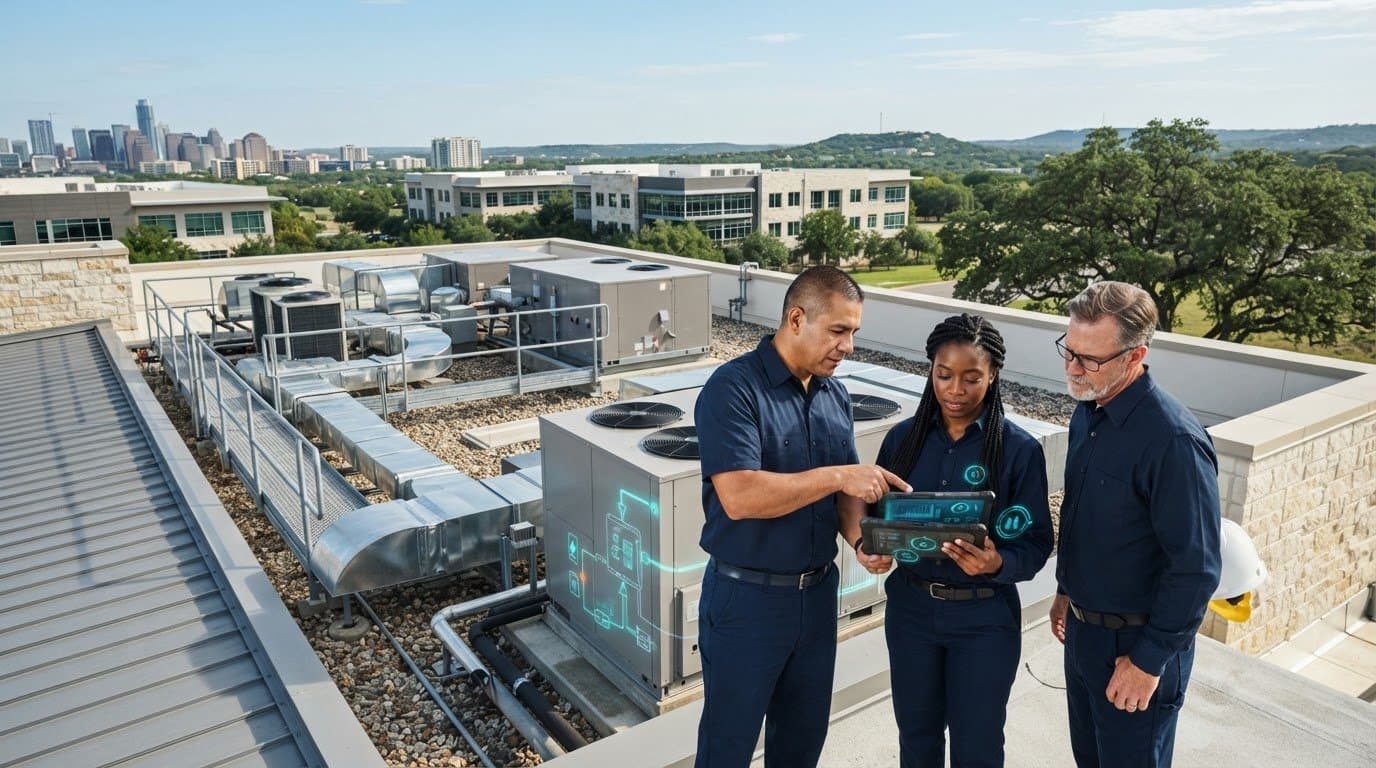
The most advanced HVAC option isn’t automatically the right next move for a commercial facility. The commercial HVAC trends 2026 brings into focus, from lower-GWP refrigerants and electrification to smart controls and indoor air quality, matter most when they address a defined facility need and fit the building’s operating realities.
It’s reasonable to ask whether emerging technologies are ready for your building, whether an upgrade can deliver a measurable benefit, and how installation can be planned without unnecessary disruption. A sound decision weighs energy performance alongside reliability, system condition, building requirements, and the practical demands of construction or replacement. Not every trend warrants immediate investment, and not every facility has the same priorities.
This article helps facility leaders identify relevant developments and connect them to a defensible upgrade or operating strategy. It examines refrigerant changes, heat pumps, VRF systems, connected controls, predictive maintenance, and indoor air quality, while outlining what to assess with a qualified commercial HVAC contractor. The goal is to help prioritize projects, not to chase every new technology.
Key Takeaways
- Use lifecycle performance, operating continuity, and capital-planning evidence to determine which HVAC changes deserve attention in your building.
- Assess commercial HVAC trends 2026 against documented facility needs, not generalized forecasts or vendor claims.
- Before comparing options, clarify the performance gap, system condition, project dependencies, and outcomes your facility needs to achieve.
- Use a structured roadmap to evaluate HVAC priorities in Central or South Texas, accounting for the distinct conditions at each location.
- Understand how commercial HVAC installation, replacement, maintenance, BIM coordination, and in-house fabrication can support project planning and delivery.
Commercial HVAC Trends in 2026: Why Facility Priorities Are Shifting
Not every widely discussed HVAC trend belongs in every building. A connected control platform may address a visibility gap in one facility, while another needs a reliability assessment or a carefully planned equipment replacement. In 2026, the sound decision is not to pursue novelty. It is to align system choices with lifecycle performance, operating continuity, and evidence-based capital planning.
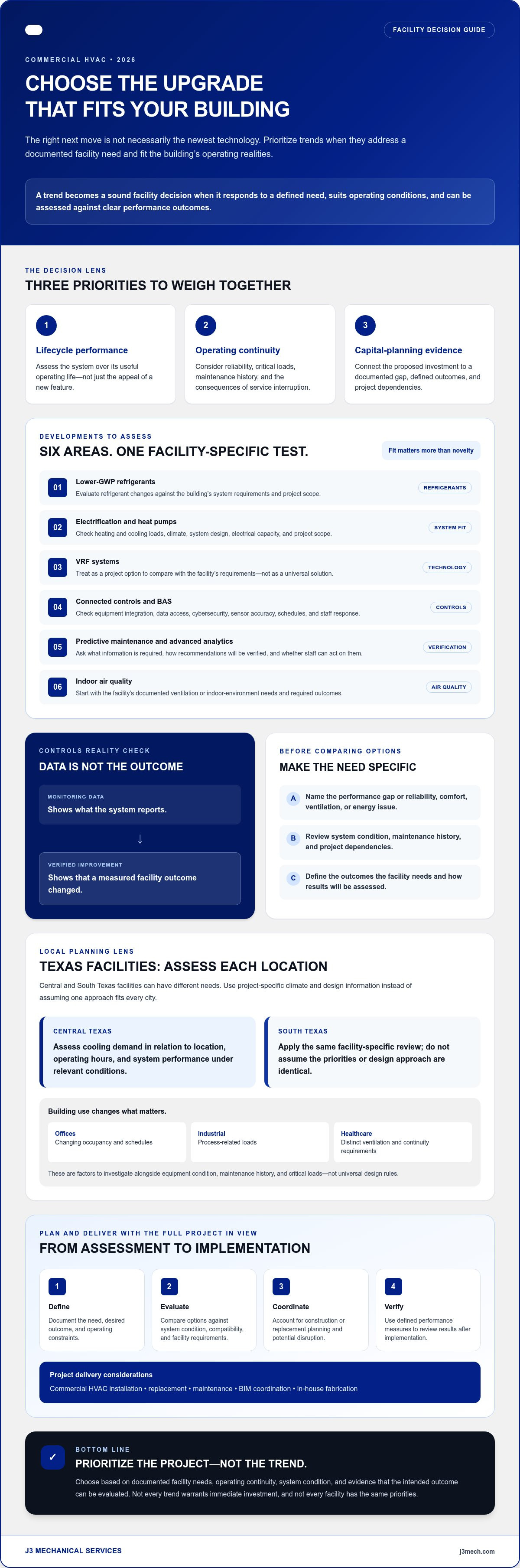
A commercial HVAC trend becomes a measurable facility decision when it responds to a documented need, fits the building’s operating conditions, and can be evaluated against defined performance outcomes. This standard helps facility leaders distinguish a viable project from a technology claim that has not been tested against their requirements.
Why commercial HVAC priorities differ by building
Building use shapes the assessment. Offices may have changing occupancy and schedules; industrial facilities can have process-related loads; healthcare settings may have distinct ventilation and continuity requirements. These are factors to investigate, not universal design rules. Consider them alongside equipment condition, maintenance history, critical loads, and the consequences of service interruption.
Texas adds a local planning consideration: assess cooling demand in relation to each facility’s location, operating hours, and system performance under relevant conditions. Needs can differ across Central and South Texas, so use project-specific climate and design information rather than assuming one approach suits every city. A foundational overview of Heating, ventilation, and air conditioning (HVAC) can clarify system purpose, but it cannot replace a facility-level assessment.
Separate durable developments from passing claims
Equipment efficiency, controls, and system coordination are established areas of HVAC planning. Their value still depends on correct application, integration, and operation. Newer applications, including advanced analytics or AI-assisted maintenance, warrant closer scrutiny. Ask what information they require, how recommendations will be verified, and whether facility staff can act on them.
Start with a documented reliability, comfort, ventilation, or energy issue. Then determine whether a proposed trend can address it, what system changes or operational dependencies it introduces, and how results will be assessed after implementation. If a business case depends on market forecasts or adoption statistics, verify the original source and publication date before using those figures to support a capital decision. A credible proposal connects the technology to a specific facility outcome instead of relying on broad claims about what every building should adopt.
Commercial HVAC Technology Trends: Controls, Electrification, and Refrigerants
Technology is useful only when a building can integrate it, operate it, and verify its effect. For commercial HVAC trends 2026, assess connected controls, electrification, and refrigerant changes as separate decisions, not as a single package. Each has distinct system requirements, risks, and measures of success.
Connected controls and data-informed operation
A building automation system (BAS) coordinates building equipment through connected controls, allowing operators to review schedules, alarms, and system trend data within one operating framework. Depending on system compatibility and configuration, this visibility can help teams spot operating patterns, investigate comfort complaints, and coordinate equipment responses. It does not guarantee lower energy use. Schedules must reflect actual occupancy, sensors must provide reliable readings, and staff must respond to useful alerts.
Monitoring data shows what a system reports; verified operational improvement shows that a measured facility outcome changed. Before specifying controls, confirm how the platform will integrate with existing equipment, who can access the data, how cybersecurity will be managed, and whether readings are complete and accurate. Establish a baseline and define which operating measures will demonstrate value.
Electrification and lower-impact refrigerants
Heat pumps can support building electrification, but suitability depends on the facility’s heating and cooling loads, climate, system design, electrical capacity, and project scope. In Texas, assess cooling operation alongside heating requirements and determine whether the proposed equipment fits the building’s distribution systems and operating needs. The evaluation may support a new-construction specification, a replacement strategy, or a decision to retain existing equipment for now.
Refrigerant requirements also depend on equipment type, manufacture or import timing, installation circumstances, and applicable jurisdictional rules. As of 2026, the federal transition includes restrictions affecting new commercial VRF equipment using R-410A, while EPA amendments allow installation of existing R-410A inventory until depleted; state requirements may differ. R-32 and R-454B are among the lower-GWP alternatives used in applicable equipment and are classified as A2L refrigerants, meaning they are mildly flammable. Confirm the current rules for the project location and equipment rather than applying a general phaseout date to every system. The EPA’s guidance on refrigerant management and regulations is a useful reference, but project teams should verify current requirements and equipment availability before specifying a system.
- Check controls compatibility, data access, and cybersecurity responsibilities.
- Review heat-pump performance against actual building loads and system design.
- Confirm refrigerant rules, service implications, and local requirements for the selected equipment.
For commercial HVAC installation, replacement, or maintenance, facility leaders can review commercial HVAC services as a starting point for defining the system assessment and project scope.
How to Compare Commercial HVAC Trends Against Facility Needs
A newer system is not automatically the right investment. Evaluate each option against a documented performance gap, then compare operational fit, integration demands, maintainability, and the disruption required to implement it. This framework turns commercial HVAC trends 2026 into project decisions grounded in facility evidence rather than novelty, vendor claims, or generalized forecasts.
| Trend or option | Potentially suitable conditions | Dependencies to assess | Questions to investigate |
|---|---|---|---|
| Connected controls or analytics | Limited system visibility, inconsistent schedules, or difficulty identifying operating patterns | Existing equipment compatibility, sensor quality, data access, cybersecurity, and staff capacity to respond | Will the system address a verified control issue? How will outcomes be measured? |
| Heat pumps or electrification | A planned replacement or building change where electrification merits evaluation | Heating and cooling loads, climate, electrical capacity, system design, and project scope | Can the proposed equipment serve the building’s actual loads and operating requirements? |
| Equipment replacement | Persistent reliability concerns, capacity mismatch, or equipment condition that warrants review | Existing distribution, installation requirements, building operations, and equipment availability | How does replacement compare with maintenance, controls work, or targeted improvements? |
| Refrigerant transition | New construction or equipment replacement requiring a refrigerant specification | Equipment type, current regulations, local requirements, and service implications | Have the applicable rules and equipment requirements been confirmed for this project? |
When controls or analytics may be a better first step
Limited visibility or schedules that do not reflect actual building use can justify a controls assessment, but these symptoms do not prove controls are the root cause. If equipment cannot meet demand because of capacity or condition, monitoring alone will not resolve the underlying problem. Establish baseline operating information, verify sensor and schedule accuracy, and obtain qualified review before estimating savings or attributing improvement to a proposed system.
When equipment replacement or electrification merits review
Review replacement when asset condition, serviceability, capacity needs, or planned building changes suggest that existing equipment may no longer fit. Compare the full scope with alternatives such as maintenance, controls adjustments, or targeted improvements, accounting for integration requirements and disruption to occupied operations. For project planning considerations, consult this commercial HVAC installation guide. A defensible selection explains why the chosen approach fits the facility better than the available alternatives.
A Texas Facility Roadmap for Evaluating HVAC Trends in 2026
Translate commercial HVAC trends 2026 into a project sequence that reflects your building, location, and operating requirements. Facilities in San Antonio, Selma, Seguin, Austin, Corpus Christi, Killeen, Joshua, Bandera, Beorne, New Braunfels, Edinburg, Mccallen, Rio Grand Valley, Rockport, Pleasanton, San Marcos, and Round Rock may have different climate conditions, schedules, building uses, and infrastructure constraints. Do not assume a strategy developed for one city will suit another. Use these steps to set priorities before selecting equipment or controls.
- Document issues. Record comfort complaints, reliability interruptions, ventilation concerns, and capacity limitations, noting when and where they occur. Gather equipment records, service history, operating schedules, and available performance data so decisions start with observable facility conditions.
- Assess assets. Review equipment condition, maintenance needs, serviceability, and how well current systems meet building demands. Include planned occupancy or building changes that could alter loads or system requirements, rather than evaluating equipment in isolation.
- Define outcomes. Establish what a project must improve, such as operating continuity, comfort, energy performance, or the ability to serve a changed space. Make the desired outcome specific enough to guide option selection and later review.
- Compare options. Weigh maintenance, controls, targeted improvements, replacement, and electrification against the documented need. Check integration requirements, project disruption, equipment availability, and applicable codes, utility programs, and incentives for the project’s exact location. Confirm current applicability with relevant authorities and program administrators before relying on them in a project plan.
- Plan delivery. Address equipment access, constructability, work sequencing, and impacts on building operations before implementation begins. For complex projects, BIM coordination and fabrication planning may help teams resolve spatial and installation considerations; see this BIM and HVAC fabrication guide for further context.
Establish a defensible facility baseline
Reliable decisions depend on a clear account of how the building performs now. Compare available operating data with schedules and service records, and connect reported problems to specific equipment, spaces, or operating periods where possible. This baseline helps distinguish an isolated complaint from a recurring system issue and gives the project team a reference point for evaluating proposed work.
Coordinate design, trades, and implementation
Planning should account for how equipment will reach its installation location, how work will be sequenced, and which building operations may be affected. Coordinate these details early, especially where multiple systems or constrained spaces are involved. Performance also needs attention after installation. Review this commercial HVAC maintenance protocol for considerations after project completion.
For facility-specific planning, discuss commercial HVAC installation, replacement, or maintenance with a qualified contractor.
Putting Commercial HVAC Trends Into Practice With a Texas Contractor
Trend assessment becomes actionable when facility priorities are translated into a defined scope of work. Depending on system condition and project goals, that scope may involve commercial HVAC installation, replacement, new construction, maintenance, or repair. The commercial HVAC trends 2026 worth pursuing are those that address a clear requirement, can be coordinated with building operations, and can be reviewed against agreed criteria.
J3 Mechanical Services specializes in commercial HVAC work across Texas, including BIM coordination and in-house fabrication. These capabilities can support project coordination and delivery planning, particularly where building conditions or installation constraints call for careful preparation. J3 serves commercial facilities in San Antonio, Selma, Seguin, Austin, Corpus Christi, Killeen, Joshua, Bandera, Beorne, New Braunfels, Edinburg, Mccallen, Rio Grand Valley, Rockport, Pleasanton, San Marcos, and Round Rock. Confirm availability for your location and project needs.
Questions to ask before selecting an HVAC project partner
A clear discussion of scope and responsibility helps facility teams evaluate a contractor’s fit before work begins. Consider asking:
- How will existing equipment, operating conditions, and project assumptions be assessed and documented?
- What coordination process will address access, sequencing, building operations, and interactions with other project work?
- Can BIM coordination or in-house fabrication support the project’s requirements, and which responsibilities remain with other project participants?
- Which services are included in the proposed scope, and is service available at the facility’s location?
Answers should make the project approach understandable, including what is known, what needs confirmation, and how proposed work relates to the facility’s stated priorities.
From trend assessment to project scope
Once a priority is selected, translate it into specific requirements. A controls-related need, for example, should identify the equipment or operating issue to address and how results will be reviewed. A replacement scope should define the equipment and building requirements to confirm during project planning. Maintenance work should specify the assets and ongoing needs covered by the agreed scope.
Before work proceeds, align with the project team on acceptance, commissioning responsibilities, and operational review criteria. Make clear who will document each item and how performance will be assessed. These criteria should reflect the project design and facility objectives rather than promise a predetermined result.
If your facility is evaluating an installation, replacement, or maintenance project, discuss its documented needs and constraints with a qualified commercial HVAC contractor. J3 Mechanical Services may be a fit when its Texas coverage and commercial HVAC services match your requirements.
Turn HVAC Priorities Into a Defensible Plan
The most useful commercial HVAC trends 2026 are not necessarily the newest technologies. They are the options that address a documented facility need and can be assessed against clear operating goals. Start with system condition, reliability, building requirements, and project constraints, then compare controls, equipment upgrades, and maintenance approaches for practical fit. Verify applicable requirements for your location before moving from evaluation to specification.
For Texas facility leaders, a qualified commercial HVAC contractor can help translate priorities into a defined installation, replacement, maintenance, or emergency repair scope. J3 Mechanical Services works across communities including San Antonio, Selma, Seguin, Austin, Corpus Christi, Killeen, Joshua, Bandera, Beorne, New Braunfels, Edinburg, Mccallen, Rio Grand Valley, Rockport, Pleasanton, San Marcos, and Round Rock. Its BIM coordination and in-house fabrication capabilities can support project planning where relevant. The right approach depends on your building and the work required, so begin with a clear review of existing conditions and desired outcomes.
Discuss your commercial HVAC project with J3 Mechanical Services to identify a practical next step for your facility. With a measured plan and qualified project support, you can move forward with greater clarity and confidence.
Frequently Asked Questions
What are the biggest commercial HVAC trends in 2026?
Key areas to assess include connected controls, data-informed operation, electrification, refrigerant changes, and system reliability. Controls and equipment developments are established planning considerations, while specific applications and adoption forecasts may be less certain. The commercial HVAC trends 2026 that matter to a facility depend on its equipment, occupancy, operating requirements, and project scope. Verify current regulations and cite dated, named sources for market statistics before using them to guide investment decisions.
How could refrigerant changes affect commercial HVAC projects in 2026?
Refrigerant changes can affect equipment selection, installation planning, and service requirements, but the impact depends on equipment type, refrigerant, project circumstances, and applicable rules. Confirm current EPA requirements, local requirements, equipment availability, and service implications with qualified professionals before specifying a system. Avoid assuming that every existing system must be replaced. Regulatory details can change, so date and source any compliance statements used in a project plan.
Are heat pumps a practical option for commercial buildings in Texas?
Heat pumps may suit some Texas commercial projects, but a building-specific engineering review is needed to determine fit. Assess heating and cooling loads, local climate conditions, existing distribution, electrical capacity, and operating requirements. For example, a replacement project and a new-construction project may have different design constraints. Compare proposed options against the facility’s needs, and verify performance claims using current sources relevant to the equipment and project conditions.
What does smart HVAC mean for a commercial facility?
Smart HVAC generally refers to connected controls, sensors, and building automation that help facility teams monitor and coordinate system operation. These tools can provide schedules, alarms, and trend data, improving visibility into how equipment is operating. Data alone does not guarantee better performance or lower energy use. Before investing, assess equipment integration, sensor and data quality, cybersecurity, and whether the facility has clear operating objectives and processes for responding to system information.
Should a commercial building replace its HVAC system in 2026?
Not solely because it is 2026. A replacement decision should reflect system condition, repair history, capacity, serviceability, operating needs, and planned building changes. A qualified assessment can compare replacement with maintenance, controls improvements, or targeted upgrades, using site-specific information rather than a trend-driven recommendation. Document the problem the project is intended to address, the options considered, and how the selected approach will be reviewed after implementation.
How can facility managers prioritize commercial HVAC upgrades?
Prioritize upgrades by documenting facility problems, reviewing equipment records and schedules, defining outcomes, and comparing options for operational fit, integration, maintainability, and disruption. Verify applicable codes and incentive eligibility locally. J3 Mechanical Services provides commercial HVAC installation, replacement, maintenance, and emergency repair, with BIM coordination and in-house fabrication, in San Antonio, Selma, Seguin, Austin, Corpus Christi, Killeen, Joshua, Bandera, Beorne, New Braunfels, Edinburg, Mccallen, Rio Grand Valley, Rockport, Pleasanton, San Marcos, and Round Rock. Confirm availability for your location and project needs.
Need a hand with your building's HVAC?
Free quotes and honest answers from licensed commercial technicians across South Texas.