
Commercial Mechanical Contractor: Engineering Precision for Texas Facilities in 2026
The integrity of a Texas facility's infrastructure is decided long before the first chiller is set, rooted instead in the digital rigor of a specialized commercial mechanical contractor. For stakeholders managing mission critical environments in the San Antonio to Austin corridor, the cost of a single coordination error or a mid-summer system failure is simply too high to leave to chance. You understand that inconsistent communication and reactive change orders don't just drain budgets, they compromise the long term stability of your entire operation.
By partnering with an organization that prioritizes technical mastery, you can eliminate these risks through systematic execution. This article explores how the integration of Level of Development (LOD) 400 Building Information Modeling (BIM) and in-house fabrication ensures zero-defect precision while meeting the stringent energy standards of 2026. We'll examine the strategic advantages of a master builder approach, showing you how to secure a coordinated mechanical system that reduces lifecycle costs and thrives under the relentless Texas heat.
Key Takeaways
- Understand the technical distinction between routine HVAC repair and the comprehensive lifecycle management provided by an authoritative commercial mechanical contractor.
- Discover how LOD 400 BIM modeling and in-house fabrication create a digital-to-physical pipeline that eliminates costly change orders and field-fit errors.
- Learn to implement predictive maintenance protocols that safeguard critical infrastructure against the extreme thermal demands of the Central Texas climate.
- Assess the essential vetting metrics, such as Experience Modification Rates (EMR) and financial bonding, required for high-stakes 2026 facility projects.
- Evaluate the operational advantages of a specialized partner whose geographic focus and dedicated HVAC expertise ensure consistent, high-performance outcomes.
Beyond HVAC: The Strategic Role of a Commercial Mechanical Contractor
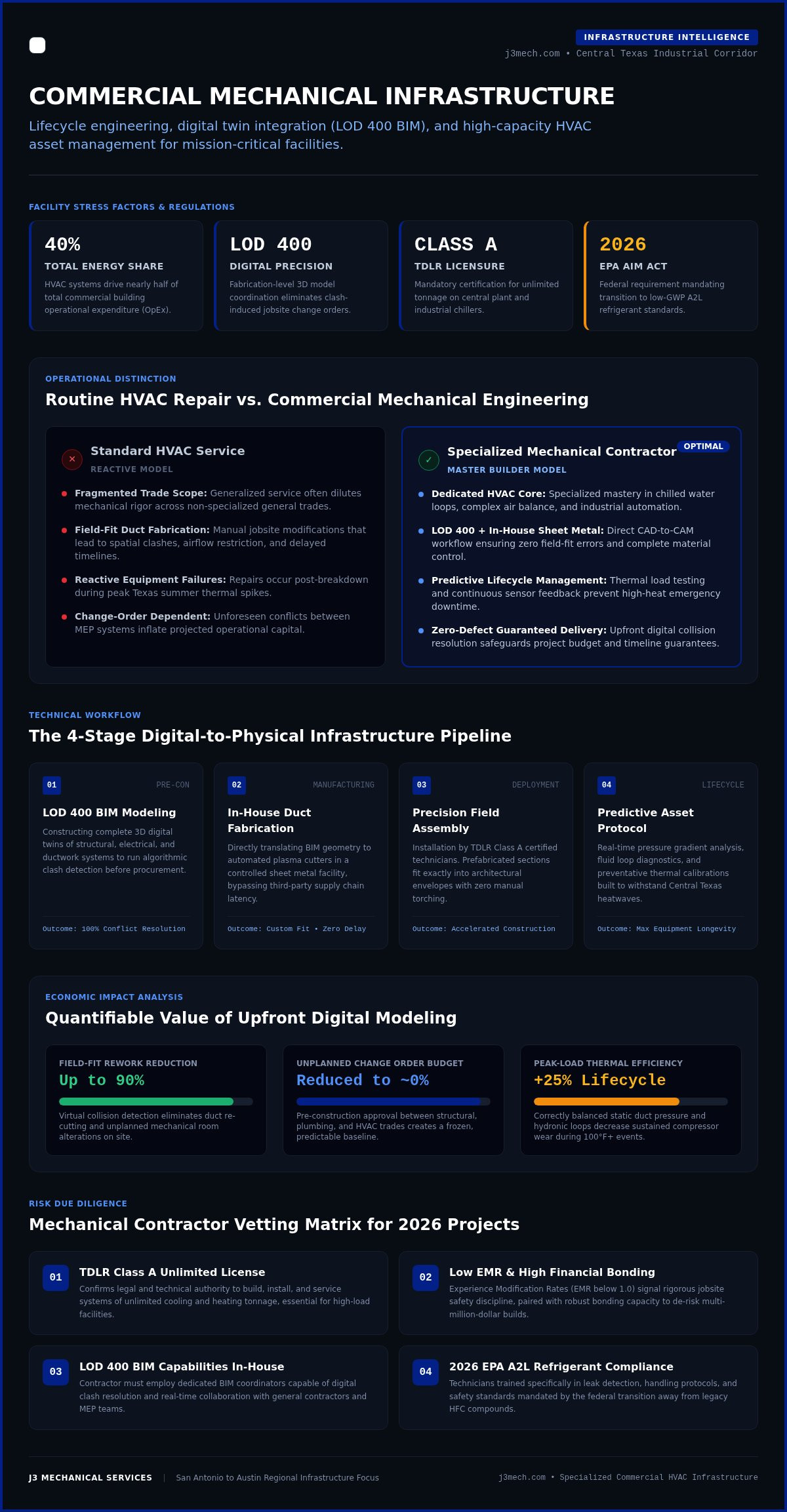
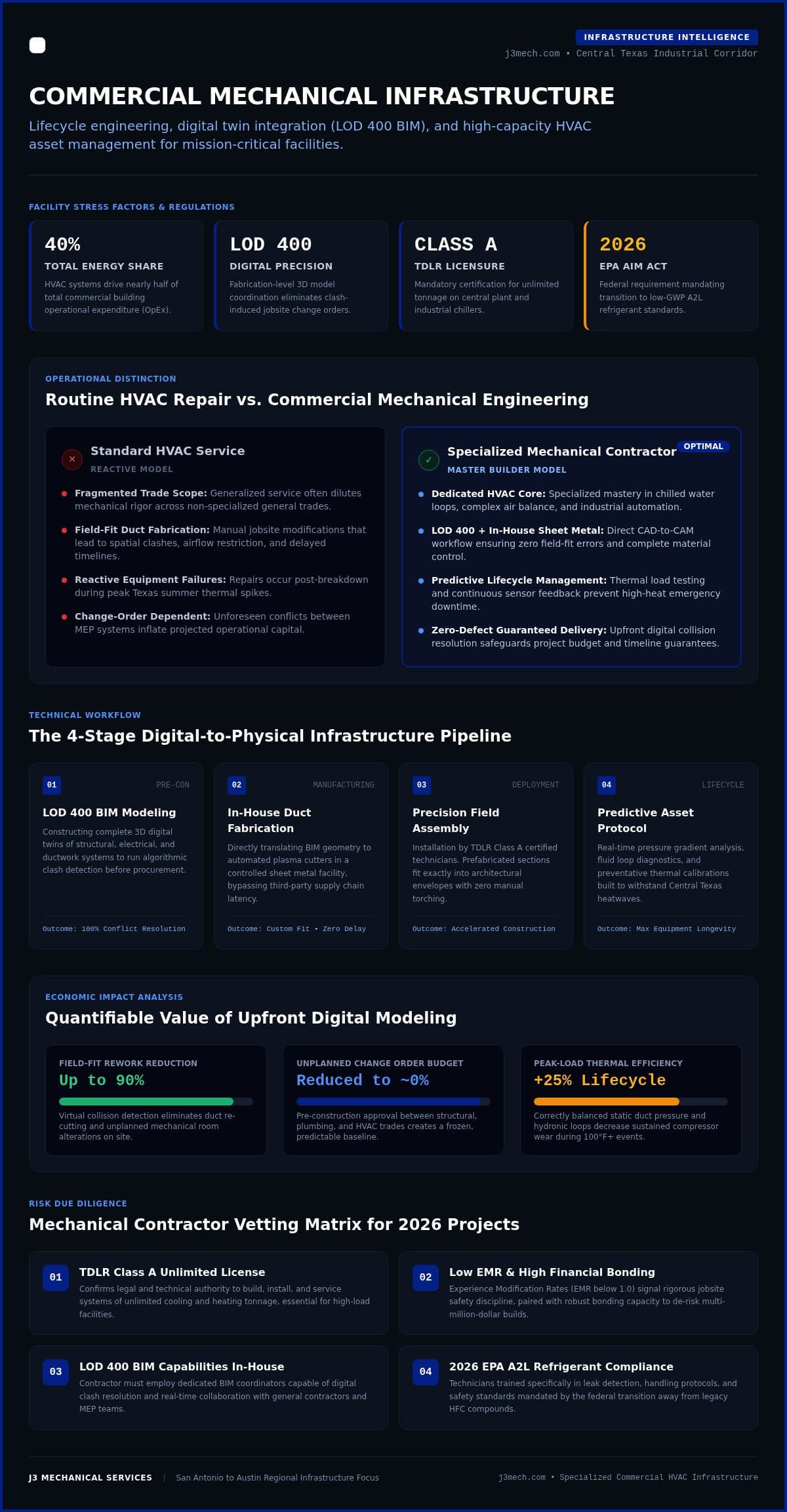
A commercial mechanical contractor functions as a strategic infrastructure partner rather than a mere service provider, managing the intricate lifecycle of high-capacity mechanical systems from conceptual engineering through long-term asset optimization. While residential services focus on localized comfort, the mechanical contractor oversees the complex fluid and air distribution networks that sustain industrial, healthcare, and corporate environments. This role requires a disciplined mastery of logistics, engineering precision, and a proactive commitment to reducing building operational expenditures (OpEx), which is essential given that HVAC systems account for approximately 40% of total commercial energy consumption.
Industrial Standards vs. Residential Practices
The distinction between residential HVAC repair and the work of a commercial mechanical contractor is defined by scale and technical rigor. Texas facilities operate under extreme thermal loads that demand industrial-grade equipment, such as high-pressure chilled water loops and multi-ton rooftop units, which far exceed the capacity of standard split systems. Maintaining these assets requires a Texas TDLR Class A Air Conditioning and Refrigeration license, which permits work on equipment of unlimited tonnage. By maintaining a specialized focus exclusively on HVAC infrastructure and intentionally excluding general plumbing, a contractor ensures a higher level of technical mastery in air balance, hydronic systems, and complex building automation.
The Lifecycle of Commercial Mechanical Assets
Strategic asset management begins with an engineering-first mindset during the pre-construction phase, where the use of Building Information Modeling (BIM) allows for the creation of digital twins to identify spatial conflicts before they manifest on the jobsite. This forward-thinking approach extends through the installation phase and into a comprehensive maintenance lifecycle that accounts for regulatory shifts, such as the 2026 transition to A2L refrigerants mandated by the EPA AIM Act. Understanding The Role of a Commercial HVAC Contractor in Modern Facility Infrastructure is vital for stakeholders who seek to future-proof their buildings against both environmental stress and evolving federal energy mandates.
Precision Engineering: Leveraging BIM and In-House Fabrication
In the high-stakes environment of 2026 commercial construction, a commercial mechanical contractor must move beyond traditional field-fit methods to embrace a digital-to-physical pipeline. By utilizing Building Information Modeling (BIM) at a Level of Development (LOD) 400, contractors create a high-fidelity digital twin of the facility's mechanical systems before any physical work begins. This process identifies spatial conflicts between HVAC ductwork, structural steel, and electrical conduits, effectively neutralizing the change order culture that often stalls large-scale Texas projects and inflates budgets.
BIM Coordination: Eliminating Field Conflicts
Digital coordination serves as the primary safeguard for project timelines and long-term system integrity. Through 3D clash detection, engineers can simulate the installation of complex mechanical rooms to ensure that every hanger, pipe, and duct fits within the designated architectural envelope. This collaborative environment allows for real-time adjustments with other trades, ensuring that the physical build mirrors the engineered intent without the need for reactive field modifications. BIM functions as a comprehensive risk-mitigation tool that provides facility owners with certainty regarding both system performance and installation schedules.
The Value of In-House Ductwork Fabrication
The transition from a digital model to a physical asset is most efficient when handled through in-house fabrication. By maintaining a dedicated sheet metal shop, a commercial mechanical contractor can control material quality and lead times, bypassing the logistical delays associated with third-party sourcing. This capability is particularly critical for projects in the San Antonio and Austin corridors, where unique architectural constraints often require custom ductwork configurations that standard off-the-shelf components cannot accommodate. For a deeper look at these integrated processes, consider reviewing our HVAC Sheet Metal Fabrication: A Commercial Guide to understand how precision engineering drives successful outcomes.
Integrating these technologies typically leads to a 30% to 50% reduction in field labor hours, as pre-tested, modular assemblies arrive on-site ready for immediate installation. This efficiency doesn't only speed up the construction schedule; it also ensures that systems are built to the rigorous technical standards necessary for future compliance with ANSI/ASHRAE/ACCA Standard 180. If you're planning a new facility, it's beneficial to consult with a specialist regarding your pre-construction coordination to ensure long-term operational stability and reduced material waste.
Asset Management: Maintenance Protocols for Large-Scale Mechanical Systems
The operational longevity of a facility's mechanical infrastructure depends on a fundamental shift from reactive repair to a disciplined asset management strategy. In 2026, a professional commercial mechanical contractor prioritizes predictive maintenance protocols that utilize systematic inspections to identify potential failure points before they result in catastrophic downtime. This proactive approach ensures that critical systems, which account for nearly 40% of building energy consumption, operate at peak efficiency throughout their entire service life while minimizing the total cost of ownership.
Predictive vs. Reactive Maintenance
A "run-to-fail" mentality introduces unacceptable risks to mission-critical operations, particularly when considering the financial impact of unscheduled outages in the Texas heat. By implementing Commercial HVAC Maintenance: A Strategic Protocol, facility managers can leverage data-driven insights to schedule interventions during planned windows. This systematic oversight provides a clear cost-benefit advantage, as the incremental expense of routine verification is significantly lower than the emergency costs associated with component failure and lost productivity. Customized preventive maintenance programs are further tailored to specific facility usage patterns, ensuring that high-demand environments like data centers receive more rigorous oversight than standard commercial office spaces.
Texas-Specific Environmental Challenges
Texas facilities face unique atmospheric stressors that require specialized maintenance programs tailored to regional conditions. In the Corpus Christi and Rio Grande Valley regions, high humidity and salt-laden air accelerate the corrosion of condenser coils and structural supports, necessitating frequent wash-downs and the application of specialized protective coatings. Conversely, in rapidly developing areas like Round Rock, the influx of construction-related dust and particulates requires more aggressive filtration management to prevent premature wear on blower motors and heat exchangers. Seasonal preparation protocols are essential to ensure that systems are calibrated for the volatile weather cycles common to the Central and South Texas corridors, where temperatures can fluctuate violently within a single 24-hour period.
Quantifying the ROI of consistent mechanical oversight involves analyzing reduced utility expenditures and the significant extension of equipment life cycles. Beyond financial metrics, the availability of 24/7 emergency services provides a layer of institutional security, ensuring that any unforeseen technical anomalies are addressed with technical mastery and immediate accountability. A strategic partnership with an ethically driven commercial mechanical contractor guarantees that your facility remains resilient against both environmental extremes and operational degradation, securing the integrity of your building's most vital systems.
Vetting Criteria: How to Evaluate Mechanical Contracting Partners
Selecting a commercial mechanical contractor is a strategic decision that dictates a facility’s operational risk profile for decades. In the complex landscape of 2026 construction, stakeholders must look beyond surface-level estimates to evaluate a partner’s technical rigor and financial durability. A verifiable Experience Modification Rate (EMR) below 1.0 is a mandatory indicator of safety compliance; elite contractors often maintain rates below 0.80, signaling a disciplined culture that protects both personnel and project timelines. Furthermore, substantial bonding capacity and a transparent balance sheet are essential for large-scale Texas projects to ensure the firm can navigate the logistical demands of multi-year contracts without financial friction.
Transparency in the bidding process serves as a litmus test for professional integrity. The lowest initial bid often obscures systemic deficiencies, such as the intent to use third-party fabricators or an inability to manage complex digital coordination. When a contractor provides a logic-driven presentation of their methodology, they demonstrate a commitment to preventing the hidden costs of field-fit errors and reactive change orders. You should prioritize firms that possess a "master builder" persona, characterized by a deep investment in the final product's integrity and a preference for meticulous preparation over rapid, uncoordinated execution.
Technical and Logistical Capacity
Evaluating a contractor’s specific experience with high-stakes environments, such as healthcare or industrial logistics, is vital for ensuring they understand the unique thermal and regulatory demands of your sector. A firm must demonstrate a seamless digital pipeline by proving they employ dedicated in-house BIM and fabrication teams rather than outsourcing these critical functions. For mission-critical infrastructure, the availability of 24/7 emergency support is not an optional service but a fundamental requirement for maintaining uptime under the thermal stress of the Texas climate. To understand the specific requirements for local projects, consult our Vetting Commercial HVAC Fabrication in San Antonio guide for a comprehensive breakdown of 2026 standards.
Ethical Alignment and Accountability
Long-term project success is often rooted in the ethical consistency of the contracting partner. Organizations driven by faith-based principles offer a unique level of accountability, viewing their work as a critical infrastructure responsibility rather than a series of transactional tasks. This ethical duty manifests in transparent communication and rigorous project management reporting, where risks are identified proactively rather than buried. Choosing a partner with a strong local presence in Central Texas ensures a level of accountability that national providers cannot match, as local firms are deeply invested in the regional economy and their own professional reputation within the community. If you are ready to secure your facility's future, we invite you to review our qualifications and see how our disciplined approach delivers technical excellence.
J3 Mechanical Services: Specialized Infrastructure Solutions in Central Texas
J3 Mechanical Services operates as a dedicated commercial mechanical contractor, maintaining a disciplined focus exclusively on high-performance HVAC systems. By intentionally omitting general plumbing services from our portfolio, we ensure that our engineering resources and technical personnel remain concentrated on the complexities of thermal management and air distribution. This specialization allows our team to achieve a level of technical mastery that is often diluted in multi-trade firms, providing facility owners with the assurance that their critical infrastructure is managed by experts who view mechanical integrity as a primary responsibility.
Our "Master Builder" philosophy is the foundation of our operational methodology, emphasizing meticulous preparation and digital coordination as the primary safeguards against project friction. From our headquarters in Selma, we serve as a proactive partner for facilities throughout the San Antonio, Austin, and Corpus Christi corridors, delivering precision-engineered solutions that thrive under the thermal stress of the Texas environment. This commitment to excellence is reinforced by our 24/7 emergency response capabilities, ensuring that mission-critical operations maintain continuous uptime even during the most volatile weather cycles of 2026.
Coordinated Execution from San Antonio to Austin
Navigating the specific building codes and environmental demands of Central Texas requires a contractor with deep localized expertise and a sophisticated logistical infrastructure. J3 Mechanical Services utilizes a seamless digital-to-physical pipeline, where our in-house fabrication and BIM teams collaborate to deliver high-performance HVAC installation protocols for both new construction and complex facility retrofits. By controlling every phase of the execution, we eliminate the delays associated with third-party sourcing and ensure that each component meets our rigorous standards for accuracy. For stakeholders planning their next capital project, our guide on Commercial HVAC Installation: Strategic Engineering provides a comprehensive framework for achieving precision execution.
Initiating Your Mechanical Strategy
Engaging with J3 Mechanical Services at the earliest stages of project development allows facility owners to leverage our pre-construction consulting and comprehensive facility assessments. Whether you're managing a transition from an aging, inefficient system to a precision-engineered replacement or designing a new state-of-the-art facility, our team provides the logic-driven insights necessary to optimize long-term asset performance. We guide you through the technical requirements of the 2026 energy landscape, ensuring your mechanical investments are both compliant and resilient. We invite you to Contact J3 Mechanical Services for a strategic consultation to discuss how our disciplined approach can secure the integrity and efficiency of your facility’s mechanical infrastructure.
Securing the Future of Texas Facility Infrastructure
The operational stability of a modern Texas facility is built upon the foundation of technical mastery and logistical foresight. As we navigate the regulatory and environmental complexities of 2026, the distinction between a standard service provider and a specialized commercial mechanical contractor becomes a critical factor in long-term asset performance. By prioritizing digital coordination through BIM and maintaining control over quality through in-house fabrication, you eliminate the systemic risks of field conflicts and costly change orders.
Resilience isn't an accidental outcome; it's the result of disciplined maintenance protocols and a commitment to 24/7 emergency readiness. Strategic facility management requires a partner who views infrastructure as a vital responsibility rather than a series of tasks. You have the opportunity to transition from reactive repairs to a model of engineering precision that safeguards your mission-critical operations against the most extreme thermal demands. We invite you to Secure your facility's infrastructure with J3 Mechanical Services and experience the peace of mind that comes from a master builder's approach. We look forward to helping you achieve a higher standard of mechanical excellence.
Frequently Asked Questions
What is the difference between a mechanical contractor and an HVAC company?
A mechanical contractor manages the entire lifecycle of complex mechanical systems, including central plants, hydronic loops, and industrial refrigeration. While an HVAC company often focuses on unitary residential or light commercial repairs, a commercial mechanical contractor handles large-scale engineering, logistics, and integrated building automation. This expertise is necessary for facilities requiring high-tonnage chillers and custom air distribution networks that exceed the scope of standard heating and cooling services.
How does BIM coordination reduce commercial construction costs?
BIM coordination reduces costs by identifying spatial conflicts in a digital environment before physical installation begins. By creating a high-fidelity digital twin, teams can perform 3D clash detection between HVAC, structural, and electrical trades. This foresight prevents the expensive change order culture that typically inflates budgets. It streamlines the construction schedule and reduces material waste, ensuring that custom assemblies fit perfectly on the first attempt without reactive field modifications.
Does J3 Mechanical Services provide commercial plumbing?
J3 Mechanical Services does not provide general plumbing services. Our organization maintains a disciplined focus exclusively on commercial HVAC installation, maintenance, and new construction to ensure the highest level of technical mastery. By specializing in mechanical infrastructure rather than acting as a generalist, we provide facility owners with authoritative expertise in complex air and fluid distribution systems. This focus is central to our commitment to engineering precision across all Texas projects.
What areas of Texas does J3 Mechanical Services cover?
Our service footprint extends throughout the San Antonio and Austin corridors, reaching into the Rio Grande Valley and North Texas. We actively support facilities in Selma, New Braunfels, Seguin, and San Marcos, as well as coastal regions like Corpus Christi and Rockport. Additionally, we provide specialized mechanical services in Killeen, Round Rock, and Edinburg. This broad geographic reach allows us to deliver consistent, high-performance HVAC solutions to diverse industrial and corporate environments across Central and South Texas.
Why is in-house fabrication important for commercial HVAC projects?
In-house fabrication is essential because it allows a commercial mechanical contractor to control quality and lead times without relying on third-party vendors. By utilizing our own sheet metal shop, we can produce custom ductwork and modular assemblies that match the exact specifications of the BIM model. This integrated approach eliminates logistical delays and ensures that every component is built to rigorous industrial standards, which is vital for meeting the unique architectural constraints of modern Texas facilities.
What should I look for in a commercial HVAC maintenance contract?
A robust contract should prioritize predictive maintenance over reactive repairs to minimize total lifecycle costs. Look for protocols that include systematic data-driven inspections, vibration analysis, and condition-based monitoring of critical assets. The agreement should be tailored to your facility's specific usage patterns and include 24/7 emergency response. Verify that the contractor uses specialized technicians who understand industrial-grade equipment and can ensure compliance with evolving 2026 energy and refrigerant standards.
How do high Texas temperatures affect commercial HVAC design?
Extreme Texas temperatures require designs that prioritize thermal resilience and grid demand response. Systems must be engineered with redundant dual-circuit infrastructure and variable-frequency drives (VFDs) to manage peak cooling loads efficiently. High ambient heat places massive stress on chillers and rooftop units, necessitating oversized condenser surface areas and specialized coatings to prevent degradation. Our engineering approach accounts for these thermal stresses to ensure your facility remains operational when the ERCOT grid and local temperatures are at their most volatile.
Does J3 Mechanical offer 24/7 emergency HVAC repair?
Yes, J3 Mechanical Services provides 24/7 emergency response for critical mechanical infrastructure. We understand that system downtime in a mission-critical Texas facility can result in significant financial loss or operational compromise. Our technical teams are equipped to handle high-pressure repairs and technical anomalies at any hour, ensuring that your facility’s HVAC systems are restored with technical mastery. This commitment to reliability is a cornerstone of our strategic partnership with facility owners across Central Texas.
Need a hand with your building's HVAC?
Free quotes and honest answers from licensed commercial technicians across South Texas.