
Commercial Mechanical Services: Engineering Precision for Texas Facilities in 2026
The structural integrity of a Texas facility often hinges not on the visible architecture, but on the invisible precision of its mechanical systems. While many operators view HVAC as a series of isolated components to be repaired, true operational stability requires treating these systems as critical infrastructure that demands rigorous engineering. You've likely experienced the frustration of a project stalled by poorly coordinated trades or the financial sting of an unexpected system failure that halts production. It's a common reality where fragmented planning leads to costly change orders and extended downtime, undermining the very efficiency your facility was designed to achieve.
Securing the long-term reliability of your commercial mechanical services involves more than just routine oversight; it requires a disciplined integration of advanced technology and logistical mastery. This article explores how specialized mechanical engineering, Building Information Modeling (BIM) coordination, and in-house fabrication work in tandem to eliminate construction friction and stabilize overhead. We'll examine the technical standards necessary for seamless HVAC integration in new construction and the systematic approach required for rapid emergency recovery. By prioritizing meticulous preparation and digital verification, you can transform your mechanical infrastructure into a predictable asset that supports your facility's mission well into 2026 and beyond.
Key Takeaways
- Recognize that sophisticated commercial mechanical services demand a level of engineering precision and technical mastery that far exceeds conventional HVAC repair.
- Understand how Building Information Modeling (BIM) and in-house fabrication eliminate field delays by resolving complex spatial conflicts during the pre-construction phase.
- Transition from a reactive emergency mindset to a strategic maintenance protocol designed to extend the lifecycle of high-stakes industrial assets.
- Identify the specific vetting criteria, such as safety EMR and bonding capacity, essential for selecting a reliable mechanical partner for large-scale Texas projects.
- Leverage the "Master Builder" approach to ensure that your new construction or system replacement projects achieve total operational stability and long-term reliability.
Defining Commercial Mechanical Services: Beyond Standard HVAC
Commercial mechanical services represent the disciplined engineering and strategic management of large-scale thermal systems within complex facility environments. While residential services focus on individual comfort, industrial-grade mechanical infrastructure prioritizes operational continuity, precise environmental control, and long-term asset protection. It's a field where the margin for error is non-existent. A failure in a multi-story medical facility or a data center has consequences far beyond a simple repair bill. Mechanical services are the integrated lifecycle management of climate control systems.
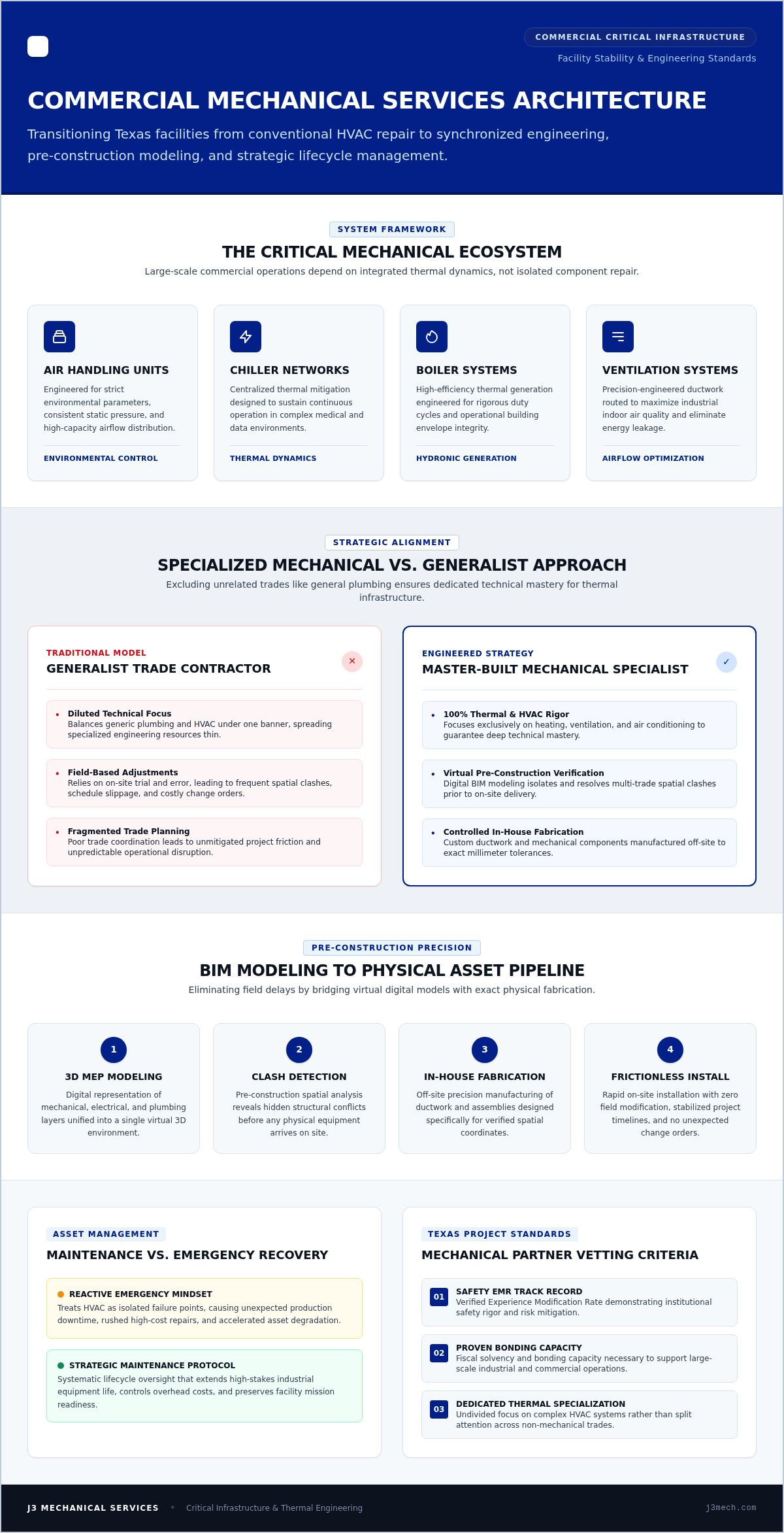
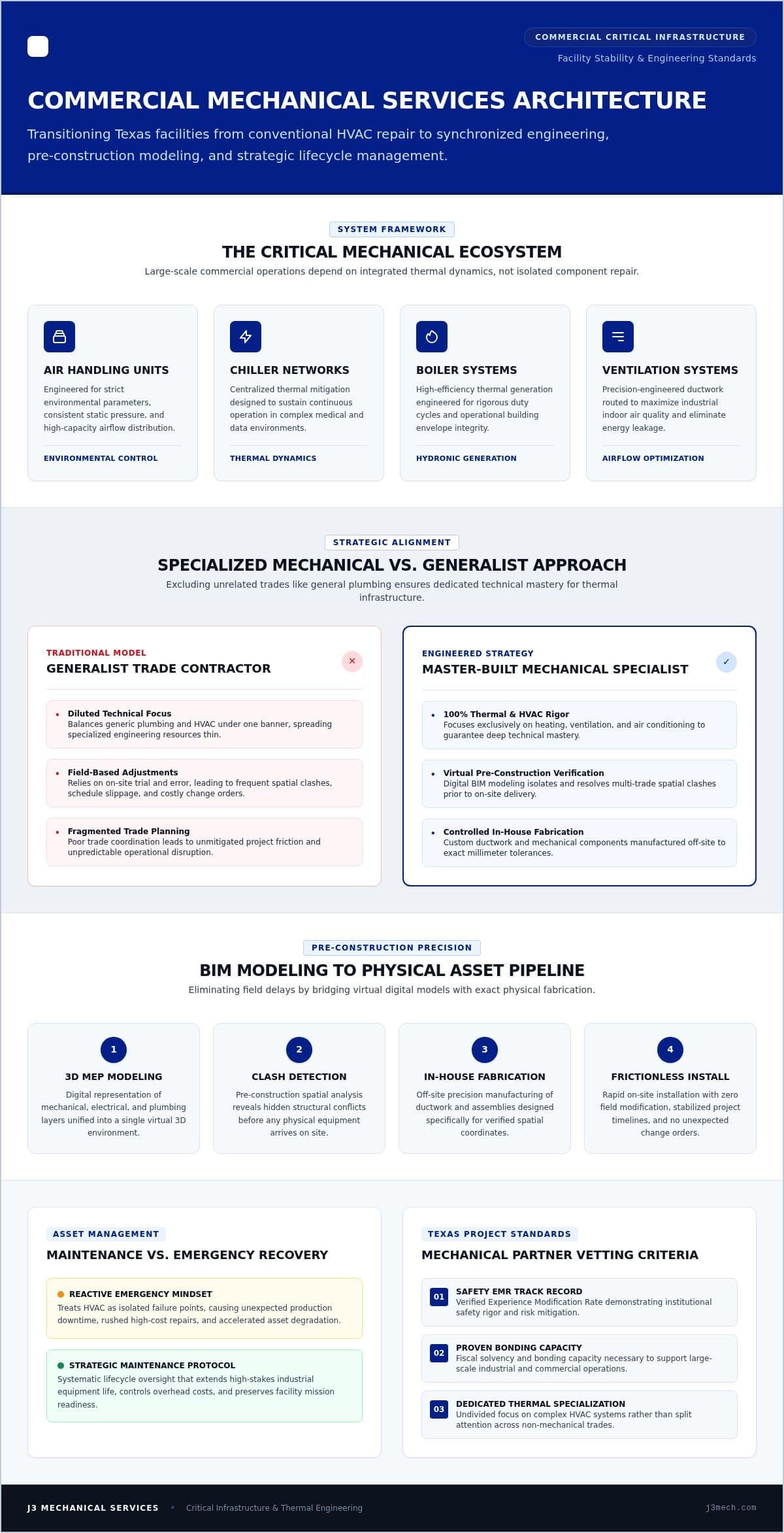
At J3 Mechanical Services, we intentionally exclude general plumbing from our service portfolio. This isn't a limitation; it's a commitment to technical mastery. By focusing exclusively on heating, ventilation, and air conditioning systems, we ensure that our engineering resources are dedicated entirely to the complexities of thermal dynamics and air distribution. This specialization allows us to provide a level of rigor that generalists cannot match. When your contractor isn't distracted by unrelated trades, they can focus entirely on the precision of your mechanical infrastructure.
The Core Components of Mechanical Infrastructure
Large-scale facilities depend on a synchronized network of air handling units, chillers, and boiler systems to maintain strict environmental parameters. These components are far more than mere machinery; they're the heart of the facility's lifecycle. Integrating advanced commercial hvac solutions ensures that ductwork and ventilation systems are optimized for industrial air quality and energy efficiency. Precision in these systems directly impacts the longevity of the entire building envelope. When these systems are engineered correctly, they provide a stable foundation for all other facility operations, reducing the likelihood of catastrophic failure.
Specialization vs. Generalization
The market often presents generalist contractors who attempt to balance plumbing and HVAC under a single banner. This approach frequently dilutes the specialized knowledge required for modern, high-efficiency mechanical systems. The role of a commercial hvac contractor in 2026 has evolved into that of a technical strategist who uses digital modeling and engineering rigor to mitigate risks. Choosing a specialized mechanical contractor ensures that every phase of the project, from initial design to final commissioning, receives the undivided attention of subject matter experts. This focused expertise is what differentiates a standard installation from a master-built infrastructure project, providing you with a partner who views their work as a critical infrastructure responsibility.
The Strategic Advantage of BIM and In-House Fabrication
The execution of modern commercial mechanical services relies on the seamless transition from virtual design to physical installation. Relying on field-based adjustments is a liability that leads to budget overruns and schedule slippage. Instead, a disciplined approach utilizes advanced modeling to resolve conflicts before a single piece of equipment arrives on-site. This proactive strategy ensures that every component is engineered for its specific spatial environment, maintaining the integrity of the building’s design while optimizing system performance. When digital precision meets physical craftsmanship, the result is a facility built for long-term stability.
BIM Coordination: Eliminating Field Errors
Digital modeling serves as the primary defensive measure against project delays. BIM is a digital representation of the physical and functional characteristics of a facility. By visualizing mechanical, electrical, and plumbing (MEP) layers within a single 3D environment, engineers can identify clash points that would otherwise remain hidden until the construction phase. This systematic verification provides several critical advantages for complex projects:
- Proactive identification of spatial conflicts between ductwork and structural steel.
- Verification of maintenance access zones to ensure long-term serviceability.
- Alignment with ASHRAE mechanical engineering standards and guidelines for airflow and safety.
When clash detection is performed during the pre-construction phase, the need for expensive field modifications is virtually eliminated. This allows the project to proceed with surgical precision, ensuring that the final installation matches the engineered intent without compromise.
In-House Fabrication and Precision Engineering
The integration of hvac sheet metal fabrication directly into the project lifecycle offers unparalleled quality control. When components are manufactured in a controlled shop environment rather than on a chaotic job site, the accuracy of every joint and seam is guaranteed. Custom ductwork solutions can be tailored to meet unique architectural requirements or specific industrial air quality needs without the typical lead times associated with third-party vendors. This in-house capability allows for the pre-assembly of complex mechanical sections, which significantly accelerates installation timelines.
By synchronizing the digital BIM model with the fabrication floor, we ensure that every piece fits perfectly upon delivery. This level of logistical coordination is essential for commercial mechanical services in high-stakes facilities that cannot afford the risks of uncoordinated trades or delayed recovery. If you are planning a high-stakes project, evaluating a partner's mechanical fabrication capabilities is a critical step in risk mitigation.
Comprehensive Asset Management: Maintenance vs. Emergency Recovery
Asset management in the mechanical sector isn't merely a checklist of tasks. It's a strategic protocol designed to safeguard the building's most expensive physical investments. Effective commercial mechanical services require a clear distinction between the steady-state oversight of preventive care and the high-stakes urgency of system restoration. While the former focuses on the preservation of efficiency and the extension of equipment lifecycle, the latter demands a disciplined, rapid response to mitigate the financial and operational fallout of a sudden failure. Transitioning from a reactive to a proactive mindset is the foundation of modern facility stability.
Preventive Maintenance Protocols for Texas Climates
Texas facilities face unique environmental stressors, from the unrelenting thermal loads of a San Antonio summer to the corrosive humidity levels found along the coastal corridors and the Rio Grande Valley. A strategic approach to commercial hvac maintenance involves systematic inspections of critical components including water-cooled chillers, high-output boiler systems, and rooftop units (RTUs). In regions with high mineral content in the water or extreme ambient temperatures, descaling and coil cleaning are essential for maintaining heat transfer efficiency. By verifying sensor accuracy and lubricant integrity before peak demand periods, operators can significantly lower their operational expenditure (OPEX) and avoid the energy spikes associated with struggling equipment.
To understand the strategic value of each approach, consider the following comparison of service models:
| Strategic Factor | Preventive Maintenance (PM) | Emergency Recovery |
|---|---|---|
| Primary Objective | Asset longevity and peak efficiency | Immediate restoration of service |
| Financial Impact | Predictable, lower OPEX | High, unbudgeted capital expense |
| Operational Risk | Minimal, planned downtime | Significant, unscheduled disruption |
| System State | Optimized performance | Critical failure recovery |
Rapid Recovery: 24/7 Emergency Mechanical Services
Despite the most rigorous maintenance, critical failure points such as compressor seizures, VFD failures, or electrical control malfunctions can still occur, necessitating immediate commercial hvac repair. In an industrial or high-traffic commercial setting, every hour of system downtime translates directly into lost production, spoiled inventory, or compromised safety. Our response strategy is rooted in the same "master builder" discipline used during construction, prioritizing a logical, diagnostic-driven recovery process. By maintaining 24/7 dispatch capabilities, we ensure that Texas facilities have a steadfast partner capable of managing high-stakes mechanical crises without friction. This commitment to rapid recovery is a vital component of a comprehensive approach to commercial mechanical services.
Vetting Mechanical Contractors for Large-Scale Texas Projects
Selecting a partner for commercial mechanical services in the Texas corridor requires a rigorous evaluation process that extends far beyond a simple review of past projects. Facility managers and developers must prioritize contractors who demonstrate both technical depth and financial resilience. For large-scale infrastructure, a firm's Experience Modification Rate (EMR) serves as a critical indicator of their operational discipline, while their bonding capacity provides a metric for their corporate stability. These figures reflect a contractor's ability to manage the inherent risks of complex industrial projects without compromising safety or schedule.
Technical Capacity and Resource Self-Sufficiency
Schedule control is the most frequent point of failure in major construction, and self-sufficiency is the primary defense against it. Contractors who maintain an in-house BIM department and fabrication floor provide a level of logistical coordination that generalist firms cannot replicate. When you are vetting commercial HVAC fabrication in San Antonio, it's essential to verify the software integration between the digital modeling team and the manufacturing shop. This direct link ensures that custom ductwork and mechanical skids are produced with surgical accuracy, which is vital for the rapid development cycles seen in cities like New Braunfels and Killeen. Ask prospective partners about their specific BIM software standards and how they manage clash detection in-house to prevent field-based modifications.
Safety, Ethics, and Professional Accountability
The integrity of a facility's mechanical system is often a reflection of the ethical framework of the contractor who built it. In the Texas market, a disciplined, faith-based approach to professional principles ensures a higher standard of accountability and transparent communication. This "master builder" persona is characterized by a commitment to technical excellence and a moral duty to the project's long-term success. Such firms are more likely to maintain strict compliance with Texas mechanical codes and industrial standards, even when facing tight deadlines. Whether your project is in the coastal environment of Corpus Christi or the industrial centers of Central Texas, choosing a partner with a proven history of ethical consistency and project stability is the most effective way to mitigate long-term operational risk. To secure this level of engineering mastery for your facility, you should partner with a specialized mechanical contractor that prioritizes technical precision.
J3 Mechanical Services: Specialized Solutions for Critical Infrastructure
J3 Mechanical Services operates as a disciplined strategist in the Texas mechanical landscape, providing specialized commercial mechanical services that prioritize long-term stability over temporary fixes. Our geographic reach extends from the industrial hubs of Austin and San Antonio through the coastal corridors and down to the Rio Grande Valley. We approach every project with the gravitas of a master builder, ensuring that the integrity of the final product is rooted in meticulous preparation and technical mastery. This authoritative focus on HVAC-specific engineering allows us to manage high-stakes environments with a level of predictability that generalist contractors cannot provide.
Unmatched Expertise in Commercial HVAC Installation
Strategic engineering is the cornerstone of our approach to new construction and large-scale facility upgrades. We integrate Building Information Modeling (BIM) and in-house fabrication into every major project phase to eliminate the construction friction that often leads to budget overruns. By self-performing these critical functions, we maintain total control over the project schedule and the quality of every mechanical component. This commitment to precision ensures that your HVAC infrastructure isn't just installed, but engineered for optimal thermal performance and industrial air quality. Our team views every mechanical contract as a critical infrastructure responsibility, providing the accountability necessary for seamless system integration.
Partnering for Long-Term Facility Performance
The decision to exclude general plumbing from our offerings is a deliberate choice to maintain an uncompromising focus on HVAC mastery. This specialization allows us to support facility managers through the entire system lifecycle, from initial design and installation to strategic asset management and rapid emergency recovery. By acting as a dedicated mechanical partner, we help you transition from a reactive maintenance mindset to a logic-driven protocol that protects your capital investment. Our methodology is designed to mitigate risks before they manifest, ensuring that your facility remains operational and efficient regardless of external thermal loads. For those seeking a partner who values ethical consistency and technical rigor, it's time to Contact J3 Mechanical Services for a Technical Consultation.
Ultimately, the reliability of a facility's climate control system depends on the technical discipline of the experts behind it. J3 Mechanical Services stands as a seasoned consultant for Texas facilities, providing the commercial mechanical services necessary to ensure your infrastructure remains a stable asset well into the future. By prioritizing meticulous preparation and digital verification, we transform complex mechanical challenges into predictable, high-performance solutions.
Engineering a Stable Operational Future
The complexity of modern facility management demands a shift from reactive repairs to disciplined infrastructure engineering. By integrating BIM-coordinated project delivery and in-house fabrication, you eliminate the logistical friction that threatens project timelines and budgets. This systematic approach ensures that your commercial mechanical services are not just a series of tasks, but a strategic investment in long-term reliability. A specialized focus on commercial and industrial HVAC provides the technical depth required to manage extreme Texas thermal loads without the dilution of unrelated trades.
Whether you're overseeing new construction or managing critical asset recovery, technical discipline remains the only path to operational stability. Our dedicated 24/7 emergency repair teams stand ready to restore your facility's integrity with surgical precision. It's time to move beyond standard maintenance and embrace a partnership rooted in accountability and engineering mastery. Secure Your Facility's Future with J3 Mechanical Services today and build a foundation for sustained excellence.
Frequently Asked Questions
What is the difference between an HVAC contractor and a mechanical contractor?
A mechanical contractor oversees the comprehensive engineering, installation, and lifecycle management of large-scale climate control systems. While an HVAC contractor might focus on specific equipment repair, mechanical contractors provide the structural and logistical coordination required for industrial-grade infrastructure. This includes managing complex thermal dynamics and ensuring that all components work as a synchronized unit. J3 Mechanical Services provides specialized commercial mechanical services, prioritizing technical mastery to ensure the long-term reliability of your facility.
Why is BIM coordination important for commercial HVAC projects?
Building Information Modeling (BIM) is essential because it allows for the digital visualization of all mechanical, electrical, and plumbing layers before physical construction begins. By identifying spatial conflicts or "clashes" in a 3D model, engineers can resolve issues that would otherwise lead to expensive field modifications. This proactive coordination ensures that installations proceed with surgical precision, significantly reducing the likelihood of project delays or unbudgeted change orders in high-stakes commercial environments.
Does J3 Mechanical Services provide general plumbing for businesses?
J3 Mechanical Services does not provide general plumbing services for businesses. We have made a deliberate strategic decision to exclude plumbing to maintain an uncompromising focus on commercial HVAC engineering and technical mastery. This specialization ensures that our resources and expertise are dedicated entirely to the complexities of thermal systems and air distribution. By concentrating exclusively on commercial mechanical services, we provide a level of rigor and accountability that generalist contractors often lack.
How often should a commercial HVAC system undergo preventive maintenance?
A commercial HVAC system should typically undergo comprehensive preventive maintenance on a quarterly basis to manage the extreme thermal loads found in the Texas climate. Consistent inspections of chillers, boilers, and rooftop units are necessary to maintain peak efficiency and extend the asset's lifecycle. In regions with high humidity, such as San Antonio or the Rio Grande Valley, more frequent filter changes and coil cleanings may be required to prevent system strain and elevated operational costs.
What areas of Texas does J3 Mechanical Services cover for mechanical projects?
J3 Mechanical Services provides comprehensive coverage across Central and South Texas, serving San Antonio, Austin, Corpus Christi, Killeen, and the entire Rio Grande Valley, including Edinburg and McAllen. Our project teams also reach Selma, Seguin, Joshua, Bandera, Boerne, and New Braunfels. We manage mechanical projects in Rockport, Pleasanton, San Marcos, and Round Rock as well. This broad geographic reach allows us to deliver disciplined engineering and 24/7 emergency support to facilities throughout the Texas corridor.
What happens during a 24/7 emergency mechanical service call?
During a 24/7 emergency mechanical service call, our dispatch team coordinates a rapid response to minimize facility downtime. A technician arrives on-site to perform a logical, diagnostic-driven assessment of the failure point, such as a compressor seizure or control malfunction. The primary objective is the immediate restoration of critical climate control to protect business continuity and industrial production. Our disciplined recovery process ensures that repairs are executed with technical precision, returning the system to a stable operational state.
Can in-house fabrication reduce the cost of my commercial HVAC installation?
In-house fabrication can significantly reduce the overall cost of a commercial HVAC installation by eliminating third-party markups and reducing material waste. By manufacturing custom ductwork and mechanical components in a controlled shop environment, we maintain total control over the production schedule. This synchronization with the project's BIM model ensures that every piece fits perfectly upon delivery, which accelerates the installation timeline and prevents the costly field modifications that often arise from using outsourced components.
How does J3 Mechanical handle humidity control in Central Texas buildings?
Handling humidity in Central Texas buildings requires precise engineering of the cooling coils and airflow rates to ensure effective latent heat removal. J3 Mechanical Services utilizes advanced modeling to size systems that manage high moisture levels in cities like Austin and San Marcos without overcooling the space. By prioritizing accurate sensor calibration and specialized ventilation strategies, we maintain strict environmental parameters that protect building materials and ensure occupant comfort throughout the most humid months of the year.
Need a hand with your building's HVAC?
Free quotes and honest answers from licensed commercial technicians across South Texas.