
Commercial Rooftop Unit Replacement: 2026 Strategic Guide
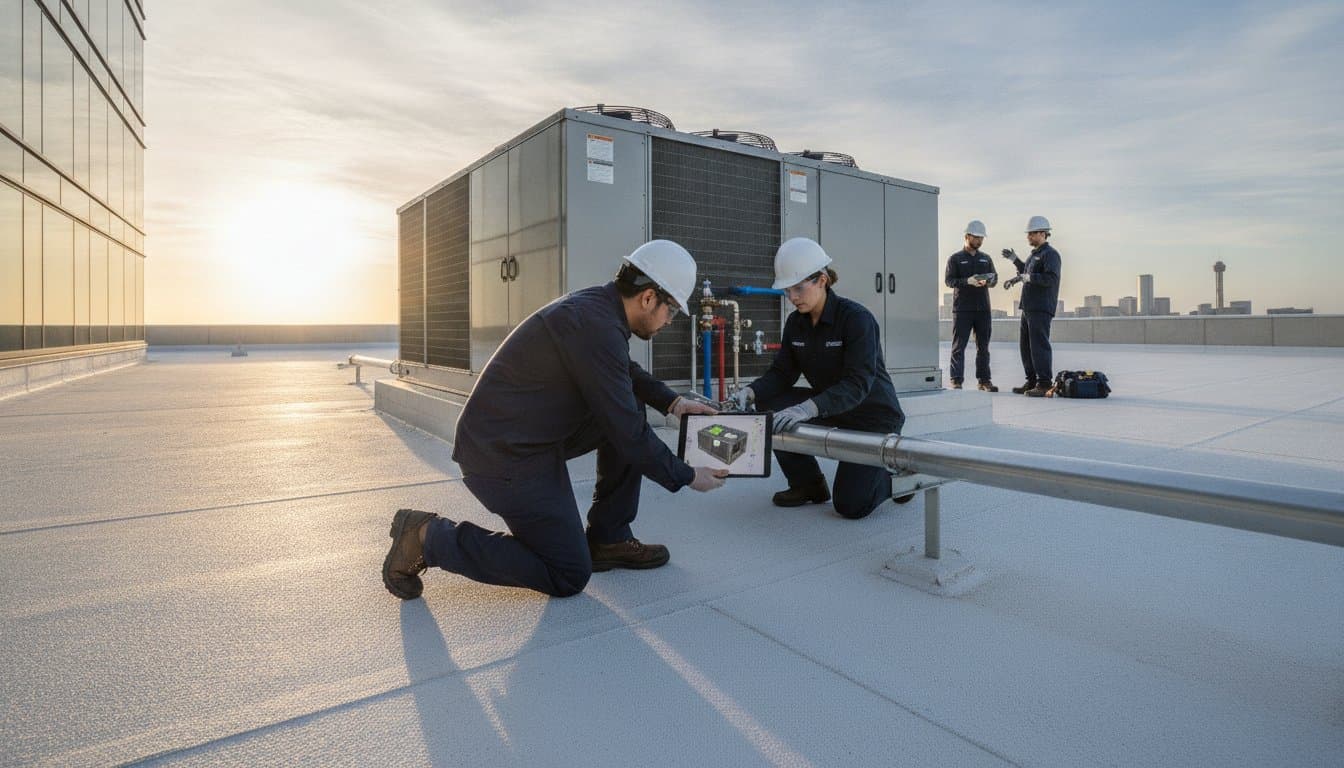
As of January 1, 2026, the Department of Energy has enforced a 15% increase in minimum efficiency standards for commercial rooftop air conditioners, a regulatory shift that fundamentally redefines the lifecycle of facility infrastructure. For Texas facility directors, the decision to pursue a commercial rooftop unit replacement is no longer a simple mechanical swap; it's a strategic response to rising operational costs and the mandatory industry transition away from R-410A refrigerants. You likely understand that maintaining an aging system in extreme heat often leads to diminishing returns, frequent downtime, and unpredictable repair expenditures that disrupt your core business operations.
By reading this guide, you'll master the technical and financial variables required to secure 15 years of system reliability and peak energy efficiency. We will analyze the impact of new A2L refrigerant mandates, the role of Building Information Modeling in eliminating installation errors, and the methodical planning necessary to ensure a precision-engineered transition that protects your facility's long-term value.
Key Takeaways
- Identify the specific operational triggers and regulatory mandates that necessitate a commercial rooftop unit replacement to avoid escalating repair costs and system obsolescence.
- Master the technical application of Manual N load calculations to ensure your new mechanical assets are engineered for the specific humidity demands of Texas environments.
- Quantify the comprehensive ROI of high-efficiency IEER units by analyzing the reduction in energy consumption alongside the mitigation of costly emergency mechanical downtime.
- Discover how digital coordination through Building Information Modeling (BIM) and in-house fabrication minimizes installation friction and ensures a seamless project lifecycle.
- Recognize the value of a "Master Builder" approach that focuses exclusively on complex mechanical infrastructure to ensure long-term facility reliability and accountability.
Strategic Indicators: When to Prioritize Commercial Rooftop Unit Replacement
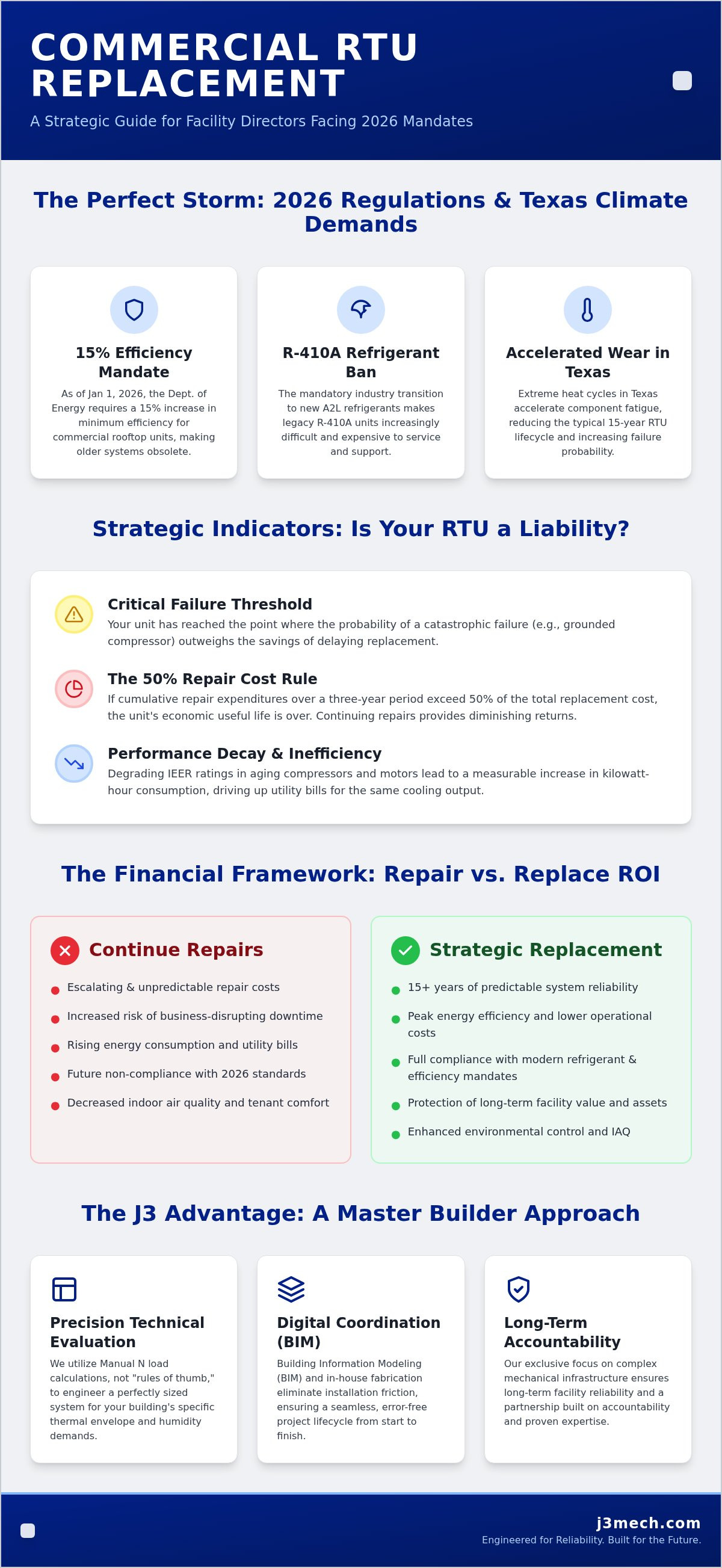
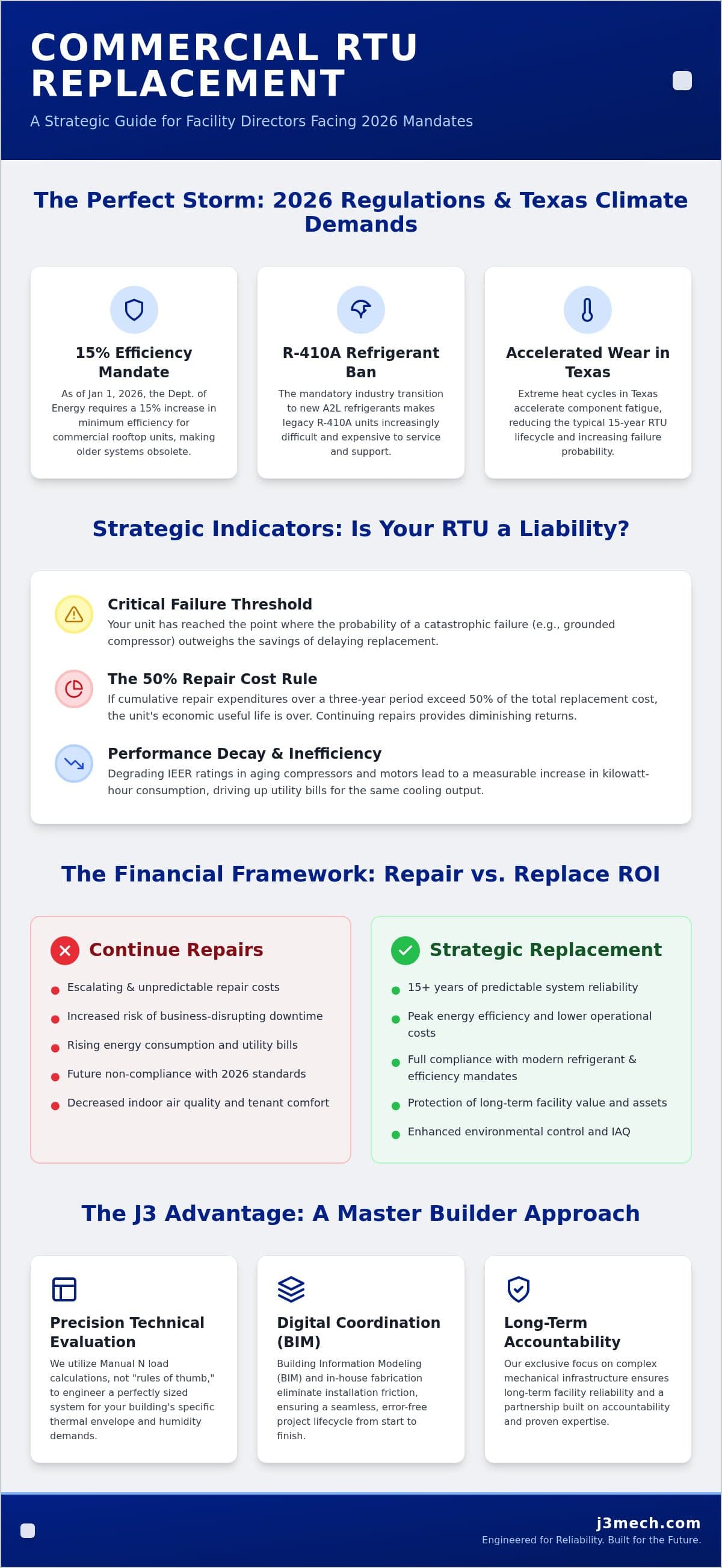
A commercial rooftop unit (RTU) functions as a unified mechanical asset, consolidating the complex requirements of Heating, ventilation, and air conditioning (HVAC) systems into a single, high-stakes enclosure. In high-demand environments, identifying the "Critical Failure Threshold" is a prerequisite for maintaining operational continuity. This threshold represents the specific moment when the statistical probability of a catastrophic component failure, such as a cracked heat exchanger or a grounded compressor, outweighs the perceived savings of delaying capital expenditure. When a system reaches this phase, it no longer provides reliable service; it becomes a liability that threatens tenant satisfaction and indoor air quality (IAQ).
The 2026 regulatory environment has accelerated the economic obsolescence of older mechanical assets. With the Department of Energy mandating a 15% increase in minimum efficiency standards and the EPA phasing out R-410A refrigerants, legacy units are increasingly difficult and expensive to support. A strategic commercial rooftop unit replacement transforms these escalating operational risks into a predictable, high-performance solution that aligns with modern environmental and fiscal standards.
The 15-Year Lifecycle vs. Texas Environmental Reality
While industry generalists often cite a 15-year lifecycle for RTUs, the extreme thermal expansion experienced in San Antonio and Austin often accelerates component fatigue. The persistent heat cycles cause metal components to expand and contract with a frequency that degrades structural integrity faster than in more temperate climates. Reliability is a necessity. Facility managers must identify the point where cumulative repair expenditures over a three-year horizon exceed 50% of the total replacement value. The Economic Useful Life of a Texas-based RTU is defined as the period during which the unit maintains design-intent environmental control without exceeding the cost-per-ton of a modern, high-efficiency system.
Performance Decay and Energy Inefficiency
Performance decay is often invisible until it manifests in the utility bill. As compressors and fan motors age, their Integrated Energy Efficiency Ratio (IEER) degrades, leading to a measurable increase in kilowatt-hour consumption for the same cooling output. Chronic refrigerant leaks and fouled coils further exacerbate this inefficiency, driving up operational overhead. Implementing a disciplined protocol for commercial hvac maintenance is the only way to generate the empirical data required for a lifecycle assessment. Without this data, facility owners remain reactive, trapped in a cycle of emergency repairs that cost significantly more than a planned, precision-engineered replacement.
Technical Evaluation: Assessing Capacity and Texas Climate Demands
Technical mastery during a commercial rooftop unit replacement starts with an empirical assessment of the building's thermal envelope. We don't rely on "rule of thumb" tonnage. Instead, we utilize Manual N load calculations to account for modern insulation, window glazing, and internal heat gains from 2026-era office equipment. This precision ensures the system isn't oversized. Oversized units fail to dehumidify properly, leading to microbial growth and tenant discomfort. By determining the optimal tonnage for modern occupancy levels, we ensure the mechanical system operates within its peak performance curve.
To meet the latest Federal energy efficiency standards, modern RTUs often utilize variable-speed or multi-stage compressors. These components allow the system to modulate output based on real-time demand rather than operating in a binary on-off cycle. This modulation is critical in Texas, where morning humidity requires different cooling profiles than the dry afternoon heat of the interior plains. Variable-speed technology maintains a consistent indoor environment while drastically reducing the wear and tear associated with frequent motor starts.
Environmental Adaptation for Central and South Texas
South Texas environments, specifically Corpus Christi and the Rio Grande Valley, present unique challenges that generic equipment specifications often ignore. High latent heat loads require specialized coil configurations to remove moisture effectively without overcooling the space. For facilities near the Gulf Coast, we specify epoxy-coated coils and stainless steel fasteners to mitigate salt-air corrosion. Ensuring thermal precision within the RTU's internal furnace cabinet is equally vital; South Texas winters still require reliable and efficient heating cycles that don't compromise the unit's cooling components. This level of environmental hardening is a standard requirement for ensuring a 15-year service life in coastal industrial zones.
Integration with Existing Building Automation Systems (BAS)
Modernizing your mechanical footprint requires seamless integration with existing Building Automation Systems (BAS). We evaluate communication protocols, such as BACnet or LonWorks, to ensure the new unit provides granular data to the facility's central command. Smart sensors and proactive performance monitoring allow for real-time adjustments, preventing minor deviations from becoming critical failures. Future-proofing your system means selecting equipment that can adapt to upcoming technological shifts in building management. For a precise analysis of your facility's specific load requirements, it's advisable to consult with a specialized mechanical partner who understands the intricacies of the Texas climate.
The Financial Framework: Analyzing Repair vs. Replacement ROI for 2026
Authorization of a commercial rooftop unit replacement is often framed as a significant capital expense, yet a disciplined financial analysis reveals it's more accurately a risk-mitigation strategy. Relying on aging infrastructure introduces hidden costs that extend far beyond simple mechanical parts. These include the "Emergency Premium" associated with unplanned downtime, which often requires expedited freight for components and premium labor rates during peak Texas summer months. When a system fails during a heatwave, the immediate loss of tenant productivity or retail revenue can easily eclipse the cost of a planned upgrade. It's a fiscal reality that reactive maintenance is the most expensive method of facility management.
Projecting energy savings over a 10-year horizon further justifies the transition to high-efficiency IEER units. Following the January 1, 2026, Department of Energy mandate that increased minimum efficiency by approximately 15%, modern systems offer a drastically lower operational baseline. Additionally, Section 179 of the current tax law allows many business owners to deduct the full cost of a commercial HVAC replacement in the year of installation rather than depreciating the asset over 39 years. This immediate tax benefit, combined with the potential for a 30% reduction in heating and cooling energy use, creates a compelling ROI for proactive facility managers who prioritize long-term stability over short-term fixes.
Total Cost of Ownership (TCO) Analysis
A comprehensive TCO analysis compares the 5-year maintenance trajectory of a new unit against the escalating requirements of a legacy system. Older units using R-410A face increasing serviceability challenges as the EPA mandates the transition to lower-impact A2L refrigerants. This transition typically adds 10-15% to the cost of new equipment but ensures long-term compliance and parts availability. While high-quality commercial hvac repair can extend the life of a system, they don't solve the fundamental issue of mechanical obsolescence. Eventually, the cumulative cost of these interventions exceeds the financial benefit of a modern, precision-engineered replacement.
Mitigating Operational Risk
Preserving business continuity is paramount in critical facilities like data centers, healthcare environments, and high-traffic retail centers. Utilizing lifecycle data allows facility directors to secure budget approval before a catastrophic failure occurs. By scheduling a replacement during shoulder seasons, organizations avoid the logistical friction of emergency crane rentals and temporary cooling solutions. A methodical approach to mechanical infrastructure ensures that your facility remains a productive asset rather than a liability, providing the stability required for long-term corporate growth.
Precision Execution: Utilizing BIM and Fabrication to Streamline RTU Replacement
The physical phase of a commercial rooftop unit replacement is a precision engineering event that requires meticulous logistical coordination to ensure facility reliability. Success in this stage isn't defined by the speed of the crane lift but by the accuracy of the preceding digital modeling. By utilizing Building Information Modeling (BIM), we create a high-fidelity virtual representation of the mechanical footprint, allowing for the identification of potential structural interferences before a single piece of equipment arrives on site. This proactive approach eliminates the need for field modifications, which are the primary cause of project delays and budget overruns in complex commercial environments. Precision is our baseline.
Digital Coordination and BIM Modeling
Mapping existing roof structures through digital coordination ensures that the new mechanical assets align perfectly with existing structural supports and penetration points. This level of detail is essential when replacing older units that may have different weights or physical dimensions than modern 2026-compliant equipment. BIM allows our engineering teams to verify clearances for maintenance access and airflow, ensuring the final installation meets all technical standards. For a deeper understanding of how these digital models translate into physical components, our guide on hvac sheet metal fabrication details the integration of precision engineering and coordination.
In-House Fabrication Advantages
Utilizing in-house fabrication provides a distinct advantage in maintaining project schedules and ensuring mechanical integrity. We produce custom-built transition curbs and adapters that allow for the immediate seating of new units onto existing roof openings. These pre-fabricated components are engineered for airtight integrity, preventing the energy loss often associated with generic, field-modified transitions. By shifting the manufacturing of supply and return duct connections to a controlled facility environment, we reduce the onsite labor footprint and minimize the disruption to your daily business operations. This systematic approach ensures that the new system is sealed and operational within the shortest possible window.
Managing the logistics of crane operations in dense urban environments, such as downtown San Antonio, requires disciplined planning and coordination with local authorities. Rushing is a liability. We handle the permitting and site safety protocols necessary to execute these high-stakes lifts without friction. Following the physical installation, we perform comprehensive post-installation commissioning to verify that the system performs exactly as specified in the initial design. This verification process includes testing all control sequences and airflow volumes to ensure your investment delivers the promised energy efficiency and reliability. To secure a precision-engineered solution for your facility, contact our team to discuss your commercial rooftop unit replacement requirements.
Selecting a Strategic Partner: The J3 Mechanical Services Approach to Facility Infrastructure
Selecting a partner for a commercial rooftop unit replacement requires an alignment with a firm that views mechanical systems as critical infrastructure rather than just equipment. J3 Mechanical Services operates under a "Master Builder" philosophy, where engineering integrity and ethical accountability are inseparable components of every project. We don't dilute our technical focus by offering general plumbing services; instead, we prioritize mastery in complex commercial environments. This specialization is guided by faith-based principles, ensuring a transparent, logic-driven communication style that prioritizes the long-term stability of your facility. From our regional hubs to the Rio Grande Valley, we provide the industrial authority necessary to manage your high-stakes assets with surgical precision.
A Disciplined Methodology for Large-Scale Assets
Our methodology is intentionally paced to mitigate risk throughout the transition to 2026-compliant technology. Every action, from the initial survey to the final commissioning, is documented to verify performance against your specific operational requirements. The technical complexity inherent in modern systems requires the specialized commercial hvac contractor expertise that J3 Mechanical Services provides across major Texas hubs like San Antonio, Austin, and Corpus Christi. We recognize that physical installation is only one phase of an asset's lifecycle, which is why we develop customized maintenance protocols to preserve the 15-year reliability promised by modern high-efficiency units. This systematic oversight prevents the performance decay often found in less disciplined installations.
Your Next Steps in Facility Modernization
Modernizing your mechanical infrastructure is a strategic investment that requires a data-driven approach to maintain business continuity. Your next step involves a comprehensive mechanical system audit conducted by J3 Mechanical Services engineers to identify assets that have reached their critical failure threshold. For multi-unit facilities, we develop a phased replacement strategy that aligns with your capital expenditure cycles and operational requirements, allowing for a smooth transition without fiscal strain. This methodical preparation ensures that your commercial rooftop unit replacement is executed with the predictability your organization demands. Contact J3 Mechanical Services today to request a precision-engineered quote and secure your facility's critical infrastructure for the next decade.
Securing the Future of Your Facility Infrastructure
Executing a commercial rooftop unit replacement is a definitive commitment to the long-term viability of your Texas facility. By integrating the technical and financial variables discussed in this guide, from 2026 SEER2 compliance to digital coordination, you transform a potential mechanical liability into a high-performing asset. This transition ensures your infrastructure remains resilient against the extreme humidity of the coast and the intense heat of the interior plains, providing a stable environment for tenants and operations alike. Proactive planning doesn't just reduce energy consumption; it secures your organization's core business continuity.
J3 Mechanical Services provides the industrial authority and disciplined methodology required to manage these complex infrastructure events with absolute accountability. Our BIM-coordinated installation process and in-house sheet metal fabrication ensure that every component is engineered for precision and long-term reliability. Should your facility require immediate assistance, our 24/7 emergency response capabilities stand ready across our Texas service areas to protect your mechanical integrity. Take control of your mechanical footprint today by taking the first step toward modernization.
Request a Precision Mechanical Audit from J3 Mechanical Services to begin the process of modernizing your mechanical footprint. We look forward to partnering with you to ensure the ongoing integrity of your critical infrastructure.
Frequently Asked Questions
How long does a typical commercial rooftop unit replacement take?
A standard physical swap typically occurs within a single business day, provided that all logistical coordination and fabrication are completed in advance. However, the comprehensive lifecycle of a commercial rooftop unit replacement involves several weeks of engineering, BIM modeling, and permitting. By executing the majority of technical work offsite, we ensure the actual crane lift and unit seating are completed with minimal impact on your facility's daily operations.
What are the current energy efficiency requirements for RTUs in Texas?
As of January 1, 2026, the Department of Energy has mandated a 15% increase in minimum efficiency standards for commercial rooftop air conditioners compared to 2018 baselines. These regulations focus on Integrated Energy Efficiency Ratio (IEER) ratings to better reflect real-world part-load performance. In Texas, meeting these standards is a prerequisite for compliance and provides a strategic opportunity to reduce the high operational costs associated with cooling large-scale facilities in extreme thermal environments.
Can I replace just the RTU or do I need to update the ductwork as well?
Most projects focus on the unit itself, utilizing custom-fabricated transition curbs to adapt the new equipment to existing roof penetrations. However, if the existing ductwork is undersized for the higher airflow requirements of modern high-efficiency systems, modifications may be necessary to prevent static pressure issues. We conduct a thorough technical evaluation of your distribution system to ensure that the new mechanical asset operates at its design-intent capacity without compromising indoor air quality.
What is the cost difference between repairing a 15-ton unit and replacing it?
While repair costs vary based on the specific component failure, a replacement becomes the logical choice when cumulative repair expenditures exceed 50% of the unit's total value. Beyond the immediate invoice, the cost difference includes the 30% energy savings typical of modern units and the elimination of emergency service premiums. Investing in a new system provides long-term fiscal stability, whereas continuing to support an obsolete unit often leads to diminishing returns and unpredictable downtime.
How does J3 Mechanical Services minimize business disruption during installation?
J3 Mechanical Services utilizes a methodical approach to project delivery that prioritizes your facility's operational continuity. By performing advanced Building Information Modeling (BIM) during the planning phase, we resolve logistical conflicts before the equipment arrives on site. Additionally, our in-house fabrication of custom curb adapters and transitions allows for a "plug-and-play" installation. This disciplined preparation ensures that the transition to new equipment occurs during designated low-impact windows, preserving your building's productivity and environmental comfort.
Are there specific tax incentives for replacing commercial HVAC systems in 2026?
Under current tax law, Section 179 allows business owners to deduct the full cost of qualifying commercial HVAC equipment in the year it is placed into service. This is a significant shift from traditional depreciation schedules that previously spanned 39 years. By leveraging these incentives for a commercial rooftop unit replacement, facility managers can significantly offset the initial capital expenditure while simultaneously benefiting from the reduced utility overhead provided by high-efficiency, 2026-compliant mechanical technology.
Why is BIM coordination necessary for a standard rooftop replacement?
Building Information Modeling (BIM) is essential for ensuring that new mechanical assets align perfectly with existing structural supports and utilities. Even in a seemingly standard replacement, modern units often have different weights, dimensions, and connection points than their predecessors. Digital coordination allows us to verify these variables in a virtual environment, eliminating the need for costly field modifications. This level of technical mastery ensures a seamless installation process and maintains the long-term integrity of your building's roof.
Do you provide 24/7 support if a newly installed unit has issues?
Yes, J3 Mechanical Services maintains 24/7 emergency recovery capabilities to support the long-term reliability of your mechanical infrastructure across Texas. While our precision-engineered installation protocols are designed to eliminate post-installation friction, we provide immediate technical assistance should any operational deviations occur. Our service teams are stationed throughout San Antonio, Austin, and the Rio Grande Valley to ensure that your critical assets remain functional. This continuous accountability is a cornerstone of our commitment to ethical contracting and facility stability.
Need a hand with your building's HVAC?
Free quotes and honest answers from licensed commercial technicians across South Texas.