
Commercial VRF System Installation: Engineering Guide
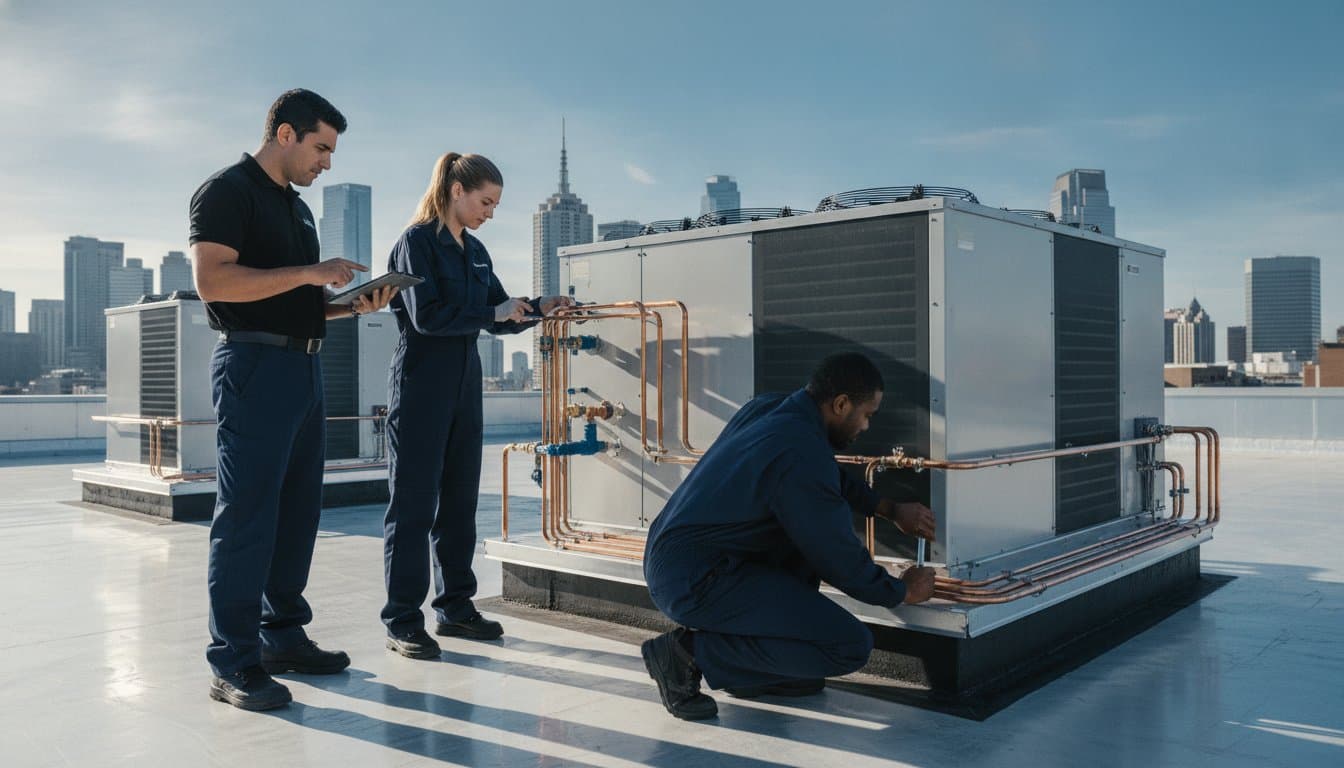
The transition to low-GWP refrigerants like R-32 and R-454B has officially redefined VRF system installation for commercial buildings as a discipline of extreme technical precision. As of January 2026, the industry has moved beyond the era of R-410A, making legacy installation methods obsolete and requiring a sophisticated understanding of A2L safety standards. You've likely recognized that traditional HVAC systems are failing to keep pace with escalating energy demands and the specific zoning requirements of modern facilities. It's an operational liability when utility budgets climb while occupant comfort remains inconsistent across different building sectors.
This guide will empower you to master the engineering complexities and the strategic ROI of Variable Refrigerant Flow technology to optimize your facility's thermal performance. By adhering to a rigorous, logic-driven methodology, you can realize a 30% reduction in energy consumption and achieve precise, simultaneous heating and cooling. We'll examine how advanced Building Information Modeling (BIM) and in-house fabrication mitigate the risks of installation downtime. You'll gain a comprehensive overview of the updated ASHRAE standards and the systematic coordination necessary to ensure your mechanical infrastructure remains a reliable asset for decades.
Key Takeaways
- Learn how the mechanism of heat recovery facilitates simultaneous heating and cooling to maximize thermal efficiency across diverse building zones.
- Utilize Building Information Modeling (BIM) to coordinate VRF system installation for commercial buildings, ensuring precise refrigerant piping networks that avoid structural or electrical conflicts.
- Evaluate the strategic ROI of VRF technology, focusing on its ability to reduce utility expenditures by up to 30% through advanced part-load performance.
- Master the systematic transition from pre-construction design to final commissioning, prioritizing rigorous load calculations and building envelope analysis.
- Identify the technical benchmarks for selecting a specialized mechanical partner, including their capacity for in-house fabrication and digital project oversight.
Understanding VRF System Technology for Commercial Facilities
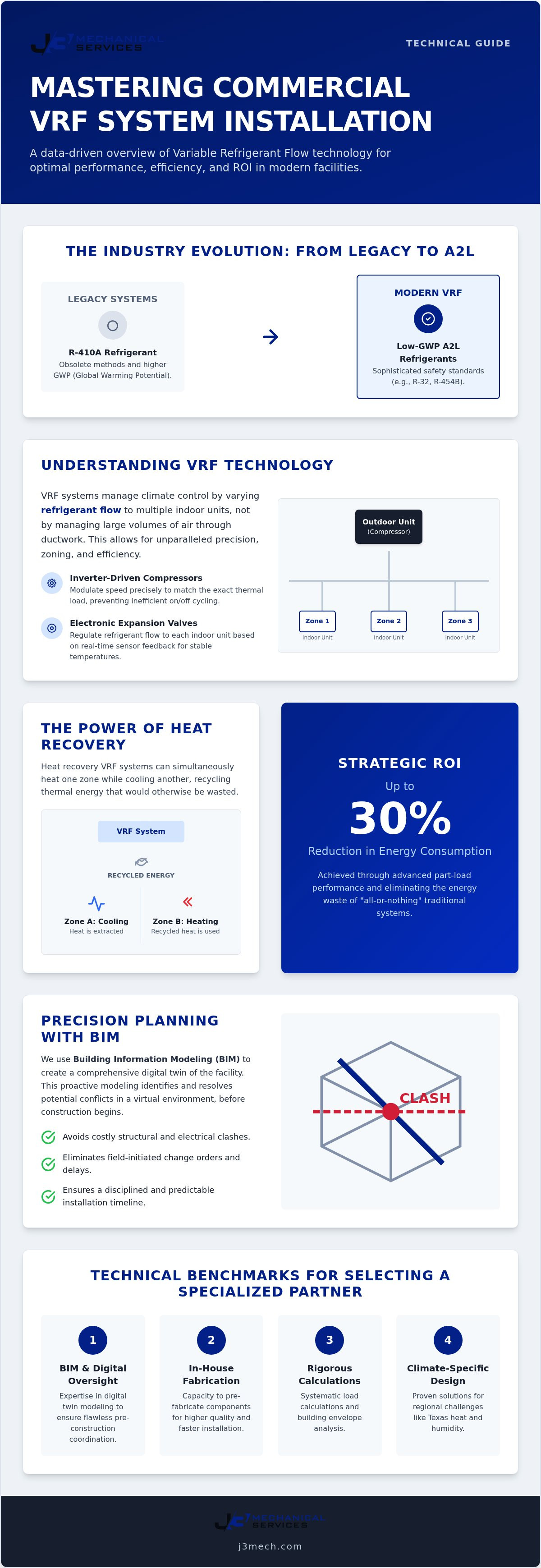
A Variable Refrigerant Flow (VRF) system represents a sophisticated multi-split mechanical solution that shifts the paradigm of commercial climate control from air-volume management to refrigerant-mass management. Unlike traditional rooftop units that distribute cooled air through massive ductwork, a VRF system varies the refrigerant flow to each indoor unit rather than varying the air volume. This technical distinction allows for a high degree of modularity, making VRF system installation for commercial buildings a preferred choice for architects who require flexible, high-performance HVAC infrastructure that adapts to the building’s specific geometry.
Texas architecture is increasingly defined by mixed-use spaces and glass-heavy facades that create erratic thermal demands throughout the day. VRF has become the standard for these modern facilities because it offers the agility to respond to rapid solar gain shifts without over-cycling a central plant. While a standard heat pump configuration provides either heating or cooling to the entire building simultaneously, heat recovery VRF systems utilize a three-pipe or branch-controller architecture to facilitate independent mode selection for every indoor unit. This allows one zone to cool while another heats, recycling energy that would otherwise be rejected into the atmosphere.
The Mechanics of Refrigerant Control
Inverter-driven compressors serve as the heart of the system, modulating their rotational speed with surgical precision to match the exact thermal load of the building at any given moment. This prevents the inefficient "all-or-nothing" cycling seen in legacy equipment, ensuring the system only draws the power it truly needs. Within the terminal units, electronic expansion valves regulate the mass flow of refrigerant based on real-time feedback from internal sensors. This systematic control ensures that individual zones maintain their setpoints without the temperature fluctuations that often plague large-scale commercial environments. It's a logic-driven approach that prioritizes occupant comfort and mechanical longevity.
Texas Climate Considerations
Deploying VRF technology in San Antonio or Austin requires a disciplined approach to high ambient temperature management. Texas heat frequently exceeds the design conditions of standard equipment, necessitating a focus on condenser placement to ensure unobstructed airflow and efficient heat rejection. Humidity control is equally critical for Gulf Coast facilities, where latent heat loads can overwhelm systems that aren't specifically sized for moisture removal. Proper VRF system installation for commercial buildings in these regions involves a rigorous calculation of the building envelope to ensure the equipment operates at peak efficiency even during the peak of a Texas summer. We don't just install hardware; we engineer a climate-specific solution that accounts for the unique humidity profiles of the South Texas region.
The Role of BIM and Precision Coordination in VRF Installation
Successful VRF system installation for commercial buildings requires a level of spatial coordination that legacy 2D drawings cannot accommodate. Because these systems rely on a high density of refrigerant piping and complex branch selector boxes, the risk of field clashes with structural beams or electrical conduits is exceptionally high. We utilize Building Information Modeling (BIM) to create a comprehensive digital twin of the facility before a single technician arrives on site. This proactive modeling identifies potential conflicts in the virtual environment, allowing our engineers to reroute piping and adjust equipment placement without the costly delays of field-initiated change orders.
The technical rigor of this approach is supported by industry research, such as the PNNL Technical Report on VRF Systems, which emphasizes that detailed planning is mandatory to capture the full economic and energy-saving potential of these systems. By resolving logistical friction during the design phase, we ensure the installation proceeds with disciplined predictability. This digital oversight transforms the mechanical room from a site of improvised fixes into a showcase of systematic engineering.
Digital Pre-Construction Protocols
Our pre-construction workflow involves creating high-fidelity 3D models that optimize the placement of branch selector boxes, which are critical for heat recovery performance. These models aren't merely for installation; they serve as a roadmap for long-term maintenance. Through virtual walkthroughs, we verify that every valve and sensor remains accessible for future service, preventing the common industrial error of "burying" critical components behind permanent structures. This phase also facilitates seamless coordination between mechanical engineers and sheet metal contractors, ensuring that the integration of ductwork with indoor fan coils is verified before fabrication begins.
In-House Fabrication Advantages
The transition from a digital model to physical infrastructure is managed through our dedicated fabrication facility. By utilizing the precise data from our BIM models, we produce custom mounting solutions for outdoor units and specialized refrigerant headers that fit perfectly upon arrival. This factory-controlled environment ensures that HVAC sheet metal fabrication meets the exact tolerances required for high-efficiency fan coils. This level of precision eliminates the need for aggressive field modifications, which often compromise system integrity. Relying on a partner with integrated fabrication capabilities ensures that your mechanical infrastructure is built to a standard of absolute accuracy rather than "close enough" field estimates.
Strategic ROI: VRF vs. Traditional Commercial HVAC Systems
While the initial capital expenditure for a VRF system installation for commercial buildings often exceeds that of traditional packaged rooftop units (RTUs), a disciplined lifecycle cost analysis reveals a superior long-term return on investment. Traditional systems frequently operate on a binary cycle, consuming maximum power regardless of the actual thermal load, which leads to excessive utility expenditures and premature mechanical fatigue. In contrast, VRF technology achieves up to a 30% reduction in energy consumption by utilizing heat recovery and part-load efficiency. This systematic approach to energy management transforms the HVAC system from a recurring liability into a strategic operational asset that pays for itself through sustained utility savings.
The elimination of large mechanical rooms and massive ductwork runs provides an additional layer of value through space optimization. By reclaiming square footage that would otherwise be dedicated to bulky mechanical infrastructure, property owners can maximize leasable area or architectural flexibility. This is particularly relevant in high-density Texas urban centers where every square foot of floor space carries significant market value. Additionally, the ability to provide precise, individualized temperature control directly correlates with higher tenant retention rates, as occupants no longer have to contend with the inconsistent "hot and cold spots" typical of centralized air distribution.
Operational Efficiency and Maintenance
The reliability of VRF systems stems from their inverter-driven compressors, which modulate speed to match precise requirements rather than engaging in high-torque starts and stops. This modulation significantly reduces mechanical wear and tear, extending the lifecycle of the equipment compared to traditional chiller or RTU setups. However, maintaining this high level of performance requires a rigorous commercial HVAC maintenance protocol that prioritizes sensor calibration and refrigerant integrity. A proactive maintenance strategy ensures that the system continues to operate within its design parameters, preventing the efficiency degradation that often occurs in neglected industrial environments.
Incentives and Sustainability
Texas facility owners can leverage specific financial incentives to offset the transition to high-efficiency mechanical systems. In 2026, commercial rebates are available for installations that meet rigorous efficiency benchmarks, such as a minimum 11.6 EER and 6.8 HSPF for heat pumps. These upgrades do more than reduce immediate costs; they contribute directly to LEED certification and corporate ESG goals by significantly lowering the building's carbon footprint. By adopting VRF technology now, you future-proof your assets against tightening energy codes and rising utility rates, ensuring that your mechanical infrastructure remains compliant and cost-effective for the next two decades.
VRF Installation: Pre-Construction to Commissioning
The lifecycle of VRF system installation for commercial buildings is a chronological progression of technical milestones that demands absolute adherence to engineering standards. It begins with Phase 1: a rigorous load calculation and system design that accounts for the building envelope, solar orientation, and specific Texas humidity profiles. Phase 2 moves into BIM-coordinated layouts and structural reinforcement for outdoor units, ensuring the building's roof or pad can support the high-density weight of modern condensers. Phase 3 involves precision piping installation where every joint is brazed under a continuous nitrogen purge to prevent internal oxidation. Phase 4 focuses on control system integration, calibrating multi-zone sensors to the building's unique occupancy patterns. Finally, Phase 5 concludes with comprehensive commissioning, a performance verification stage where we stress-test the system under full load to ensure it meets design specifications.
This methodical approach eliminates the "trial and error" methodology that often plagues large-scale mechanical projects. By treating the installation as a disciplined sequence of events, we mitigate the risk of operational failures during the building's first cooling season. Each phase is documented and verified, providing the facility owner with a transparent record of the system's structural and mechanical integrity. This level of oversight is what differentiates a standard contractor from a strategic mechanical partner who views your infrastructure as a critical long-term asset.
Critical Piping and Pressure Standards
Refrigerant integrity is the most critical factor in long-term system reliability. We utilize a triple evacuation process to remove all non-condensables and moisture from the lines, reaching a deep vacuum that ensures the refrigerant remains pure. Managing oil return and calculating the precise refrigerant charge for long pipe runs requires a high level of mathematical accuracy to prevent compressor failure. Technicians must execute a 24-48 hour nitrogen pressure test at 550 PSI to ensure the system's hermetic integrity before charging the refrigerant. This systematic verification prevents microscopic leaks that could lead to significant efficiency loss or costly emergency repairs over the life of the system.
Controls and Building Automation
Modern VRF systems aren't isolated islands of technology; they must integrate seamlessly with existing Building Management Systems (BMS) through BACnet or LonWorks protocols. This allows facility managers to monitor energy consumption and adjust zone setpoints from a centralized interface, maximizing the system's native efficiency. Understanding the role of a commercial hvac contractor in this process is essential, as they bridge the gap between mechanical hardware and digital automation. If you're ready to secure a partner who prioritizes this level of technical oversight, explore our commercial HVAC installation and replacement capabilities for your next project.
Selecting a Specialized VRF Contractor in Central Texas
Standard HVAC contractors often lack the technical depth required for the intricate control logic and refrigerant management inherent in VRF systems. Selecting a partner for VRF system installation for commercial buildings is a decision that impacts the facility's operational viability for decades. A qualified contractor must demonstrate proficiency in digital modeling and manufacturer-specific protocols rather than relying on general mechanical knowledge. This specialization ensures that the system's sophisticated heat recovery capabilities are fully realized rather than compromised by improper field execution. In an environment where a single sensor error can disrupt the efficiency of an entire building zone, the margin for error is non-existent.
A contractor's investment in Building Information Modeling (BIM) and in-house fabrication serves as a primary indicator of their professional competence. These tools allow for the pre-emptive resolution of structural conflicts and the production of precision-engineered components that fit the unique constraints of the building. Without these capabilities, projects often suffer from cascading delays and unbudgeted change orders. For critical commercial environments, the availability of 24/7 emergency support is not an optional service but a fundamental requirement for maintaining infrastructure stability. When mechanical systems fail, the response must be immediate and informed by a deep understanding of the specific facility's layout.
The J3 Mechanical Advantage
J3 Mechanical Services operates with a disciplined commitment to technical mastery and ethical responsibility in every mechanical project we undertake. By maintaining an exclusively commercial focus, we ensure our technicians possess the specific expertise required for high-stakes industrial and corporate environments. Our approach to commercial hvac installation is rooted in a "master builder" philosophy, where meticulous preparation is valued as highly as the physical labor of the install. We don't dilute our specialization with residential or general plumbing services, allowing us to remain the proactive partner for complex mechanical infrastructure across Texas, from San Antonio to Austin.
Securing Your Facility’s Future
Choosing a mechanical partner involves more than a simple bid evaluation; it's a consultation on the long-term stability of your facility. Our in-house sheet metal and ductwork fabrication facilities significantly reduce lead times and ensure that every component of your VRF network meets our rigorous internal standards. This systematic control allows us to manage complex projects with predictable excellence, mitigating the risks that often manifest during large-scale mechanical transitions. If you're ready to transition your facility to a high-performance thermal environment, partner with J3 Mechanical for your VRF system installation and secure the professional oversight your infrastructure deserves.
Optimizing Your Facility’s Mechanical Infrastructure
The transition to Variable Refrigerant Flow technology represents a definitive step toward operational excellence and sustainable facility management. By leveraging the technical precision of BIM-coordinated modeling and the reliability of our in-house fabrication facility, you can transform your building’s thermal performance while securing significant utility savings. A successful VRF system installation for commercial buildings is not merely a hardware upgrade; it is a systematic investment in your property’s long-term value and occupant satisfaction. We view every mechanical project as a critical infrastructure responsibility that requires absolute accuracy from design through commissioning.
J3 Mechanical Services stands ready to serve as your strategic partner, bringing the gravitas of a master builder to your facility. Our methodology prioritizes meticulous preparation and technical mastery, ensuring that your mechanical infrastructure remains stable even under the most demanding Texas climate conditions. With 24/7 emergency response protocols in place, we provide the ongoing oversight necessary to protect your critical assets. Request a Disciplined Mechanical Consultation from J3 Mechanical to begin the process of future-proofing your facility with engineered precision. We look forward to establishing a standard of reliability that serves your business for decades.
Frequently Asked Questions
What is the primary advantage of VRF over a traditional VAV system?
VRF technology provides superior efficiency by varying the mass flow of refrigerant directly to each indoor unit rather than modulating air volume from a central plant. While Variable Air Volume (VAV) systems depend on large ductwork and central air handlers, VRF allows for independent zone control and simultaneous heating and cooling. This eliminates the energy losses associated with duct leakage and ensures more granular temperature management across complex commercial floor plans.
How much energy can a commercial building realistically save with a VRF system?
Commercial facilities typically achieve energy savings ranging from 20% to 40% compared to legacy rooftop units or chiller-based systems. These gains are realized through inverter-driven compressors that operate at part-load and heat recovery mechanisms that recycle thermal energy between zones. By reducing the total mechanical load required to maintain setpoints, VRF system installation for commercial buildings transforms the HVAC system into a high-performance asset that lowers long-term utility expenditures.
Is VRF suitable for retrofitting older buildings in San Antonio or Austin?
VRF is an ideal solution for retrofitting older commercial structures in Central Texas because its small-diameter refrigerant piping requires significantly less plenum space than traditional ductwork. This is particularly beneficial for historic buildings in downtown San Antonio where structural constraints limit mechanical modifications. We utilize Building Information Modeling (BIM) to map these existing environments, ensuring the new infrastructure integrates seamlessly with the building’s original architecture without requiring extensive structural demolition.
What are the specific maintenance requirements for a commercial VRF system?
Maintenance protocols focus on sensor calibration, refrigerant charge verification, and the inspection of electronic expansion valves to ensure precise flow control. Because these systems are digitally integrated, regular software diagnostics are necessary to monitor the performance of inverter compressors. Our specialized maintenance programs in cities like New Braunfels and San Marcos prioritize these technical benchmarks to prevent efficiency degradation and ensure the long-term reliability of the facility’s mechanical infrastructure.
How does simultaneous heating and cooling work in a heat recovery VRF system?
Heat recovery VRF systems utilize a branch controller to divert thermal energy from zones requiring cooling to those requiring heat within the same facility. Instead of rejecting heat to the atmosphere, the system captures it and redirects it to areas that need it. This mechanism is highly effective for Texas buildings with significant solar gain on one side, allowing for absolute comfort across different zones without engaging the primary heating source.
Why is BIM coordination essential for VRF installation in high-density buildings?
BIM coordination is mandatory for VRF system installation for commercial buildings due to the high density of refrigerant piping and the complexity of branch selector placement. By creating a digital twin of the project, we identify potential clashes with structural or electrical systems before the installation phase begins. This disciplined approach prevents costly field modifications and ensures that all mechanical components remain accessible for future service in high-density environments like Austin or Round Rock.
What happens if a VRF system develops a refrigerant leak?
Modern VRF systems are equipped with leak detection sensors that trigger an automatic compressor shutdown to prevent refrigerant buildup, adhering to updated ASHRAE safety standards. In systems utilizing new A2L refrigerants, these safety protocols are critical for mitigating flammability risks and environmental impact. Our 24/7 emergency service protocols ensure that facilities in Corpus Christi or the Rio Grande Valley receive immediate technical intervention to identify the leak source and restore system integrity.
Can VRF systems handle the extreme summer humidity in Texas?
VRF systems manage extreme humidity through sophisticated fan speed modulation and precise latent heat removal. By operating at lower speeds for longer durations, the system effectively strips moisture from the air without over-cooling the interior space. This is a vital capability for facilities in humid regions like Edinburg or McAllen, where maintaining proper indoor air quality and occupant comfort requires a logic-driven approach to moisture management and temperature control.
Need a hand with your building's HVAC?
Free quotes and honest answers from licensed commercial technicians across South Texas.