
Cost to Replace Commercial Rooftop AC Unit in Austin: 2026 Pricing Guide
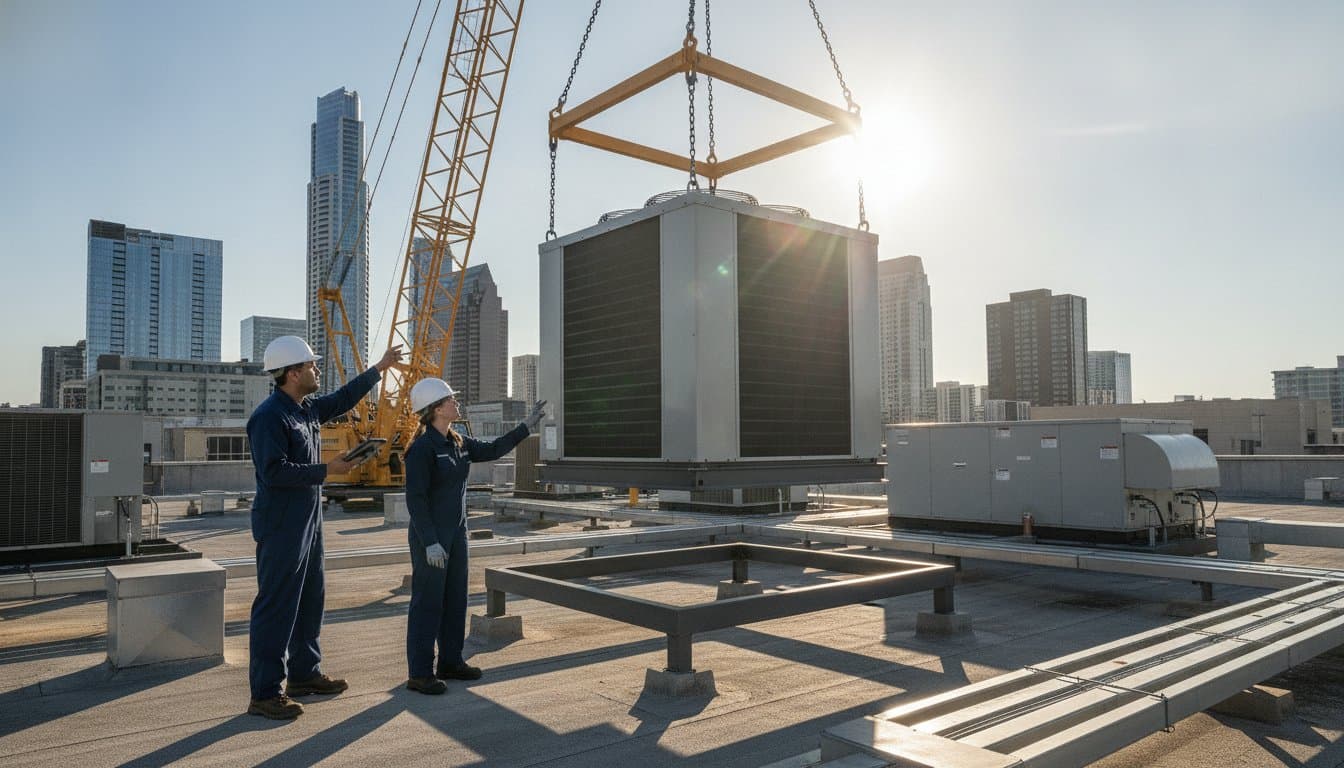
The true cost to replace commercial rooftop AC unit Austin installations in 2026 is rarely found on a manufacturer price sheet; it is instead dictated by the complex intersection of municipal code compliance, logistical execution, and engineering precision. You likely recognize that a mechanical failure or an inefficient system during a Central Texas summer is more than a technical inconvenience. It's a direct threat to operational continuity and your organization's bottom line.
This guide provides a rigorous analysis of the factors influencing your capital investment. We examine the mandatory transition to low-GWP refrigerants like R-32 and R-454B and the specific permitting requirements enforced by the City of Austin. We also detail how strategic planning, including BIM coordination and in-house fabrication, mitigates the risk of hidden logistical expenses while ensuring your facility meets the 14.3 SEER2 minimum standards. This comprehensive breakdown allows you to validate contractor expertise and maximize long-term energy efficiency ROI through meticulous preparation and technical mastery. By understanding these variables, you can transform a necessary infrastructure replacement into a strategic advantage for your facility.
Key Takeaways
- Understand how the total cost to replace commercial rooftop AC unit Austin assets is influenced by more than just hardware, focusing instead on the critical integration of logistical and engineering variables.
- Identify the impact of 2026 regulatory shifts, including mandatory low-GWP refrigerant transitions and 14.3 SEER2 efficiency standards, on your project’s technical specifications and hardware selection.
- Navigate the "Austin Factor" by accounting for hidden logistical overheads such as complex crane rigging, urban street closures, and rigorous municipal permitting requirements.
- Learn how advanced methodologies like Building Information Modeling (BIM) and in-house fabrication eliminate costly field-level errors while significantly reducing lead times for custom components.
- Establish a strategic framework for long-term ROI by transitioning from precise system commissioning to a proactive lifecycle maintenance plan that protects your mechanical infrastructure.
Table of Contents
- The Financial Reality of Commercial RTU Replacement in Austin
- Technical Cost Drivers: Engineering the Right Solution
- Logistical Overhead: The "Austin Factor" in HVAC Costs
- Strategic Cost Mitigation: The J3 Mechanical Services Advantage
- Executing Your RTU Replacement with J3 Mechanical Services
The Financial Reality of Commercial RTU Replacement in Austin
Packaged rooftop units, commonly referred to as RTUs, serve as the foundational architecture for Heating, ventilation, and air conditioning (HVAC) in the Central Texas commercial sector. These systems integrate all necessary mechanical components into a single, weatherized cabinet, providing a streamlined solution for climate control on flat-roofed structures. In Austin, where high ambient temperatures and humidity levels place extreme stress on mechanical assets, the RTU is the industry standard for maintaining interior environmental stability. Understanding the cost to replace commercial rooftop AC unit Austin equipment requires a shift from residential pricing expectations to an industrial perspective. A commercial replacement isn't merely an equipment purchase; it's a complex logistical operation involving crane coordination, structural assessments, and precise electrical integration.
Sticker shock often occurs when stakeholders compare commercial infrastructure to residential scales. While a residential unit might focus on simple comfort, a commercial RTU is a high-performance machine designed for continuous operation, advanced air filtration, and complex zoning. The baseline investment for 2026 reflects the sophisticated engineering required to meet new federal efficiency mandates and the industry-wide shift toward low-GWP refrigerants. Prioritizing capital expenditure on a high-quality replacement ensures long-term operational stability, as modern units are engineered to mitigate the risk of catastrophic failure during peak Texas summers. For investors seeking to fund these types of critical property upgrades, Jet Lending, LLC provides specialized financial services for real estate professionals. This proactive investment protects your building's productivity and prevents the compounding costs of emergency service calls.
Typical Investment Ranges by Facility Type
The scale of your facility dictates the complexity and hardware requirements of the replacement project. Retail and light commercial spaces often utilize units in the 3-ton to 10-ton range, focusing on footprint efficiency and basic zoning requirements. Large-scale industrial complexes or multi-story office buildings typically require 25-ton units or larger, which demand significant rigging and structural support. For those planning new construction to house such heavy equipment, check out Bradberry Steel for robust pre-engineered building solutions. Specialized environments, such as medical facilities or data centers, require even higher precision. These units often include advanced humidity controls and redundancy features that increase the technical scope of the installation.
Repair vs. Replacement: The 50% Rule
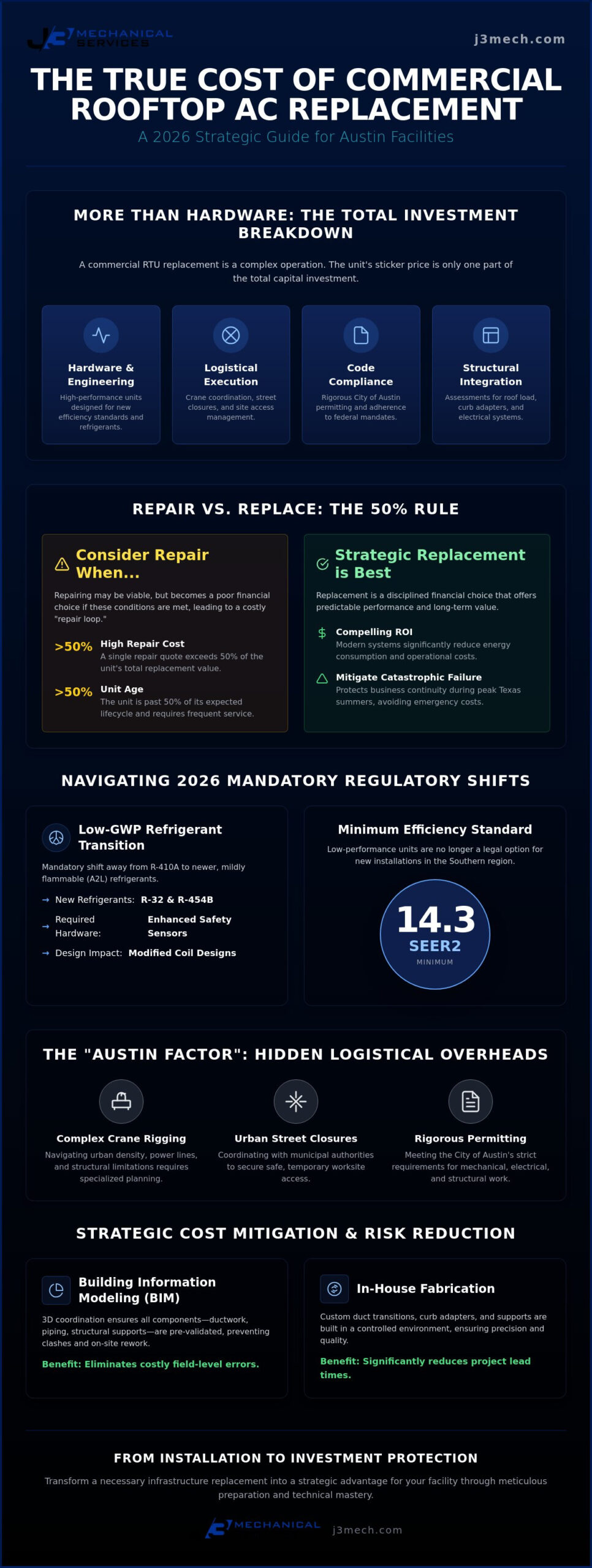
Decision-makers must evaluate the cumulative cost of repeated emergency repairs against the predictable performance of new hardware. The "Rule of 50" suggests that if a single repair cost exceeds 50% of the unit's total value, or if the unit has reached 50% of its expected lifecycle while requiring frequent intervention, replacement is the more disciplined financial choice. With the 2026 implementation of 14.3 SEER2 efficiency standards, older units using phased-out refrigerants like R-410A become increasingly expensive to maintain. Modern systems offer a compelling ROI through reduced energy consumption and the elimination of the "repair loop" that plagues aging Austin mechanical assets.
Technical Cost Drivers: Engineering the Right Solution
Hardware selection for a commercial facility is a technical exercise in risk mitigation rather than a simple purchase. When calculating the cost to replace commercial rooftop AC unit Austin infrastructure, building owners must look beyond the physical dimensions of the cabinet. The internal specifications, mandated by the 2026 transition to low-GWP refrigerants such as R-32 and R-454B, represent a significant evolution in hardware design. These newer A2L refrigerants require enhanced safety sensors; they also necessitate modified coil designs to manage their mildly flammable properties. While these regulations ensure environmental compliance, they also influence the initial equipment procurement costs. The requirement for 14.3 SEER2 minimum efficiency in the Southern region means that entry-level, low-performance units are no longer a viable or legal option for new installations.
To justify these technical investments, sophisticated facility managers utilize a Life-Cycle Cost Analysis (LCCA) to project the total ownership expense over fifteen to twenty years. This methodology moves the conversation from the initial price tag to the true economic impact of the asset. Strategic planning during the design phase, often supported by precision load auditing, prevents the common pitfall of over-sizing equipment, which is a frequent cause of premature system failure in the Central Texas climate.
The Role of Tonnage and Load Calculations
Precision engineering is the only defense against the thermal load of the Texas sun. Matching tonnage to actual thermal load is critical because over-sizing a unit is a recipe for humidity failure. If a unit is too large, it reaches the set temperature too quickly and shuts off before it can effectively remove moisture from the air. This leads to a "cold and clammy" environment that encourages mold growth and degrades building materials. We utilize Manual N load calculations to account for building square footage, occupancy levels, and glazing ratios, ensuring the system is sized for performance rather than guesswork.
Efficiency Ratings and Long-Term ROI
IEER (Integrated Energy Efficiency Ratio) provides a more accurate picture for commercial assets than SEER2 alone. It measures performance across various load levels, reflecting the reality that units rarely run at 100% capacity. High-IEER units often qualify for Austin Energy rebates, which as of April 2026, can offset a portion of the upgrade cost if the equipment exceeds IECC baselines. Additionally, the Section 179D tax deduction remains a vital tool for businesses that begin energy-efficient replacements before the June 30, 2026 deadline. These incentives directly correlate system efficiency with reduced facility electrical infrastructure needs and a shorter payback period.
Logistical Overhead: The "Austin Factor" in HVAC Costs
Austin's urban architecture requires a methodical approach to logistics that often surprises facility managers accustomed to suburban environments. The cost to replace commercial rooftop AC unit Austin equipment is heavily influenced by the "last mile" of delivery, which is the transition from the transport vehicle to the roof curb. In the downtown district or high-density areas like the Domain, this isn't a simple lift. It involves detailed site surveys to determine crane positioning, ground pressure limitations, and the necessity of municipal street closure permits. These logistical layers are essential for safety; however, they represent significant overhead that must be accounted for during the initial budgeting phase to avoid mid-project financial strain.
Environmental stewardship also adds a layer of accountability that impacts the total project budget. Responsible disposal of the decommissioned unit requires strict adherence to EPA Section 608 regulations for refrigerant recovery. As the industry moves toward low-GWP alternatives, the handling of legacy R-410A or R-22 requires certified technicians and documented chain-of-custody for hazardous materials. We align our disposal protocols with Federal Energy Management Program (FEMP) guidance to ensure that every replacement project meets federal sustainability standards while protecting the client from environmental liability. Proper disposal is a non-negotiable step in maintaining the integrity of the mechanical lifecycle.
When mechanical upgrades are part of a larger building renovation, coordinating with specialized site preparation experts ensures that all structural and environmental risks are managed; for a look at how professional teams handle complex industrial removals, check out TSIAC International.
Navigating Austin Building Codes and Permits
The City of Austin Development Services Department enforces the 2021 International Mechanical Code (IMC) with local amendments. Every commercial replacement requires a mechanical permit, and for 2026 projects, the review process focuses heavily on energy code compliance. Inspectors verify that new installations meet the 2021 International Energy Conservation Code (IECC) requirements. This verification includes checking duct sealing, insulation R-values, and thermostat controls. Rushing this process leads to failed inspections and costly project delays. A disciplined contractor manages these timelines to ensure seamless system commissioning without regulatory friction.
The Complexity of Rooftop Access and Rigging
Industrial rigging is a high-stakes operation that demands precision and comprehensive insurance coverage. Evaluating crane reach and weight capacity is particularly challenging for high-rise installations where wind speeds and urban canyons create volatile conditions. Safety protocols must be absolute. We coordinate off-hours installations, typically during weekends or late nights, to minimize business disruption and ensure public safety. This coordination includes managing traffic control teams and securing the perimeter. It ensures that the physical transition of the asset is executed without field errors or safety incidents.
Strategic Cost Mitigation: The J3 Mechanical Services Advantage
While the hardware and logistical factors define the baseline, the final cost to replace commercial rooftop AC unit Austin projects is often determined by the efficiency of the contractor's internal processes. Poorly coordinated trades and field-level errors are the primary drivers of budget overruns in high-stakes mechanical replacements, which is why many commercial developers look to design-build experts like dgrconstruction.net to streamline complex infrastructure management. J3 Mechanical Services mitigates these risks through a methodology rooted in digital precision and vertical integration. By controlling the design and fabrication phases, we eliminate the reliance on third-party suppliers and generic components that frequently lead to installation friction. This disciplined approach ensures that every labor hour and crane rental minute is utilized with maximum effectiveness.
BIM Coordination: Visualizing the Installation
Traditional mechanical replacements often suffer from clashes where new equipment interferes with existing structural elements or utility lines. We utilize Building Information Modeling (BIM) to create a high-fidelity digital twin of your facility's roof and mechanical mezzanine. Building Information Modeling (BIM) reduces project timelines by identifying potential structural or mechanical conflicts in a digital environment before physical installation commences. This visualization process allows our engineering team to resolve structural interferences and optimize the rigging plan by calculating exact weights and centers of gravity. By ensuring perfect alignment with existing electrical conduit and plumbing configurations, we reduce the total duration of on-site labor through pre-planned installation sequences.
In-House Fabrication and Precision Engineering
The transition between a decommissioned unit and a new high-efficiency RTU often requires a curb adapter to bridge the difference in footprints. Many contractors rely on generic, mass-produced adapters that can lead to air leakage and structural instability. Our in-house fabrication facility produces custom-engineered curbs and duct transitions designed specifically for your building's unique requirements. This vertical integration provides a significant cost advantage by reducing lead times through local Texas sheet metal fabrication and ensuring an airtight seal that prevents post-installation thermal loss. Precision-fit components mean the unit is set and secured faster, directly reducing the expensive hourly rates associated with heavy lifting equipment.
This level of technical mastery ensures your infrastructure investment is protected from the hidden costs of poor planning. To see how our integrated approach can streamline your next project, explore our commercial HVAC installation and replacement services today.
Executing Your RTU Replacement with J3 Mechanical Services
The successful execution of a high-stakes mechanical project depends on the contractor's ability to synthesize engineering data with field operations. While hardware procurement constitutes a significant portion of the cost to replace commercial rooftop AC unit Austin assets, the long-term value is truly realized during the commissioning phase. J3 Mechanical Services positions itself as a strategic partner, ensuring your critical infrastructure is not only installed but optimized for a decade of performance. This disciplined approach eliminates the ambiguity that often leads to operational downtime or budget overruns. By choosing a partner with dedicated industrial expertise, you ensure that every electrical connection, refrigerant charge, and duct interface is verified against rigorous performance benchmarks.
The J3 Replacement Protocol
Our protocol begins with a comprehensive site audit that transcends basic square footage measurements. We conduct a thermal load verification to ensure the specified equipment matches the actual building envelope performance. Following this, the BIM-assisted design phase coordinates every mechanical and electrical interface to prevent field-level conflicts. The final stage is a precision installation, which concludes with multi-point system testing to verify that the integrated components operate within their engineered parameters. This methodical progression ensures a seamless transition with minimal disruption to your daily operations, providing a level of accountability that generalists cannot replicate.
Protecting the Asset: Post-Installation Maintenance
Protecting your asset requires a transition from reactive repairs to a disciplined commercial HVAC maintenance program. Regular service is a non-negotiable prerequisite for manufacturer warranty compliance; it's also the only effective method to prevent the efficiency degradation caused by the relentless Austin heat. Proactive monitoring allows our technicians to identify minor technical deviations before they manifest as catastrophic failures, securing your facility's operational continuity. This methodical oversight ensures that the initial cost to replace commercial rooftop AC unit Austin infrastructure translates into a lower total cost of ownership over the system's entire lifecycle. J3 Mechanical Services provides the technical mastery and ethical consistency required to manage your facility's most critical mechanical assets for years to come.
Strategic Infrastructure Investment for Long-Term Operational Continuity
Navigating the complexities of a mechanical infrastructure upgrade requires a transition from viewing HVAC as a commodity to treating it as a critical strategic asset. As established in this analysis, the true cost to replace commercial rooftop AC unit Austin equipment is defined by the intersection of 2026 regulatory compliance, precise load engineering, and the logistical mastery required for urban rigging. By utilizing advanced tools like BIM-coordinated precision and leveraging in-house sheet metal fabrication, you eliminate the technical friction that often leads to unpredictable budget overruns. This disciplined approach ensures that your facility meets modern efficiency standards while maintaining strict control over the project's financial scope.
Maintaining operational stability in the Central Texas climate demands a partner who provides more than physical labor. Our methodology ensures that your new system is commissioned to exact technical standards and supported by 24/7 industrial emergency support to protect your organization's bottom line. Investing in meticulous preparation today secures your facility's environmental integrity and comfort for the next decade. We invite you to Request a Strategic Quote for Your Austin RTU Replacement to begin the process of modernizing your mechanical infrastructure with a team committed to engineering excellence. Your path to a more efficient and reliable cooling solution starts with a commitment to technical precision.
Frequently Asked Questions
What is the average cost of a 10-ton commercial RTU in Austin?
The total investment for a 10-ton commercial RTU is determined by the specific technical requirements of the facility, including the selection of low-GWP refrigerants and high-efficiency IEER ratings. While hardware is a significant factor, the total cost to replace commercial rooftop AC unit Austin assets includes the engineering of curb adapters and integrated control systems. Pricing varies based on the unit's configuration and whether it meets the 15.2 SEER2 threshold required for local utility rebates.
How long does a commercial rooftop AC unit replacement typically take?
A standard physical replacement typically occurs within a single business day, provided that the pre-installation engineering and logistical coordination are completed in advance. The total project lifecycle, which includes site audits, BIM modeling, and municipal permitting, often spans several weeks. Our methodology prioritizes off-hours rigging to minimize operational downtime, ensuring that the transition from the decommissioned asset to the new system is executed with industrial precision.
Do I need a permit from the City of Austin for an RTU replacement?
Yes, the City of Austin Development Services Department requires a mechanical permit for all commercial rooftop unit replacements. Compliance with the 2021 International Mechanical Code and the 2021 International Energy Conservation Code is mandatory for every installation. We manage the entire permitting process, including the coordination of municipal inspections, to ensure that your new infrastructure meets all local regulatory standards and safety protocols without administrative friction.
Can I just replace the compressor instead of the entire rooftop unit?
While replacing a compressor is technically possible, it's often a reactive measure that fails to address the underlying degradation of an aging system. If the unit is over ten years old or uses phased-out R-410A refrigerant, the "Rule of 50" suggests that a full replacement is the more disciplined financial decision. Modern systems offer significantly higher efficiency and compatibility with 2026 environmental regulations, providing a superior return on investment.
How does a crane rental impact the total cost of HVAC replacement?
Crane and rigging logistics represent a critical overhead component, particularly in Austin's dense urban environments where street closures and traffic control are required. The complexity of the lift, including the necessary reach and weight capacity, directly influences the logistical budget. Precise coordination through BIM allows us to optimize crane time and minimize the duration of street closures, effectively mitigating the hidden fees associated with high-rise or restricted-access installations.
What are the energy efficiency requirements for commercial HVAC in Texas for 2026?
As of 2026, all new commercial HVAC installations in Texas must adhere to a minimum efficiency standard of 14.3 SEER2. The transition to low-GWP refrigerants like R-32 and R-454B is now mandatory for new equipment, replacing the legacy R-410A standard. Selecting equipment that exceeds these baselines, specifically those with a SEER2 rating of 15.2 or higher, is often required to qualify for current Austin Energy commercial rebates. This ensures your facility remains compliant.
How often should a commercial rooftop unit be replaced?
Commercial rooftop units typically reach the end of their reliable operational lifecycle after fifteen to twenty years of service in the Central Texas climate. When evaluating the cost to replace commercial rooftop AC unit Austin assets, property managers should prioritize a life-cycle cost analysis that accounts for increasing repair frequency. Proactive replacement before a catastrophic failure occurs ensures that you maintain operational continuity and capitalize on modern efficiency gains that lower your total cost of ownership.
Does J3 Mechanical Services provide emergency RTU replacement services?
Yes, J3 Mechanical Services provides 24/7 emergency service for critical infrastructure that requires immediate technical intervention or replacement. We understand that unpredictable downtime is a significant liability for commercial facilities, and our team is equipped to manage high-stakes mechanical failures with quiet confidence. Our integrated fabrication capabilities and logistical expertise allow us to respond rapidly to critical cooling failures, restoring environmental stability to your facility through disciplined, systematic execution.
Need a hand with your building's HVAC?
Free quotes and honest answers from licensed commercial technicians across South Texas.