
Data Center HVAC Requirements in Texas: Engineering for 2026 Resilience
With ERCOT currently auditing approximately 200 gigawatts of proposed data center projects, the margin for mechanical error in the Lone Star State has effectively vanished. You likely recognize that maintaining 100 percent uptime in Central and South Texas requires more than just high-capacity chillers; it demands a disciplined approach to thermal management that accounts for both extreme ambient temperatures and evolving regulatory scrutiny. This article serves as a comprehensive technical guide to the data center HVAC requirements Texas facilities must meet to achieve 2026 resilience, focusing on the intersection of mechanical precision and operational efficiency.
We'll explore how Building Information Modeling (BIM) mitigates construction delays, the specific ASHRAE thermal guidelines for high-density AI loads, and the strategic use of in-house fabrication to ensure your cooling infrastructure remains a reliable asset rather than a liability. By aligning your facility's mechanical standards with current ERCOT and TCEQ mandates, you can reduce operational overhead while securing the long-term stability of your mission-critical infrastructure. This methodical overview provides the engineering clarity needed to navigate the complexities of modern cooling requirements in an increasingly strained energy landscape.
Key Takeaways
- Identify the specific data center HVAC requirements Texas facilities must meet to maintain thermal stability against extreme ambient temperatures and the urban heat island effect.
- Compare the technical advantages of chilled water systems and specialized CRAH units to determine the optimal mechanical architecture for high-density AI computing environments.
- Learn how Building Information Modeling (BIM) and 3D clash detection streamline the construction process by identifying mechanical interferences before they cause costly field delays.
- Navigate the latest regulatory standards for Texas sales tax exemptions, ensuring your mechanical infrastructure investments align with state eligibility criteria for 2026.
- Discover the strategic benefits of utilizing in-house fabrication and disciplined maintenance protocols to safeguard mission-critical assets and guarantee 100 percent operational uptime.
Understanding Data Center HVAC Requirements in the Texas Climate
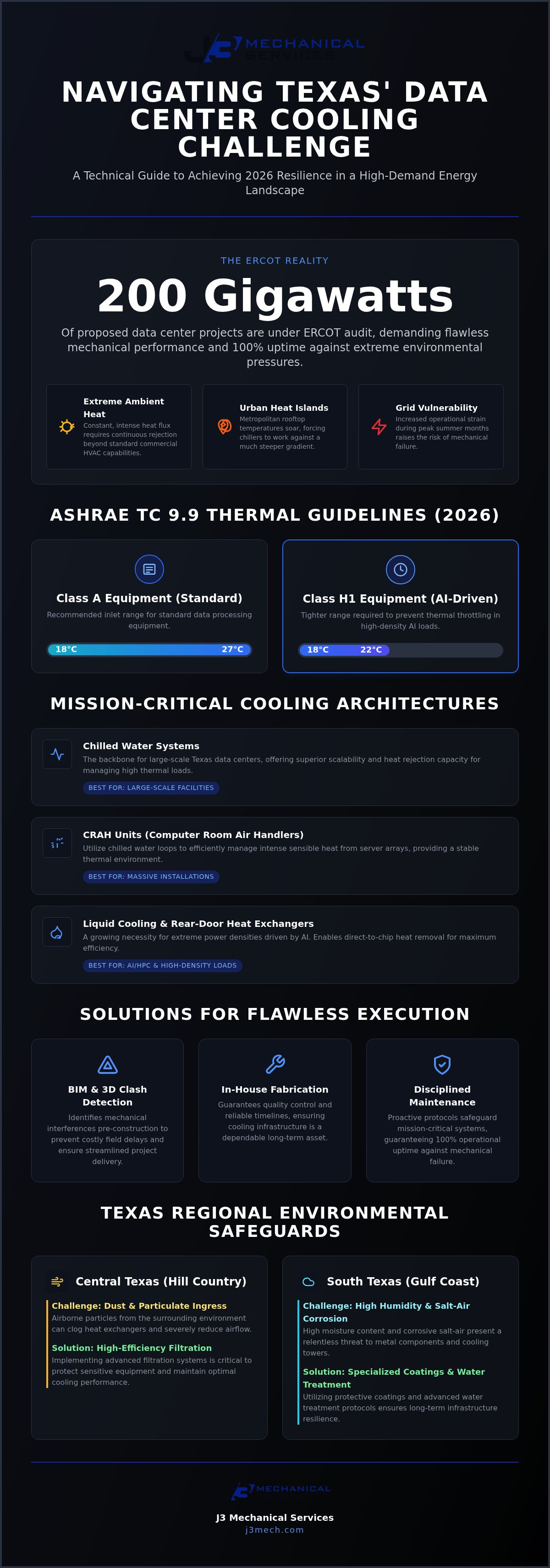
Engineering for 2026 resilience begins with a precise evaluation of the local thermal profile. The data center HVAC requirements Texas facilities must adhere to have evolved beyond simple air conditioning to encompass sophisticated atmospheric management. Standard commercial systems often fail because they're designed for human comfort, whereas high-density computing generates a constant, intense heat flux that demands continuous rejection. In metropolitan areas like Austin and San Antonio, the "Heat Island" effect causes rooftop temperatures to soar significantly higher than the reported ambient, which forces chillers to work against a much steeper temperature gradient. This operational strain reduces efficiency and increases the risk of mechanical failure during peak summer months when the grid is most vulnerable.
Managing the atmospheric conditions of the Gulf Coast requires a nuanced understanding of sensible and latent heat. While sensible heat refers to the measurable temperature of the air, latent heat involves the energy associated with the high moisture content prevalent in South Texas. Precise Data Center Environmental Control isn't just about cooling; it's about maintaining a stable dew point to prevent condensation on sensitive electronic components. We achieve this through rigorous humidity control and specialized air handling units that can decouple moisture removal from temperature reduction.
The ASHRAE Thermal Guidelines for Data Processing
The 2026 ASHRAE TC 9.9 standards reflect a critical shift in how we manage thermal envelopes for mission-critical infrastructure. For standard Class A equipment, the recommended inlet range remains 18°C to 27°C, but the rise of AI-driven Class H1 systems requires a tighter range of 18°C to 22°C to prevent thermal throttling. While some operators are shifting toward higher allowable temperatures to reduce Power Usage Effectiveness (PUE), this strategy requires disciplined monitoring in humid Texas environments. Liquid cooling is becoming a necessity for these high-density loads, as traditional air cooling cannot always meet the 2026 energy performance framework requirements for AI-driven data centers.
Regional Environmental Challenges in Central and South Texas
Geographic placement within the state dictates specific mechanical safeguards. Facilities in Central Texas must prioritize high-efficiency filtration to manage dust and particulate ingress from the surrounding hill country, which can otherwise clog heat exchangers and reduce airflow. Conversely, data centers in Corpus Christi or the Rio Grande Valley face the relentless threat of salt-air corrosion. We address these risks by utilizing specialized coatings on cooling towers and implementing advanced water treatment protocols. This disciplined approach ensures that the mechanical infrastructure remains resilient against both the intense heat of the interior and the corrosive humidity of the coast.
Technical Cooling Architectures for Mission-Critical Reliability
The selection of a mechanical architecture is a strategic decision that dictates the long-term viability of a facility. Large-scale chilled water systems serve as the primary backbone for data centers in the Texas market because they offer superior scalability and heat rejection capacity compared to localized DX units. While Computer Room Air Conditioners (CRAC) utilize direct expansion refrigeration for smaller footprints, Computer Room Air Handlers (CRAH) are the preferred choice for massive installations. These units utilize chilled water loops to manage the intense sensible heat loads generated by modern server arrays, providing a more stable and efficient thermal environment.
Engineering for 2026 requires a realistic assessment of evaporative cooling limitations. In the high-humidity regions of South Texas and the Gulf Coast, the wet-bulb temperature often approaches the ambient dry-bulb temperature, which renders traditional "swamp cooling" ineffective. As AI-driven computing drives power densities to new heights, the industry is transitioning toward liquid cooling and rear-door heat exchangers. These technologies are essential for maintaining the 18°C to 22°C inlet temperatures required for Class H1 equipment, especially as traditional air-cooled methods struggle to keep pace with the thermal output of high-performance chips. Implementing these advanced systems requires the type of mechanical installation expertise that prioritizes technical mastery over speed.
Redundancy and Uptime Standards (N+1 vs. 2N)
Achieving Tier III and Tier IV reliability necessitates a disciplined approach to redundancy. We engineer HVAC systems with N+1 or 2N configurations to ensure that the failure of a single chiller, pump, or air handler doesn't compromise the mission-critical environment. This involves the strategic placement of backup infrastructure and the integration of automated failover protocols. Continuous 24/7 monitoring acts as a vital safety net, allowing for the immediate detection of anomalies before they escalate into outages. This level of preparation is the only way to guarantee 100 percent uptime during the peak of a Texas summer.
PUE Optimization: Maximizing Energy Efficiency
Power Usage Effectiveness (PUE) has become a primary metric for operational success, particularly as ERCOT audits approximately 200 gigawatts of proposed data center projects. To maximize efficiency, we utilize Variable Frequency Drives (VFDs) that allow mechanical components to match the actual IT load rather than operating at constant, full capacity. Following FEMP's best practices for data centers, we also implement rigorous hot-aisle and cold-aisle containment strategies. These physical barriers prevent the mixing of supply and exhaust air, which significantly reduces the workload on the cooling plant and lowers the overall energy footprint of the facility.
Strategic Coordination: The Role of BIM and In-House Fabrication
Building Information Modeling (BIM) has transitioned from a sophisticated luxury to an absolute prerequisite for mission-critical mechanical construction. The complexity inherent in the data center HVAC requirements Texas projects must satisfy requires a level of coordination that traditional 2D drafting simply cannot provide. By utilizing 3D clash detection, we identify spatial conflicts between massive chilled water piping, electrical conduits, and structural steel long before a single piece of equipment arrives on site. This proactive methodology aligns with the increasing scrutiny of state leaders, as reflected in the Texas data center audit requirements, which emphasize the need for transparency and efficiency in infrastructure development.
The strategic integration of digital modeling and in-house fabrication allows for the creation of modular mechanical skids and piping spools in a controlled environment. This approach significantly reduces on-site labor hours and mitigates the safety risks associated with crowded, high-stakes job sites. By shifting the bulk of the assembly process to a fabrication facility, we ensure that the integrity of every weld and connection is verified through rigorous quality control protocols. This disciplined execution is essential for maintaining the aggressive commissioning schedules required by the 2026 Texas data center market.
BIM Coordination for Complex Mechanical Rooms
Managing the dense mechanical footprint of a modern data center requires precision placement of massive chiller units and complex hydronic loops. BIM serves as the single source of truth for the entire project team, allowing designers, fabricators, and installers to work from a unified digital twin. This level of synchronization prevents the costly change orders and construction delays that often plague large-scale mechanical installs. Specifically, our specialized hvac sheet metal fabrication process integrates directly with BIM data to ensure that custom ductwork is manufactured to exact tolerances, streamlining the path from design to final commissioning.
Advantages of In-House Ductwork and Piping Fabrication
In-house fabrication provides a level of quality assurance that is impossible to replicate in the field. By manufacturing piping spools and custom ductwork in a climate-controlled shop, we eliminate the variables of Texas weather and site-specific logistical hurdles. This is particularly advantageous for refurbished facilities where unique spatial constraints require bespoke mechanical solutions that don't fit standard catalog specifications. J3 Mechanical utilizes this vertical integration to meet aggressive commissioning dates, ensuring that the cooling infrastructure is ready to support IT loads the moment the facility goes live. This methodical preparation reinforces our role as a stable partner capable of managing the most demanding mission-critical environments.
Regulatory Compliance and Texas State Incentives
Navigating the intersection of fiscal incentives and mechanical engineering is essential for large-scale data center operators. The state sales and use tax exemption, managed by the Texas Comptroller, offers a 6.25 percent reduction for facilities that meet specific investment and operational thresholds. Because mechanical systems represent a significant portion of the capital expenditure required to hit the $200 million investment mark, the data center HVAC requirements Texas projects must follow are inherently tied to tax eligibility. With the state currently auditing approximately 200 gigawatts of proposed projects, demonstrating that your cooling plant is both high-capacity and energy-efficient is no longer optional.
The link between mechanical infrastructure and state incentives is particularly evident during the audit process. Out of 138 data centers receiving the state tax exemption by mid-2026, several were found to be out of compliance due to insufficient documentation of capital investments. By aligning your mechanical design with the Comptroller’s criteria, you ensure that every chiller, air handler, and piping spool contributes toward your total investment goal while providing the mission-critical stability your clients expect.
Qualifying for the Data Center State Sales Tax Exemption
To qualify for the state’s tax break, a facility must exceed 100,000 square feet and commit to creating at least 20 permanent jobs at 120 percent of the local median salary. At this industrial scale, the cooling infrastructure must be engineered to maintain the mission-critical environment against the state’s extreme thermal peaks. Strategic documentation of all mechanical equipment as "essential to operation" is a prerequisite for a successful audit, especially given the increased scrutiny from Texas lawmakers regarding the $3.2 billion fiscal impact of these exemptions. Precision commercial hvac installation ensures that these high-value assets are correctly classified as capital investments, supporting the required $200 million threshold over the initial five-year period.
Environmental and Safety Standards for Texas Facilities
Compliance with the Texas Commission on Environmental Quality (TCEQ) is equally critical for ongoing operations. This includes obtaining air emissions permits for backup generators and TPDES permits for the discharge of industrial wastewater from cooling towers. As we approach 2026, refrigerant management and leak detection have become more heavily regulated, requiring disciplined maintenance protocols to avoid significant environmental fines. Municipal noise ordinances also dictate the placement and acoustic treatment of rooftop mechanical equipment, particularly in urban environments like Austin or Dallas where proximity to residential areas is a concern. For help navigating these complex mechanical and regulatory hurdles, you can consult with our engineering team to ensure your project remains compliant and efficient.
Executing the Mission: J3 Mechanical’s Industrial Solutions
Achieving total project control in mission-critical environments requires more than technical knowledge; it demands a disciplined commitment to the role of the master builder. At J3 Mechanical, we approach every contract as a critical infrastructure responsibility, ensuring that the data center HVAC requirements Texas operators face are met with quiet confidence and technical mastery. Our methodology is rooted in transparent, logic-driven planning that prioritizes long-term stability over the convenience of quick fixes. By integrating our in-house fabrication and BIM capabilities into every phase of the project, we provide a streamlined construction process that eliminates construction delays and ensures the integrity of the final mechanical installation.
We recognize that the lifecycle of a data center cooling system extends far beyond the initial commissioning date. A facility's ability to maintain 100 percent uptime during a record-breaking Texas summer is a direct result of meticulous preparation and ongoing oversight. Whether we're coordinating a complex new construction project or managing a sophisticated retrofit of an existing chilled water plant, our team maintains a steadfast focus on accuracy and verification. This proactive stance allows us to mitigate risks before they manifest as operational failures, securing the efficiency and reliability of your facility's most vital assets.
Precision Installation and New Construction Protocols
Our approach to new construction leverages decades of industrial expertise to manage the high-stakes mechanical infrastructure required for modern computing. We maintain a strict commitment to project timelines and budget transparency, utilizing digital modeling to ensure that every component is installed to exact specifications. To protect these significant capital investments, our commercial hvac maintenance programs are designed as strategic protocols. These programs go beyond surface-level checks to provide deep-cycle asset management, effectively extending the equipment's lifecycle and reducing the total cost of ownership for our partners.
Critical Recovery and Emergency Response
In the event of a mechanical anomaly, the speed and precision of the response are the only things standing between a minor incident and a catastrophic outage. We provide rapid-response commercial hvac repair services that are specifically tailored to the needs of mission-critical facilities. Our technicians maintain a state of constant readiness, supported by a strategic parts inventory that ensures critical components are available the moment they're needed. This 24/7 recovery capability acts as a vital safety net, allowing operators to navigate the complexities of the Texas energy environment with absolute certainty. Consult with J3 Mechanical for your next data center project to secure a partner dedicated to industrial excellence and unwavering accountability.
Securing Operational Stability in the Evolving Texas Landscape
Resilience in the 2026 data center market is a product of meticulous engineering and strategic foresight. Meeting the rigorous data center HVAC requirements Texas mandates involves more than just selecting high-capacity equipment; it requires a disciplined integration of digital modeling and industrial-scale fabrication to ensure every component performs under extreme thermal stress. By aligning mechanical infrastructure with state tax incentives and grid audit requirements, operators can transform their cooling systems from a necessary overhead into a high-performance asset that guarantees 100 percent uptime.
J3 Mechanical stands ready to serve as your master builder, providing the technical mastery and ethical consistency needed to manage complex mechanical environments. Our methodology focuses on proactive risk mitigation through BIM-coordinated execution and the precision of in-house fabrication. This approach ensures your facility remains stable against the unpredictable Texas climate and the shifting regulatory landscape. We invite you to Partner with J3 Mechanical for Precision Data Center HVAC Engineering and secure the 24/7 mission-critical support your infrastructure demands. With the right mechanical partner, your facility will not only meet today's standards but will thrive in the years to come.
Frequently Asked Questions
What are the standard PUE targets for new data centers in Texas for 2026?
PUE targets for new data centers in 2026 align with the recent AI Data Center Energy Performance Framework, often aiming for a Power Usage Effectiveness of 1.1 to 1.4. In the competitive Texas energy market, achieving these low targets requires sophisticated mechanical architectures that minimize parasitic cooling loads. Facilities failing to meet these efficiency standards may face increased operational overhead and potential regulatory scrutiny from ERCOT as they manage large-load interconnection audits.
How does the Texas humidity affect free-cooling or economizer cycles?
High ambient humidity in South Texas and the Gulf Coast significantly reduces the efficacy of free-cooling and air-side economizer cycles. When the outdoor wet-bulb temperature remains elevated, mechanical refrigeration must remain active to manage both temperature and latent heat. Engineering for the specific data center HVAC requirements Texas geography dictates requires a realistic assessment of these environmental constraints to avoid over-reliance on atmospheric cooling that isn't available during humid summer peaks.
What HVAC equipment qualifies for the Texas sales tax exemption?
Most mechanical infrastructure essential to the operational cooling of the facility qualifies for the 6.25 percent state sales and use tax exemption. This includes massive chiller plants, CRAH units, cooling towers, and the associated piping or ductwork fabrication. To secure this benefit, documentation must demonstrate that the data center HVAC requirements Texas projects follow are integral to the mission-critical function and contribute to the required $200 million capital investment threshold over five years.
Why is BIM coordination essential for data center mechanical installations?
BIM coordination is a prerequisite for mission-critical installations because it allows for the precise 3D mapping of dense mechanical rooms before construction begins. By utilizing digital twins to identify and resolve clashes between piping, ductwork, and electrical systems, we eliminate costly field interferences. This disciplined approach ensures that complex HVAC systems are installed correctly the first time, preventing construction delays and ensuring long-term serviceability for facility technicians.
How often should data center HVAC systems undergo preventive maintenance?
Mission-critical HVAC systems require a tiered preventive maintenance schedule to ensure 100 percent operational uptime. While major components like chillers undergo comprehensive quarterly inspections, high-wear items such as filters and sensors often require monthly verification. This steady cadence of oversight, combined with 24/7 remote monitoring, allows for the early detection of mechanical drift or component fatigue before they escalate into an emergency repair scenario or a facility-wide outage.
What are the most common cooling failures in Texas mission-critical facilities?
The most frequent cooling failures in Texas facilities stem from the extreme rooftop heat island effect and mineral scaling in water-cooled systems. Excessive ambient heat can cause compressor cycling issues or sensor failures; meanwhile, high mineral content in local water supplies often leads to fouling in heat exchangers. Proactive maintenance and advanced water treatment protocols are the primary safeguards against these common failure points in high-stakes commercial mechanical environments.
Can J3 Mechanical handle HVAC retrofits for existing data centers?
J3 Mechanical specializes in both new construction and complex mechanical retrofits for existing data center facilities across Texas. Our team manages the entire lifecycle of a retrofit project, from initial BIM coordination to the precision installation of high-efficiency cooling components. We utilize in-house fabrication to manufacture custom piping and ductwork that fits within the unique spatial constraints of older buildings, ensuring that upgrades are completed without disrupting ongoing operations.
What is the difference between CRAH and CRAC units in a data center context?
The primary difference lies in the cooling medium used to reject heat from the data hall. Computer Room Air Conditioners (CRAC) utilize direct expansion refrigeration cycles, making them suitable for smaller footprints or decentralized cooling. Conversely, Computer Room Air Handlers (CRAH) utilize chilled water loops and are the preferred choice for large-scale Texas data centers due to their superior heat rejection capacity and operational efficiency in high-density environments.
Need a hand with your building's HVAC?
Free quotes and honest answers from licensed commercial technicians across South Texas.