
Emergency Commercial Furnace Repair in Corpus Christi: Strategic System Recovery
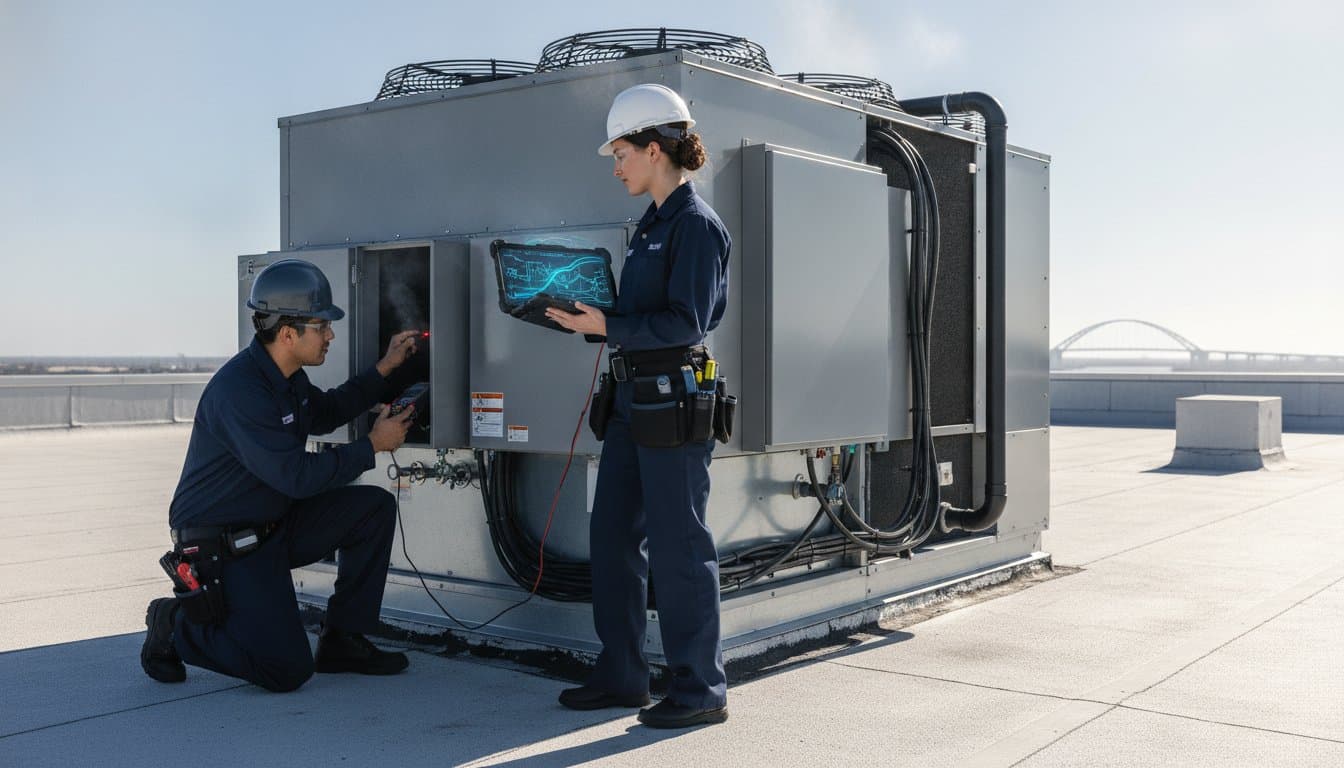
For a high-capacity facility, a furnace failure is never just a maintenance ticket; it represents a critical infrastructure breach that threatens both operational continuity and employee safety. When your facility faces a sudden loss of thermal precision, the distinction between a simple fix and a strategic recovery becomes the difference between a stable environment and recurring downtime. Securing qualified emergency commercial furnace repair corpus christi requires an authoritative partner who understands that industrial systems demand more than residential-grade solutions. You need a disciplined approach that accounts for the corrosive salt air of the Coastal Bend and the stringent requirements of the 2021 International Mechanical Code.
It's frustrating when contractors lack the technical transparency or the industrial equipment necessary to handle large-scale mechanical failures. We agree that your organization deserves a response rooted in technical mastery and professional accountability rather than high-energy salesmanship. This professional guide will outline how to manage critical heating failures by utilizing advanced diagnostic reporting and systematic execution. You'll learn how to restore system stability through precise logistical coordination and why in-house fabrication is essential for rapid, industrial-grade recovery.
Key Takeaways
- Identify the technical thresholds of "red-line" heating failures to distinguish between minor operational disruptions and critical infrastructure emergencies.
- Learn to interpret complex diagnostic signals, such as controller flash codes and gas pressure fluctuations, to provide technical teams with precise preliminary data.
- Understand why a systematic diagnostic protocol is the only reliable method for securing emergency commercial furnace repair corpus christi without risking repeat system failures.
- Develop a proactive facility management strategy by establishing priority response agreements and maintaining updated digital schematics for rapid mechanical intervention.
- Discover how the integration of BIM data and in-house fabrication facilitates the precision recovery of obsolete or highly customized commercial heating components.
Table of Contents
- Critical Thermal Failures: Defining the Scope of Commercial Emergencies
- Technical Indicators of Commercial Furnace Failure
- Strategic Emergency Response: Industrial Standards vs. Temporary Fixes
- Facility Manager’s Checklist: Preparing for Thermal Emergencies
- The J3 Advantage: Precision Engineering in Emergency Recovery
Critical Thermal Failures: Defining the Scope of Commercial Emergencies
Commercial heating failures represent a profound breach of facility integrity that extends far beyond the simple discomfort found in residential settings. In a corporate or industrial context, a furnace malfunction translates directly into operational paralysis, potential inventory loss, and significant safety liabilities for employees and tenants. Identifying "red-line" failures is a critical skill for facility managers who must determine when a system requires an immediate, high-capacity intervention. These emergencies often involve the failure of HVAC systems to maintain strict thermal precision, which is a requirement for specialized environments like data centers, medical labs, or manufacturing floors in Corpus Christi. The logistical cost of downtime in high-value assets can escalate rapidly, making a strategic partnership for emergency commercial furnace repair corpus christi an essential component of any risk mitigation strategy.
High-Stakes Failure Scenarios
Critical failures in high-capacity furnaces often manifest through specific mechanical sequences that demand industrial-grade diagnostics. When these components fail, the system's safety protocols will typically force a total shutdown to prevent catastrophic damage or hazardous conditions. Common scenarios include:
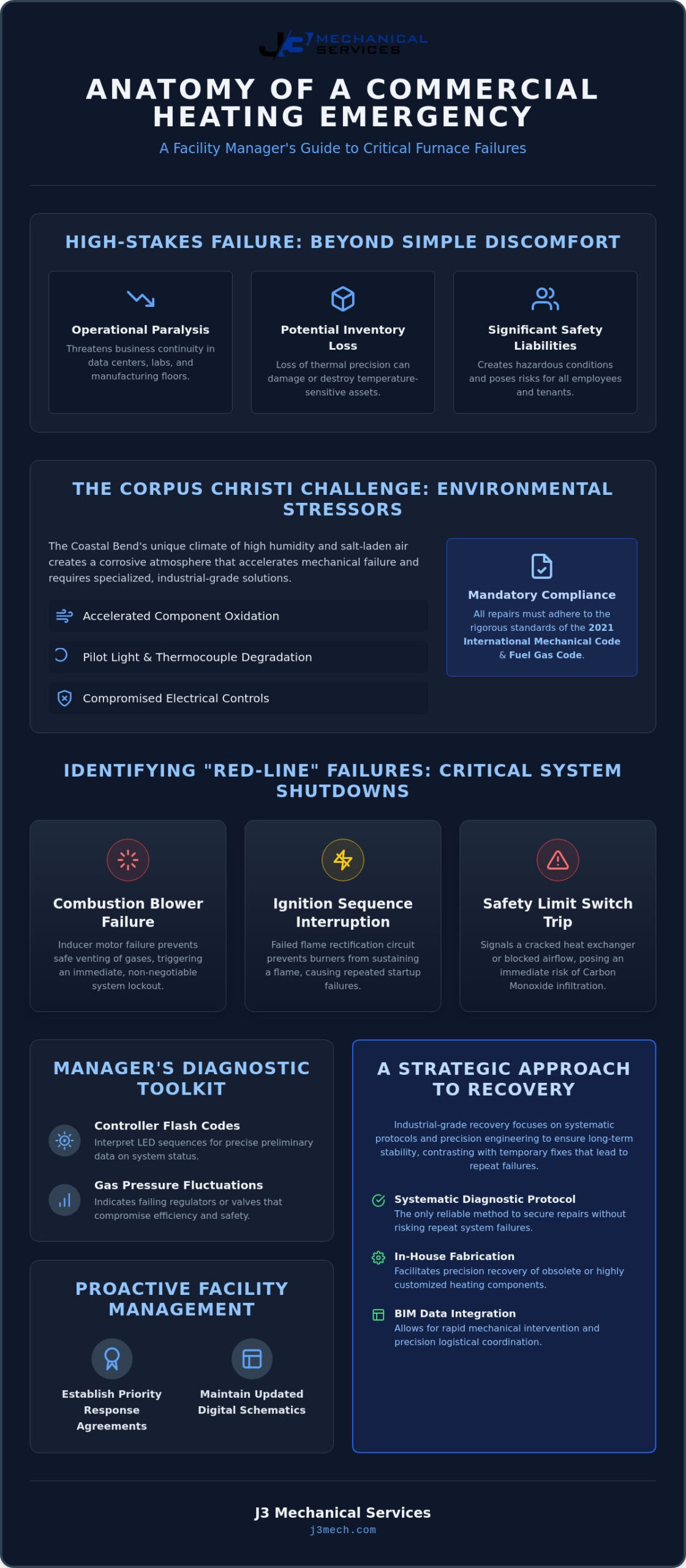
- Complete combustion blower failure: When the inducer motor fails in a high-capacity furnace, the system cannot safely vent combustion gases, triggering an immediate and non-negotiable system lockout.
- Ignition sequence interruptions: Modular heating units often face failures in the flame rectification circuit, which prevents the burners from sustaining a stable flame and results in repeated startup failures.
- Safety limit switch trips: These switches serve as the final line of defense against cracked heat exchangers or restricted airflow, signaling a condition that poses an immediate risk of carbon monoxide infiltration.
The Impact of Corpus Christi’s Coastal Environment
The environmental conditions in the Coastal Bend present unique challenges to the longevity of commercial mechanical systems. High humidity levels combined with salt-laden air accelerate the oxidation of furnace cabinets and internal components, leading to structural compromises that residential-grade units cannot withstand. This corrosive atmosphere often causes pilot light instability as thermocouples degrade or burner ports become obstructed by mineral deposits. Because the City of Corpus Christi adopted the 2021 International Mechanical Code and the 2021 International Fuel Gas Code in August 2023, all repairs must adhere to these rigorous standards to ensure building safety and legal compliance. Environmental factors also compromise electrical control reliability, as salt crystals can create conductive bridges on circuit boards, leading to erratic behavior or total system failure during critical weather shifts. Addressing these issues requires a disciplined technical approach that accounts for the specific atmospheric pressures and chemical exposures inherent to our region. While these standards protect commercial assets, homeowners can ensure their own venting systems remain safe and clear by consulting specialists like Absolute Chimney Pros.
Technical Indicators of Commercial Furnace Failure
Technical indicators of commercial furnace failure are rarely as simple as a total lack of heat; instead, they manifest as subtle deviations from established performance baselines. Facility managers must understand how to interpret diagnostic flash codes on integrated furnace controllers, as these LED sequences provide a preliminary roadmap for emergency commercial furnace repair corpus christi. A specific flash pattern might indicate a pressure switch failure, while a rapid pulse could suggest a polarity issue or a grounded flame sensor. Identifying these codes early allows for a more targeted technical response, reducing the time spent in the diagnostic phase of a recovery operation.
Precision monitoring of gas pressure is equally vital for maintaining industrial-grade combustion. Fluctuations in manifold pressure often signal a failing regulator or a sticking gas valve, both of which compromise efficiency and safety. When an inducer motor exhibits an abnormal amperage draw, it frequently points toward restricted venting or a compromised heat exchanger integrity. These mechanical stressors require immediate verification to prevent secondary system damage. High-output industrial burners also rely on flame rectification, where the furnace control board monitors a microamp signal to confirm the presence of a stable flame. If this signal drops below the required threshold, the system will initiate a lockout to prevent unburned fuel from accumulating.
Mechanical Failure Markers
High-volume blower assemblies should never exhibit excessive vibration. If they do, it often indicates an out-of-balance wheel or failing bearings that will eventually lead to catastrophic motor failure. Delayed ignition events are particularly hazardous, as the audible "booms" signal gas accumulation that can lead to high-velocity combustion risks. Soot accumulation within the cabinet or burner ports is a definitive marker of incomplete combustion, creating a severe carbon monoxide risk that necessitates immediate commercial HVAC repair intervention.
Control and Electrical Vulnerabilities
Electrical stability is the foundation of mechanical reliability in complex systems. Failure points in 24V control circuits often stem from transformer saturation or shorted contactor coils, while corroded sensor probes lead to frequent system short-cycling. For facilities utilizing Variable Frequency Drives (VFDs), malfunctions in the drive parameters can disrupt critical airflow and static pressure management. All electrical troubleshooting and maintenance must strictly adhere to OSHA safety standards to ensure technician safety and facility compliance. By maintaining a disciplined diagnostic approach, facility managers can secure emergency commercial furnace repair corpus christi before minor electrical faults escalate into total infrastructure failures.
Strategic Emergency Response: Industrial Standards vs. Temporary Fixes
Commercial mechanical systems are sophisticated assemblies that demand a systematic diagnostic protocol rather than the reactive parts-swapping often seen in residential services. When a high-capacity unit fails, the objective isn't merely to restore heat; it's to ensure the entire system operates within its engineered parameters. A critical phase of this process involves verifying the integrity of the heat exchanger before combustion is ever restored. This verification step is mandatory to prevent hazardous gases from entering the building's airstream, especially in facilities where employee safety and regulatory compliance are paramount. For those seeking emergency commercial furnace repair corpus christi, it's essential to partner with a team that provides dedicated 24/7 emergency service and views each repair as a strategic intervention within the broader context of the facility's lifecycle.
Rigorous documentation serves as the foundation for both insurance claims and warranty preservation. Every action taken during an emergency response must be logged with technical precision, detailing the exact failure point and the corrective measures utilized. This level of transparency ensures that facility managers have a clear digital record to present to stakeholders or auditors. By integrating emergency repairs into a comprehensive maintenance plan, organizations can identify recurring vulnerabilities and address them before they lead to another catastrophic failure. This disciplined approach to reporting mirrors the technical mastery required to manage complex industrial-grade units; for instance, residential property owners in West Sussex can discover WellPlumbed to find the same level of professional integrity in domestic heating and plumbing.
J3's Disciplined Repair Protocol
Our approach to emergency commercial furnace repair corpus christi begins with a strict safety lockout and an assessment of the local environmental factors that may have contributed to the failure. Because our technicians operate with a master-builder mindset, they use advanced calibrated diagnostic tools to isolate the root cause of a malfunction. This methodical identification prevents the common pitfall of treating symptoms while leaving the underlying defect intact. Once the repair is complete, we perform a systematic verification of all safety controls, ensuring the system meets or exceeds the 2021 International Mechanical Code standards before it's returned to service.
Temporary vs. Permanent System Recovery
In the rush to restore climate control, some contractors might resort to "jumping" safety switches to bypass a lockout. This practice is fundamentally unethical and dangerous, as it removes the critical protections designed to prevent fires or carbon monoxide poisoning. We prioritize permanent system recovery by ensuring part compatibility with legacy industrial furnace models, often utilizing our in-house fabrication capabilities for custom components. Balancing the need for immediate restoration with long-term mechanical stability is a core tenet of our methodology. We don't just aim for a quick fix; we aim for a disciplined recovery that secures the stability of your critical infrastructure.
Facility Manager’s Checklist: Preparing for Thermal Emergencies
Strategic readiness is the primary defense against the operational paralysis caused by heating failures. For facility managers in the Coastal Bend, preparing for a crisis involves more than simply keeping a technician's number on file; it requires a structured framework of logistical coordination and technical foresight. Establishing a priority response agreement with a contractor specialized in high-capacity systems ensures that your facility bypasses the delays common during peak demand periods. This proactive alignment allows for a more rapid deployment of emergency commercial furnace repair corpus christi, as the service team will already possess a baseline understanding of your mechanical infrastructure.
Implementing remote monitoring technology represents another layer of sophisticated risk management. By integrating sensors that track real-time performance data, managers can detect failure markers like rising amperage or declining static pressure before a total system shutdown occurs. Additionally, conducting seasonal pre-checks on industrial gas lines and venting systems is essential for compliance with the 2021 International Fuel Gas Code. These inspections identify potential obstructions or regulator drift that could lead to combustion instability during a cold front, allowing for corrective action while the environment is still stable.
Emergency Documentation Access
Rapid system recovery depends heavily on the accessibility of technical data during a crisis. Managers should maintain a centralized digital repository that includes mapped furnace locations and gas shut-off valves to facilitate immediate site control. It's also vital to secure current warranty information for all high-capacity units to prevent unnecessary out-of-pocket expenses. Utilizing historical commercial hvac installation records provides technicians with critical baseline performance data, such as original design flow rates and pressure settings, which are indispensable for accurate recalibration. If your current documentation is incomplete, you can request a facility mechanical audit to establish a new technical baseline.
Proactive Mitigation Strategies
A disciplined maintenance schedule significantly reduces the probability of a "red-line" failure. Scheduling semi-annual combustion analysis for all commercial burners ensures that fuel-to-air ratios remain within precise engineering tolerances, mitigating the risk of soot accumulation or heat exchanger stress. Standardizing filter replacement cycles is equally important, as it prevents the airflow-related limit trips that often trigger emergency lockouts. Finally, training on-site staff on basic lockout/tagout (LOTO) safety procedures ensures that the facility remains compliant with safety standards while technicians prepare for intervention. These steps move the facility from a reactive posture to one of total project control and long-term mechanical stability.
The J3 Advantage: Precision Engineering in Emergency Recovery
J3 Mechanical Services functions as a disciplined strategist for critical infrastructure, moving beyond the reactive nature of standard maintenance to provide comprehensive system recovery. Our commitment to emergency commercial furnace repair corpus christi is defined by a refusal to accept the delays inherent in traditional supply chains or the inaccuracies of technical guesswork. By maintaining 24/7 emergency service availability, we ensure that high-capacity facilities across the region have immediate access to technical mastery when thermal precision is compromised. This authoritative approach is rooted in a sense of ethical duty, where every repair is treated as a critical infrastructure responsibility rather than a mere series of mechanical tasks.
Accountability is the cornerstone of our service delivery, manifested through a logic-driven presentation of our methodology and a transparent diagnostic process. We understand that facility managers require more than a temporary fix; they need a partner who prioritizes long-term stability and professional accountability. By utilizing advanced tools and a structured syntax of operations, we mitigate risks before they manifest as repeat failures. This methodical rhythm of planning and execution ensures that every project, regardless of scale, is managed with the gravitas and precision that industrial environments demand.
In-House Fabrication and Rapid Response
The ability to perform in-house fabrication represents a significant advantage in rapid system restoration, particularly for facilities with legacy industrial furnace models or unique architectural constraints. When a critical component fails and an OEM replacement is either obsolete or faces an extended lead time, our facility produces custom sheet metal transitions and mechanical components that meet or exceed original standards. This precision manufacturing eliminates the typical delays associated with external vendors, allowing for a seamless integration of new hardware into existing systems. By controlling the production process, we ensure that every component is verified for accuracy before it reaches the job site, significantly reducing the downtime experienced by Texas industrial facilities.
The Role of BIM in Complex Repairs
Building Information Modeling (BIM) isn't reserved solely for new construction; it's a vital tool in the execution of complex commercial HVAC repair operations. By utilizing digital twins and existing BIM data, our technicians can visualize the intricate relationships between furnace units, ductwork, and other facility utilities before physical intervention begins. This strategic foresight allows us to identify hidden failure points and coordinate repairs that don't conflict with electrical or structural elements. It's a proactive methodology that ensures long-term mechanical stability and system longevity, providing facility managers with the transparency and accountability required to manage high-stakes environments without friction.
Securing Long-Term Stability through Strategic Mechanical Recovery
Managing a high-capacity facility requires a transition from reactive maintenance to a disciplined framework of technical oversight. We've established that identifying red-line failures and utilizing advanced diagnostic indicators are the first steps in preventing total operational paralysis. By prioritizing industrial standards over temporary fixes, organizations ensure compliance with current mechanical codes while protecting the integrity of their critical infrastructure. Securing a partner capable of emergency commercial furnace repair corpus christi provides the necessary assurance that your facility remains stable during even the most severe thermal crises.
Our methodology integrates 24/7 emergency response with in-house fabrication and BIM-coordinated execution to deliver results that are both precise and predictable. You can Secure Industrial-Grade Emergency Repair—Contact J3 Mechanical Now to establish a new standard of mechanical reliability for your organization. We look forward to supporting your facility's ongoing operational success through rigorous engineering and ethical accountability.
Frequently Asked Questions
What constitutes a 'commercial heating emergency' in Corpus Christi?
A commercial heating emergency involves any system failure that results in a total loss of climate control within critical operational zones or triggers a safety lockout. These situations often include cracked heat exchangers that risk carbon monoxide infiltration or combustion blower failures that paralyze industrial processes. Because these incidents threaten employee safety and asset integrity, they require immediate intervention to restore thermal precision and meet the safety requirements of the 2021 International Mechanical Code.
How quickly can J3 Mechanical respond to a furnace failure in Corpus Christi?
We provide 24/7 emergency response availability to ensure that critical infrastructure failures are addressed with minimal delay. Our logistical coordination allows for the rapid deployment of technicians who specialize in high-capacity systems throughout the region. While response times can vary based on current call volume, we prioritize facilities with established service agreements to facilitate the fastest possible system recovery and maintain regional operational stability during extreme weather events.
Do you service industrial boilers and high-capacity rooftop units?
Our technical expertise extends to high-capacity rooftop units and complex industrial heating systems designed for large-scale facilities. We specialize in the repair and recalibration of modular heating units and integrated furnace controllers that demand a higher level of technical mastery than residential equipment. Each intervention follows a disciplined diagnostic protocol to ensure that high-output burners and high-volume blower assemblies operate within their specific engineered tolerances.
Is 24/7 emergency service available for non-contract customers?
Yes, our emergency commercial furnace repair corpus christi is accessible to all regional facilities facing critical infrastructure failures. While we maintain priority response agreements for our long-term partners, we recognize our ethical duty to assist any organization experiencing a red-line mechanical emergency. We provide the same level of professional accountability and technical rigor to every call, ensuring that even non-contract customers receive industrial-grade diagnostic reporting and precise system restoration.
How does coastal humidity affect commercial furnace life expectancy in Texas?
Coastal humidity and salt-laden air significantly accelerate the oxidation of internal components and furnace cabinets, often reducing the overall life expectancy of mechanical systems in Corpus Christi. This corrosive environment leads to pilot light instability and the degradation of electrical control circuits if not managed through rigorous maintenance. Addressing these environmental stressors requires a proactive approach that utilizes corrosion-resistant materials and frequent combustion analysis to verify the integrity of the heat exchanger over time.
Can J3 fabricate custom parts if my furnace model is obsolete?
We utilize our in-house fabrication capabilities to manufacture precision components for obsolete or highly customized furnace models. This facility allows us to produce sheet metal transitions and mechanical parts that meet or exceed original equipment manufacturer standards, effectively eliminating the delays caused by traditional supply chain disruptions. By manufacturing these components internally, we maintain total project control and ensure that repairs for unique industrial systems are executed with absolute technical accuracy.
What information should I have ready when calling for emergency repair?
You should provide the system's model and serial numbers, any visible diagnostic flash codes, and specific site access requirements when requesting a repair. Having this technical data ready allows our team to conduct a preliminary assessment and prepare the necessary logistical resources before arrival. Providing a brief history of recent mechanical behavior or previous emergency commercial furnace repair corpus christi records also assists our technicians in isolating the root cause of the current failure more efficiently.
Does J3 provide detailed diagnostic reports for corporate compliance?
Every emergency intervention includes a comprehensive diagnostic report that details the failure point, the corrective actions taken, and the final verification of safety controls. These digital records are essential for corporate compliance, insurance documentation, and warranty preservation, providing facility managers with a transparent account of the recovery operation. We prioritize professional accountability by ensuring that all technical data is presented in a logic-driven format suitable for review by stakeholders or regulatory auditors.
Need a hand with your building's HVAC?
Free quotes and honest answers from licensed commercial technicians across South Texas.