
Hotel HVAC Maintenance Plan: A Strategic Protocol for Texas Hospitality Assets (2026)
In the high-stakes environment of Texas hospitality, a mechanical failure during a triple-digit heatwave is not merely a technical glitch; it is a direct threat to the asset's reputation and long-term financial viability. Most facility directors understand that reactive repairs represent the most inefficient method of asset management, yet many remain trapped in a cycle of emergency interventions and rising energy costs. Developing a rigorous hotel HVAC maintenance plan is the primary mechanism for transforming these critical systems from a source of liability into a predictable, high-performance infrastructure. You recognize that guest satisfaction is inextricably linked to the precise control of indoor air quality and thermal comfort, especially as Texas humidity levels place extreme stress on aging chiller plants and rooftop units.
This article provides a technical framework to engineer a maintenance protocol that ensures zero downtime during peak occupancy while maintaining documented compliance for corporate audits. We will examine the strategic integration of 2026 regulatory updates, including the mandatory transition to low-GWP A2L refrigerants and the newly adopted 2024 International Mechanical Code standards. By following this protocol, you will gain the methodology required to reduce operational overhead, extend the lifecycle of your mechanical infrastructure, and establish a data-driven foundation for predictable capital expenditure planning.
Key Takeaways
- Understand the direct correlation between mechanical reliability and hospitality revenue, specifically how a comprehensive hotel HVAC maintenance plan protects ADR and RevPAR by preventing catastrophic system failures.
- Identify the critical technical components, from centralized chiller plants to air distribution systems, that require rigorous oversight to ensure consistent indoor air quality and thermal stability.
- Master the management of latent heat loads and dehumidification to optimize energy efficiency and guest comfort within the extreme environmental parameters of the Texas climate.
- Establish a disciplined, multi-tiered service schedule that balances seasonal quarterly inspections with comprehensive annual deep-servicing for long-term infrastructure stability.
- Evaluate the strategic advantages of engineering-led maintenance and 24/7 emergency response capabilities in safeguarding high-capacity hospitality assets against operational downtime.
The Critical Infrastructure of Hospitality: Why Hotel HVAC Maintenance is Non-Negotiable
The operational integrity of a hospitality asset relies on the invisible performance of its mechanical systems. Within the context of a Heating, ventilation, and air conditioning (HVAC) system, failure is not a localized event; it's a systemic risk that impacts every metric of property performance. A robust hotel HVAC maintenance plan functions as a strategic safeguard, ensuring that Indoor Air Quality (IAQ) remains within the strict parameters required for guest comfort and safety. Poor IAQ, often manifested through excessive humidity or stagnant air, correlates directly with lower guest satisfaction scores and negative digital reviews that can tarnish a brand's reputation for years.
Beyond the guest experience, the financial implications of mechanical neglect are severe. A 24-hour chiller failure during a Texas summer can force immediate room closures, leading to significant drops in Average Daily Rate (ADR) and Revenue Per Available Room (RevPAR). Mechanical infrastructure must also support diverse environments. This includes the specific acoustic requirements of a quiet lobby and the rigorous exhaust standards of commercial kitchens. Compliance with the Texas Department of Licensing and Regulation (TDLR) standards is mandatory. The state has adopted the 2024 editions of the International Mechanical Code, effective September 1, 2026, which necessitates a more disciplined approach to system oversight.
The High Cost of Reactive Maintenance
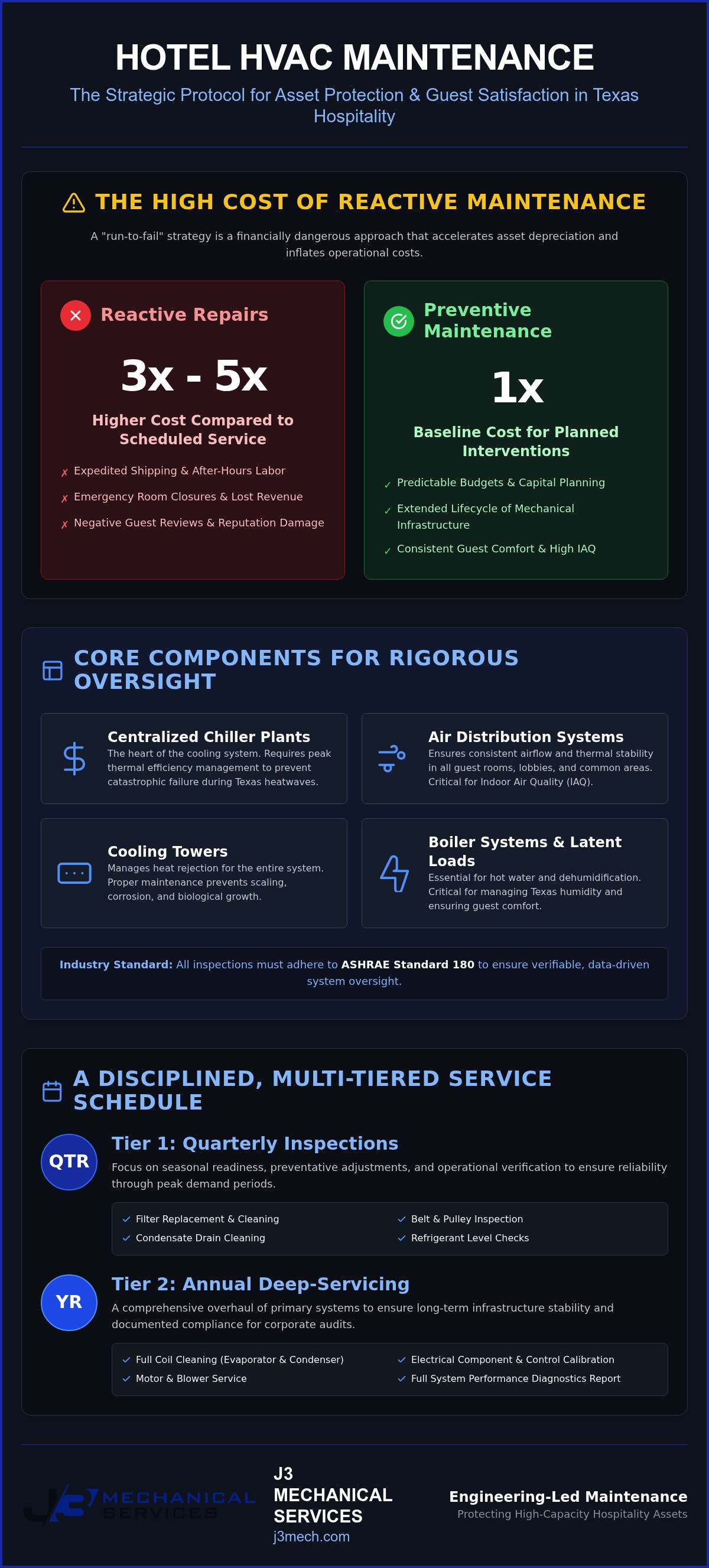
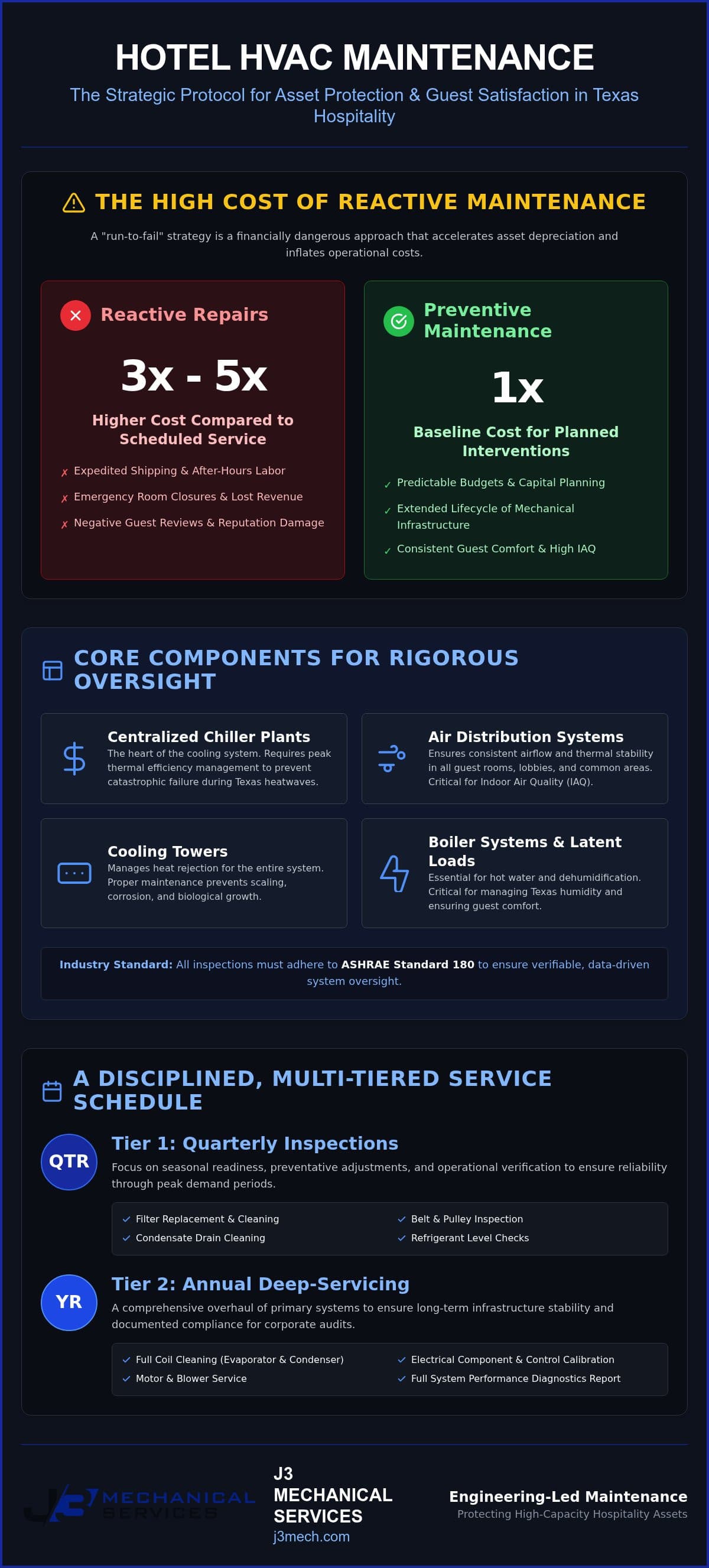
Adopting a "run-to-fail" strategy is a financially dangerous approach that accelerates the depreciation of multi-million dollar assets. Industry data suggests that emergency repairs carry a 3x to 5x cost multiplier when compared to scheduled service interventions. These costs stem from expedited shipping for specialized components, after-hours labor rates, and the logistical friction of managing repairs during peak occupancy. In high-occupancy environments, inadequate ventilation presents a significant liability. It potentially leads to mold growth or the accumulation of airborne contaminants that compromise the health of both staff and guests, creating a risk profile that no professional operator should accept.
Defining Industrial Standards for Hospitality
Hospitality assets require a transition from residential-style "tune-ups" to disciplined, commercial-grade mechanical protocols. Large-scale facilities cannot rely on surface-level inspections; they demand commercial hvac maintenance that utilizes technical verification and detailed reporting. This approach ensures accountability through every phase of the hotel HVAC maintenance plan, moving away from anecdotal assessments toward a data-driven methodology. Precise documentation is essential for corporate audits and long-term capital expenditure planning. It provides the transparency needed to manage complex mechanical ecosystems with confidence and ethical consistency.
Core Components of a Comprehensive Hotel HVAC Maintenance Plan
A sophisticated hotel HVAC maintenance plan requires a granular focus on the heavy mechanical infrastructure that defines large-scale hospitality operations. While residential services focus on basic airflow, commercial assets demand a systematic approach to centralized plant management. This protocol ensures that chillers, cooling towers, and boiler systems operate at peak thermal efficiency. Adhering to the technical requirements of ASHRAE Standard 180 provides a baseline for these inspections, ensuring that every critical component is verified against established industry benchmarks. By prioritizing these high-capacity assets, facility managers can mitigate the risks of catastrophic failure and ensure consistent environmental control.
Centralized Cooling and Heating Assets
The integrity of a centralized plant depends on rigorous chemical management and mechanical verification. Cooling towers require precise chemical treatment and scale prevention protocols to mitigate the risk of biological growth and maintain heat transfer efficiency. Chiller maintenance must include regular compressor oil analysis and high-sensitivity refrigerant leak detection, particularly as the industry transitions to low-GWP A2L refrigerants in 2026. For heating infrastructure, boiler combustion analysis is essential to ensure thermal efficiency and safety. These procedures aren't just recommendations; they're the foundation of a disciplined asset management strategy that prevents the accelerated depreciation of multi-million dollar mechanical systems.
High-capacity Air Handling Units (AHUs) and Variable Air Volume (VAV) boxes represent the primary delivery mechanism for conditioned air throughout the property. Maintaining these systems involves inspecting ductwork integrity and calibrating dampers to ensure precise volumetric control. Integration with a Building Automation System (BAS) allows for real-time monitoring and energy precision. Calibrating these control systems ensures the facility responds dynamically to occupancy shifts, reducing energy waste without compromising environmental stability.
Terminal Units and Guest Comfort
Terminal units, such as Packaged Terminal Air Conditioners (PTAC), Vertical Terminal Air Conditioners (VTAC), and Variable Refrigerant Flow (VRF) systems, require specialized technical protocols to maintain room-level comfort. Condensate lines must be cleared systematically to prevent water damage and microbial growth. Thermostat calibration and sensor verification in common areas are critical for maintaining the intended setpoints across the property. Acoustic testing serves as a proactive measure to identify mechanical vibrations or bearing wear before these issues escalate into guest complaints. Because every hotel HVAC maintenance plan must prioritize guest experience, partnering with a specialized mechanical services provider ensures technical oversight remains consistent and accountable.
The Economic Impact of Preventive Maintenance in Texas Climates
The economic performance of a hospitality asset in Texas is tethered to the efficiency of its mechanical infrastructure. Managing the latent heat load represents a primary technical challenge. Extreme humidity in regions like San Antonio and Austin requires specialized dehumidification strategies to prevent microbial growth and maintain structural integrity. A disciplined hotel HVAC maintenance plan addresses these environmental pressures by ensuring that systems don't just cool the air but effectively remove moisture. When temperatures exceed 100°F, the return on investment for clean coils and calibrated economizers becomes immediately apparent in the property's utility expenditures. These precision adjustments reduce the mechanical strain on compressors, which can extend the operational life of heavy assets by five to seven years.
By prioritizing preventive measures, facility managers significantly reduce the frequency of commercial hvac repair during peak summer demand. This operational continuity is essential for maintaining a seamless guest experience. It protects the property's bottom line from the volatility of emergency service costs and the logistical friction of equipment failure during high-occupancy periods. Reliability in these environments isn't accidental; it's the result of rigorous technical oversight.
Peak Demand Performance in San Antonio and Austin
The "Texas Summer Stress Test" from June through September places unprecedented loads on cooling infrastructure. Systems that haven't been rigorously maintained are susceptible to damage from grid-related brownouts or sudden component failure under constant high-load operation. A strategic hotel HVAC maintenance plan includes the staging of cooling assets to manage peak load pricing. This ensures that backup systems are verified before they're needed. Proactive oversight mitigates the risk of catastrophic failure when the cost of downtime is at its highest. It allows the facility to operate with quiet confidence even during the most extreme thermal events.
Capital Expenditure (CapEx) Forecasting
Consistent maintenance data provides a technical baseline for accurate Capital Expenditure forecasting. By tracking the performance and degradation of mechanical components, facility directors can predict with high accuracy when a full-scale commercial hvac installation will be necessary. This allows for a transition from emergency, high-cost replacements to planned system upgrades. These upgrades can be budgeted years in advance to avoid capital friction. Detailed service records also serve as a critical asset during property valuations. They demonstrate a commitment to infrastructure integrity that increases the resale value of hospitality real estate by proving the asset's long-term stability.
Developing a Multi-Tiered Preventive Maintenance Schedule
A high-performance hotel HVAC maintenance plan transitions from a simple calendar of tasks to a disciplined industrial protocol. This multi-tiered approach ensures that mechanical systems receive the appropriate level of intervention based on seasonal demand and component wear cycles. Quarterly inspections focus on high-wear items and seasonal adjustments, preparing the facility for the rapid temperature shifts characteristic of the Texas climate. During these intervals, technicians verify belt tension, sensor accuracy, and filter integrity to maintain baseline efficiency. Conversely, the annual deep service represents a comprehensive technical teardown. This phase involves chemical cleanings of evaporator and condenser coils, vibration analysis of motor bearings, and a full system recalibration to ensure the infrastructure meets its original design specifications.
Customization is essential when applying these schedules to diverse hospitality assets. A historic San Antonio hotel, often featuring retrofitted ductwork and restricted mechanical closets, requires a different tactical approach than a modern Austin high-rise equipped with centralized VRF systems. Tailoring the protocol ensures that the unique architectural constraints of the property don't compromise the thoroughness of the service. This precision prevents small mechanical deviations from escalating into systemic failures during periods of 100 percent occupancy.
The Role of BIM and Precision Engineering
Modern maintenance protocols leverage Building Information Modeling (BIM) to create digital twins of the building's mechanical skeleton. This technology allows technicians to map hidden access points and specific part requirements before they arrive on-site. Deep knowledge of hvac sheet metal fabrication is vital here; it informs how ductwork should be inspected for structural integrity and airflow obstructions. By utilizing digital models, facility managers can identify hard-to-reach components that are frequently overlooked in standard inspections. Coordinating these complex interventions during low-occupancy windows minimizes the logistical impact on guests while ensuring that critical infrastructure receives the technical attention it requires.
Documentation and Verification Protocols
Accountability in a maintenance schedule is maintained through rigorous documentation and technical verification. Implementing a centralized logging system is mandatory for preserving equipment warranties and tracking long-term performance trends. Technicians must record "Before and After" data, such as refrigerant pressures and amperage draws, to provide a transparent record of system health. Training on-site facility staff to assist in daily monitoring further strengthens this protocol. They serve as the first line of defense, identifying acoustic changes or minor leaks before they necessitate emergency intervention. To establish a more resilient infrastructure for your property, you can partner with our mechanical specialists to engineer a customized oversight program.
The J3 Mechanical Advantage: Engineering-Led Maintenance for Hotels
J3 Mechanical Services operates with the fundamental understanding that hospitality mechanical systems are critical infrastructure assets that require disciplined, engineering-led oversight. A high-performance hotel HVAC maintenance plan is only as effective as the technical expertise behind its execution. By prioritizing accountability and technical mastery, we provide a level of service that moves beyond the reactive "fix-it" mentality. Our approach is rooted in industrial authority, ensuring that every chiller, cooling tower, and air distribution system is managed with ethical precision and a commitment to long-term stability.
Engaging a specialized commercial hvac contractor is essential for large-scale assets where the margin for error is non-existent. We offer 24/7 emergency response capabilities, recognizing that guest comfort is time-sensitive and that mechanical failure during peak occupancy can have immediate financial consequences. Our in-house fabrication facility allows us to produce custom mechanical components and ductwork, which eliminates the logistical friction often associated with legacy hotel systems in Texas. This vertical integration ensures that replacement parts meet exact specifications and are installed with minimal lead times, safeguarding the property against prolonged downtime.
Specialized Solutions for Texas Facilities
Our operational footprint covers the critical hospitality corridors of San Antonio, Austin, and Corpus Christi, where we specialize in high-rise mechanical coordination and complex new construction projects. We understand the unique municipal codes and environmental stresses specific to these regions, allowing us to navigate technical challenges without friction. By utilizing professional, engineering-first communication, we ensure that facility leadership is always informed of system status and potential risks. This transparency fosters a partnership based on reliability and technical competence rather than high-energy salesmanship.
Next Steps for Facility Leadership
Transforming a property's mechanical performance begins with a comprehensive baseline audit. This initial assessment involves a rigorous mechanical system audit and performance testing to identify existing inefficiencies and latent risks. From this data, we design a customized hotel HVAC maintenance plan tailored to the specific age, usage, and architectural constraints of your asset. This proactive methodology allows for predictable capital expenditure planning and ensures the infrastructure remains a source of value rather than a liability. We invite you to consult with J3 Mechanical Services for a strategic maintenance audit to establish total control over your facility's mechanical lifecycle.
Engineering Long-Term Stability for Hospitality Assets
The transition from reactive repair cycles to a disciplined hotel HVAC maintenance plan is a strategic necessity for Texas hospitality leaders who prioritize operational continuity and asset preservation. By integrating BIM-coordinated system analysis with a multi-tiered service schedule, you can mitigate the risks of catastrophic equipment failure and manage the extreme latent heat loads characteristic of the Gulf Coast and Central Texas regions. This engineering-led approach doesn't just protect guest comfort; it establishes a transparent framework for predictable capital expenditure and ensures compliance with the evolving mechanical codes of 2026.
At J3 Mechanical Services, we bring specialized commercial and industrial expertise to every facility, providing the technical mastery required to manage complex centralized plants and terminal units alike. Our 24/7 emergency repair response ensures that your property remains resilient against unforeseen mechanical friction, even during peak occupancy. We invite you to take the next step in safeguarding your mechanical infrastructure and property reputation. Secure Your Facility with a J3 Mechanical Strategic Maintenance Plan today and ensure your asset continues to perform at its design potential for years to come.
Frequently Asked Questions
How often should a hotel HVAC system undergo professional maintenance?
Professional maintenance should occur at least quarterly to manage the extreme thermal loads characteristic of cities like Austin and San Antonio. A disciplined hotel HVAC maintenance plan involves specific seasonal adjustments before the intense summer humidity and comprehensive annual deep-servicing. These intervals allow technicians to verify component integrity and calibrate controls for peak occupancy. Consistent oversight prevents the gradual efficiency losses that lead to higher utility expenditures and accelerated mechanical depreciation.
What are the specific maintenance requirements for hotel cooling towers?
Cooling towers require rigorous chemical treatment and scale prevention protocols to ensure heat transfer efficiency and biological safety. In San Antonio and Austin, municipal codes necessitate regular inspections for biological growth and structural integrity. Maintenance must include cleaning the distribution basin, checking motor bearings, and verifying the functionality of water make-up systems. These technical interventions prevent the system from becoming a source of liability or operational friction for the property.
Can a preventive maintenance plan reduce hotel energy consumption in Texas?
A proactive hotel HVAC maintenance plan significantly reduces energy consumption by ensuring that systems operate at their intended design efficiency. In 100°F+ Texas weather, clean coils and calibrated economizers allow the mechanical plant to reject heat more effectively. Managing the latent heat load through precise dehumidification prevents the system from overworking. These technical optimizations lead to a documented ROI through lower peak-demand utility charges and reduced mechanical strain on high-capacity compressors.
What is the difference between a residential tune-up and a commercial HVAC maintenance plan?
Residential tune-ups focus on basic airflow for small split systems, while commercial plans address complex, high-capacity mechanical infrastructure. Commercial maintenance requires a disciplined approach to centralized plants, cooling towers, and boiler systems. It utilizes advanced coordination tools like BIM and detailed performance logging for corporate accountability. Unlike residential services, industrial-grade maintenance focuses on long-term asset stabilization and the mitigation of large-scale operational risks in high-occupancy hospitality environments.
How does a maintenance plan help with hotel CapEx planning?
Maintenance data provides the technical baseline required for accurate capital expenditure forecasting. By tracking the degradation of critical components over time, facility directors can predict when a full-scale replacement will be necessary. This moves the financial burden from high-cost emergency interventions to planned, budgeted upgrades. Detailed service records also prove the asset's stability during property valuations, which can increase the resale value of hospitality real estate across the Texas corridors.
What should be included in a hotel PTAC maintenance checklist?
A technical checklist for PTAC units must prioritize condensate line clearance to prevent mold growth and water damage. It should also include filter replacement, coil cleaning, and thermostat sensor verification. Acoustic testing is essential to identify mechanical vibrations before they result in guest complaints. Regular calibration ensures each guest room remains a stable thermal environment, protecting the property's reputation for comfort even during the most humid months in Corpus Christi.
How do centralized boilers and chillers impact hotel operational costs?
Centralized boilers and chillers are the primary drivers of a hotel's operational costs due to their significant energy requirements. When these systems operate inefficiently, they directly impact RevPAR by increasing overhead and risking room closures. Proper maintenance ensures these multi-million dollar assets reach their full operational lifecycle of 20 to 30 years. Neglecting these centralized systems leads to catastrophic failure risks that can jeopardize the property's financial viability during peak occupancy periods.
Why is 24/7 emergency service critical for hotel HVAC maintenance providers?
Guest comfort is a time-sensitive metric that leaves no room for mechanical downtime. 24/7 emergency service is critical because it ensures rapid recovery of critical infrastructure during unforeseen failures. Whether it's a chiller failure in Austin or a boiler issue in San Antonio, immediate technical intervention prevents negative guest reviews and lost revenue. A provider with 24/7 capabilities demonstrates a commitment to the property's operational integrity and guest satisfaction standards.
Need a hand with your building's HVAC?
Free quotes and honest answers from licensed commercial technicians across South Texas.