
Industrial Facility HVAC Installation in Texas: A Guide to Precision Engineering
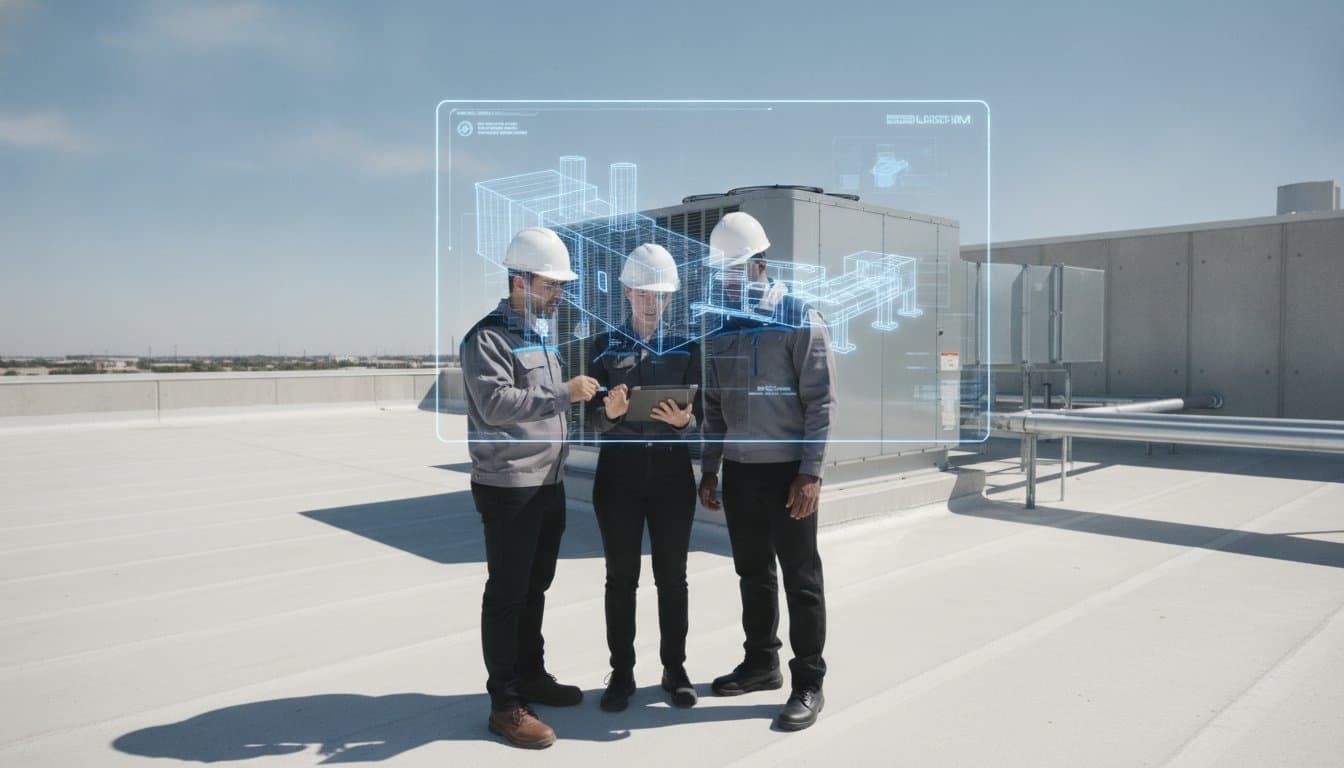
What if the primary catalyst for your facility's operational downtime isn't a mechanical failure, but a coordination error finalized months before the first duct was ever installed? In the demanding climate of the Lone Star State, an industrial HVAC system represents far more than mere climate control; it serves as a critical infrastructure component that dictates the viability of your entire production line. You recognize that the traditional approach to industrial facility HVAC installation Texas often collapses under the weight of poor interdisciplinary coordination and reactive field fixes. These inefficiencies don't just delay schedules; they introduce systemic vulnerabilities that the extreme Texas heat will eventually exploit.
This guide details a more disciplined methodology rooted in technical mastery and proactive risk mitigation. By leveraging advanced Building Information Modeling (BIM) as a single source of truth, we ensure that every mechanical component aligns perfectly with structural realities before fabrication begins. You'll discover how the synergy between digital precision and in-house fabrication eliminates costly change orders and secures long-term operational stability. We'll outline the systematic processes required to deliver a high-efficiency system that remains resilient against the most rigorous industrial demands.
Key Takeaways
- Understand the specific mechanical standards required to withstand the extreme thermal loads and rigorous regulatory demands of Texas industrial environments.
- Learn how Building Information Modeling (BIM) serves as a single source of truth for an industrial facility HVAC installation Texas, eliminating structural clashes before construction begins.
- Discover how utilizing in-house fabrication for custom components reduces project lead times while maintaining the strict engineering tolerances required for high-performance systems.
- Explore the disciplined technical protocols for rigging and placing heavy mechanical equipment to ensure zero-error execution on complex industrial sites.
- Identify the strategies for integrating 24/7 emergency response and proactive maintenance into a facility management plan to secure long-term operational continuity.
Table of Contents
- The Complex Landscape of Industrial HVAC Installation in Texas
- Leveraging BIM Coordination for Error-Free Industrial HVAC Design
- The Strategic Advantage of In-House HVAC Fabrication for Industrial Facilities
- Executing the Installation: A Technical Protocol for Industrial Sites
- Securing Operational Continuity with J3 Mechanical Services’ Industrial Solutions
The Complex Landscape of Industrial HVAC Installation in Texas
Industrial environments in the Texas triangle aren't just buildings; they're complex thermodynamic puzzles. A standard commercial unit can't handle the internal heat generated by intensive manufacturing processes combined with the external 100-degree days common in San Antonio and Austin. Generic solutions often fail because they prioritize initial cost over the lifecycle durability required for heavy industrial duty cycles. A successful industrial facility HVAC installation Texas necessitates a departure from "off-the-shelf" thinking. It requires a partner who views the mechanical system as a critical infrastructure component that dictates the viability of your entire production line.
Local geographic expertise is the foundation of a reliable system. In the Central and South Texas corridors, we must account for localized variables such as soil stability, wind loads for rooftop equipment, and utility infrastructure limitations. When a system is designed without these specifics, it leads to premature equipment fatigue and spiraling operational costs. We focus on a disciplined, engineering-first approach that ensures your mechanical assets are built to withstand the unique stresses of the Texas industrial landscape.
Navigating Texas Climate and Environmental Load
In this region, the thermal load isn't a static variable. High-ambient temperature performance for cooling towers and chillers is the baseline for operational stability. For facilities in Corpus Christi, the latent heat load from extreme coastal humidity adds a layer of complexity that standard systems aren't equipped to manage. We calculate performance based on "worst-case" atmospheric conditions rather than seasonal averages. This precision engineering ensures that air quality and filtration systems maintain the integrity of manufacturing environments, preventing particulate contamination that could compromise product quality or worker safety.
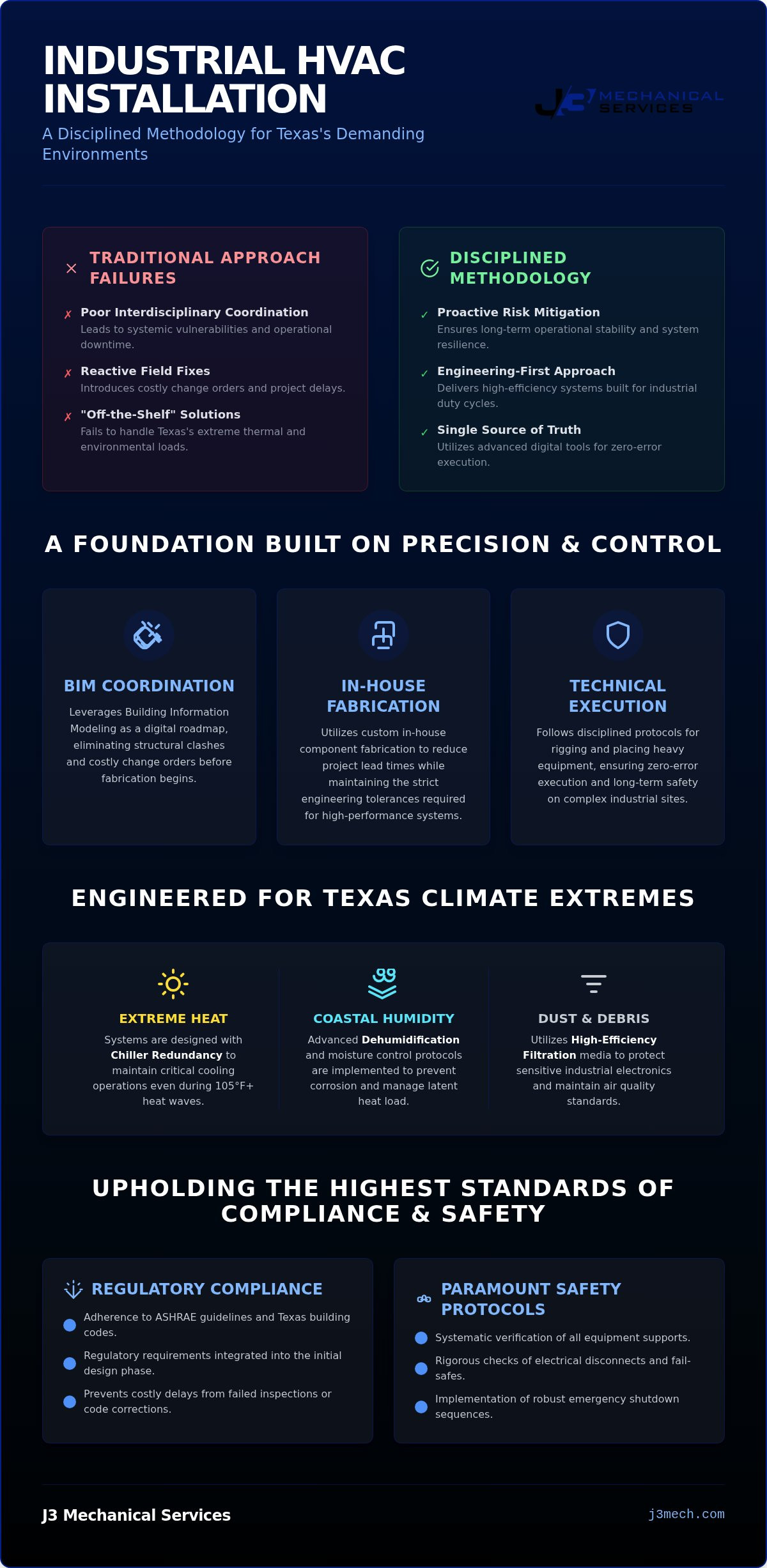
- Chiller Redundancy: Designing systems that maintain critical cooling even during peak 105°F heat waves.
- Dehumidification: Implementing advanced moisture control to prevent corrosion in high-humidity coastal zones.
- Filtration Standards: Utilizing high-efficiency media to protect sensitive industrial electronics from Texas dust and debris.
Regulatory Compliance and Industrial Standards
Compliance isn't just a checkbox; it's a technical standard that ensures long-term safety and accountability. Adhering to ASHRAE guidelines and local Texas building codes requires a deep understanding of how large-scale mechanical infrastructure interacts with structural framing. An industrial facility HVAC installation Texas involves complex permitting that demands a technical liaison between ownership and municipal inspectors. Our methodology integrates these regulatory requirements into the initial design phase, which prevents the costly delays associated with failed inspections or last-minute code corrections.
Safety protocols for large-scale mechanical infrastructure are equally paramount. This includes the systematic verification of equipment supports, electrical disconnects, and emergency shutdown sequences. By maintaining a rigorous focus on these standards, we provide a transparent, logic-driven path to project completion that satisfies both insurance underwriters and state safety officials.
Leveraging BIM Coordination for Error-Free Industrial HVAC Design
In the high-stakes environment of large-scale mechanical construction, the margin for error is essentially nonexistent. An industrial facility HVAC installation Texas requires a level of foresight that traditional 2D blueprints simply cannot provide. Building Information Modeling (BIM) acts as the strategic foundation for this foresight, transforming abstract designs into a precise digital roadmap that governs the entire project lifecycle. By utilizing virtual design and construction (VDC), engineers can validate the integrity of a complex system before a single piece of equipment arrives on-site. This proactive verification process ensures that the transition from digital model to physical installation is seamless, predictable, and disciplined, reflecting the professional accountability our clients expect.
Clash Detection and Spatial Coordination
The primary utility of BIM lies in its ability to facilitate automated clash detection, a process where software identifies physical overlaps between mechanical, electrical, and structural components. Building Information Modeling is a digital twin protocol for mechanical systems that allows for the meticulous mapping of every duct, pipe, and support within the facility's 3D volume. When we integrate HVAC systems with existing structural frameworks, we identify potential conflicts in the virtual environment where they're easily corrected. This eliminates the need for reactive field modifications that typically lead to expensive change orders and schedule delays. By optimizing routing in a 3D space, we also maximize the usable volume of the facility, ensuring that mechanical assets don't interfere with production floor clearances or future equipment footprints.
Data-Driven Procurement and Scheduling
Beyond spatial coordination, BIM provides a data-rich environment that informs every stage of the project lifecycle. We use these high-fidelity models for precise material take-offs, which allows for exact budgeting and reduces the risk of procurement errors that often plague large-scale contracts. Digital sequencing enables our teams to visualize the construction timeline day-by-day, identifying logistical bottlenecks before they manifest in the field. This level of planning is essential for maintaining the momentum of a complex project, as it allows for the just-in-time delivery of components fabricated in our shop. Accurate virtual planning minimizes on-site waste and ensures that labor resources are deployed with maximum efficiency. For developers seeking this level of technical mastery, integrating BIM into your mechanical strategy is the most effective way to secure a reliable, high-performance outcome that meets strict engineering tolerances during an industrial facility HVAC installation Texas.
The Strategic Advantage of In-House HVAC Fabrication for Industrial Facilities
The integration of digital precision with physical production represents the pinnacle of industrial mechanical service. While many contractors rely on third-party vendors for ductwork, a truly disciplined industrial facility HVAC installation Texas utilizes an in-house fabrication model to maintain total project control. This internal capability ensures that the high-fidelity data generated during the BIM coordination phase translates directly into physical components without the risk of external misinterpretation. By operating our own fabrication shop, we eliminate the communication gaps that frequently occur between designers and outside manufacturers; it's a level of accuracy that's mandatory for complex industrial environments.
This "master builder" approach prioritizes accountability at every stage of the manufacturing process. When we control the fabrication of custom components, we can guarantee that every joint, flange, and support meets our internal standards for technical mastery. This isn't just about speed; it's about the integrity of the final product and the long-term stability of your facility's infrastructure.
Custom Ductwork and Component Engineering
Industrial facilities often require specialized air handling solutions that exceed the specifications of standard commercial systems. We engineer and produce heavy-gauge ductwork designed to withstand high-pressure industrial environments, ensuring the system remains structurally sound under extreme operational loads. This technical rigor extends to the fabrication of specialized components for cleanrooms and laboratories, where maintaining strict environmental tolerances is non-negotiable. In regions like Corpus Christi, we prioritize material selection for corrosion resistance, utilizing stainless steel or specialized coatings to protect the system against the aggressive coastal atmosphere. Our hvac sheet metal fabrication process is governed by these specific engineering requirements, ensuring each component meets the project's unique technical standards.
Logistical Efficiency and Project Pacing
The timeline of a large-scale industrial project is often dictated by the reliability of the supply chain. By maintaining in-house production, we insulate our clients from the delays and volatility associated with third-party outsourcing. This control allows for the implementation of just-in-time delivery, where fabricated components arrive at the job site precisely when they're needed for installation. This methodical pacing prevents site congestion and reduces the risk of material damage during storage. Because our fabrication team works in direct alignment with our project managers, we don't have to wait on external vendors to respond to evolving site conditions. This synergy is a critical component of a successful industrial facility HVAC installation Texas, providing a stable and predictable path to facility commissioning.
Executing the Installation: A Technical Protocol for Industrial Sites
The transition from digital modeling and shop fabrication to the physical job site represents a critical phase where theoretical design meets structural reality. For an industrial facility HVAC installation Texas, this execution phase must be governed by a strict technical protocol to prevent the logistical friction that often compromises project timelines. We begin with a comprehensive site verification process, cross-referencing the BIM model against the "as-built" conditions of the facility. This ensures that every utility connection point and structural support is positioned exactly as planned, allowing the installation to proceed without the need for reactive adjustments or field-engineered workarounds. Our methodology prioritizes a disciplined workflow where every movement on-site is pre-calculated for maximum efficiency.
Rigging and Heavy Equipment Installation
Placing high-capacity mechanical equipment requires a level of logistical coordination that extends far beyond simple lifting. We develop detailed rigging plans that account for the weight distribution of large chillers and rooftop units, ensuring the facility's structural integrity is never compromised during the placement process. In the Central Texas corridor, we must also account for wind load variables that can impact crane safety and equipment stability during high-elevation lifts. Our teams operate under rigorous safety protocols for both confined space work and elevated installations, maintaining a disciplined environment where technical mastery and physical safety are treated as inseparable priorities. This systematic approach eliminates the risks associated with moving multi-ton mechanical assets in active industrial zones.
System Commissioning and Verification
The final verification of a system's performance is where the integrity of the entire engineering process is confirmed. System commissioning involves a systematic balancing of air and water flows to ensure the mechanical assets achieve their designed thermal performance. We integrate the HVAC hardware with the building automation system (BAS), verifying that control sequences respond accurately to fluctuating internal loads. Addressing the specific environmental demands of the region, we conduct performance audits under peak Texas summer conditions to ensure the system maintains stability when ambient temperatures exceed 100 degrees. This rigorous testing phase is a mandatory component of a successful industrial facility HVAC installation Texas, guaranteeing that the facility operates at maximum efficiency from the moment of turnover.
Upon completion, we provide facility managers with comprehensive documentation, including detailed maintenance schedules and system schematics. This transparency ensures that the operational staff has the necessary data to maintain the system's long-term stability and equipment longevity. If you require a partner who prioritizes this level of technical rigor, you can contact our team for expert industrial mechanical solutions. This structured turnover process marks the transition from construction to ongoing facility management, securing the reliability of your critical mechanical infrastructure.
Securing Operational Continuity with J3 Mechanical Services’ Industrial Solutions
The successful completion of an industrial facility HVAC installation Texas marks the transition from a complex construction phase to a long-term operational lifecycle where technical stability is the primary objective. In a heavy industrial environment, the mechanical system doesn't operate in isolation; it's the lifeblood of the production floor, and its reliability dictates the facility's overall output. We view our role as a disciplined strategist, providing the ongoing oversight required to protect your critical infrastructure from the stresses of continuous operation. By integrating a 24/7 emergency response protocol into your facility management plan, J3 Mechanical Services ensures that technical mastery is always accessible, providing a safety net that maintains production momentum even during unforeseen mechanical challenges.
Specialized expertise is particularly vital in the Texas industrial corridor, where equipment must endure unrelenting thermal loads and high-ambient humidity. A generic service model lacks the technical depth to manage the sophisticated engineering tolerances of large-scale chillers and custom air handlers. Our approach is rooted in accountability and a deep understanding of the "master builder" persona, where every maintenance action is performed with the same precision as the initial installation.
Long-Term Asset Management and Reliability
The longevity of industrial mechanical assets is directly proportional to the rigor of the oversight they receive. We develop strategic commercial hvac maintenance protocols that are customized to the specific duty cycles of your facility, focusing on high-wear components and system calibration. This proactive methodology allows J3 Mechanical Services to identify and mitigate potential failure points before they result in operational downtime, which is a critical consideration for facilities that operate on a 24/7 schedule. By maintaining a steady, methodical pace of inspections and performance audits, we extend the functional lifecycle of your equipment and ensure that the efficiency gains achieved during the industrial facility HVAC installation Texas are preserved over the long term.
Partnering with a Disciplined Mechanical Contractor
A partnership with J3 Mechanical Services is built on a foundation of ethical consistency and professional discipline. Our faith-based business model ensures that we remain accountable for the integrity of your mechanical systems, providing a level of transparency that's often missing in the commercial service sector. As industrial hubs across San Antonio, Austin, and Corpus Christi continue to expand, we offer the scalable mechanical solutions required to support growing infrastructure demands. We prioritize meticulous preparation and logical execution in every contract, ensuring that your facility remains a stable and productive environment. We invite you to Consult with J3 Mechanical Services for your next industrial project to secure a mechanical partner who views your operational continuity as an ethical responsibility.
Securing Long-Term Stability through Technical Mastery
Maintaining the integrity of a large-scale mechanical system requires a departure from reactive maintenance and a commitment to meticulous preparation. We've explored how a successful industrial facility HVAC installation Texas relies on the synergy of BIM-coordinated project delivery and the technical precision of an in-house sheet metal fabrication shop. These advanced tools don't just prevent field errors; they establish a single source of truth that ensures every component meets strict engineering tolerances before arriving on-site. By prioritizing this proactive methodology, facility owners secure a high-performance environment capable of withstanding the most rigorous industrial demands.
Operational continuity is the ultimate metric of project success. Our team remains committed to your facility's long-term stability through 24/7 industrial emergency support and disciplined oversight. J3 Mechanical Services acts as a strategic partner in your infrastructure's lifecycle, providing the technical mastery necessary to navigate complex mechanical challenges with confidence. Partner with J3 Mechanical Services for Precision Industrial HVAC Installation to ensure your next project is defined by accuracy and accountability. We look forward to building a resilient future for your facility.
Frequently Asked Questions
How does BIM coordination reduce industrial HVAC installation costs?
BIM coordination mitigates costs by identifying structural and mechanical clashes in a virtual environment before physical construction begins. By resolving these conflicts digitally, we eliminate the expensive change orders and labor delays that typically occur when obstacles are discovered in the field. This digital twin protocol also allows for exact material procurement, which reduces waste and ensures that capital is allocated with maximum efficiency throughout the project lifecycle.
What is the typical timeline for a large-scale industrial HVAC installation in Texas?
The timeline for an industrial facility HVAC installation Texas is dictated by the specific complexity of the mechanical systems and the scale of the facility. A disciplined approach typically involves several weeks of BIM coordination followed by parallel in-house fabrication to streamline the site schedule. While durations depend on project scope, our methodical sequencing ensures that equipment placement and commissioning occur without the logistical bottlenecks that often delay uncoordinated industrial contracts.
Why is in-house fabrication important for industrial mechanical projects?
In-house fabrication provides total project control by removing the volatility of third-party supply chains. This internal capability allows us to manufacture heavy-gauge ductwork and custom components that align perfectly with the BIM model's specifications. By controlling the production schedule, we reduce lead times and ensure that every fabricated asset meets our internal standards for technical mastery and structural integrity, which is essential for high-pressure industrial air handling.
Can J3 Mechanical Services handle HVAC installation for new industrial construction?
J3 Mechanical Services acts as a technical partner from the initial design phase, integrating Building Information Modeling to ensure that the mechanical infrastructure is optimized for the building's specific operational requirements. Our team specializes in HVAC new construction for large-scale industrial and commercial facilities across the Texas triangle. This proactive involvement allows us to manage the complex logistics of new sites, from structural rigging to final system commissioning, with professional accountability.
How do you manage humidity control in South Texas industrial facilities?
Managing humidity in coastal regions requires systems designed for high latent heat loads and precise dehumidification. We utilize advanced psychrometric calculations to specify equipment that maintains stable internal environments despite extreme external moisture. This technical rigor prevents corrosion of sensitive industrial assets and ensures that air quality standards are maintained, which is a critical requirement for manufacturing facilities and laboratories operating in the South Texas climate.
What safety standards are followed during high-stakes mechanical rigging?
Our rigging protocols are governed by a disciplined safety strategy that includes detailed lift plans and structural verification of all equipment supports. We coordinate crane operations with a focus on load distribution and atmospheric variables, such as wind speeds, to ensure the safety of both personnel and the facility. Every high-elevation or confined space task is performed under strict adherence to industrial safety standards, reflecting our commitment to professional accountability and technical mastery.
Does J3 Mechanical Services provide 24/7 emergency repair after the installation is complete?
J3 Mechanical Services provides 24/7 emergency service to ensure that your facility maintains operational continuity long after the initial installation is finalized. This immediate response capability is integrated into our broader mechanical service model, providing facility managers with a reliable technical partner for critical system failures. Our commitment to long-term stability means that our expert technicians are available at any hour to resolve mechanical issues during an industrial facility HVAC installation Texas.
Need a hand with your building's HVAC?
Free quotes and honest answers from licensed commercial technicians across South Texas.