
Industrial HVAC Preventative Maintenance: Strategic Protocols for Critical Facility Reliability in 2026
Treating industrial plant reliability as a routine checklist of quarterly filter swaps and belt replacements is a direct path to catastrophic mechanical failure. In high-demand production and manufacturing facilities, industrial HVAC preventative maintenance isn't merely a series of basic service tasks; it represents disciplined asset lifecycle engineering designed to eliminate operational risk before it manifests on the plant floor. Facility directors and engineering leaders already know the severe disruption of unplanned mechanical downtime interrupting tight production schedules, especially when intense regional heat loads push critical chiller and boiler systems into thermodynamic degradation and drive peak electrical demand.
Discover how establishing rigorous, protocol-driven maintenance protects capital mechanical assets, optimizes system efficiency, and insulates your enterprise against costly emergency interventions. This guide outlines the strategic protocols essential for maintaining facility continuity in 2026, examining how to manage lower-GWP refrigerant transitions, navigate tightened EPA leak inspection thresholds, and implement a predictable mechanical lifecycle management framework that guarantees continuous industrial reliability.
Key Takeaways
- Implementing structured industrial HVAC preventative maintenance transitions facility operations from volatile, reactive troubleshooting to disciplined lifecycle engineering that eliminates unscheduled production shutdowns.
- Rigorous inspection checklists must move beyond superficial service to prioritize analytical refrigeration chemistry, hydronic flow balancing, and non-destructive mechanical stress testing.
- Combatting severe regional ambient heat demands dedicated condenser protocols designed to mitigate excessive head pressures and minimize peak electrical demand during critical operating windows.
- Deploying continuous condition monitoring and baseline vibration analysis enables technical teams to identify motor anomalies and component fatigue before irreversible equipment damage occurs.
- Vetting mechanical contractors on verifiable engineering rigor, trade certifications, and integrated fabrication support ensures critical infrastructure remains fully compliant and operational.
The Strategic Imperative of Industrial HVAC Preventative Maintenance
In modern industrial facilities, climate control assemblies don't serve as peripheral comfort utilities. They represent central operational infrastructure directly tied to process stability, product tolerances, and worker life safety. Applying an engineering-led preventive maintenance protocol mitigates the mechanical hazards inherent to industrial duty cycles. Without disciplined oversight, continuous thermal loading creates compounding mechanical friction, micro-cracking from harmonic vibration, and accelerated winding degradation within drive motors. Systematic industrial HVAC preventative maintenance neutralizes these failure modes before physical deterioration triggers an unrecoverable plant shutdown.
The financial consequences of unmonitored equipment degradation far outstrip the calculated capital required for structured maintenance programs. When an unscheduled shutdown halts a continuous processing or manufacturing line, losses accumulate instantly across spoiled raw materials, idle labor, contract fulfillment penalties, and expedited component delivery. Proactive servicing transforms unpredictability into a controlled lifecycle model, ensuring critical infrastructure operates predictably within its designed performance envelope.
Distinguishing Industrial Protocols from Standard Commercial Servicing
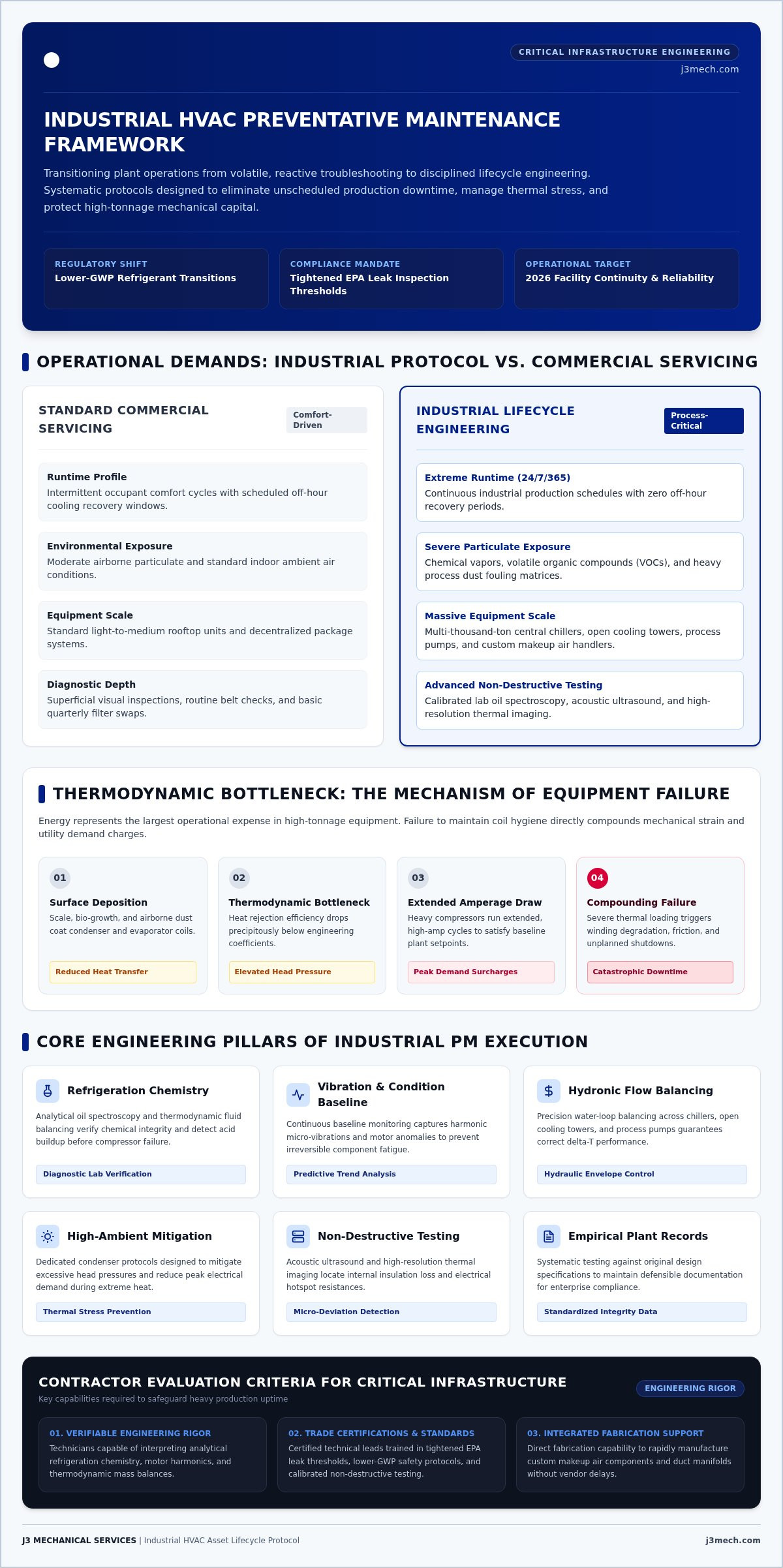
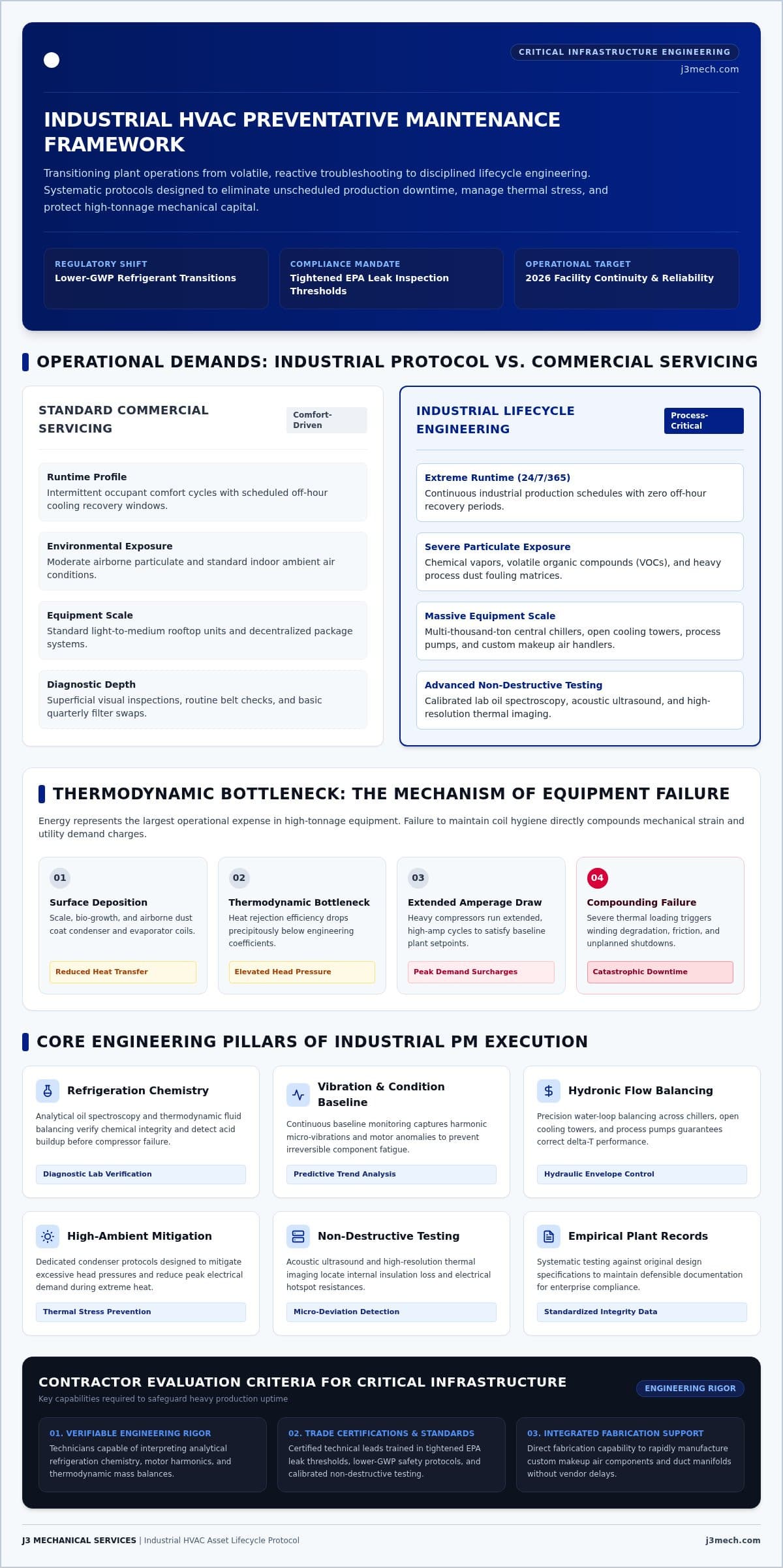
Commercial office maintenance typically addresses intermittent occupant comfort and moderate runtimes. In contrast, heavy industrial applications demand distinct, high-rigor procedures:
- Extreme Runtime Hours: Facilities frequently operate on continuous 24/7/365 production schedules, eliminating standard off-hour cooling recovery cycles.
- Severe Particulate Exposure: Airborne chemical vapors, volatile organic compounds, and heavy process dust rapidly foul air-handling filters and heat exchanger matrices.
- Massive Equipment Scale: Systems center on multi-thousand-ton central water chillers, open cooling towers, process pumps, and custom build-to-suit makeup air handlers.
- Advanced Non-Destructive Diagnostics: Maintenance requires calibrated laboratory oil spectroscopy, acoustic ultrasound, and high-resolution thermal imaging rather than superficial visual checks.
Lifecycle Extension and Thermodynamic Energy Conservation
Energy consumption represents the largest ongoing expense across high-tonnage industrial equipment. When scale, bio-growth, or airborne particulate deposits coat condenser and evaporator coils, heat transfer rates drop precipitously. This thermodynamic bottleneck forces heavy compressors into extended, high-amperage cycles to meet baseline setpoints, elevating electrical draw and introducing damaging thermal stress to internal components.
Systematic coil cleaning, tube brushing, and precision refrigerant optimization maintain verified thermodynamic coefficients and keep head pressures within design specifications. Rigorous instrumentation calibration aligns mechanical output with true building thermal loads, lowering utility demand charges. To establish dependable operational thresholds across major equipment, technical leaders can align facility operations with established commercial HVAC maintenance protocols that protect vital mechanical capital.
Core Engineering Pillars of a Comprehensive Industrial HVAC PM Checklist
Executing defensible industrial HVAC preventative maintenance requires technical verification far beyond superficial visual surveys. Each subsystem must be procedurally tested against original engineering design parameters, establishing rigorous data baselines to detect micro-deviations before mechanical thresholds fail. Systematic documentation of electrical continuity, thermodynamic balances, and fluid dynamics ensures that asset managers hold an empirical record of true plant integrity.
Refrigeration Circuit and Compressor Diagnostic Integrity
Compressor assemblies represent the mechanical core of process cooling. Technicians must record precise suction and liquid line temperatures to evaluate superheat and subcooling, confirming appropriate thermodynamic phase changes across expansion valves. Diagnostic protocols require laboratory oil spectroscopy to detect trace acid formation, moisture saturation, copper plating, and accelerated bearing wear. Technicians also evaluate crankcase heater continuity, inspect valve plates for blow-by, and verify mechanical spring isolator deflection to suppress structural vibration transfer.
Air-Handling Dynamics, Duct Static Pressures, and Filtration
Air distribution networks demand continuous aerodynamic calibration to protect manufacturing air quality and system efficiency. Maintenance procedures evaluate blower wheel dynamic balance, laser shaft alignment, and bearing grease degradation curves to eliminate motor drag. Calibrated digital manometers measure differential static pressure drops across high-capacity MERV and HEPA arrays, preventing bypass leakage and unmanaged fan slip. Technicians also evaluate structural ductwork joints for pressure loss and verify variable air volume damper actuators against automation control signals.
Hydronic Distribution, Chilled Water Loops, and Cooling Towers
Closed and open hydronic systems sustain the critical thermal heat sink for process equipment. Rigorous preventative protocols require laser dial-indicator alignment on chilled water and condenser pumps, mechanical seal face leak detection, and elastomer coupling inspection. Cooling tower maintenance involves verifying variable-pitch fan drives, inspecting gearboxes, flushing basin strainers, and evaluating fill cleanliness to prevent biological scaling and tube fouling within shell-and-tube chillers. Partnering with an engineering-focused mechanical team like J3 Mechanical Services ensures these complex hydronic loops undergo systematic diagnostic analysis tailored to continuous industrial demands.
Managing Thermal Stress in Demanding Regional Climates
Operating critical production infrastructure across Texas introduces aggressive thermodynamic challenges rarely addressed by standard national guidelines. Plants located in Central Texas, San Antonio, and Corpus Christi face prolonged multi-month heat waves where dry-bulb temperatures frequently exceed 100°F. These sustained external loads force condenser arrays to run at peak condensing temperatures for months at a time, generating unrelenting head pressure spikes. Along maritime corridors like Corpus Christi, airborne chlorides accelerate galvanic corrosion across bare aluminum fins and copper tube sheets, quickly degrading coil surfaces. For continuous industrial operations, industrial HVAC preventative maintenance must adapt dynamically to counter these severe regional atmospheric strains.
Mitigating Extreme Ambient Heat and Head Pressure Spikes
Sustained thermal exposure rapidly pushes reciprocating, scroll, and centrifugal chillers to their upper operational envelope. When ambient air temperatures remain elevated, compressors consume massive amounts of power to reject heat through fouled micro-channel surfaces. Key preventative steps must include:
- Chemical-Neutral Descaling: Removing baked-on particulate deposits from micro-channel condenser coils restores thermal transfer rates without etching thin aluminum fin stock.
- Condenser Fan Drive Diagnostics: Verifying that variable frequency drives operate smoothly without thermal tripping keeps airflow rates stable across all condensing stages.
- Head Pressure Relief Verification: Calibrating electronic expansion valves and high-pressure safety cutouts avoids unexpected compressor lockouts during afternoon peak loading.
When aging infrastructure can no longer satisfy severe regional heat loads despite disciplined maintenance, engineering leaders often evaluate complete plant modernization through targeted commercial HVAC installation to restore thermodynamic efficiency and operating margin.
Managing Relative Humidity and Psychrometric Infiltration
Gulf Coast humidity dramatically compounds facility thermal management by amplifying latent cooling loads. High ambient dew points continuously force dedicated outdoor air systems (DOAS) to operate near maximum dehumidification capacity. Service protocols must ensure that enthalpy heat-recovery wheels rotate without drive slippage, seal clearances match factory specifications, and desiccant media remains uncompromised by oily industrial fumes. Technicians also must calibrate modulating chilled-water control valves to guarantee continuous coil condensation drainage. Failing to maintain tight psychrometric control introduces excess indoor humidity, which threatens product packaging integrity, corrodes sensitive control enclosures, and promotes microbial growth in facility distribution plenums.
Predictive Methodologies: Transitioning from Reactive Servicing to Precision PM
Transitioning from reactive troubleshooting to modern predictive maintenance requires an intentional, four-stage technical framework. Step one deploys automated condition monitoring using calibrated telemetry sensors permanently mounted to vital cooling loops. Step two establishes baseline vibration profiles across critical rotating motor assemblies to detect micro-harmonic shifts. Step three introduces regular infrared electrical thermography on primary switchgear, motor control centers, and mechanical disconnects. Step four consolidates these diagnostic inputs into an actionable schedule, establishing structured intervals for monthly checks, quarterly calibrations, and major annual mechanical overhauls. This systematic integration shifts industrial HVAC preventative maintenance from calendar guesswork to empirical asset management.
Advanced Diagnostic Testing: Thermography and Vibration Analysis
Precision diagnostics eliminate blind spots across heavy mechanical infrastructure through non-destructive verification:
- Infrared Electrical Thermography: High-resolution thermal cameras capture thermal signatures across distribution panels, identifying high-resistance terminations, loose lugs, and phase load unbalances before bus bars degrade.
- Vibration Spectral Analysis: Accelerometers map velocity and acceleration spectra across compressor shafts and fan housings, revealing early bearing raceway flaking, angular misalignment, or mechanical looseness long before audible noise emerges.
- Acoustic Ultrasound Scanning: Handheld ultrasound detectors identify the high-frequency turbulence created by micro-fissures in pressurized lines, isolating pinhole leaks and internal valve bypass conditions across sealed refrigeration circuits.
Structured Scheduling: Establishing the Maintenance Cadence
Maintaining long-term mechanical reliability requires aligning diagnostic tasks with a disciplined operational calendar. Monthly procedures focus on physical verification, ensuring proper drive belt tension, evaluating filtration resistance, and conducting visual refrigerant circuit assessments. Quarterly milestones mandate safety control verification, sensor recalibration against precision master gauges, and thorough psychrometric load checks across all treatment zones. Annual shutdowns represent the pinnacle of preventative care, requiring offline eddy-current testing across chiller condenser and evaporator copper tubes to detect wall thinning, pitting, and structural fatigue before catastrophic rupture occurs.
When unexpected equipment failures strike continuous operations despite rigid scheduling, facilities need immediate technical stabilization. Engaging rapid-response specialists for precision commercial HVAC repair ensures that damaged assemblies are quickly evaluated and restored to service. To protect plant operational continuity and engineer a predictable asset lifecycle, partner with J3 Mechanical Services for comprehensive preventative maintenance programs.
Selecting an Industrial Mechanical Contractor for Critical Infrastructure
Managing high-capacity environmental systems requires mechanical partners with engineering depth rather than simple retail staffing. Selecting a service organization for industrial HVAC preventative maintenance demands strict evaluation of technical masteries, proven diagnostic capabilities, and documented safety protocols. Plant engineers can't rely on vendors who treat critical chillers, industrial boilers, and complex air-handling networks like standard rooftop light-commercial units. The selected partner must possess the engineering acumen to decipher complex psychrometric challenges and maintain thermodynamic discipline across mission-critical spaces.
Advanced Engineering Capabilities, BIM, and In-House Fabrication
True operational resilience connects proactive field service with modern design and manufacturing capabilities. Advanced engineering differentiators include:
- Building Information Modeling (BIM): Utilizing spatial BIM coordination maps tight mechanical rooms in three dimensions, validating access pathways for heavy component extraction before rigging crews arrive.
- Dedicated In-House Fabrication: In-house sheet metal and pipe fabrication capabilities bypass third-party supplier backlogs, delivering custom duct transitions and pre-welded hydronic headers built to precise tolerances.
- Pre-Assembled Modular Skids: Fabricating replacement assemblies offsite streamlines onsite installation, drastically compressing operational downtime during scheduled plant maintenance windows.
Aligning with a fully integrated commercial HVAC contractor provides immediate access to turnkey engineering assets that eliminate logistical bottlenecks across complex facility retrofits.
Contractual Accountability, Emergency Mobilization, and Safety
Contractual agreements must guarantee measurable accountability across every site visit. Industrial facility executives should examine a contractor's safety record, looking for low Experience Modification Rates (EMR) and comprehensive OSHA compliance training that matches strict plant floor protocols. In addition, service level agreements must define guaranteed mobilization windows backed by a dedicated 24/7 emergency response infrastructure. Preventative maintenance visits should conclude with exhaustive computerized reports detailing baseline telemetry trends, oil spectroscopy metrics, vibration spectra, and thermal scans. This high degree of transparency transforms maintenance documentation into an auditable compliance record that validates long-term mechanical asset preservation.
Engineering Long-Term Operational Certainty for Critical Infrastructure
Operating high-output manufacturing and processing facilities leaves zero margin for mechanical ambiguity. Shifting from reactive emergency repairs to disciplined industrial HVAC preventative maintenance safeguards capital investments, optimizes thermodynamic efficiency, and protects demanding production schedules against catastrophic disruption. Sustained plant reliability requires moving beyond basic visual checklists to deploy predictive vibration diagnostics, analytical refrigeration chemistry, and specialized thermal defenses designed to withstand brutal regional operating conditions.
Achieving this level of operational control requires a partner equipped for high-stakes mechanical execution. Backed by advanced Building Information Modeling (BIM) coordination, extensive in-house mechanical and sheet metal fabrication capabilities, and a 24/7 dedicated commercial and industrial emergency response infrastructure, facility leaders secure the technical resources required to maintain complete environmental control. Take command of your plant's operational lifecycle: Partner with J3 Mechanical Services for Industrial Mechanical Reliability and build an unshakeable framework for asset longevity.
Frequently Asked Questions
What is the primary difference between commercial and industrial HVAC preventative maintenance?
The primary difference lies in operating intensity, equipment scale, and direct process dependencies. While commercial servicing focuses on intermittent occupant comfort and standard light-duty equipment, industrial HVAC preventative maintenance governs continuous, high-tonnage infrastructure directly linked to production tolerances. Industrial applications require advanced non-destructive diagnostics, continuous telemetry, and rigorous chemical testing to maintain tight operational parameters under continuous 24/7 mechanical loading and severe environmental contamination.
How frequently should industrial HVAC equipment undergo professional mechanical servicing?
Industrial systems require a tiered servicing cadence rather than a single annual visit. Facilities should implement monthly physical filter and belt assessments, quarterly sensor calibrations and thermodynamic checks, and comprehensive annual shutdowns for eddy-current tube testing and motor teardowns. Facilities operating across demanding climates like San Antonio, Austin, or Corpus Christi often require intensified quarterly reviews to manage severe ambient heat loads and prevent unexpected mid-season performance drops.
How does industrial HVAC maintenance directly reduce enterprise utility expenditures?
Maintenance reduces expenditures by eliminating heat-transfer barriers that drive up compressor electrical draw. Particulate buildup on condenser arrays forces equipment to run extended cycles under elevated head pressures, consuming excessive kilowatt-hours. Calibrating variable frequency drives, balancing hydronic flows, and descaling heat exchangers restore original design heat transfer rates. This systematic tuning keeps motors operating at optimal amperage, immediately trimming baseline energy consumption and avoiding steep peak electrical demand penalties.
What specialized diagnostic equipment is utilized during an industrial HVAC audit?
Comprehensive audits deploy advanced diagnostic instrumentation rather than basic hand tools. Technicians utilize high-resolution infrared cameras to detect electrical resistance anomalies, dynamic vibration spectral analyzers to evaluate motor bearing degradation, and digital manometers for airflow static pressure profiling. In addition, acoustic ultrasound detectors locate minute refrigerant leaks, while eddy-current electromagnetic testing probes scan internal heat exchanger tube walls for pitting, erosion, and structural thinning before mechanical breaches occur.
Can proactive HVAC preventative maintenance prevent emergency plant shutdowns?
Yes, structured maintenance systematically eliminates the compounding mechanical fatigue and thermal stress that trigger sudden shutdowns. By tracking baseline telemetry, monitoring vibration frequencies, and identifying refrigerant phase anomalies early, technicians isolate component degradation before catastrophic failure halts active production lines. Pairing comprehensive industrial HVAC preventative maintenance with dedicated 24/7 emergency response protocols ensures continuous facility resilience, shielding manufacturing plants and distribution hubs from immense financial disruption.
Why is oil analysis necessary for industrial HVAC compressors?
Compressor lubricant functions as the mechanical lifeblood of the refrigeration circuit, and chemical spectroscopy reveals internal health without invasive disassembly. Laboratory oil testing detects microscopic wear metals like copper and iron, identifying bearing decay and shaft scoring early. The analysis also measures moisture saturation and acid concentration, which degrade electrical motor windings and corrode internal valve plates. Catching chemical breakdown early allows technicians to remediate lubrication issues before compressor seizure occurs.
What qualifications should facility executives look for in an industrial HVAC contractor?
Facility executives should look for demonstrated engineering mastery, low safety Experience Modification Rates, and dedicated 24/7 industrial emergency capabilities. A top-tier mechanical contractor must possess advanced technical capabilities, such as Building Information Modeling (BIM) for complex mechanical coordination and dedicated in-house sheet metal and pipe fabrication. These integrated capabilities ensure custom replacement components are produced rapidly without third-party delays, maintaining continuous operational stability across critical Texas facilities.
Need a hand with your building's HVAC?
Free quotes and honest answers from licensed commercial technicians across South Texas.