
Industrial HVAC Service: A Comprehensive Reference for Critical Mechanical Infrastructure
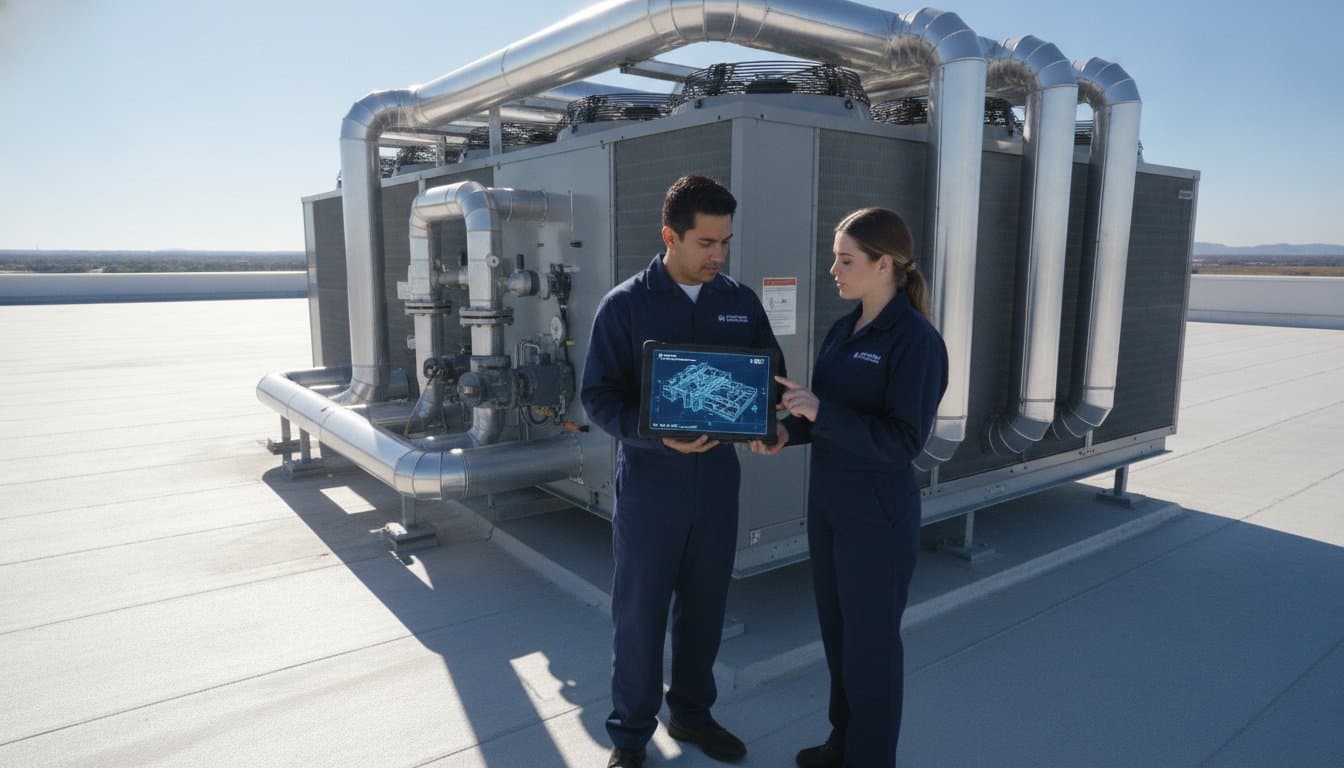
The integrity of a high-output industrial facility depends less on the scale of its machinery and more on the rigorous technical standards applied to its mechanical infrastructure. You likely recognize that in the extreme Texas heat, a minor system inefficiency isn't just a comfort issue. It's a direct threat to your bottom line and equipment longevity. This guide provides the authoritative framework for industrial hvac service, detailing the maintenance protocols and data-driven strategies required to secure 100% operational uptime.
We'll examine the critical shift toward 2026 refrigerant standards and the necessity of Building Information Modeling (BIM) to eliminate coordination gaps between design and execution. By prioritizing engineering precision and in-house fabrication, facility managers can mitigate the risks of costly downtime. This comprehensive reference outlines the methodology for implementing a proactive, disciplined maintenance strategy that views mechanical systems as vital corporate assets rather than mere overhead costs.
Key Takeaways
- Understand the fundamental engineering distinctions between light commercial units and high-capacity industrial systems, focusing on chilled water and hydronic heating infrastructure.
- Discover how Building Information Modeling (BIM) serves as a proactive tool to visualize digital twins and eliminate logistical conflicts before field execution begins.
- Implement a disciplined industrial hvac service schedule designed to maximize system lifecycle and protect critical manufacturing processes from the risks of unscheduled downtime.
- Evaluate the role of in-house sheet metal fabrication in maintaining technical precision and accelerating project timelines for heavy-duty mechanical installations.
- Learn the essential vetting criteria for selecting mechanical partners in Texas who demonstrate the technical mastery required to navigate unique regional environmental demands.
Table of Contents
- Defining Industrial HVAC Service: Beyond Standard Commercial Cooling
- Engineering Requirements for Heavy-Duty Mechanical Systems
- Advanced Coordination: Leveraging BIM and Custom Fabrication
- Mitigating Operational Risk: Maintenance and Emergency Protocols
- Strategic Partnership: Selecting Industrial HVAC Specialists in Texas
Defining Industrial HVAC Service: Beyond Standard Commercial Cooling
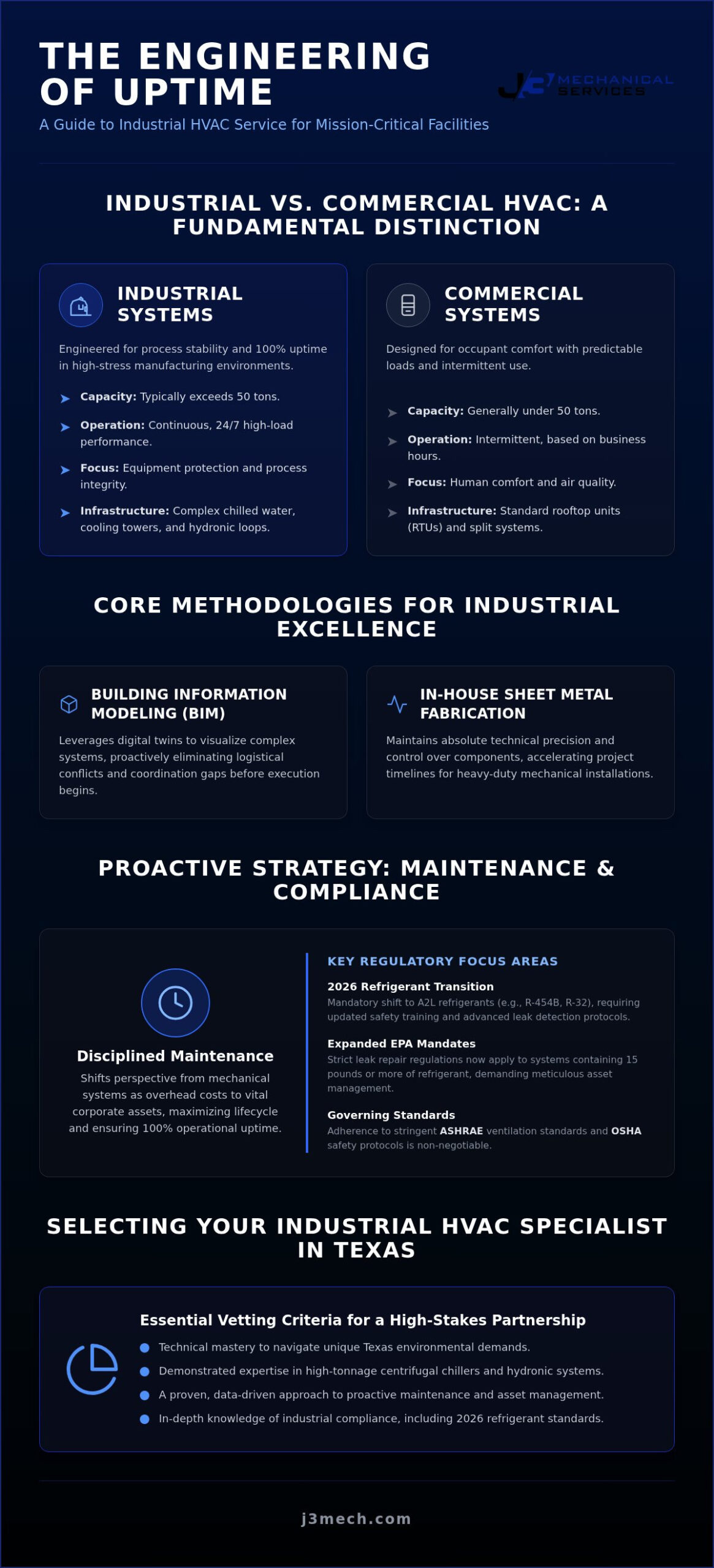
Industrial hvac service represents a fundamental departure from standard commercial climate control, moving beyond simple occupant comfort to ensure the stability of critical manufacturing and processing environments. While residential and light commercial systems are designed for intermittent use and predictable loads, industrial systems must maintain rigorous thermal stability and airflow precision under extreme operational stress. This specialized engineering discipline requires a deep understanding of foundational HVAC principles applied to high-tonnage machinery that operates continuously. The distinction lies in the complexity of the equipment, where specialized technicians must manage high-tonnage centrifugal chillers, industrial furnaces, and sophisticated hydronic loops that are central to a facility's production capacity.
The technical mastery required for this work involves more than basic mechanical repair; it necessitates a disciplined approach to system integration and logistical coordination. In an industrial setting, a variance of even a few degrees or a slight drop in static pressure can lead to compromised product integrity or total system failure. These environments demand a level of precision that standard office cooling cannot provide, making the role of the industrial mechanical partner one of critical infrastructure management rather than simple maintenance.
Capacity and Scale Considerations
Managing mechanical systems that exceed 50 tons of cooling capacity introduces unique engineering challenges that are absent in smaller applications. High-velocity air handlers and specialized filtration systems are often required to manage particulate matter or volatile organic compounds generated during industrial processes. Because the financial impact of a shutdown is so high, redundant systems are a standard requirement in these designs. This ensures that if one component requires service, the secondary system maintains 100% operational uptime, preserving the continuity of the facility's mission-critical functions.
Industrial Standards and Regulatory Compliance
Compliance in the industrial sector is governed by stringent ASHRAE standards for ventilation and OSHA safety protocols that protect technicians working on high-stakes mechanical assemblies. As of 2026, the transition to A2L refrigerants like R-454B and R-32 has added another layer of complexity, requiring updated safety training and leak detection protocols. Implementing a robust strategy for commercial HVAC asset management is essential for navigating these regulatory changes. By maintaining detailed records and adhering to the EPA's expanded leak repair mandates, which now target systems containing 15 pounds or more of refrigerant, facilities can ensure they remain compliant while maximizing the lifecycle of their mechanical investments.
Engineering Requirements for Heavy-Duty Mechanical Systems
Managing the mechanical load of a high-capacity facility requires an engineering approach that prioritizes thermal efficiency and system resilience. Industrial cooling towers and chilled water systems form the backbone of many Texas manufacturing plants, where the rejection of massive heat loads is essential for both equipment safety and process continuity. Unlike standard units, these heavy-duty systems involve complex fluid dynamics and heat exchange variables that demand rigorous oversight. A failure in water chemistry or a drop in thermal transfer efficiency doesn't just increase energy costs; it threatens the structural integrity of the entire mechanical loop.
Chillers and Hydronic Systems
The maintenance protocols for centrifugal and screw chillers are significantly more intensive than those for smaller rooftop units. Technicians must perform regular vibration analysis, oil sampling, and tube cleaning to prevent the gradual degradation of performance. Effective industrial hvac service relies on maintaining precise water chemistry to prevent scale and corrosion within the hydronic network. By implementing a strategy for commercial air conditioning optimization, facility managers can significantly extend the operational life of these high-value assets while reducing the frequency of emergency repairs.
Industrial Ventilation and Air Quality
Pressurized industrial environments require the seamless integration of makeup air units (MAU) to replace exhausted air and maintain safe indoor conditions. These systems must be designed to adhere to OSHA ventilation standards, particularly when managing hazardous fumes or volatile organic compounds. In manufacturing sectors like pharmaceuticals or electronics, maintaining HEPA standards in cleanrooms is a non-negotiable requirement for production quality. Precise humidity control is equally vital, as excess moisture can lead to material degradation or equipment malfunctions. Achieving this level of precision often requires advanced building automation systems that provide real-time data on airflow and atmospheric conditions. If your facility faces complex environmental challenges, partnering with a firm that specializes in heavy-duty mechanical engineering can provide the technical clarity needed for long-term stability.
Large-scale boiler and hydronic heating systems add another layer of complexity to the industrial landscape. These systems require meticulous pressure vessel inspections and burner tuning to ensure safe, high-efficiency operation. When these thermal systems are integrated into a centralized building automation platform, they allow for a level of granular control that standard thermostats can't replicate. This data-driven approach to industrial hvac service transforms mechanical infrastructure from a passive utility into a strategically managed asset that supports the facility's broader operational goals.
Advanced Coordination: Leveraging BIM and Custom Fabrication
The precision required for modern industrial hvac service is achieved through the integration of Building Information Modeling (BIM) long before a single technician arrives on-site. By creating a digital twin of the facility's mechanical infrastructure, engineers can visualize the complex interplay between ductwork, piping, and structural constraints. This virtual environment allows for the identification of potential spatial conflicts and failure points that would otherwise remain hidden until the construction or retrofit phase. This proactive approach ensures that every component is placed with surgical accuracy, maintaining the integrity of the original design while optimizing the system for long-term accessibility.
BIM-Led Maintenance and Installation
Utilizing 3D modeling for mechanical, electrical, and plumbing (MEP) layouts is essential for coordinating the high-density infrastructure found in industrial sites. This methodology streamlines commercial hvac installation by allowing for the pre-verification of every assembly. It's not just about fitting parts together; it's about ensuring that critical valves, sensors, and access panels are positioned for efficient future service. When the field team works from a coordinated BIM model, the risk of field-ordered change orders is virtually eliminated, as every logistical hurdle has been resolved in the digital planning phase.
The transition from digital model to physical installation is bridged by in-house hvac sheet metal fabrication. When the same entity manages both the modeling and the manufacturing of components, the level of precision in industrial hvac service increases exponentially. Shop drawings derived directly from the BIM model allow for the creation of assemblies that fit perfectly within the unique footprint of an industrial facility. This vertical integration reduces the reliance on field labor and field-cut adjustments, which often introduce vulnerabilities into high-pressure systems.
Custom Fabrication for Industrial Durability
Industrial environments subject mechanical systems to significant stress, requiring heavy-gauge ductwork and reinforced supports that exceed standard commercial specifications. Adhering to OSHA industrial ventilation standards requires a level of structural integrity that generic, off-the-shelf components can't provide. Custom fabrication ensures that high-pressure ventilation systems maintain their seal and airflow velocity over decades of continuous operation. By customizing components to match the specific thermal and chemical demands of a facility, engineers can guarantee that the mechanical infrastructure remains a stable foundation for industrial production.
Mitigating Operational Risk: Maintenance and Emergency Protocols
Unscheduled downtime in a manufacturing or industrial setting is measured in thousands of dollars per hour, making the mitigation of operational risk a primary objective of any mechanical strategy. While standard buildings might tolerate a temporary loss of climate control, industrial processes often rely on precise thermal parameters to maintain chemical reactions, equipment stability, or material integrity. Establishing a rigorous commercial hvac maintenance schedule for 2026 is the first step in transitioning from a reactive posture to one of total system control. This disciplined approach moves beyond traditional time-based checklists, opting instead for condition-based monitoring that uses real-time data to predict component failure before it disrupts production.
The complexity of industrial hvac service requires a shift in how facility managers view the lifecycle of their mechanical assets. Relying on a fixed calendar for service often leads to over-maintenance of healthy components or, more dangerously, the oversight of emerging issues in high-stress machinery. By integrating sensors that monitor pressure variances and refrigerant flow, technicians can identify subtle deviations from the baseline performance. This level of oversight ensures that maintenance resources are directed where they provide the greatest impact on system reliability and energy efficiency.
Preventive Maintenance (PM) Strategies
Effective industrial hvac service utilizes advanced diagnostic tools like vibration analysis and infrared thermography to assess the internal health of motors and compressors without requiring a teardown. These non-invasive methods allow technicians to identify bearing wear or electrical imbalances that indicate imminent failure. Systematic descaling of industrial heat exchangers is equally critical, as mineral buildup can severely compromise thermal transfer efficiency and increase energy consumption. Every service action must be documented within a centralized asset lifecycle tracking system, providing the historical data necessary to justify long-term capital expenditure decisions.
24/7 Emergency Recovery Protocols
When critical infrastructure fails, the response must be immediate and methodical. For industrial assets, 24/7 emergency availability is a non-negotiable requirement of a service partnership. Rapid restoration depends on standardized diagnostic procedures that eliminate guesswork and focus on the root cause of the malfunction. Maintaining a dedicated inventory of critical spare parts specifically for industrial clients further accelerates recovery times, ensuring that rare or high-capacity components are available when minutes matter. Clear communication chains between the field team and facility managers ensure that stakeholders are informed of the restoration timeline at every stage of the crisis. To secure your facility against the high costs of mechanical failure, schedule a comprehensive infrastructure audit with our engineering team today.
Strategic Partnership: Selecting Industrial HVAC Specialists in Texas
Selecting a partner for industrial hvac service is a strategic decision that directly impacts the long-term viability of a facility's mechanical assets. It requires looking beyond simple labor rates to evaluate technical depth and regional performance history. In the high-stakes environment of heavy industry, the relationship between a facility manager and their mechanical contractor must be built on a foundation of transparent methodology and verified competence. A partner who views their work as a critical infrastructure responsibility provides more than just repairs; they provide the stability necessary for continuous production.
Texas presents unique environmental challenges that demand specialized engineering responses. Managing the latent heat loads of the Rio Grande Valley or the extreme humidity of Central Texas requires more than standard engineering knowledge. It requires a localized understanding of how high-tonnage systems respond to these specific variables over time. When evaluating commercial hvac companies in San Antonio and Austin, facility managers must prioritize safety metrics, including the Experience Modification Rate (EMR). A low EMR isn't just a safety statistic. It indicates a disciplined approach to field execution that mirrors the precision required for the machinery itself.
Regional Service Capabilities
The industrial corridors of New Braunfels, San Marcos, and Round Rock demand rapid logistical coordination and specialized cooling knowledge to maintain production schedules. Manufacturing hubs in the Rio Grande Valley face unique thermal stressors that require high-capacity, resilient mechanical loops capable of operating under constant demand. Providing effective industrial hvac service to remote sites in South Texas necessitates a robust logistical framework that ensures technicians and critical spare parts are available exactly when they're needed. This regional expertise ensures that environmental factors don't become a liability for your operational uptime.
The J3 Mechanical Services Standards
At J3 Mechanical Services, we operate with the gravitas of a seasoned consultant and the technical precision of a master builder. Our methodology is rooted in a faith-based approach to professional accountability, ensuring that ethical duty is as prominent as technical mastery. We prioritize technical mastery and ethical duty in every industrial mechanical project. This commitment to disciplined execution and transparent reporting ensures that your critical infrastructure remains a stable, high-performing asset for years to come. By choosing a partner who values meticulous preparation as much as physical labor, you secure the future of your facility's most vital mechanical systems.
Securing the Future of Your Industrial Infrastructure
Managing a high-tonnage mechanical system requires a shift from simple oversight to a disciplined strategy of infrastructure management. By integrating advanced BIM coordination and condition-based monitoring, facility managers can eliminate the coordination gaps and technical variances that lead to costly operational downtime. This comprehensive approach ensures that every component of your industrial hvac service is optimized for the extreme thermal demands and regulatory standards of the 2026 landscape. Precision in the planning phase, supported by in-house fabrication, remains the only way to guarantee the structural integrity of your facility's ventilation and cooling loops.
True mechanical resilience is built on a foundation of engineering precision and an unwavering commitment to 24/7 emergency response. With Texas-wide industrial coverage and a focus on technical mastery, our team provides the stability your mission-critical processes require. We're ready to help you implement a data-driven maintenance strategy that treats your mechanical systems as vital corporate assets. You're invited to Secure Your Critical Infrastructure with J3 Mechanical Services today. We look forward to establishing a partnership defined by ethical duty and long-term mechanical excellence.
Frequently Asked Questions
What is the primary difference between commercial and industrial HVAC service?
The primary difference between commercial and industrial hvac service lies in the complexity of the machinery and the critical nature of the environments they support. While commercial systems prioritize occupant comfort in offices, industrial service manages high-tonnage centrifugal chillers and specialized ventilation systems essential for manufacturing stability. These systems operate continuously under extreme loads, requiring technicians with advanced engineering knowledge to maintain precise atmospheric control for process-dependent facilities.
How often should industrial HVAC systems undergo preventive maintenance?
Industrial systems require a maintenance cadence that reflects their operational intensity, typically involving monthly condition-based monitoring supplemented by comprehensive quarterly technical audits. Relying on a fixed annual schedule is insufficient for high-capacity assets that run 24/7. By tracking vibration levels and thermal transfer efficiency on a frequent basis, facility managers can identify emerging mechanical risks before they manifest as costly system failures or production delays.
Why is BIM coordination important for industrial HVAC retrofits?
Building Information Modeling (BIM) is essential for industrial retrofits because it allows engineers to resolve spatial conflicts in a virtual environment before physical installation begins. By coordinating mechanical, electrical, and plumbing (MEP) layouts through a digital twin, teams can verify that new high-pressure ductwork and piping fit within existing facility footprints. This proactive coordination eliminates field-ordered change orders and ensures that critical access points remain clear for future service.
What are the common signs of industrial HVAC system failure?
Common signs that necessitate industrial hvac service include abnormal vibration patterns in motors, rising discharge temperatures, and subtle variances in refrigerant pressure. Facility managers should also monitor for a decrease in airflow velocity or an unexplained increase in energy consumption. These symptoms often indicate internal component wear or fouled heat exchangers, necessitating immediate technical intervention to prevent a total loss of critical mechanical infrastructure.
How does industrial HVAC service impact energy efficiency in large plants?
Mechanical service optimizes energy efficiency by ensuring that high-tonnage units operate at their peak thermal transfer capacity. Through systematic descaling of condenser tubes and precise burner tuning for boiler systems, technicians reduce the electrical and fuel requirements of the facility. Even a minor improvement in the heat rejection process can lead to substantial reductions in annual utility expenditures across large-scale manufacturing plants.
What should a facility manager look for in a 24/7 emergency HVAC partner?
A facility manager should prioritize an emergency partner who demonstrates a low Experience Modification Rate (EMR) and maintains a dedicated inventory of high-capacity spare parts. Reliability in a crisis depends on a partner's ability to deploy specialized technicians who follow standardized diagnostic protocols for rapid restoration. A transparent communication chain and a proven record of managing critical infrastructure in high-stakes environments are non-negotiable criteria for these partnerships.
Can custom fabrication improve the performance of an existing industrial system?
Custom fabrication improves existing system performance by replacing standard components with heavy-gauge assemblies that are precision-engineered for the facility's unique airflow demands. Generic, off-the-shelf ductwork often fails to maintain the static pressure required for industrial ventilation. By utilizing shop drawings derived from digital models, in-house fabrication teams create seamless transitions and reinforced supports that enhance the structural integrity and durability of the entire mechanical network.
What are the specific HVAC challenges for industrial facilities in Texas?
Industrial facilities in Texas face the dual challenge of managing extreme latent heat loads and navigating the 2026 transition to A2L refrigerants. The high humidity levels in central and south Texas require systems that can reject massive amounts of moisture without compromising thermal stability. Meeting these environmental demands necessitates a disciplined mechanical strategy that adheres to updated EPA leak detection mandates and OSHA safety standards for high-temperature work environments.
Need a hand with your building's HVAC?
Free quotes and honest answers from licensed commercial technicians across South Texas.