
Restaurant HVAC Repair in San Antonio: Precision Recovery for Culinary Infrastructure
In the high-stakes environment of a professional kitchen, your mechanical systems are not merely amenities; they're the primary infrastructure that sustains your entire operation. When a system failure occurs during a peak service window, the requirement for restaurant HVAC repair San Antonio becomes a matter of immediate economic survival rather than simple maintenance. You understand that every minute of thermal instability threatens perishable inventory and risks the physical well-being of your culinary team. This isn't just a comfort issue; it's a critical threat to your brand's reputation and your bottom line.
We recognize the intense pressure of managing a facility where a single equipment malfunction can lead to negative guest reviews and significant revenue loss. This article details how a disciplined approach to mechanical engineering and rapid response protocols can restore your environment with surgical precision. You'll learn how identifying the root cause of a failure prevents recurrence and why a 24/7 technical partnership is essential for maintaining the integrity of your culinary infrastructure. We'll examine the systematic processes required to secure long-term stability in the demanding San Antonio climate through 2026 and beyond.
Key Takeaways
- Understand that restaurant mechanical systems require a specialized integration of cooling, ventilation, and makeup air that demands industrial-grade precision rather than residential-style fixes.
- Identify how specific stressors, such as grease accumulation in evaporator coils and makeup air imbalances, compromise kitchen safety and lead to negative guest experiences.
- Recognize the necessity of 24/7 restaurant HVAC repair San Antonio to mitigate the immediate risks of perishable inventory loss and staff exhaustion during peak service hours.
- Apply the "50% Rule" and utilize Building Information Modeling (BIM) to determine whether a strategic repair or a complete system replacement is the most fiscally responsible decision.
- Evaluate potential mechanical partners based on their technical mastery and proven rapid response protocols to ensure long-term stability for your culinary infrastructure.
The Critical Role of HVAC in San Antonio’s Restaurant Industry
A restaurant's mechanical infrastructure represents a sophisticated integration of Heating, ventilation, and air conditioning (HVAC) systems that must operate in perfect synchronization to maintain food safety and patron comfort. In San Antonio, where 100°F+ temperatures are a standard occurrence for much of the summer, these systems aren't luxuries; they're the lifeblood of the facility. The system manages three distinct functions: cooling the guest environment, ventilating the kitchen to remove heat and smoke, and providing makeup air to balance the pressure within the building. When one component falters, the entire operation faces immediate risk.
Standard commercial units often succumb to the unique stressors found in a professional kitchen. High-grease environments coat evaporator and condenser coils, creating an insulating layer that forces compressors to work far beyond their intended design specifications. When this internal stress meets the external heat of a South Texas afternoon, the result is rapid mechanical fatigue. The direct correlation between mechanical uptime and revenue preservation is absolute. A failed system doesn't just mean a warm dining room; it leads to lost inventory and a shuttered business. This reality makes professional restaurant HVAC repair San Antonio a fundamental requirement for any serious operator.
Regulatory Standards and Health Code Compliance
San Antonio health department regulations demand strict adherence to specific temperature and air quality standards to ensure public safety. If a kitchen's thermal control fails, the risk of bacterial growth in food preparation areas increases exponentially, threatening the integrity of your perishable stock. Proper ventilation is also vital to prevent mold and the accumulation of airborne contaminants that can affect both staff health and food quality. Should an inspector determine that the dining room or kitchen exceeds safe temperature thresholds, they have the authority to trigger an immediate facility shutdown. Such an event results in thousands of dollars in lost daily revenue and potential damage to your brand's reputation.
San Antonio Climate Challenges in 2026
As we navigate the climate conditions of 2026, heat index trends in Central Texas continue to push rooftop units (RTUs) to their absolute physical limits. The intense solar load on these units requires high-static pressure systems capable of managing the high latent heat loads characteristic of our humid environment. Off-the-shelf residential solutions simply lack the engineering depth to handle these industrial demands. Effective restaurant HVAC repair San Antonio requires a deep understanding of these specific environmental pressures. Systems must be calibrated to remove moisture efficiently while maintaining a steady thermal envelope, ensuring that your culinary infrastructure remains resilient even during record-breaking heatwaves.
Identifying High-Stress Failure Points in Commercial Kitchen Mechanical Systems
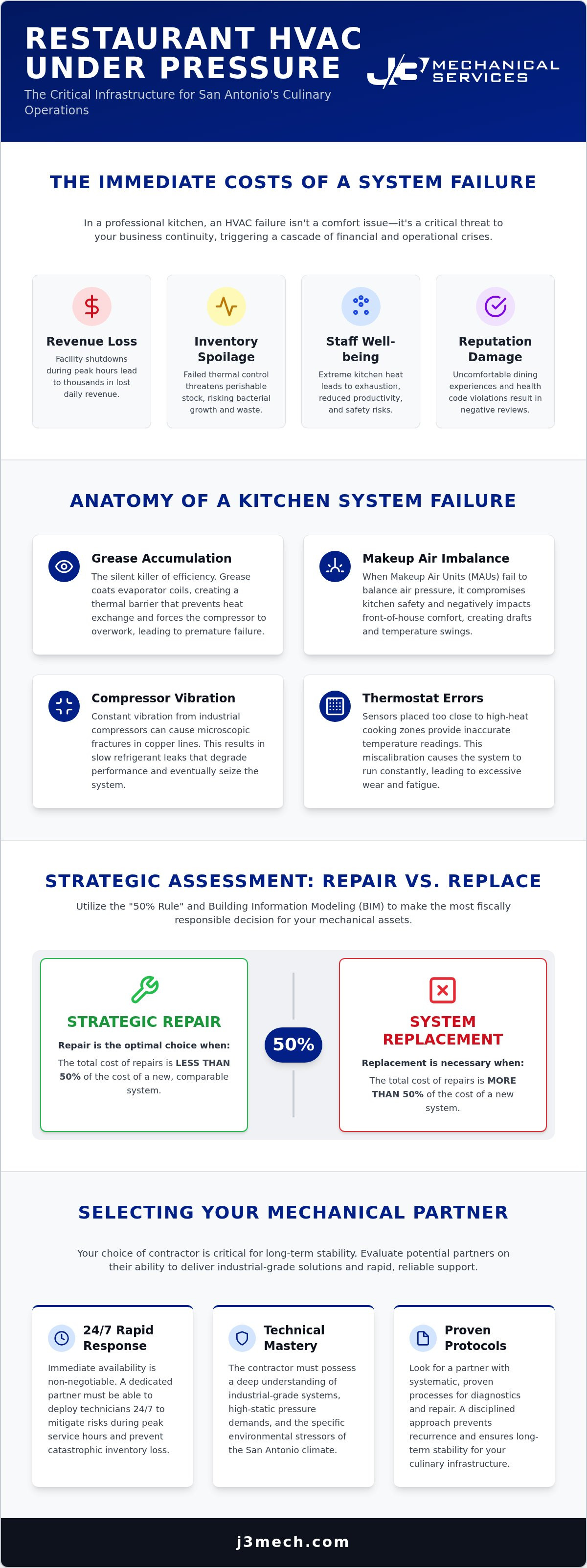
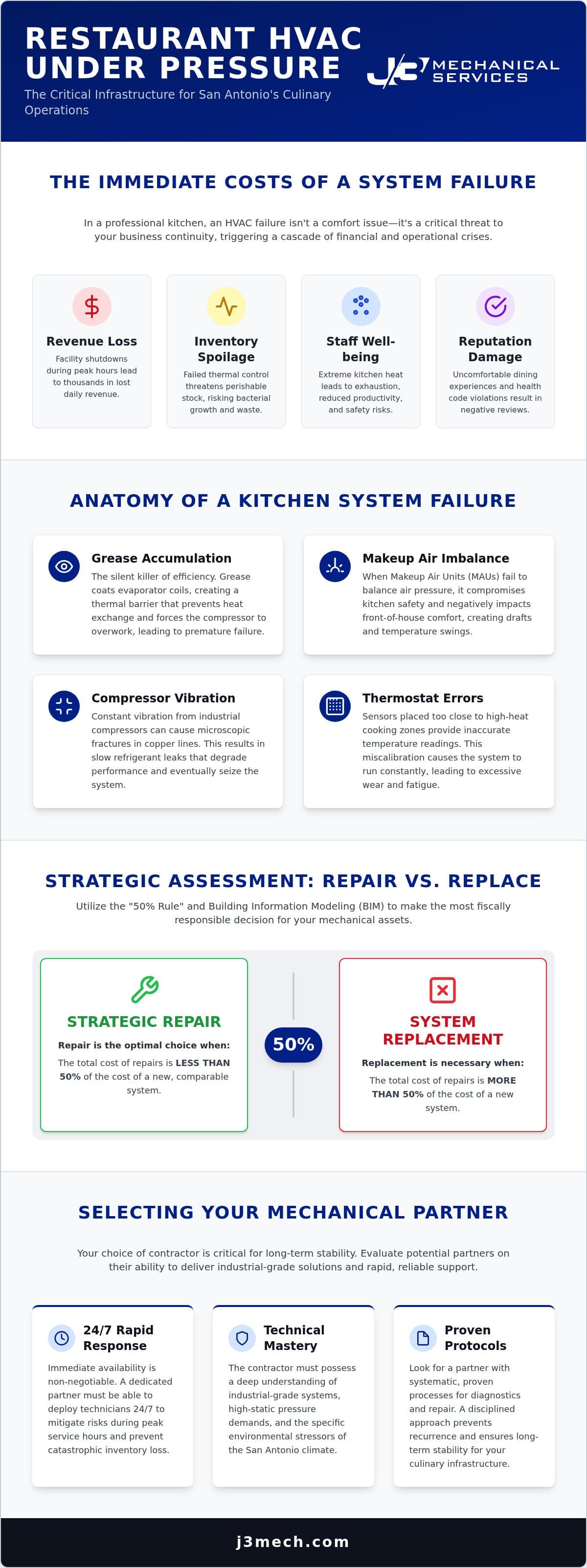
Commercial kitchen environments introduce unique chemical and physical stressors that standard air conditioning systems aren't designed to withstand without rigorous oversight. Grease accumulation on evaporator coils remains the most persistent silent killer of efficiency; it creates an organic thermal barrier that prevents effective heat exchange and forces the system to run continuously. This overexertion often leads to thermostat calibration errors, especially when sensors are placed too close to high-heat zones on the cooking line, leading to inaccurate readings and system fatigue. Additionally, the constant vibration of high-volume industrial compressors can cause microscopic fractures in copper lines, resulting in refrigerant leaks that compromise the entire cooling cycle. For operators facing these complex mechanical issues, securing expert commercial HVAC repair is the only way to ensure systemic integrity.
Makeup air unit (MAU) imbalances represent another critical failure point that directly affects front-of-house comfort. When an MAU fails to provide sufficient air to replace what the exhaust hoods remove, the building enters a state of negative pressure. This imbalance forces unconditioned outside air through every available gap, leading to "whistling" doors, lingering kitchen odors in the dining area, and localized hot spots that disrupt the guest experience. Addressing these imbalances requires a technical understanding of fluid dynamics and pressure differentials within a commercial space.
The Ventilation and Hood Integration Gap
The efficiency of your cooling system is inextricably linked to the performance of your kitchen ventilation. When a hood system is poorly balanced, the air conditioning must work significantly harder to overcome the influx of heat and humidity. Adherence to NFPA 96 standards ensures that ventilation systems are properly designed and maintained to manage grease-laden vapors effectively. Failure to integrate these systems correctly results in high exhaust fan speeds that pull conditioned air out of the building, effectively wasting energy and increasing the frequency of restaurant HVAC repair San Antonio.
Electrical and Component Failures
During the peak power demands of a San Antonio summer in 2026, electrical components are subjected to extreme thermal stress. Blown capacitors and contactors are common occurrences as voltage fluctuations and high ambient temperatures challenge the limits of industrial electrical panels. The high humidity levels in South Texas also lead to rapid algae growth in condensate lines, causing clogs that trigger safety float switches and shut down units unexpectedly. Short-cycling occurs when a system turns on and off too frequently due to improper sizing or sensor errors, which drastically reduces the operational life of the compressor motor through premature wear and tear.
Strategic Assessment: When to Repair vs. Replace Restaurant HVAC Assets
Professional kitchen operators must approach mechanical failures with a strategist's mindset, weighing the immediate costs of restoration against the long-term stability of the facility. The "50% Rule" serves as a primary decision framework in this evaluation; when the projected cost of a restaurant HVAC repair San Antonio reaches or exceeds half the value of the existing equipment, the logic-driven choice typically shifts toward replacement. This is especially true for aging systems that utilize obsolete refrigerants or lack the electrical efficiency of modern SEER2 rated commercial units. Investing in a newer, high-efficiency asset often provides a more predictable return on investment through reduced energy consumption and the elimination of recurring downtime.
Compliance with OSHA requirements regarding indoor air quality and thermal safety remains a critical factor in this assessment. A system that can no longer maintain a safe working environment for kitchen staff represents a significant liability that repairs may only temporarily mask. By prioritizing the integrity of your culinary infrastructure, you ensure that your facility remains a productive, safe, and regulatory-compliant environment. When a replacement is deemed necessary, leveraging advanced logistical tools ensures the transition occurs with minimal operational friction.
The Precision of In-House Fabrication
One of the most significant barriers to rapid system replacement is the lead time associated with third-party components. In-house fabrication allows for the immediate production of custom curb adapters and specialized ductwork, ensuring that new units integrate seamlessly with existing roof penetrations. Custom-fabricated components reduce air turbulence and increase overall airflow efficiency, which is vital for maintaining the high-static pressure required in commercial kitchens. To understand the technical advantages of this approach, you may review our comprehensive guide to HVAC Sheet Metal Fabrication.
BIM Coordination for Complex Kitchen Retrofits
Building Information Modeling (BIM) provides a digital blueprint that identifies the most efficient path for equipment installation within congested kitchen environments. This technology allows engineers to verify that new mechanical assets will clear existing structural elements and exhaust hood infrastructure before the project begins. Utilizing BIM significantly reduces the risk of costly change orders and ensures that emergency replacements are executed with industrial precision. This methodical preparation is a core component of our Commercial HVAC Installation methodology, providing a narrative of total control over the replacement lifecycle.
Selecting a Specialized Commercial HVAC Contractor in Central Texas
Selecting a mechanical partner is a decision that extends beyond immediate technical capability; it's an exercise in identifying a strategist who understands the "Master Builder" philosophy of total project accountability. In a landscape where thermal failure leads to immediate revenue loss, industrial authority matters significantly more than a low-cost quote. You must verify that your contractor possesses 24/7 emergency response capabilities and that their technicians have undergone specialized training for high-volume commercial environments. Vetting for comprehensive insurance, bonding, and a strict commercial-only specialization ensures you're partnering with a firm that views your facility as critical infrastructure rather than a residential service call. This professional rigor is essential for successful restaurant HVAC repair San Antonio, particularly as heat indices in 2026 continue to challenge standard mechanical designs.
Questions to Ask Your Mechanical Partner
When evaluating potential partners, your inquiries should focus on their technical methodology and logistical coordination. Ask specifically if they utilize Building Information Modeling (BIM) to coordinate complex repairs, as this prevents friction during the execution phase. You should also verify their experience with high-grease kitchen ventilation and how they manage logistical challenges to minimize dining room downtime. A partner who can detail their systematic approach to these variables demonstrates the competence required to manage high-stakes culinary environments. These questions help distinguish between a simple service provider and a disciplined mechanical consultant capable of executing high-level restaurant HVAC repair San Antonio.
The Value of Preventive Maintenance Protocols
Transitioning from a reactive repair model to a strategic asset management framework is the most effective way to preserve your mechanical investment. Customizing your Commercial HVAC Maintenance schedule based on your restaurant's volume and menu type allows for the identification of potential failures before they manifest. This proactive stance mitigates the risk of catastrophic downtime and extends the operational life of your rooftop units. By maintaining a methodical oversight of your equipment, you avoid the high costs of emergency recovery and ensure a consistent environment for both guests and staff. For operators seeking a partner who views mechanical systems through the lens of ethical duty, securing a reliable 24/7 emergency service protocol provides the necessary assurance that your infrastructure is protected.
J3 Mechanical Services: 24/7 Emergency Recovery and Industrial-Grade Solutions
J3 Mechanical Services operates with the disciplined precision of a strategic partner, recognizing that culinary infrastructure requires a higher standard of technical mastery than standard commercial systems. When you engage our team for restaurant HVAC repair San Antonio, you're securing a relationship with an entity that views mechanical stability as a critical infrastructure responsibility. Our methodology is rooted in a logic-driven presentation of facts, ensuring that every intervention is justified by rigorous data and engineering standards. This commitment to transparency is bolstered by our in-house fabrication shop, which allows us to manufacture essential components immediately. By eliminating the reliance on external supply chains for custom curb adapters or specialized ductwork, we significantly reduce the duration of system outages and restore thermal control with surgical accuracy.
Our 24/7 Emergency Response Framework
Our 24/7 Emergency Service is structured around a strategic triage protocol designed to prioritize kitchen uptime and inventory preservation. Upon arrival, our technicians utilize advanced diagnostic tools to conduct a comprehensive assessment of the mechanical failure, moving beyond surface-level symptoms to identify the true root cause. This methodical approach was recently demonstrated when we restored a high-volume San Antonio eatery's environmental control in under 4 hours during a peak 2026 summer weekend. By deploying a technician equipped with mobile diagnostic technology and backed by our logistical coordination team, we executed a precision recovery that prevented significant revenue loss and protected the brand's reputation from the fallout of a forced closure.
The J3 Mechanical Services Difference: Commercial Specialization
We maintain a strict focus on mechanical systems, deliberately avoiding the generalist trap of offering adjacent services to ensure our expertise remains concentrated on complex HVAC engineering. This specialization allows us to master the specific thermal dynamics of commercial kitchens, such as high latent heat loads and grease-laden ventilation systems that residential-focused firms often misunderstand. Our professional accountability is further informed by faith-based principles, which dictate a sense of ethical duty and consistency in every contract we manage. Understanding The Role of a Commercial HVAC Contractor is vital for any operator who views their facility as a long-term asset rather than a series of temporary fixes. We position ourselves as a proactive strategist dedicated to the long-term integrity of your mechanical infrastructure, providing the stability necessary to thrive in the demanding San Antonio market.
Securing Long-Term Stability for Your Culinary Infrastructure
Maintaining the integrity of your culinary environment requires a transition from reactive maintenance to strategic mechanical oversight. The high-stress conditions of a professional kitchen, combined with the extreme thermal loads of the Central Texas climate, demand a partner who treats your HVAC system as critical infrastructure rather than a series of isolated tasks. By utilizing Building Information Modeling (BIM) and leveraging in-house fabrication, you can eliminate the friction of long lead times and ensure that every intervention is executed with industrial precision. This methodical approach identifies root causes and implements logic-driven solutions that protect your operational bottom line.
When a system failure threatens your inventory and your reputation, the requirement for professional restaurant HVAC repair San Antonio becomes a matter of immediate economic survival. We provide the technical mastery and ethical consistency required to manage high-stakes commercial environments with 24/7 emergency response and BIM-coordinated engineering. It's time to take the necessary steps to safeguard your facility and ensure your kitchen remains a stable, productive environment through 2026 and beyond. Secure Your Facility with 24/7 Emergency HVAC Repair and partner with a strategist dedicated to your mechanical excellence.
Frequently Asked Questions
Why is my restaurant AC blowing warm air even after a filter change?
Warm air typically indicates a failure in the refrigeration cycle or a compromised compressor rather than a simple airflow restriction. In professional kitchens, grease deposits often coat the condenser coils, creating an insulating layer that prevents the system from shedding heat effectively. This mechanical stress can lead to permanent component fatigue if it's not addressed through specialized restaurant HVAC repair San Antonio. Our technicians conduct thorough diagnostics to identify whether the issue is electrical, mechanical, or chemical in nature.
How quickly can J3 Mechanical Services respond to an emergency HVAC failure in San Antonio?
J3 Mechanical Services maintains a 24/7 Emergency Service protocol designed specifically for the rapid recovery of critical culinary infrastructure. Our technicians are strategically dispatched throughout San Antonio and the surrounding Central Texas region to ensure immediate response times during peak service hours. By prioritizing facility uptime, we aim to begin the diagnostic process shortly after your request is logged. This rapid mobilization is essential for preventing perishable inventory loss and maintaining staff safety in high-heat environments.
Does a restaurant HVAC system require more frequent maintenance than an office building?
Yes, restaurant systems require more frequent oversight due to the high volume of grease-laden air and near-constant operational duty cycles. Unlike office buildings, kitchens generate significant internal heat and humidity that place a continuous load on rooftop units. We recommend a customized maintenance schedule that accounts for your specific cooking volume and menu type to prevent organic debris accumulation. Regular inspections identify potential failure points before they manifest as costly emergency repairs or systemic shutdowns.
What causes negative air pressure in a restaurant, and how is it repaired?
Negative air pressure occurs when the kitchen exhaust hoods remove more air than the Makeup Air Unit (MAU) provides. This imbalance creates a vacuum effect that pulls unconditioned air through every available gap, causing drafts and lingering odors in the dining area. Repairing this issue requires a technical recalibration of the ventilation system to restore pressure equilibrium. Our engineers use precise measurements to ensure your MAU and exhaust fans operate in perfect synchronization with your cooling units.
Can a failing HVAC system impact my restaurant’s health department score?
Thermal instability can lead to immediate health department violations if food preparation or storage areas exceed safe temperature thresholds. San Antonio inspectors prioritize food safety, and a failing HVAC system increases the risk of bacterial growth in perishable stock. Maintaining a consistent environment is a regulatory requirement that protects your facility from forced shutdowns and brand damage. Professional restaurant HVAC repair San Antonio ensures your infrastructure remains compliant with all local health and safety codes through 2026.
Should I repair or replace my rooftop unit if it is over 10 years old?
The decision to replace an aging unit depends on its operational history and the projected cost of restoration versus its current asset value. We utilize the 50% Rule as a strategic framework; if the repair cost exceeds half the value of the equipment, replacement is often the more fiscally responsible choice. Modern SEER2 rated units offer superior energy efficiency and reliability compared to older models. We provide a logic-driven assessment to help you determine the most efficient path for your facility's long-term stability.
Does J3 Mechanical Services handle kitchen hood and exhaust fan repairs?
J3 Mechanical Services provides comprehensive repair services for the entire mechanical system, including the critical integration of kitchen hoods and exhaust fans. These components are essential for maintaining the pressure balance and air quality of your facility's interior. Our specialization in commercial mechanical systems ensures that your ventilation infrastructure is repaired with industrial-grade precision. We focus exclusively on HVAC solutions, ensuring our technical expertise remains concentrated on the complex needs of modern restaurant environments.
Why is my dining room humid even though the AC is running constantly?
Excess humidity often indicates that the air conditioning system is short-cycling or that the Makeup Air Unit is failing to remove latent heat from incoming air. When a unit is improperly sized or the thermostat is poorly calibrated, it may cool the air without removing sufficient moisture. In the humid San Antonio climate, this creates a damp environment that negatively impacts guest comfort and staff productivity. Our diagnostic process identifies whether the issue stems from equipment sizing, sensor errors, or ventilation imbalances.
Need a hand with your building's HVAC?
Free quotes and honest answers from licensed commercial technicians across South Texas.