
Strategic Benefits of a Commercial HVAC Maintenance Agreement in 2026
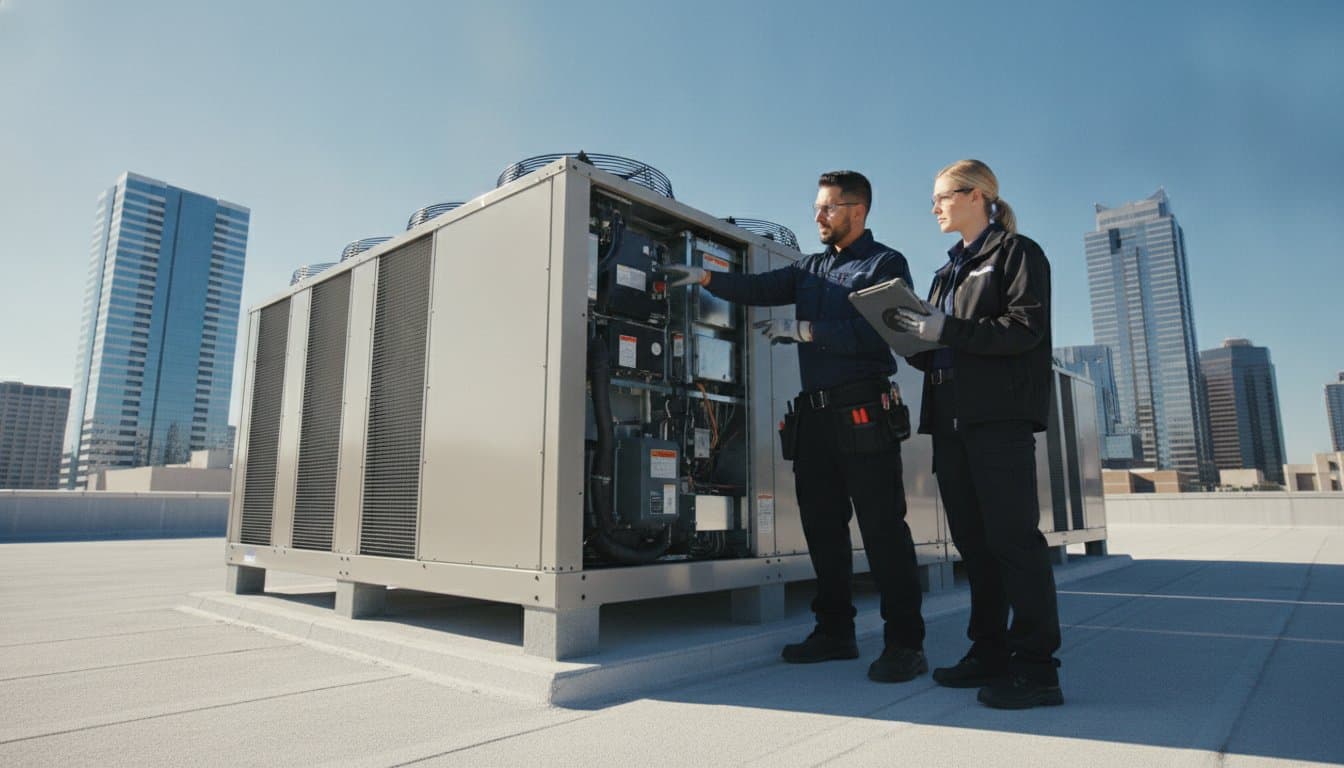
The assumption that mechanical systems are merely background utilities is a precarious oversight that often results in catastrophic failure when Texas thermal loads reach their peak. For the disciplined facility manager, the benefits of a commercial HVAC maintenance agreement extend far beyond simple filter changes, serving instead as a rigorous risk-mitigation protocol that secures critical infrastructure against unpredictable capital expenditures. As the 2026 transition to A2L refrigerants drives a 15 to 30 percent increase in the cost of new equipment, the strategic imperative to preserve existing assets has never been more vital for maintaining operational continuity.
You understand that an unplanned shutdown during a high-demand period is an unacceptable breach of professional standards that compromises both indoor air quality and occupant comfort. This article provides a comprehensive overview of how a structured maintenance program transforms your mechanical oversight into a predictable, logic-driven asset management strategy. We will explore how technical mastery, proactive logistical coordination, and priority response protocols ensure your facility achieves an extended equipment lifespan while navigating the complexities of modern engineering standards and regulatory compliance.
Key Takeaways
- Learn to transition from reactive repair cycles to a structured asset management protocol that treats mechanical systems as critical strategic investments.
- Analyze the long-term benefits of commercial HVAC maintenance agreement programs, specifically regarding the optimization of ROI and the preservation of high-capital assets like industrial chillers.
- Gain insight into sophisticated technical protocols, including Building Automation System (BAS) integration and sensor calibration, that go beyond basic filter and belt replacements.
- Implement specialized maintenance strategies designed to withstand extreme Texas thermal loads and high humidity, preventing premature corrosion and catastrophic failure during peak summer months.
- Understand why it's essential to integrate a professional mechanical contractor into your infrastructure strategy to secure 24/7 priority response and expert oversight.
The Strategic Role of Commercial HVAC Maintenance Agreements
Viewing mechanical systems as isolated components leads to fragmented facility management and unpredictable operational costs. A structured maintenance agreement serves as a comprehensive protocol that integrates technical precision with logistical oversight. While residential units focus on basic comfort, commercial systems represent high-capital assets that require rigorous engineering standards to maintain operational integrity. One of the core benefits of commercial HVAC maintenance agreement programs is the establishment of a formal service partnership where accountability is documented and verified at every phase of the equipment lifecycle.
Defining the Professional Maintenance Protocol
A professional mechanical audit transcends the superficial inspections typical of general maintenance. While a handyman check might focus on obvious visual defects, a professional audit utilizes diagnostic tools to verify the calibration of complex internal components. A commercial maintenance agreement is a legally binding commitment to system integrity that ensures every component operates within its original design parameters. This systematic approach includes precise documentation of all service intervals, which is essential for maintaining manufacturer warranties and meeting ASHRAE 2026 compliance standards. Without this rigorous record-keeping, facility managers risk liability and the potential forfeiture of equipment protection during a dispute.
The Risk of Reactive Facility Management
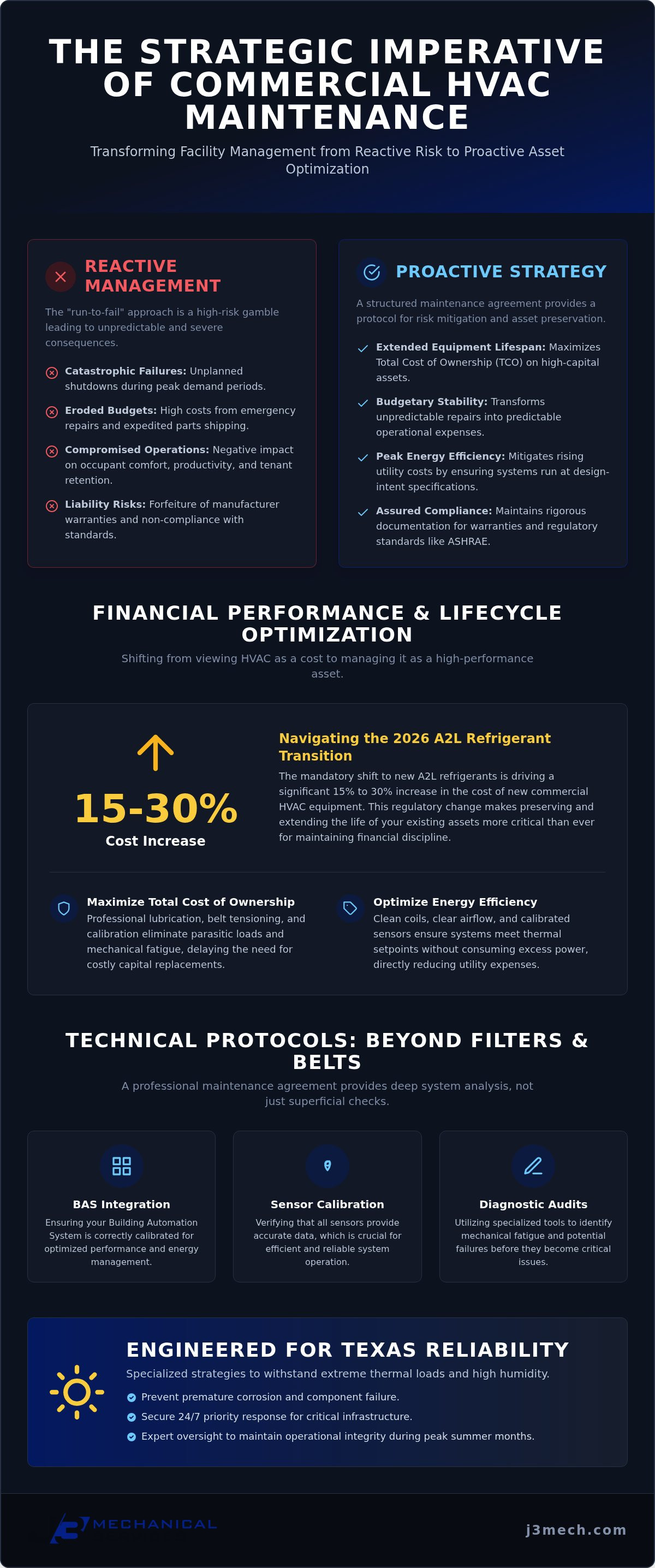
Adopting a "run-to-fail" strategy is a high-risk gamble that often results in unbudgeted capital expenditures and compromised business continuity. When critical infrastructure fails during a Texas summer, the impact on tenant retention and operational productivity is immediate and severe. The hidden costs of emergency repairs often exceed the investment of a structured agreement, as expedited shipping for custom parts and after-hours labor rates quickly erode facility budgets.
Many organizations mistakenly believe their internal teams can manage these systems effectively. However, internal staff often lack the specialized diagnostic tools and the depth of experience required for deep system calibration or the management of new A2L refrigerant standards. Professional oversight identifies mechanical fatigue before it manifests as a catastrophic outage. By securing the benefits of commercial HVAC maintenance agreement structures, facility managers move from a position of vulnerability to one of total project control, ensuring that their mechanical assets remain a strategic advantage rather than a liability.
Financial Performance and Mechanical Asset Lifecycle Optimization
Financial discipline in facility management requires a fundamental shift from viewing mechanical systems as sunk costs to managing them as high-performance assets. One of the primary benefits of commercial HVAC maintenance agreement structures is the immediate and measurable impact on energy efficiency. Systems that operate with obstructed airflow, fouled coils, or miscalibrated sensors consume significantly more power to meet thermal setpoints. By maintaining peak efficiency, facility managers can effectively mitigate the rising utility costs that often plague unmonitored industrial buildings.
Maximizing the Total Cost of Ownership (TCO)
Friction and heat are the primary enemies of industrial motors and compressors. By ensuring that drive belts are properly tensioned and bearings are lubricated according to manufacturer specifications, technicians eliminate the parasitic loads that lead to premature mechanical fatigue. This level of consistent care is essential for delaying the need for commercial hvac replacement, especially as the 2026 transition to A2L refrigerants has driven a 15% to 30% increase in the price of new equipment. According to Operations & Maintenance Best Practices, proactive oversight remains the most effective method for optimizing the lifecycle of high-capital infrastructure while maintaining the system's design-intent efficiency.
Budgetary Stability for Facility Managers
Predictability is the cornerstone of successful facility budgeting. Emergency repairs are inherently chaotic and expensive, often requiring expedited shipping for custom components and premium labor rates for after-hours response. A structured agreement converts these volatile, unbudgeted expenses into planned maintenance tasks that can be scheduled during off-peak hours. This approach eliminates the "sticker shock" of sudden system failures that compromise business continuity.
The value of a formal partnership also includes priority service status, which is vital for maintaining critical infrastructure during extreme weather events. Detailed service reports generated during each visit provide the data necessary for long-term capital planning, allowing you to forecast future needs with engineering precision. You can effectively stabilize your mechanical expenditures by securing a partner who prioritizes the integrity of your facility's infrastructure over simple quick fixes.
Technical Maintenance Protocols: Beyond Filters and Belts
While generic services often limit their scope to basic consumables, the technical benefits of commercial HVAC maintenance agreement programs are defined by a commitment to mechanical verification and engineering rigor. A structured protocol moves beyond the replacement of filters and belts, focusing instead on the precise calibration of the sensors that drive your Building Automation System (BAS). Miscalibrated sensors provide inaccurate data to the central controller, which causes the system to overcompensate and leads to unnecessary mechanical wear. Adhering to ASHRAE Standard 180 ensures that these diagnostic checks are performed with the frequency and accuracy required to maintain the design-intent performance of complex industrial equipment.
Deep-clean protocols for heat exchangers and industrial coils are equally critical, as even microscopic layers of debris can significantly impede thermal transfer and force compressors to work harder. As the industry navigates the transition to A2L refrigerants in 2026, refrigerant circuit analysis and leak detection protocols have become specialized tasks that require advanced technical training. Technicians must verify the integrity of the entire circuit to prevent the loss of these new refrigerants, ensuring both safety and environmental compliance through systematic execution. It's this level of detail that separates a professional partnership from a mere task-based service.
Advanced Mechanical Diagnostics
Modern facility management utilizes Building Information Modeling (BIM) to map the lifecycle of mechanical assets and identify potential failure points before they manifest as outages. Proactive testing of electrical components and control logic allows technicians to verify that the sequence of operations remains optimized for energy efficiency. This level of diagnostics is vital for critical environments such as medical laboratories or data centers, where even a minor deviation in thermal precision can result in significant financial or operational loss. By analyzing vibration patterns in large-scale motors, we can detect bearing fatigue before it results in a catastrophic failure.
Custom Component Oversight
Large-scale facilities often rely on specialized infrastructure that standard maintenance plans frequently overlook. For example, custom hvac sheet metal fabrication requires specific inspection for seal integrity and structural stability to prevent air leakage and vibration-induced fatigue. Maintaining the balance of complex air distribution systems in high-rise buildings involves verifying that dampers and actuators function correctly across every floor. By including the oversight of specialized filtration and UV purification systems, a professional agreement ensures that the entire mechanical ecosystem, from the chiller plant to the individual diffuser, operates with absolute precision.
Regional Reliability: HVAC Maintenance in the Texas Climate
Operating high-capacity mechanical systems in Central and South Texas requires a localized strategy that accounts for extreme thermal cycling and intense atmospheric moisture. Generic maintenance plans designed for temperate climates often fail to address the specific mechanical loads encountered during San Antonio and Austin heatwaves, where ambient temperatures frequently exceed 100°F for extended periods. One of the primary benefits of commercial HVAC maintenance agreement structures in this region is the ability to preemptively address the accelerated component wear caused by these relentless operational demands. By tailoring technical protocols to Texas-specific conditions, facility managers ensure their infrastructure remains resilient against the volatility of local weather patterns.
Humidity and Corrosion Control
Coastal environments in Rockport and Corpus Christi present unique challenges for outdoor mechanical assets, as salt-laden air accelerates the oxidation of aluminum fins and copper tubing. Without specialized protective coatings and systematic cleaning, coil corrosion can lead to significant efficiency losses and premature system failure. Effective condensate management is equally vital in the high-humidity corridors of the Rio Grande Valley, where excessive moisture accumulation can foster biological growth within air handling units. A disciplined maintenance protocol includes the verification of drainage systems and the application of antimicrobial treatments to maintain indoor air quality and protect the building’s structural integrity from moisture-related damage.
Peak Season Readiness
The transition between erratic Texas seasons necessitates a rigorous "Spring Protocol" to prepare systems for the sudden onset of extreme heat. This phase of commercial hvac maintenance focuses on validating the performance of cooling towers, chillers, and rooftop units before they're subjected to peak seasonal stress. Ensuring that backup systems are fully operational and control logic is calibrated for high-load scenarios prevents grid-stress failures during periods of maximum demand. This proactive preparation is essential for maintaining business continuity when regional power resources are most strained.
Compliance with local mechanical codes in municipalities across South Texas requires a partner who understands regional regulatory nuances and engineering standards. By establishing a formal agreement, you secure the expert oversight necessary to navigate these complexities while maintaining total project control. Secure your facility's operational continuity against the Texas climate by establishing a professional mechanical maintenance partnership today.
Integrating Maintenance into Facility Infrastructure Strategy
A strategic mechanical partnership transcends the traditional vendor relationship by positioning the commercial hvac contractor as a disciplined extension of your internal engineering team. In complex industrial or high-rise environments, internal staff often manages a broad spectrum of facility needs, making it difficult to maintain the specialized focus required for high-level mechanical oversight. By integrating a professional agreement into your broader infrastructure strategy, you secure a partner who takes full accountability for the technical mastery and logistical coordination of your HVAC systems. This alignment ensures that every maintenance action supports your long-term operational goals rather than merely addressing immediate mechanical symptoms.
One of the most critical benefits of commercial HVAC maintenance agreement structures is the guarantee of 24/7 priority response for agreement holders. In high-stakes environments where downtime results in significant financial loss, having an established protocol for emergency recovery is an essential risk-management tool. This partnership also streamlines administrative burdens by providing the expert documentation required for facility audits and insurance compliance. Detailed service records serve as a transparent verification of your commitment to equipment safety and regulatory standards, ensuring that your facility remains prepared for any technical or legal scrutiny.
Partnering with J3 Mechanical Services
J3 Mechanical Services operates with the "Master Builder" persona, a philosophy rooted in the belief that meticulous preparation is as vital as the physical execution of a project. Our approach is defined by a commitment to technical precision and a sense of ethical duty, ensuring that we view your facility's infrastructure as a critical responsibility. Because we maintain in-house fabrication capabilities, we possess a unique understanding of how custom components interact with your overall system, allowing us to provide a level of oversight that generic service providers cannot match. Our faith-based principles translate into a steady, logic-driven methodology where accountability and transparency are the standards for every interaction.
Next Steps for Facility Execution
Transitioning from a reactive repair cycle to a proactive management strategy begins with a baseline assessment of your current mechanical assets. J3 Mechanical Services conducts an initial system audit to establish a clear understanding of your equipment's health and to identify any immediate vulnerabilities that could compromise business continuity. This data allows us to customize the scope of work to match the specific thermal loads and mechanical requirements of your industrial or commercial facility. You're invited to request a comprehensive mechanical audit from J3 Mechanical Services to begin the process of transforming your HVAC management into a strategic asset for your organization.
Securing Long-Term Operational Integrity
Transitioning from a reactive repair cycle to a disciplined asset management protocol is the most effective method for securing your facility's critical infrastructure against unpredictable failure. By leveraging the strategic benefits of commercial HVAC maintenance agreement programs, you ensure that high-capital assets operate at their design-intent efficiency while effectively mitigating the rising costs associated with modern regulatory standards. This logic-driven approach transforms your mechanical systems from a recurring expense into a stable, high-performance asset that supports your broader organizational goals.
Our methodology at J3 Mechanical Services integrates specialized commercial fabrication capabilities with expertise in BIM-coordinated mechanical systems to provide a level of technical precision that generic providers cannot replicate. Agreement holders further secure their operations with 24/7 emergency response, ensuring that critical infrastructure remains resilient even during the most extreme South Texas thermal loads. Establishing a formal partnership allows you to navigate complex engineering requirements with quiet confidence and steadfast reliability. We invite you to Secure Your Facility’s Future with a J3 Mechanical Services Maintenance Agreement and experience the difference of professional mechanical oversight. We look forward to helping you achieve total project control.
Frequently Asked Questions
What is typically included in a commercial HVAC maintenance agreement?
A professional agreement encompasses systematic inspections, sensor calibration, and deep-cleaning protocols for heat exchangers and industrial coils. It moves beyond basic filter changes to include refrigerant circuit analysis and electrical component testing. These protocols ensure every mechanical component operates within its original engineering parameters. By including Building Automation System (BAS) integration and vibration analysis, the agreement provides a comprehensive risk-mitigation framework that preserves the integrity of high-capital infrastructure.
How often should a commercial HVAC system be serviced under an agreement?
Most large-scale facilities require at least two comprehensive service visits per year to manage the transition between extreme Texas seasons. High-demand environments like data centers or medical labs often necessitate quarterly inspections to maintain thermal precision and prevent catastrophic failure. This steady rhythm of oversight allows technicians to identify mechanical fatigue before it manifests as an outage. Regular service intervals are a fundamental requirement for meeting ASHRAE 2026 standards and ensuring long-term equipment reliability.
Will a maintenance agreement lower my business’s energy bills?
Yes, maintaining a calibrated and clean system significantly reduces power consumption by ensuring that mechanical loads remain within design-intent parameters. One of the measurable benefits of commercial HVAC maintenance agreement structures is the elimination of energy waste caused by obstructed airflow or fouled coils. When compressors and motors operate without parasitic friction, monthly utility expenditures remain predictable. This logic-driven approach to efficiency directly optimizes your facility's total cost of ownership.
Does a maintenance contract cover the cost of emergency repairs?
A maintenance agreement typically focuses on preventive oversight rather than covering the full cost of parts and labor for major repairs. However, it often includes priority 24/7 emergency response and discounted rates for agreement holders. This ensures that critical infrastructure receives immediate attention during a failure, minimizing the financial impact of operational downtime. By shifting from reactive repair cycles to proactive maintenance, you effectively convert unpredictable emergency expenses into a stable, planned facility budget.
Can a maintenance agreement help my facility stay compliant with local Texas codes?
Yes, a structured agreement ensures that your mechanical systems meet the specific regulatory requirements of municipalities in San Antonio, Austin, and Corpus Christi. Technicians provide the detailed documentation necessary for facility audits, insurance compliance, and local mechanical code verification. This expert oversight is particularly vital in 2026 as facilities navigate new A2L refrigerant mandates. A professional partnership provides the technical mastery needed to maintain legal and environmental standards without operational friction.
How does a professional agreement affect my equipment’s manufacturer warranty?
Consistent, documented maintenance is almost always a mandatory requirement for preserving the validity of a manufacturer's warranty. If a high-capital component fails, manufacturers require proof of professional service to verify that the equipment wasn't neglected. A maintenance agreement provides a transparent record of all technical interventions, protecting your investment from being disqualified during a warranty claim. This level of accountability ensures that your system remains covered throughout its entire operational lifecycle.
What is the difference between a service contract and a maintenance agreement?
A service contract is often a reactive arrangement designed to address specific repairs as they occur, whereas a maintenance agreement is a proactive strategy focused on asset preservation. While a service contract might offer a fixed price for labor, a maintenance agreement establishes a disciplined protocol for ongoing oversight and risk mitigation. This distinction is critical for facility managers who prioritize long-term stability and equipment longevity over the temporary fixes associated with standard service calls.
How do I know if my current mechanical system is a good candidate for an agreement?
Any commercial mechanical system, regardless of age, is a candidate for a structured agreement to prevent accelerated degradation and unbudgeted failure. Older systems benefit from intensive diagnostics to manage the phase-down of older refrigerants, while new systems require calibration to maintain their high-efficiency ratings. A professional audit serves as the initial baseline to determine the specific technical needs of your facility. This assessment allows for a customized scope of work that matches your industrial requirements.
Need a hand with your building's HVAC?
Free quotes and honest answers from licensed commercial technicians across South Texas.