
Strategic Commercial HVAC Replacement in Austin: Engineering Long-Term Facility Reliability
A commercial HVAC replacement in Austin is not merely a mechanical upgrade; it is a high-stakes logistical operation where the margin for error is measured in operational downtime and budgetary volatility. It's a reality that most facility managers face with a sense of apprehension, knowing that a single miscalculation in the field can lead to costly change orders or significant disruptions for building occupants. You've likely seen how aging, inefficient units can drain resources, yet the prospect of a full-scale transition often feels like a choice between two different types of financial strain.
This comprehensive guide details a more disciplined approach, focusing on how precision engineering and Building Information Modeling (BIM) eliminate the traditional friction of mechanical projects. We'll explore the technical methodologies that ensure a seamless transition to high-efficiency equipment, leveraging in-house fabrication and rigorous logistical coordination. By the end of this analysis, you'll understand how to navigate the 2026 energy standards and Austin Energy rebates to secure a verified return on investment while maintaining total facility reliability.
Key Takeaways
- Learn how to identify the optimal window for a strategic transition by analyzing ASHRAE service life benchmarks for mechanical systems operating in the Central Texas climate.
- Discover how to maximize long-term ROI during a commercial HVAC replacement Austin by aligning with 2026 SEER2 standards and IECC compliance to reduce facility energy expenditures.
- Understand the role of Building Information Modeling (BIM) and digital twins in preventing structural clashes and eliminating costly change orders during complex mechanical retrofits.
- Navigate the technical nuances of the City of Austin’s ECAD requirements and the specific latent cooling loads necessary to manage regional humidity levels effectively.
- Evaluate the critical infrastructure requirements for specialized contractors, including the necessity of in-house fabrication and advanced digital coordination capabilities.
Identifying the Indicators for Commercial HVAC Replacement
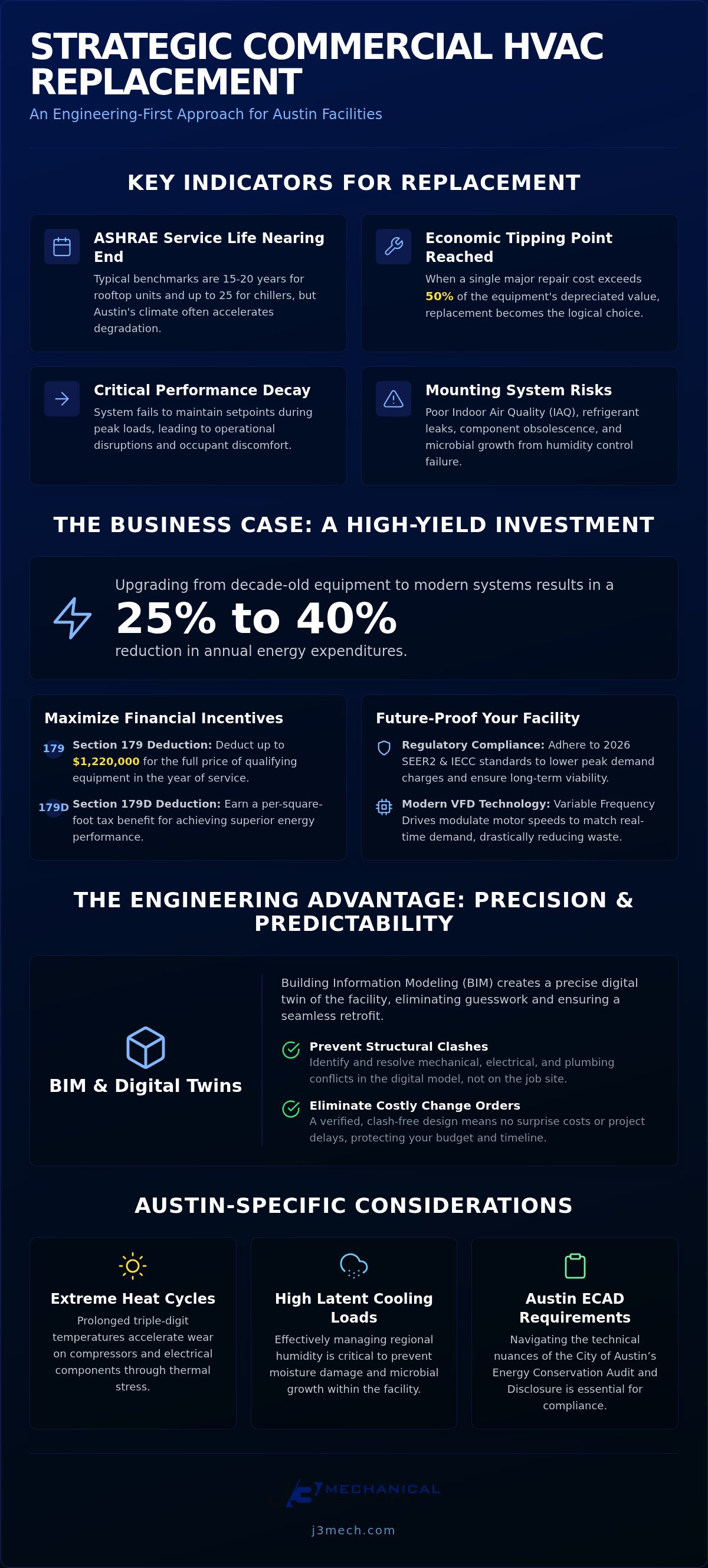
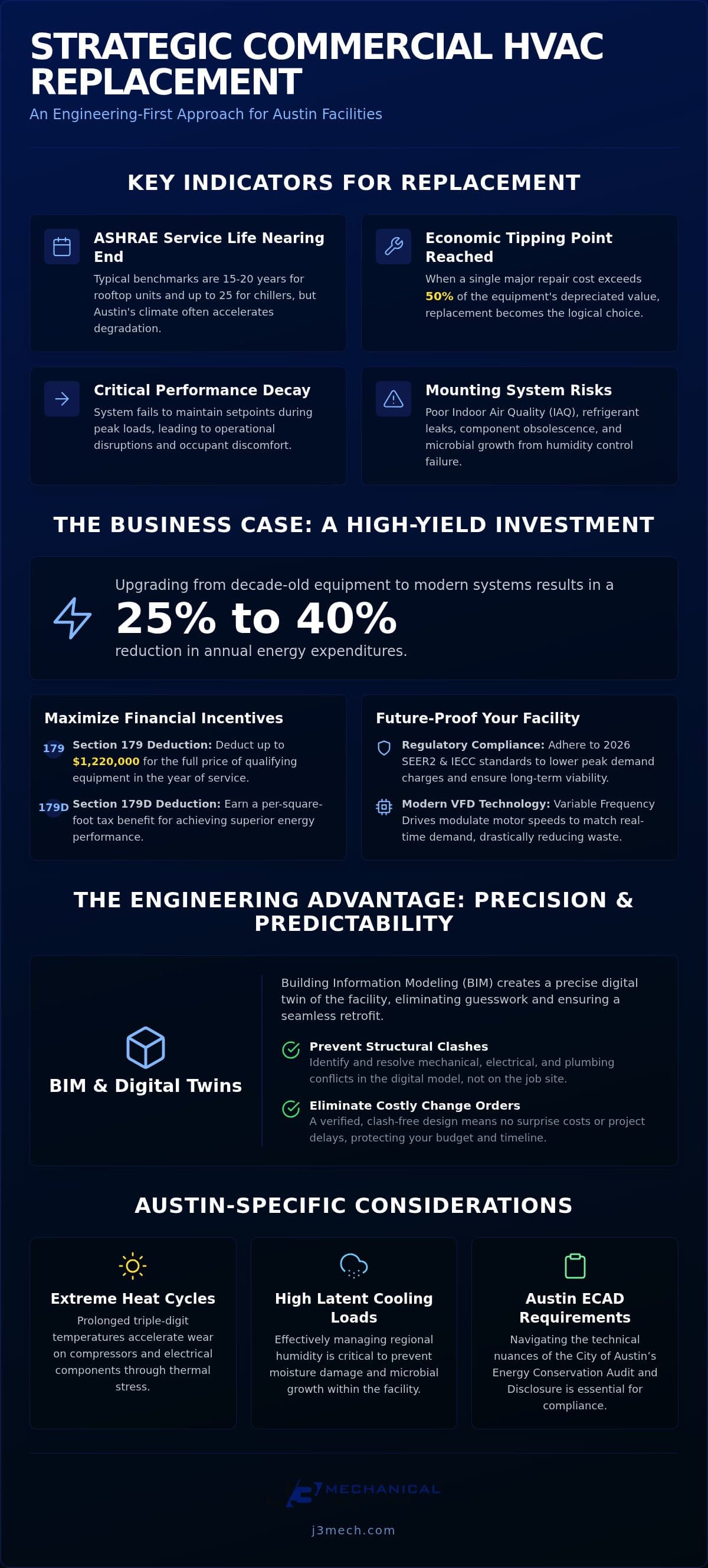
Managing industrial assets requires a transition from the "run-to-fail" mentality toward a disciplined, strategic replacement schedule. For facility managers in Central Texas, understanding the foundational HVAC systems overview and its specific engineering tolerances is vital for maintaining operational continuity. While ASHRAE benchmarks suggest a service life of 15 to 20 years for rooftop units and up to 25 years for water-cooled chillers, these figures often contract under the rigorous thermal demands of the Austin corridor. Component obsolescence, particularly regarding legacy refrigerants and control boards that are no longer manufactured, frequently renders a full-scale commercial HVAC replacement Austin more logical than localized repairs.
Industrial mechanical assets reach a critical "repair-to-replace" ratio when the cost of a single major repair exceeds 50% of the equipment's depreciated value. This calculation must include the hidden costs of downtime and the rising price of phased-out refrigerants. When the frequency of service calls begins to impact the bottom line, the system is no longer an asset; it's a liability.
Lifecycle Assessment of Industrial Mechanical Systems
Austin’s extreme heat cycles, characterized by prolonged periods of triple-digit temperatures, accelerate compressor wear and degrade electrical components through thermal expansion and contraction. A systematic audit should involve vibration analysis, refrigerant leak rates, and historical energy consumption data to identify performance drift. The economic tipping point for HVAC replacement occurs when the projected energy savings from 2026 SEER2 compliance and IECC standards exceed the total cost of ownership for maintaining an aging, sub-standard asset.
Performance Decay and Air Quality Implications
Aging heat exchangers and compromised seals often lead to indoor air quality (IAQ) risks, including the introduction of particulate matter into the airstream. In large-scale commercial facilities, humidity control failure points often manifest as microbial growth or moisture damage long before the cooling capacity itself fails. Recognizing terminal system fatigue requires looking beyond mechanical failure to identify structural corrosion or the inability of the system to maintain setpoints during peak load hours. When a system can no longer manage the latent cooling loads required for the Texas climate, the risk to building integrity necessitates a professional commercial HVAC replacement Austin.
The Business Case: ROI and Operational Continuity
A strategic commercial HVAC replacement Austin should be viewed as a high-yield capital optimization rather than a simple maintenance expenditure. When calculating the Total Cost of Ownership (TCO), facility managers must account for the 25% to 40% reduction in energy expenditures typically observed when upgrading from decade-old equipment to modern, high-efficiency systems. These financial gains are solidified by strict adherence to 2026 SEER2 and IECC benchmarks, which mandate efficiency levels that significantly lower peak demand charges. Beyond direct utility savings, high-performance mechanical systems enhance property valuation and serve as a critical lever for tenant retention in a competitive Austin commercial market.
Financial incentives further de-risk the transition and accelerate the payback period. Under Section 179 of the tax code, businesses can deduct the full purchase price of qualifying equipment up to $1,220,000 in the year it's placed in service, provided the assets are operational by the end of 2026. Additionally, the Section 179D deduction offers a per-square-foot benefit for buildings that achieve superior energy performance relative to ASHRAE standards. Selecting Energy-efficient commercial HVAC equipment ensures that a facility remains compliant with these federal standards while maximizing the available tax advantages.
Energy Efficiency as a Capital Investment
The transition from legacy R-22 systems to modern, lower-GWP refrigerants like R-32 or R-454B is now a regulatory necessity. Modern systems utilize Variable Frequency Drives (VFDs) to modulate motor speeds based on real-time demand, which drastically reduces operational overhead compared to older constant-speed units. This precision engineering reduces the mechanical stress on components, leading to a quantifiable decrease in emergency service calls. Establishing a Commercial HVAC Maintenance protocol immediately following installation ensures these efficiency gains are preserved throughout the system’s lifecycle.
Mitigating Downtime During System Transition
Operational continuity is paramount during a large-scale mechanical swap because any loss of climate control can compromise sensitive equipment or occupant productivity. Unplanned downtime in critical sectors, such as data centers or healthcare facilities, carries a financial penalty that can quickly exceed the cost of the equipment itself. Disciplined project coordination allows for temporary climate control solutions to remain in place while new units are positioned. By utilizing meticulous logistical planning, a commercial HVAC replacement Austin can be executed with minimal impact on building occupants. If you're ready to secure your facility's future, consult with a mechanical strategist to begin your technical assessment.
The Engineering Advantage: BIM and Pre-Fabrication
A successful commercial HVAC replacement Austin depends on the precision of the pre-construction phase. Traditional methods often rely on manual measurements that fail to account for the complex spatial constraints of modern industrial mechanical rooms. By contrast, Building Information Modeling (BIM) allows for the creation of a high-fidelity digital twin, ensuring that every component is accounted for before physical work commences. This disciplined approach transforms the replacement process from a series of reactive field adjustments into a controlled engineering execution.
The integration of digital modeling ensures that new equipment aligns perfectly with existing infrastructure. This is particularly vital when upgrading systems to meet Federal energy efficiency standards, as modern high-efficiency units often have different footprints than the legacy assets they replace. Meticulous planning at this stage dictates the project’s financial success and ensures that the final installation meets the exact technical specifications required for long-term reliability.
Digital Coordination and Clash Detection
We utilize 3D spatial analysis to perform rigorous clash detection, identifying potential interference between new mechanical runs and existing structural or electrical systems. This technology is indispensable when managing a commercial HVAC replacement Austin in historic or densely packed downtown structures where overhead clearance is minimal. By resolving these conflicts in a virtual environment, we eliminate the need for costly field-level change orders that typically plague less sophisticated projects. Advanced BIM coordination reduces field labor hours by 20% or more by ensuring that every component arrives on-site ready for immediate, frictionless installation.
Systematic coordination bridges the gap between virtual modeling and field execution, creating a narrative of total project control. This procedural flow ensures that logistical hurdles, such as crane placement or street closures in high-traffic Austin corridors, are managed with the same rigor as the mechanical design itself. By maintaining this consistent, thorough cadence, the project avoids the operational friction typically associated with large-scale industrial retrofits.
The Role of In-House Sheet Metal Fabrication
Precision in the virtual model is only effective if the physical components match that level of accuracy. In-house fabrication allows for total control over the production of custom ductwork and transitions, which is essential for high-velocity commercial systems. Our methodology for HVAC Sheet Metal Fabrication focuses on creating airtight integrity and optimal airflow patterns that legacy, off-the-shelf solutions cannot provide. This synergy between digital design and physical manufacturing ensures that the new mechanical system operates at its peak engineered capacity from the moment it's commissioned.
Austin-Specific Considerations for Mechanical Replacements
Austin's regulatory environment demands a high degree of technical compliance, particularly regarding the Energy Conservation Audit and Disclosure (ECAD) ordinance. For facilities exceeding 10,000 square feet, energy reporting is a mandatory component of building ownership, making a high-efficiency commercial HVAC replacement Austin a tactical necessity for maintaining regulatory standing. Beyond energy reporting, mechanical systems must adhere to the latest Texas Department of Licensing and Regulation (TDLR) standards, which govern the safety and structural integrity of industrial installations. These standards ensure that every replacement project meets the state's rigorous safety codes and technical benchmarks.
Designing for the Central Texas climate requires more than simple temperature control. The region's specific latent cooling loads, which represent the energy required to remove moisture from the air, are substantial. A system engineered for a drier climate will fail to maintain comfort and building integrity here. Precision engineering ensures that the equipment is sized to manage both sensible heat and the heavy humidity characteristic of the Austin corridor, preventing the microbial risks associated with moisture accumulation and ensuring long-term indoor air quality.
High-Rise and Large Facility Logistics
Executing a mechanical swap in high-density areas like the Domain or Downtown Austin requires a sophisticated logistical framework. Crane permitting and street closure coordination are critical phases that must be synchronized with the city’s transportation department to avoid significant fines or project delays. In occupied multi-tenant commercial buildings, we prioritize noise attenuation strategies to ensure that the increased capacity of new units doesn't compromise the acoustic environment of the workspace below. This level of preparation ensures that the transition is invisible to the building's occupants, maintaining productivity throughout the installation process.
Environmental and Regulatory Compliance
Adherence to Austin Energy’s efficiency benchmarks is essential for securing the financial rebates that offset capital costs, such as the $1,500 incentive for high-efficiency heat pumps. Our teams follow strict refrigerant recovery and disposal protocols to ensure that legacy fluids are managed according to EPA and Texas environmental standards. By selecting systems that utilize lower-GWP refrigerants, facility managers can future-proof their assets against the inevitable tightening of environmental regulations. To ensure your project meets every local and state requirement, schedule a technical site evaluation with our engineering team today.
Selecting a specialized Commercial HVAC Contractor
Choosing a partner for a commercial HVAC replacement Austin requires a rigorous vetting process that looks beyond surface-level reviews or generalist experience. There is a fundamental distinction between a general HVAC repair company and an industrial mechanical engineering firm; the former often lacks the sophisticated infrastructure required to manage high-tonnage retrofits. When evaluating potential partners, you must prioritize those with documented BIM capabilities and in-house fabrication facilities, as these resources are the primary safeguards against field errors and logistical delays. Understanding The Role of a Commercial HVAC Contractor in modern infrastructure helps clarify why specialized expertise is non-negotiable for critical assets.
A contractor with a dedicated focus on commercial-only systems understands the unique pressures of industrial environments, where a single hour of downtime can have catastrophic financial consequences. Generalists who split their focus with residential services often lack the specialized tooling and the disciplined, corporate-industrial mindset necessary for complex mechanical coordination. By selecting a specialist, you ensure that your project is managed by experts who view your facility’s climate control as a vital piece of industrial infrastructure rather than a mere series of service calls.
The J3 Mechanical Standards of Precision
Our methodology is rooted in a disciplined, logic-driven approach to project management that prioritizes accountability at every phase of the construction lifecycle. We operate under faith-based principles that translate into a transparent, ethical duty to deliver on our engineered promises without the friction of hidden costs or unexplained delays. We explicitly exclude general plumbing services from our offerings to maintain absolute mastery over mechanical systems, ensuring that our technical focus isn't diluted by adjacent trades. This commitment to specialization allows us to execute a commercial HVAC replacement Austin with the precision of a master builder.
Securing Your Facility’s Future
The successful commissioning of a new system is merely the first step in a long-term mechanical roadmap designed to protect your capital investment. We provide a strategic framework for ongoing oversight, ensuring that your high-efficiency equipment continues to meet the 2026 SEER2 standards throughout its service life. Because mechanical failures don't follow a schedule, we provide 24/7 emergency support to maintain the integrity of your newly installed infrastructure. Integrating a plan for Commercial HVAC Repair into your facility’s management strategy provides a necessary safety net, ensuring that your critical operations remain resilient against any future variables.
Optimizing Your Mechanical Infrastructure for the Next Decade
The successful execution of a commercial HVAC replacement Austin relies on the transition from reactive maintenance to a disciplined engineering strategy rooted in technical mastery. By leveraging advanced Building Information Modeling and in-house precision fabrication, facility managers can effectively eliminate the typical volatility and logistical friction associated with large-scale retrofits. This methodical approach ensures that new installations don't just meet the 2026 energy standards; they provide a verified return on investment through reduced operational overhead and enhanced system reliability.
As a dedicated commercial-only mechanical authority, we prioritize the technical integrity of your facility's critical infrastructure above all else. Our BIM-coordinated project delivery ensures that every structural clash is resolved during the digital modeling phase, preventing costly field-level disruptions and unnecessary change orders. We invite you to consult with our mechanical engineering experts for your Austin facility replacement to secure a comprehensive roadmap for long-term operational stability. Investing in engineering precision today guarantees the resilience and efficiency of your facility for the next decade.
Frequently Asked Questions
How long does a typical commercial HVAC replacement take in Austin?
A standard rooftop unit replacement can often be completed within a single day; however, complex mechanical retrofits requiring extensive ductwork or structural modifications may span several weeks. The duration of a commercial HVAC replacement Austin is dictated by the depth of the pre-construction modeling and the logistical coordination of crane services. By utilizing BIM coordination, we minimize field-level variables, ensuring that the physical installation phase remains as compressed and predictable as possible.
Can I replace my commercial AC unit without closing my business?
Operational continuity is maintained through methodical logistical planning and the deployment of temporary climate control solutions where necessary. Most commercial installations are scheduled during off-peak hours or weekends to eliminate any impact on building occupants or business transactions. Our master builder approach prioritizes a seamless transition, ensuring that the critical infrastructure remains functional while the legacy system is decommissioned and the high-efficiency equipment is commissioned and verified.
What is the average lifespan of a rooftop HVAC unit in the Texas heat?
While ASHRAE benchmarks suggest a service life of 15 to 20 years, the extreme thermal cycles of the Central Texas corridor often accelerate component fatigue. Prolonged exposure to triple-digit temperatures increases compressor stress and degrades electrical components, often reducing the effective operational life to 12 or 15 years. Regular performance audits are essential to identify the economic tipping point where maintenance costs begin to outweigh the benefits of a strategic system replacement.
Does Austin Energy offer rebates for commercial HVAC replacements in 2026?
Austin Energy provides several financial incentives for commercial upgrades, including rebates of up to $1,500 for qualifying high-efficiency heat pumps. Additionally, the utility offers incentives for high-efficiency controllers and commercial tune-ups through participating contractors. These programs are designed to offset the capital expenditure of modernizing mechanical systems, provided the equipment meets the specific efficiency benchmarks outlined in the 2021 International Energy Conservation Code (IECC) and ASHRAE 90.1-2019 standards.
What is BIM, and why is it necessary for my HVAC project?
Building Information Modeling (BIM) is the process of creating a high-fidelity digital twin of a facility’s mechanical systems to perform rigorous clash detection. It's necessary because it identifies structural or electrical interferences in a virtual environment before any physical work begins. This disciplined coordination eliminates the need for reactive change orders and ensures that custom-fabricated components fit with surgical precision, significantly compressing the installation schedule while ensuring total project control.
Is it better to repair or replace my aging commercial chiller?
The decision to repair or replace should be based on a rigorous analysis of the "repair-to-replace" ratio and projected energy savings. If a single major repair exceeds 50% of the unit's depreciated value, or if the system relies on phased-out refrigerants like R-22, a full-scale commercial HVAC replacement Austin is the more viable economic path. Modern chillers offer significantly lower operational overhead and improved reliability compared to legacy assets reaching terminal fatigue.
How does in-house fabrication affect my project timeline?
In-house fabrication shortens project timelines by removing the volatility of third-party supply chains and ensuring that all sheet metal components are manufactured to exact engineered specifications. This vertical integration allows for real-time adjustments based on BIM data, facilitating a faster transition from the modeling phase to field execution. By controlling the manufacturing process, we maintain absolute authority over the quality and airtight integrity of the ductwork, which is critical for overall system performance.
What are the current SEER2 requirements for commercial buildings in Texas?
Commercial systems in Texas must comply with the 2021 International Energy Conservation Code (IECC) and ASHRAE 90.1-2019 benchmarks. These regulations mandate specific SEER2 and EER2 efficiency ratings based on the equipment's tonnage and the building's specific climate zone. Staying compliant requires selecting equipment that incorporates variable-speed technology and advanced refrigerants, ensuring the facility meets all state and local environmental standards while maximizing long-term energy savings and operational reliability.
Need a hand with your building's HVAC?
Free quotes and honest answers from licensed commercial technicians across South Texas.