
Warehouse HVAC Solutions Texas: Engineering for Scale and Efficiency in 2026
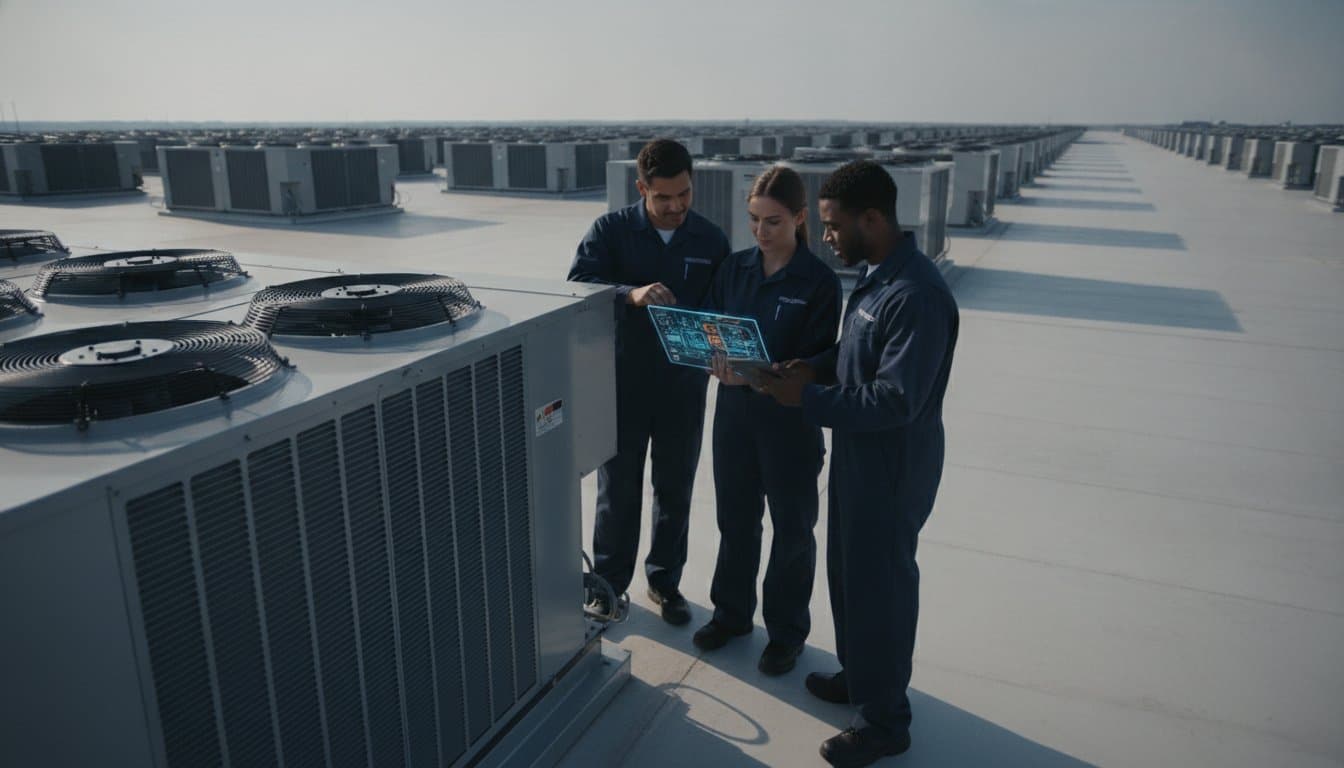
Industrial climate control for massive facilities is an intricate engineering mandate where a single miscalculation leads to catastrophic operational overhead. With over 57 million square feet of industrial space currently under construction across the state, the demand for robust warehouse HVAC solutions Texas has reached a critical juncture. You're likely already contending with the reality of exorbitant energy bills during the peak of August or the persistent threat of system failure when humidity levels spike. It's a frustrating cycle where uneven cooling in high-ceiling environments compromises both inventory integrity and worker safety.
This article demonstrates how precision mechanical engineering and Building Information Modeling (BIM) provide the definitive framework for solving these unique thermal challenges. By integrating advanced digital coordination with in-house fabrication, it's possible to secure ASHRAE-compliant air quality and long-term mechanical reliability while significantly reducing operational costs. We'll examine the 2026 regulatory landscape regarding low-GWP refrigerants and explore how disciplined, proactive design mitigates the risks inherent in large-scale Texas warehouse environments.
Key Takeaways
- Identify the specific engineering requirements for managing extreme latent heat and massive air volumes in Central and South Texas industrial facilities.
- Evaluate the performance metrics of high-capacity rooftop units and VRF systems to ensure alignment with 2026 energy standards and operational goals.
- Leverage Building Information Modeling (BIM) and custom fabrication to eliminate spatial conflicts with existing infrastructure and minimize costly construction delays.
- Discover how specialized warehouse HVAC solutions Texas provide the technical framework necessary to maintain ASHRAE-compliant air quality and mechanical reliability.
- Quantify the operational benefits of rigorous preventative maintenance schedules in safeguarding critical inventory against the risks of catastrophic system failure.
Navigating the Unique Challenges of Texas Warehouse Climate Control
Warehouse climate control represents a distinct mechanical discipline that transcends the requirements of standard commercial cooling; it involves the management of massive air volumes and the mitigation of significant latent heat loads within expansive, open-structure environments. In the context of high-demand industrial operations, warehouse HVAC solutions Texas must be engineered to address the specific physics of large-scale spaces where traditional equipment often reaches its performance threshold. It's not merely a matter of lowering the thermostat, but rather a complex exercise in air distribution and moisture management that requires a high degree of technical mastery.
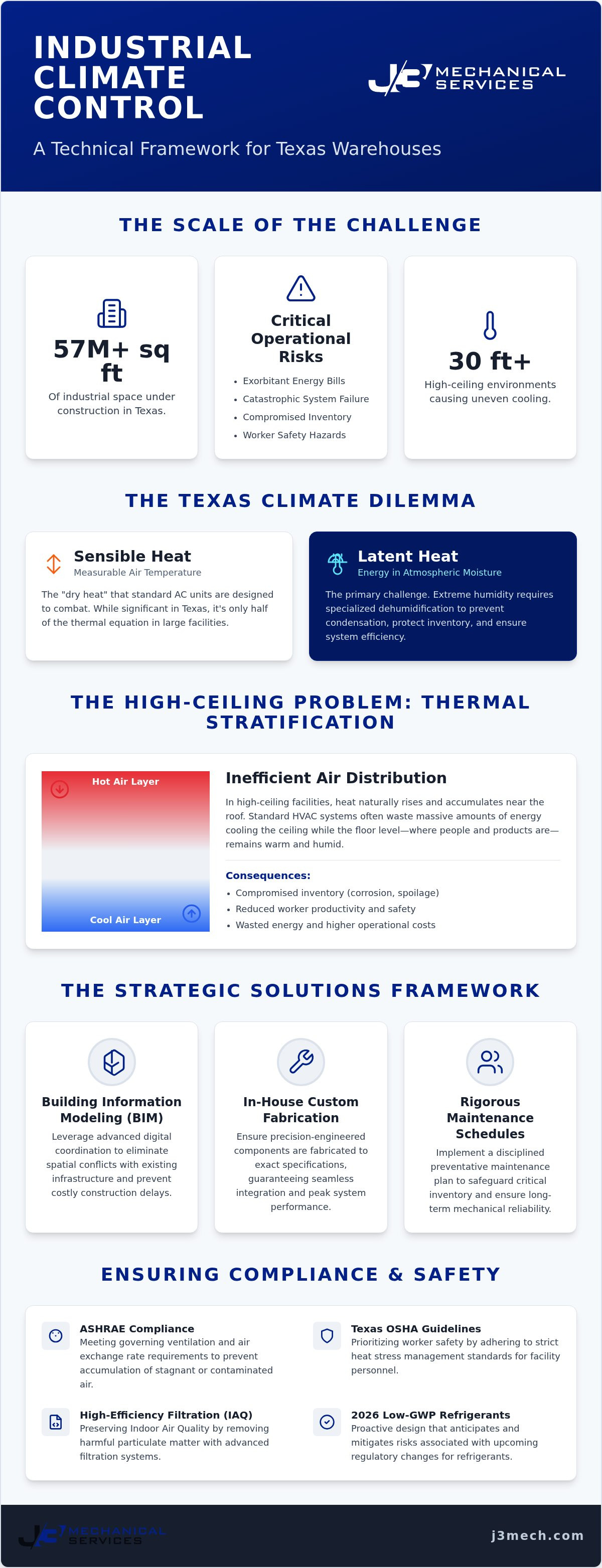
A primary obstacle in these facilities is thermal stratification, a phenomenon where heat naturally rises and accumulates in the upper reaches of buildings with 30-foot ceilings. Standard rooftop units frequently fail to achieve uniform air distribution, leading to temperature variances that can compromise sensitive assets. Uncontrolled humidity levels pose a direct threat to inventory integrity, particularly for electronics prone to corrosion, pharmaceuticals requiring strict temperature bands, and perishables at risk of accelerated spoilage. Without a disciplined approach to airflow, the energy consumed by the system is often wasted on cooling the ceiling while the floor level remains uncomfortably warm and humid.
The Impact of Latent Heat and Humidity in Texas
Engineering for the Texas climate requires a precise understanding of the distinction between sensible heat, which is the measurable temperature of the air, and latent heat, which refers to the energy held within atmospheric moisture. While Austin or San Antonio may experience intense dry heat, facilities in Corpus Christi or the Rio Grande Valley must contend with extreme humidity that necessitates specialized dehumidification strategies. Psychrometrics is the study of air-water vapor mixtures in industrial environments. By analyzing these data points, engineers can design systems that remove moisture effectively without overcooling the space, ensuring that the dew point is consistently managed to prevent condensation on racking systems and inventory.
Regulatory Standards and ASHRAE Compliance
Adherence to established technical standards ensures both operational efficiency and legal compliance. ASHRAE provides the governing ventilation requirements for large-scale industrial assets, dictating the necessary air exchange rates to prevent the accumulation of stagnant or contaminated air. Beyond these mandates, maintaining worker safety standards under Texas OSHA heat stress guidelines is a critical responsibility for facility managers who must prioritize the health of their personnel. High-efficiency filtration systems play a vital role in this process, preserving indoor air quality (IAQ) within distribution centers by removing particulate matter that could otherwise damage both mechanical components and human health. This systematic approach to compliance isn't just a regulatory necessity; it's a foundational element of long-term mechanical reliability.
Evaluating High-Capacity HVAC Systems for Large-Scale Facilities
Selecting the appropriate mechanical configuration for a 100,000-square-foot facility is a complex decision that dictates long-term operational viability and determines the baseline for annual utility expenditure. Warehouse HVAC solutions Texas generally fall into three primary categories: high-capacity Rooftop Units (RTUs), Variable Refrigerant Flow (VRF) systems, and industrial evaporative cooling. Each technology offers distinct advantages depending on the specific thermal load and ventilation requirements of the building. While evaporative cooling is effective in high-ventilation environments, it often struggles with the extreme latent heat loads characteristic of the Gulf Coast, making mechanical refrigeration the standard for precision-reliant operations.
Efficiency metrics must be evaluated through the lens of continuous 24/7 operations. While SEER2 ratings provide a baseline for seasonal performance, the Energy Efficiency Ratio (EER) is often a more accurate predictor of system behavior during the sustained peak loads typical of a Texas summer. When selecting energy-efficient commercial HVAC equipment, engineers prioritize units that maintain high EER values even under extreme ambient temperatures. Designing for scalability ensures that the initial mechanical infrastructure can support future facility expansions without requiring a total system overhaul, while maintenance accessibility remains a priority to ensure technicians can safely and efficiently service units across a massive industrial footprint.
Rooftop Units (RTU) vs. VRF Systems
RTUs remain the industrial standard due to their robust construction and ability to withstand direct exposure to the Texas sun. These units often incorporate economizers that allow for "free cooling" by drawing in outside air during cool winter nights, which significantly reduces compressor wear. Conversely, VRF systems provide superior precision for zoned cooling, making them ideal for facilities that include integrated administrative offices or climate-controlled laboratory spaces. This targeted approach prevents the energy waste associated with cooling unoccupied zones to the same standard as high-activity floor areas. For complex installations, consulting with specialists in commercial HVAC installation ensures that the chosen system aligns with the building's specific architectural constraints.
The Role of High-Volume Low-Speed (HVLS) Fans
HVLS fans serve as a critical mechanical supplement rather than a standalone solution. These large-scale fans facilitate destratification by pushing trapped warm air down from the ceiling, which directly addresses the thermal layering issues mentioned in previous sections. This movement of air increases the "perceived cooling" for workers through the evaporative effect, allowing for slightly higher thermostat setpoints without compromising comfort. Strategic placement near loading docks is particularly effective, as these areas are subject to frequent thermal incursions every time a bay door opens. By maintaining a consistent airflow pattern, HVLS fans help stabilize the indoor environment and improve the ROI of the primary mechanical investment.
The Strategic Advantage of BIM and Custom Fabrication
Building Information Modeling (BIM) functions as the definitive digital blueprint for complex industrial mechanical systems, providing a level of foresight that traditional 2D drafting cannot replicate. By utilizing advanced 3D coordination, engineers identify and resolve spatial conflicts with fire suppression lines, high-bay lighting, and complex racking systems before any physical components arrive on site. This proactive methodology is essential for warehouse HVAC solutions Texas, where the scale of the facility often amplifies the cost and time impact of even minor logistical oversights. It's a disciplined approach that views the installation as a critical infrastructure project requiring absolute precision.
The integration of in-house sheet metal fabrication allows for a seamless transition from digital model to physical execution, ensuring that every component meets the exact specifications of the facility. Pre-fabricating complex assemblies in a controlled environment minimizes the labor required on-site and facilitates just-in-time delivery to the job site. This logistical coordination reduces overall project timelines and prevents the accumulation of material waste, reinforcing a commitment to efficiency and systematic execution throughout the project lifecycle.
BIM: Eliminating Change Orders in New Construction
Digital twins allow for the virtual testing of airflow patterns and thermal loads before a single bolt is turned, mitigating the risk of performance gaps after the building is occupied. This level of verification is particularly valuable in fast-tracking the permitting and inspection process in growing Texas markets like San Antonio and Round Rock. For a deeper understanding of these processes, consulting a HVAC Sheet Metal Fabrication guide clarifies how digital precision translates into long-term mechanical stability. By resolving clashes in the virtual environment, project managers effectively eliminate the costly change orders that frequently plague large-scale industrial builds.
Precision Ductwork for Industrial Air Distribution
Off-the-shelf ducting often fails to deliver the necessary static pressure required to move massive air volumes across vast warehouse floorplans. Custom-fabricated, heavy-gauge ductwork is engineered to withstand the rigors of industrial environments while maintaining the integrity of the air distribution system over decades of use. These custom fittings are designed to reduce air leakage and optimize airflow, which directly improves the overall efficiency of the warehouse HVAC solutions Texas being deployed. It's this commitment to technical mastery and high-quality materials that ensures the final product functions as a reliable, high-performance asset rather than a series of compromised components.
Strategic Maintenance and Energy Optimization for Texas Warehouses
In the industrial sector, preventative maintenance functions as a critical safeguard against the operational paralysis caused by system failure during 100°F+ Texas summers. High-capacity warehouse HVAC solutions Texas require a disciplined oversight protocol that moves beyond reactive repairs to prioritize long-term mechanical stability. By addressing wear and tear before it manifests as a total shutdown, facility managers preserve the integrity of their mechanical assets and avoid the compounding costs of emergency recovery. This lifecycle management approach ensures that high-use industrial equipment operates at peak efficiency throughout its intended service life.
Consistent filter changes and coil cleaning provide measurable financial returns by maintaining the design-specified airflow of the system. These routine tasks are essential for:
- Reducing the amperage draw of blower motors and compressors.
- Extending the operational lifespan of expensive mechanical racks.
- Preventing moisture-related corrosion in high-humidity environments.
- Maintaining ASHRAE-compliant indoor air quality for personnel.
Predictive maintenance takes this a step further by utilizing sensors to identify potential failure points with surgical precision. These systems provide a data-driven narrative of equipment health, enabling technicians to intervene during scheduled downtime rather than reacting to a mid-shift crisis. It's a proactive strategy that views HVAC systems as critical infrastructure rather than just a utility expense.
Combating the Texas Dust and Pollen Load
Environmental factors in Central Texas, particularly the high seasonal pollen counts and ambient industrial dust, create a persistent insulating layer on condenser coils. This accumulation restricts airflow and forces compressors to work harder, which directly increases energy consumption and accelerates component degradation. Specialized cleaning protocols are necessary to restore heat transfer efficiency to baseline levels. For a comprehensive look at these industrial standards, the Commercial HVAC Maintenance protocol details the specific steps required for critical asset management in these harsh environments.
Building Automation and Smart Controls
Modern energy optimization relies heavily on Building Management Systems (BMS) that regulate peak demand through sophisticated automation. Demand-controlled ventilation (DCV) is a strategic tool for distribution centers, as it adjusts outdoor air intake based on real-time occupancy levels rather than a fixed schedule. This precision reduces the load on the cooling system during low-activity shifts, yielding substantial utility savings. Remote monitoring capabilities provide 24/7 oversight across multiple Texas locations, ensuring that any deviation from optimal performance is flagged and addressed immediately. To secure your facility's operational future, establishing a partnership for commercial HVAC maintenance ensures these complex systems remain calibrated and reliable.
J3 Mechanical: Specialized Warehouse HVAC Solutions in Texas
J3 Mechanical Services operates with a profound commitment to industrial mastery, positioning itself as the disciplined strategist required for complex warehouse HVAC solutions Texas. Unlike providers that divide their attention between residential services and general plumbing, our firm maintains an exclusive focus on large-scale commercial mechanical systems. This specialization ensures that every project benefits from a high level of technical rigor and accountability. We view our work as a critical infrastructure responsibility, employing a "Master Builder" methodology that guides a project from initial Building Information Modeling (BIM) design through in-house sheet metal fabrication to final system commissioning.
Our 24/7 emergency response capability serves as a vital safety net for mission-critical Texas facilities where even a brief period of climate instability can lead to significant inventory loss. This commitment to reliability is not merely a service offering but an ethical duty to the partners we serve. By maintaining total control over the fabrication and installation lifecycle, we provide a transparent, logic-driven presentation of our methodology that reassures clients of our professional competence and modern innovation.
Comprehensive Installation and Replacement Protocols
The process for replacing legacy infrastructure with modern, high-efficiency units requires meticulous logistical coordination to prevent operational friction. We understand that distribution centers often operate on a 24-hour cycle, which is why our replacement protocols prioritize strategic planning to minimize disruption within live warehouse environments. By utilizing pre-fabricated components from our in-house facility, we reduce on-site labor time and ensure that every fitting meets the precise requirements established during the digital coordination phase. This systematic execution is further detailed in our guide to Commercial HVAC Installation, which outlines our engineering-first approach to precision execution.
Your Partner in Texas Industrial Growth
Our service coverage extends across the primary industrial corridors of San Antonio, Austin, and the Rio Grande Valley, providing a reliable foundation for the state's expanding logistics sector. We provide a steadfast presence that prioritizes long-term stability over quick fixes, ensuring that your mechanical assets contribute to your bottom line rather than draining it through inefficiency. This reliability is rooted in our ethical business principles, which dictate a standard of transparency and technical excellence in every contract we manage. We invite you to experience a partnership defined by professional competence and a proactive commitment to your facility’s long-term stability. To begin the process of optimizing your industrial environment, schedule a professional consultation with J3 Mechanical Services today.
Securing Operational Stability for the Texas Industrial Landscape
The integration of advanced BIM-coordinated project delivery and in-house precision fabrication provides the technical foundation necessary to manage the extreme thermal loads of large-scale facilities. As established throughout this guide, the complexities of psychrometrics and thermal stratification in high-ceiling environments require more than generic hardware; they demand a disciplined, engineering-first approach. Implementing robust warehouse HVAC solutions Texas is a strategic investment that directly impacts long-term mechanical reliability and ASHRAE compliance. By prioritizing proactive maintenance and leveraging smart building automation, facility managers can effectively mitigate the risks of catastrophic downtime during peak summer humidity.
J3 Mechanical remains committed to this standard of excellence, offering 24/7 industrial emergency response to ensure your mission-critical operations remain stable and efficient. We invite you to consult with J3 Mechanical for your warehouse HVAC strategy to secure the integrity of your infrastructure. Your facility's future depends on the precision of today's mechanical decisions, and we're ready to provide the technical mastery your project requires. With a focused commitment to industrial excellence, your operations can thrive despite the most challenging environmental conditions.
Frequently Asked Questions
What is the most energy-efficient HVAC system for a Texas warehouse?
The most energy-efficient configuration for a large facility involves high-capacity Rooftop Units (RTUs) equipped with economizers or Variable Refrigerant Flow (VRF) systems for zoned cooling. Efficiency is maximized by selecting units with high Energy Efficiency Ratio (EER) ratings to handle the sustained peak loads of a Texas summer. These systems provide the necessary precision to manage massive air volumes while minimizing utility expenditure across expansive industrial footprints in regions like San Antonio and Austin.
How does humidity affect warehouse HVAC requirements in coastal Texas cities like Corpus Christi?
In coastal regions like Corpus Christi and the Rio Grande Valley, humidity significantly increases the latent heat load on mechanical systems. Warehouse HVAC solutions Texas must incorporate specialized dehumidification strategies to prevent moisture accumulation on racking and inventory. Effective design requires a precise understanding of psychrometrics to ensure the system removes atmospheric moisture without overcooling the environment, which preserves both structural integrity and indoor air quality for the facility.
Why is BIM coordination important for new industrial construction?
Building Information Modeling (BIM) is essential for identifying and resolving spatial conflicts between HVAC ductwork, fire suppression lines, and lighting systems before construction begins. This 3D coordination prevents costly change orders and ensures that the mechanical installation integrates seamlessly with the building's structural and electrical infrastructure. By utilizing digital twins, engineers can verify system performance and airflow patterns in a virtual environment, which accelerates the permitting process in cities like San Marcos and Round Rock.
How often should industrial HVAC units be serviced in the Texas climate?
Industrial units in the Texas climate should undergo comprehensive maintenance on a quarterly basis to address the high dust and pollen loads found in Central Texas. Regular inspections focus on coil cleaning, filter replacement, and amperage verification to ensure the system operates within its design parameters. This disciplined approach to preventative maintenance mitigates the risk of component degradation and extends the functional lifespan of expensive mechanical assets in high-demand distribution centers across the state.
Can HVLS fans replace a traditional HVAC system in a warehouse?
High-Volume Low-Speed (HVLS) fans cannot replace a traditional HVAC system because they don't provide mechanical cooling or dehumidification. Instead, they serve as a critical supplement that facilitates destratification and increases the perceived cooling effect for personnel through enhanced airflow. When integrated correctly, these fans allow for higher thermostat setpoints, which reduces the overall load on the primary cooling equipment and improves the efficiency of warehouse HVAC solutions Texas in expansive environments.
What happens if our warehouse HVAC system fails during a Texas summer heatwave?
A system failure during a heatwave can lead to catastrophic downtime and potential loss of climate-sensitive inventory such as pharmaceuticals or electronics. J3 Mechanical provides 24/7 emergency repair services to restore critical climate control and minimize the impact on your supply chain operations. Maintaining a proactive service agreement is the most effective way to identify failure points before they manifest during extreme ambient temperatures, ensuring your facility remains operational throughout the peak cooling season.
Does J3 Mechanical handle HVAC for new warehouse construction projects?
J3 Mechanical specializes in HVAC for new warehouse construction projects, providing comprehensive design, installation, and commissioning services. Our methodology incorporates advanced BIM coordination and in-house sheet metal fabrication to ensure that every project is delivered with surgical precision and minimal waste. This "Master Builder" approach allows us to manage complex mechanical requirements for facilities across the San Antonio and Austin corridors, ensuring long-term stability from the first day of occupancy.
Why should I choose a contractor that specializes only in commercial HVAC?
Choosing a contractor with an exclusive commercial focus ensures that your project is managed by experts who understand the unique engineering requirements of large-scale industrial environments. J3 Mechanical avoids the distractions of residential services or general plumbing to maintain absolute mastery over complex mechanical systems and technical standards. This specialization guarantees a higher level of accountability and professional competence, providing a transparent, logic-driven partnership that prioritizes the critical infrastructure needs of your business operations.
Need a hand with your building's HVAC?
Free quotes and honest answers from licensed commercial technicians across South Texas.