
What Defines a Leading Commercial AC Company in 2026?
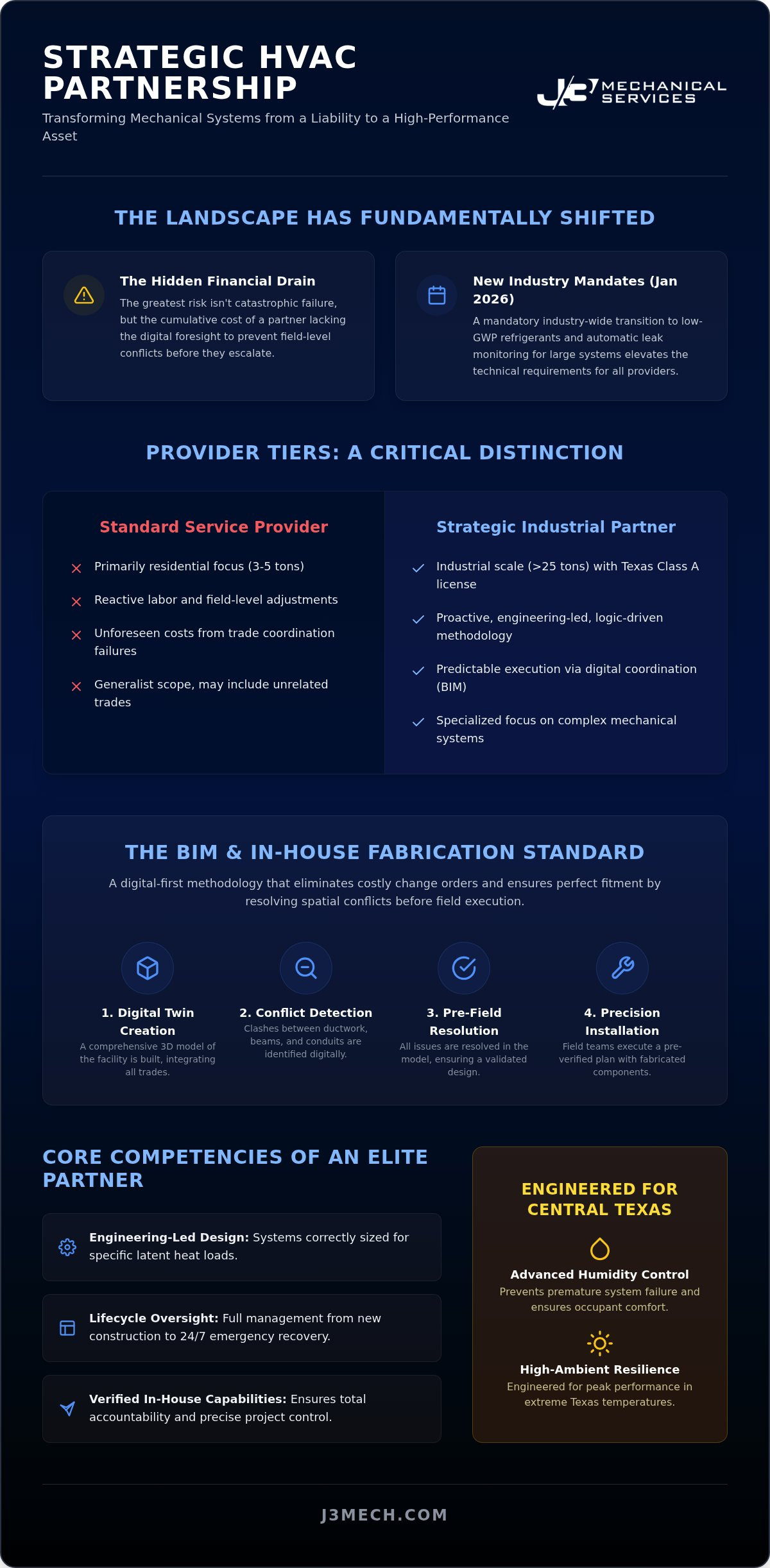
The most significant financial risk to a facility is rarely the total collapse of a mechanical system, but rather the cumulative drain of a partner who lacks the digital foresight to prevent field-level conflicts before they manifest. It's likely you recognize that as of January 2026, the industry-wide transition to low-GWP refrigerants and the mandate for automatic leak monitoring on large systems have fundamentally elevated the technical requirements for any commercial ac company. While many providers offer basic repairs, a true strategic partner views your mechanical systems as critical infrastructure that requires a disciplined, logic-driven methodology to ensure long-term stability.
This article explores the technical standards, advanced coordination tools, and lifecycle services that separate elite contractors from standard service providers. You will discover how the integration of Building Information Modeling (BIM) and in-house fabrication can eliminate the friction of costly change orders and substandard trade coordination. We will provide a comprehensive overview of how a proactive approach to maintenance and technical mastery of complex systems can transform your HVAC operations from a source of high energy expenditure into a predictable, high-performance asset.
Key Takeaways
- Distinguish between general contractors and dedicated industrial specialists to ensure your systems are managed with the necessary technical rigor.
- Understand how Building Information Modeling (BIM) and in-house fabrication minimize project friction by resolving spatial conflicts before field execution begins.
- Identifying a leading commercial ac company requires evaluating their capacity for lifecycle oversight, from new construction engineering to 24/7 emergency recovery.
- Prioritize contractors with verified in-house capabilities in Texas to ensure accountability and precise project management across the entire mechanical asset lifespan.
- Learn the engineering requirements for Central Texas facilities, focusing on humidity control and high-ambient temperature resilience to prevent premature system failure.
Table of Contents
- Defining the Scope of a Professional Commercial AC Company
- Advanced Coordination: The BIM and Fabrication Standard
- Lifecycle Services: From New Construction to Emergency Recovery
- Vetting Criteria for Commercial HVAC Partners in Texas
- Strategic Climate Management for Central Texas Facilities
Defining the Scope of a Professional Commercial AC Company
A professional Heating, ventilation, and air conditioning (HVAC) partner operates within a sphere where technical precision directly correlates with operational viability. For a commercial ac company, the mission extends far beyond simple temperature control; it involves the systematic management of complex mechanical ecosystems that support commercial new construction and large-scale industrial facilities. These entities are responsible for the entire lifecycle of high-tonnage rooftop units (RTUs), chillers, and VAV boxes, requiring a level of accountability that transcends the capabilities of residential providers. A dedicated commercial partner views these systems as critical infrastructure, where every design choice impacts long-term energy expenditures and building integrity.
The Distinction Between Residential and Commercial HVAC
The transition from residential service to commercial mechanical contracting isn't merely a change in equipment size, but a fundamental shift in engineering philosophy and regulatory adherence. While a residential unit might manage 3 to 5 tons of cooling, commercial projects frequently involve systems exceeding 25 tons, requiring a Class A license from the Texas Department of Licensing and Regulation (TDLR) to operate without limitation. Navigating Texas-specific commercial building codes demands a disciplined understanding of structural loads and high-occupancy ventilation requirements. In these environments, system downtime isn't a minor inconvenience; it's a significant threat to business revenue and operational continuity, making the reliability of a professional commercial ac company a strategic necessity rather than a luxury.
Core Competencies of Industrial Mechanical Partners
Leading mechanical contractors distinguish themselves through an engineering-led approach that prioritizes meticulous preparation over reactive labor. This methodology relies on advanced tools to ensure that project execution remains friction-free and predictable. True industrial partners focus their technical mastery exclusively on mechanical systems, which allows for a deeper specialization in the following areas:
- Engineering-Led Design: Utilizing disciplined modeling to ensure system components are sized correctly for the specific latent heat loads of Central Texas.
- High-Volume Project Management: Coordinating multi-trade schedules to ensure that HVAC installation aligns perfectly with structural and electrical milestones.
- Specialized Scope: Maintaining a strict focus on mechanical systems, which excludes unrelated trades like general plumbing to ensure the highest level of technical expertise.
- Digital Integration: Employing Building Information Modeling (BIM) to identify and resolve spatial conflicts before any physical components are fabricated or installed.
This systematic execution ensures that every phase of the project, from initial design to final decommissioning, is handled with the gravitas and precision required for modern commercial infrastructure.
Advanced Coordination: The BIM and Fabrication Standard
In the high-stakes environment of industrial mechanical projects, the traditional reliance on field-level adjustments is an unacceptable liability. A leading commercial ac company mitigates this risk by adopting a digital-first methodology that prioritizes advanced coordination long before a single technician arrives on-site. By leveraging Building Information Modeling (BIM), contractors can create a comprehensive digital twin of the facility, allowing for the identification and resolution of spatial conflicts between ductwork, structural beams, and electrical conduits. This proactive verification process ensures that the physical installation remains an exercise in precision rather than a series of reactive corrections.
The Role of BIM in New Construction
BIM serves as the digital backbone of modern mechanical coordination, providing a collaborative platform where architects and engineers can synchronize their designs in real-time. This 3D visualization capability allows for the precise routing of complex mechanical runs through confined interstitial spaces, ensuring perfect fitment during the construction phase. In an era where new energy conservation standards demand increasingly sophisticated equipment configurations, digital modeling provides the necessary accuracy to maintain compliance without sacrificing spatial efficiency. This level of foresight directly contributes to zero-friction project execution, as field teams follow a verified blueprint that has already been tested in a virtual environment.
Benefits of In-House Sheet Metal Fabrication
The integration of in-house fabrication capabilities further distinguishes elite contractors by providing total oversight of the supply chain and material integrity. When a commercial ac company maintains its own fabrication shop, it eliminates the lead time delays and quality variances often associated with third-party vendors. This capability allows for the rapid production of custom components that meet the unique architectural requirements of a specific project, whether it involves a high-rise office or a specialized industrial plant. By controlling the manufacturing process, a partner like J3 Mechanical Services can guarantee that every piece of ductwork meets SMACNA standards for precision and durability.
This synergy between digital coordination and physical production creates a streamlined workflow that significantly reduces the occurrence of costly change orders. Project managers can trust that the components arriving at the job site are pre-coordinated and ready for immediate installation, which accelerates the overall project timeline. Research indicates that BIM-driven prefabrication can reduce construction time by 20% to 50% while simultaneously lowering material waste. Maintaining this level of operational control is essential for managing the high-ambient heat loads of Central Texas, where every minute of system downtime represents a tangible loss in productivity.
Lifecycle Services: From New Construction to Emergency Recovery
A sophisticated mechanical system represents a significant capital investment that requires a comprehensive management strategy spanning its entire operational life. A leading commercial ac company doesn't merely view their role as a series of isolated tasks, but as a commitment to the long-term stability and efficiency of a facility's critical infrastructure. This lifecycle approach begins with the initial engineering and extends through decades of disciplined maintenance and strategic replacement. By maintaining total project control from the outset, a professional partner ensures that every component is optimized for the specific environmental demands of Central Texas, where extreme heat loads can rapidly degrade substandard equipment.
Commercial HVAC Installation and Project Logistics
The execution of Commercial HVAC Installation: Strategic Engineering and Precision Execution for 2026 demands a level of logistical mastery that transcends basic mechanical labor. Managing the complexity of crane lifts for high-tonnage rooftop unit (RTU) placements requires rigorous safety verification and precise coordination with structural engineers to ensure building integrity. Beyond the physical rigging, the integration of these systems into sophisticated Building Automation Systems (BAS) is essential for modern facility management. This digital synchronization allows for real-time performance monitoring and granular control over energy consumption, ensuring that the new installation functions as a seamless part of the building's broader mechanical ecosystem.
Preventive Maintenance and Emergency Recovery
Ensuring the continuity of business operations requires a transition from reactive repairs to a logic-driven preventive maintenance program. Adhering to the ASHRAE Standard Practice for Inspection and Maintenance provides a methodical framework for identifying potential points of failure before they manifest as costly downtime. A professional commercial ac company utilizes these standards to build a narrative of total system oversight, prioritizing long-term stability over temporary fixes. When unforeseen mechanical failures do occur, the capacity for 24/7 emergency recovery becomes a vital safeguard for Texas businesses. These recovery protocols are defined by a sense of ethical duty and technical rigor, where every repair is followed by a transparent, data-driven verification process to ensure the system has been restored to its peak industrial performance. This proactive stance on maintenance and recovery minimizes the financial impact of system failure and extends the overall lifespan of the mechanical asset.
Vetting Criteria for Commercial HVAC Partners in Texas
Selecting a partner for critical mechanical infrastructure requires a rigorous vetting process that prioritizes industrial specialization over general service. A commercial ac company must demonstrate a depth of resources that ensures project stability under high-stakes conditions, where failure to perform results in significant financial loss. This evaluation extends beyond a simple cost analysis to include a thorough review of safety records and insurance bonding capacity, which are essential for protecting the owner's investment in large-scale projects. By verifying a contractor's financial stability and historical performance, stakeholders can ensure they're partnering with an entity capable of managing complex, high-tonnage systems without the risk of operational insolvency.
Technical and Ethical Verification
Verification of a contractor's licensure is the baseline, but true vetting involves assessing their commitment to the "master builder" persona. This persona is defined by an ethical duty to take full ownership of the mechanical outcome, ensuring that the final installation meets the highest standards of engineering integrity. In the Texas market, where regulatory compliance is strictly enforced by the Texas Department of Licensing and Regulation (TDLR), a partner's disciplined accountability is often rooted in a firm corporate culture. Faith-based principles can serve as a powerful driver of this reliability, as they instill a sense of stewardship and precision that guides every phase of the project lifecycle. It reflects the gravitas of a seasoned consultant who prioritizes long-term stability over the expediency of a quick fix, ensuring that technical mastery is always paired with ethical consistency.
Geographic and Logistical Capacity
A partner's geographic reach is a critical factor for organizations managing assets across the Central Texas corridor. It's essential to confirm that the commercial ac company possesses the logistical bandwidth to service sites from Austin and San Antonio to Corpus Christi or the Rio Grande Valley without compromising response times. This capacity is measured through fleet size and technician availability, ensuring the contractor can manage high-volume new construction while simultaneously providing 24/7 emergency recovery. Assessing this bandwidth prevents the common pitfall of selecting a firm that is overextended, which often leads to project delays and substandard oversight. If you require a partner who combines technical mastery with a disciplined approach to project execution, contact J3 Mechanical Services to discuss your facility's specific mechanical requirements.
To ensure a comprehensive evaluation, stakeholders should utilize the following criteria during the selection process:
- Verification of a Class A Air Conditioning and Refrigeration Contractor License to handle systems of any tonnage.
- Documentation of General Liability insurance with a coverage threshold of at least $300,000 per occurrence.
- Evidence of in-house BIM and fabrication capabilities to maintain total project control and precision.
- Review of safety protocols and historical Experience Modification Rate (EMR) data to ensure a culture of risk mitigation.
- Confirmation of 24/7 emergency response capabilities to safeguard critical business operations.
Maintaining this level of scrutiny ensures that the chosen partner is not merely a service provider, but a strategic engineering consultant dedicated to the integrity of your building's mechanical systems.
Strategic Climate Management for Central Texas Facilities
The environmental conditions of the San Antonio and Austin corridors present a relentless operational challenge that necessitates a sophisticated engineering response from any commercial ac company. In this region, high-ambient temperatures frequently exceed design parameters, which can lead to system short-cycling or catastrophic mechanical failure if the infrastructure isn't precisely calibrated. Strategic climate management involves more than just resisting the heat; it requires a disciplined approach to thermal precision that accounts for the specific heat gain of industrial glazing, high-occupancy loads, and the rigorous demands of 24/7 operations. By engineering systems for these extremes, facility managers ensure long-term stability and prevent the premature degradation of their mechanical assets.
Humidity Control and Indoor Air Quality (IAQ)
Effective moisture management is a critical pillar of industrial health and structural integrity in Central Texas. Texas humidity demands mechanical systems that go beyond simple cooling to active moisture management. According to industry data, latent heat removal can account for 30% to 40% of the total cooling load in this region, making robust dehumidification a primary design parameter rather than a supplemental feature. Adhering to ASHRAE Standard 55-2020, which recommends maintaining relative humidity between 30% and 60%, is essential for preventing microbial growth and ensuring occupant comfort. Implementing advanced filtration and ventilation strategies alongside these dehumidification protocols ensures that indoor air quality meets industrial standards, protecting both the personnel and the sensitive electronic infrastructure within the facility.
Energy Efficiency and Thermal Precision
The pursuit of energy efficiency is a logic-driven necessity for managing Texas-sized utility bills and meeting the evolving environmental standards of 2026. As of January 1, 2026, all newly installed systems must utilize low-GWP refrigerants such as R-32 or R-454B, a transition that requires a commercial ac company to possess deep technical mastery of modern equipment. Leveraging Variable Refrigerant Flow (VRF) technology and high-SEER2 commercial units allows for granular control over thermal zones, significantly reducing the total cost of ownership (TCO) over the system's lifecycle. These high-efficiency systems provide a measurable return on investment by optimizing power consumption during peak demand periods. Understanding the full scope of business HVAC trends shaping commercial mechanical systems in 2026 is essential for facility managers who want to future-proof their infrastructure against rising energy costs and stricter regulatory mandates.
J3 Mechanical Services integrates these Texas-specific requirements into every project, using a master builder's perspective to ensure that every installation is future-proofed against rising energy costs and stricter regulatory mandates. This commitment to precision engineering ensures that your facility's mechanical systems remain a stable and predictable component of your critical infrastructure. By focusing on the "how" of systematic execution, we provide the industrial-grade reliability that modern commerce demands, ensuring that your climate management strategy is as disciplined as the operations it supports.
Securing the Future of Your Mechanical Infrastructure
The long-term stability of a modern facility depends on a shift from reactive maintenance to a disciplined engineering methodology. As we've explored, the distinction of a leading commercial ac company in 2026 is defined by its ability to integrate Building Information Modeling (BIM) with in-house fabrication to eliminate field-level friction. This technical mastery ensures that complex mechanical systems aren't just installed; they're engineered to withstand the specific high-ambient heat and humidity loads unique to the Central Texas corridor. By prioritizing these advanced standards, you transform your HVAC operations from a variable expense into a predictable, high-performance asset.
Achieving zero-friction project execution and predictable lifecycle costs requires a partner who views their work as a critical infrastructure responsibility. J3 Mechanical Services remains committed to Texas industrial mechanical standards, providing the technical rigor and ethical consistency necessary for high-stakes environments. Through BIM-coordinated project execution and a 24/7 emergency response capability, we ensure your operations remain resilient against unforeseen challenges. Partner with J3 Mechanical for Disciplined Commercial HVAC Solutions to manage your mechanical assets with the precision they deserve. Your facility's reliability is our highest priority.
Frequently Asked Questions
What is the difference between a commercial AC company and a residential HVAC service?
A dedicated commercial ac company operates under different regulatory and technical standards than residential providers. While residential shops focus on smaller units for individual comfort, a commercial partner manages high-tonnage systems, such as chillers and rooftop units, that support large-scale business operations. This distinction includes the requirement for a Class A license to handle unlimited tonnage and a deep understanding of commercial building codes that residential services simply don't encounter.
Why is BIM coordination important for commercial HVAC installation?
BIM coordination is essential because it allows for the creation of a digital twin, identifying spatial conflicts between mechanical runs and structural elements before physical installation begins. By resolving these issues in a virtual environment, contractors eliminate the friction of field-level adjustments and costly change orders. This proactive verification ensures that the final installation remains an exercise in precision, maintaining the integrity of the building's broader mechanical ecosystem.
Does a commercial AC company also handle industrial boiler and furnace service?
Yes, a professional mechanical contractor manages the full spectrum of industrial heating systems, including boilers and furnaces. These high-capacity units require specialized technical mastery and disciplined maintenance to ensure operational safety and efficiency in demanding industrial environments. Proper service involves rigorous verification of combustion cycles and pressure tolerances, which are critical for maintaining the stability of a facility's heating infrastructure throughout the Texas winter.
How often should a commercial HVAC system undergo preventive maintenance in Texas?
Commercial HVAC systems in Texas should undergo preventive maintenance at least quarterly to manage the region's extreme heat loads and high humidity. Adhering to the ASHRAE Standard Practice for Inspection and Maintenance provides a methodical framework for identifying potential points of failure before they manifest as downtime. This disciplined schedule ensures that systems remain optimized for latent heat removal, which is vital for protecting both occupant comfort and sensitive electronic equipment.
What are the benefits of in-house sheet metal fabrication for my project?
In-house fabrication provides total oversight of material integrity and eliminates the lead time delays frequently associated with third-party vendors. This capability allows for the rapid production of custom components that ensure a precise fit for unique architectural requirements or retrofits. By controlling the manufacturing process, a commercial ac company can guarantee that every piece of ductwork meets industrial standards for durability and aerodynamic efficiency.
What should I do if my facility has a mechanical emergency after hours?
If a mechanical emergency occurs after hours, you should immediately engage a partner with 24/7 emergency recovery capabilities to protect your facility's infrastructure. Rapid response times are critical for minimizing business downtime and preventing secondary damage from system failures in sensitive environments. A disciplined recovery protocol includes a transparent, logic-driven assessment of the failure followed by data-driven verification that the system has been restored to peak industrial performance.
Do commercial HVAC contractors in San Antonio provide services for new construction?
Yes, leading contractors specialize in HVAC new construction across San Antonio and the broader Central Texas corridor. This scope of work includes managing complex logistics, such as high-tonnage crane lifts and rooftop unit placements, while coordinating with other trades through digital modeling. These projects require a partner capable of integrating new mechanical systems into advanced Building Automation Systems to ensure seamless operational control from the day of commissioning.
Why should a commercial AC company explicitly exclude general plumbing services?
Specialized mechanical contractors exclude general plumbing to maintain absolute focus on the engineering and technical requirements of high-tonnage HVAC systems. This disciplined approach ensures that all resources and training are dedicated to the mastery of complex mechanical infrastructure. By avoiding the dilution of expertise that comes with unrelated trades, a partner provides a higher level of accountability and precision for critical climate management systems.
Need a hand with your building's HVAC?
Free quotes and honest answers from licensed commercial technicians across South Texas.