
Commercial Air Handler Replacement in Corpus Christi: Costs

A low installation figure is incomplete if the scope and warranty terms are unclear. For commercial air handler replacement in Corpus Christi, the project price depends on the equipment configuration, building conditions, removal work, controls, and startup scope, with pricing provided after a quote request. Any installation warranty terms should be stated in writing rather than assumed.
A useful proposal explains which equipment and work are included, which items are quoted separately, and what warranty terms apply. A clear estimate helps you assess the project before work begins and understand how the replacement is planned to meet the building’s needs.
This guide explains which air handler configurations may suit different commercial buildings, what to look for in a written estimate, and how to assess installation warranty terms. It also outlines the factors that shape replacement scope and how J3 Mechanical Services’ commercial HVAC installation and replacement work can support a coordinated project.
Key Takeaways
- Compare written estimates by scope, including the equipment covered, removal, startup checks, and separately quoted work.
- Match the air handler configuration to the building’s zones, use patterns, and comfort requirements.
- Review installation warranty terms in writing so you can distinguish coverage for the equipment from coverage for the installation.
- Weigh repair against replacement by considering equipment age, recurring performance issues, and the building’s heating and cooling needs.
- Plan the project in stages, from assessment and equipment coordination through installation and startup checks.
Written estimates and recent reviews
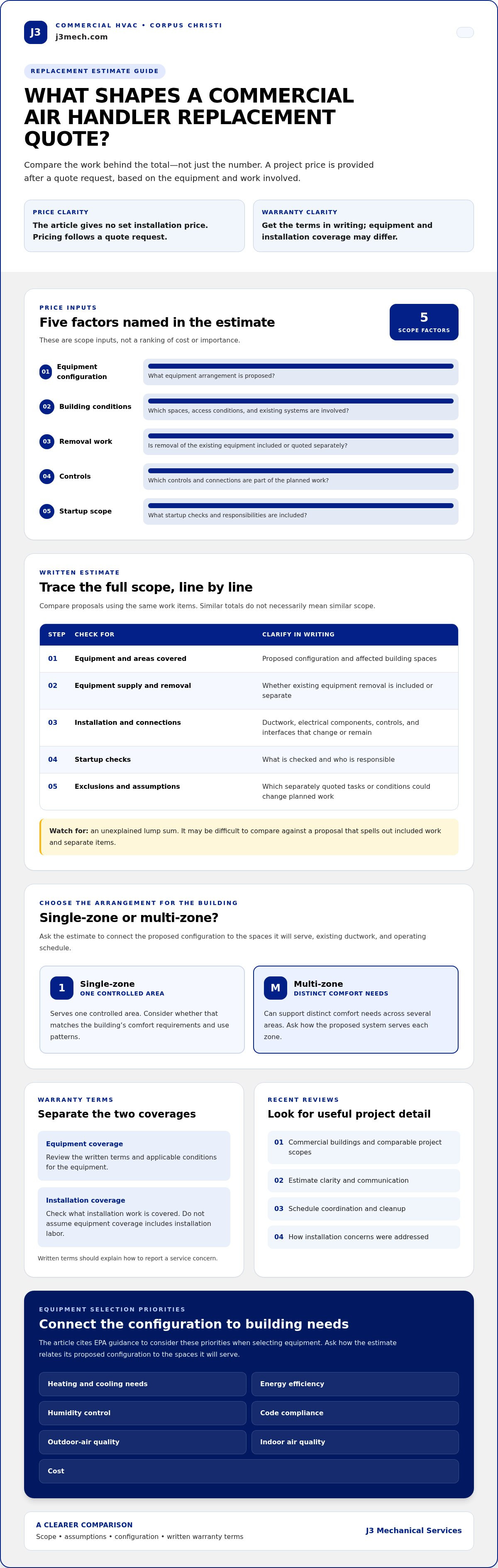
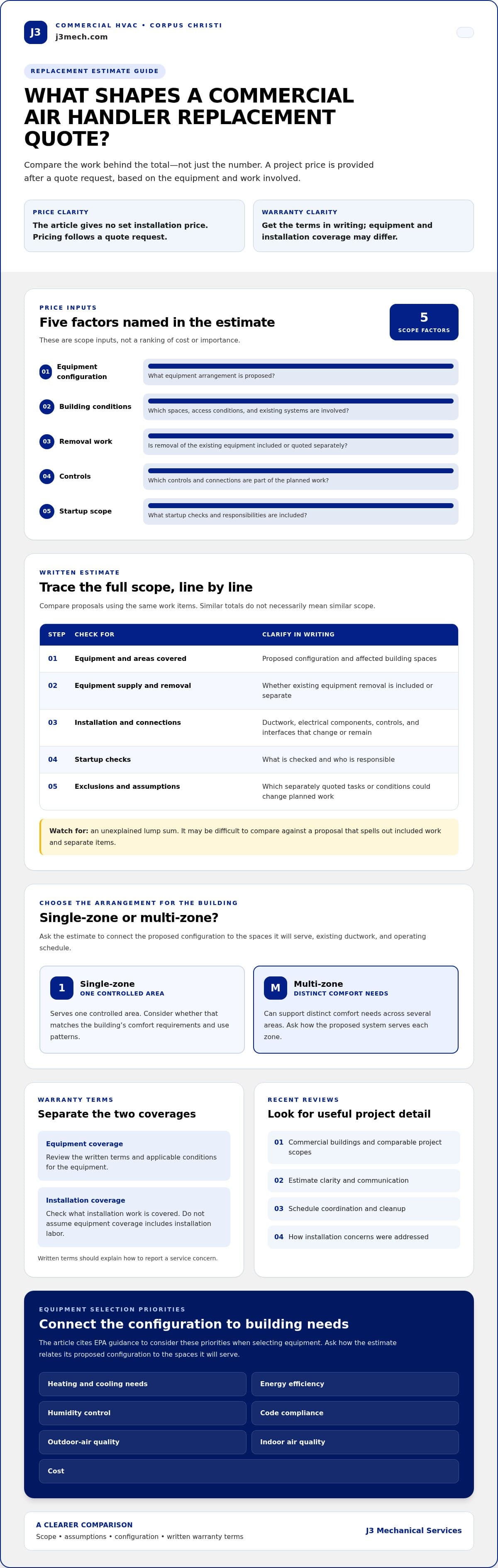
For commercial air handler replacement in Corpus Christi, a written estimate should define the project before equipment is ordered. Compare the proposed configuration, affected building areas, removal work, startup checks, and separately quoted tasks. These details show whether estimates cover the same scope or merely have similar totals.
Start by identifying the equipment and spaces covered. A single-zone air handler serves one controlled area, while a multi-zone arrangement can support distinct comfort needs across several areas. The estimate should identify the proposed arrangement and explain how it relates to the building’s air conditioning requirements, existing ductwork, and operating schedule.
Then trace each work item. Look for equipment supply, removal of existing equipment, installation, connections, controls, and startup checks. If a task is quoted separately, make sure it is named clearly. For example, one proposal may include old equipment removal while another lists it separately, changing the scope even if both describe a replacement.
Ask the contractor to present project pricing after a quote request, based on the equipment, building conditions, removal requirements, controls, and startup scope. A complete written estimate should also identify exclusions and assumptions, so building managers can see what could change the planned work. Avoid treating an unexplained lump sum as a complete comparison.
Review warranty language separately from the equipment scope. The estimate or attached terms should distinguish equipment coverage from installation coverage, state applicable conditions, and explain how to report a service concern. Do not assume an equipment warranty covers installation labor. The written terms establish what protection applies to each part of the project.
Recent reviews can add context, but focus on details relevant to commercial work rather than star ratings alone. Look for specific descriptions of communication, schedule coordination, cleanup, and how installation issues were addressed. A review that describes a documented startup process is more useful than a brief statement that the service was good.
- Compare whether reviews describe commercial buildings and similar project scopes.
- Note repeated comments about estimate clarity and communication.
- Check whether reviewers explain how concerns were resolved.
Finally, assess the proposed equipment against building performance priorities. The U.S. Environmental Protection Agency says equipment selection should account for heating and cooling needs, energy efficiency, humidity control, code compliance, outdoor-air quality, indoor air quality, and cost. Ask the estimate to connect its configuration to those priorities and the spaces it will serve.
Review scope, assumptions, warranty terms, and relevant feedback together. This helps clarify what the contractor will install, what the building receives at startup, and which written terms govern the completed work.
Commercial air handler replacement contractors in Corpus Christi, TX
For commercial air handler replacement in Corpus Christi, assess the contractor’s planning process alongside the proposed equipment. A commercial building may have separate zones, different operating hours, and specialized ventilation demands. The replacement plan should account for those conditions rather than treat every air handler as interchangeable. Ask how the proposed system will serve the spaces and connect with existing ductwork and controls.
Begin with a site assessment that records the existing equipment, access constraints, and affected areas. An air handler above a busy corridor, for example, may require different staging from one in a dedicated mechanical room. The contractor should identify how equipment will enter and leave the building, where work areas will be set up, and how staff or tenants may be affected. These details help shape a workable sequence before installation starts.
Review technical coordination before comparing proposals. Replacement may involve connections to existing ductwork, electrical components, controls, and other mechanical equipment. Ask which interfaces will remain and which will change. A clear explanation helps facilities teams anticipate dependencies, plan building access, and coordinate with operations. It also distinguishes a direct equipment swap from work that requires broader system adjustments. For building managers navigating multi-trade or mechanical considerations, comprehensive service providers like All Types Plumbing, Heating & Air Conditioning LLC highlight the value of coordinating related utility and environmental systems smoothly.
Texas directs consumers to the Texas Department of Licensing and Regulation for contractor license searches by license number, business name, or address. Use the department’s lookup process to identify the contractor’s record. Then compare the written scope and project approach using the same criteria for each estimate:
- Confirm which air handlers, zones, and building areas the proposal covers.
- Review equipment removal, installation, and startup responsibilities.
- Identify controls, connections, or other work listed separately.
- Check whether the proposed schedule addresses building operations.
- Read installation warranty terms separately from equipment coverage.
Recent reviews can help reveal how a contractor communicates during commercial work. Look for examples describing access coordination, schedule updates, and resolution of installation concerns. A detailed account of work at a commercial facility gives more relevant context than a short, general rating. Compare recurring themes across reviews, then consider whether the written proposal reflects the same clarity.
For a building with several zones, ask how the contractor will address the intended comfort levels in each area. A proposal should explain the configuration and work interfaces in practical terms, not rely on equipment labels alone. This gives the facilities team a basis for assessing technical fit and operational coordination before approving the project.
When replacement planning is the next step, review the scope of commercial HVAC installation and replacement alongside your building’s operating requirements. A defined project scope gives the facilities team a more useful basis for scheduling and coordination.
What factors affect the cost of replacing a commercial air handler?
Project pricing depends on scope and is provided after a quote request. For commercial air handler replacement in Corpus Christi, key factors include building conditions, equipment configuration, access, controls, removal, and startup work. Two facilities with similar floor areas may still need different equipment and installation tasks. A site assessment connects these conditions to the proposed scope and clarifies what the estimate covers.
Building size, insulation, and usage patterns influence replacement recommendations, according to Mathews CCAC. A facility with changing occupancy may need a different zoning approach from one operating on a consistent schedule. Existing ductwork and controls also affect integration. Restricted access, such as equipment above an active work area, can add handling and coordination requirements to the installation plan.
Configuration affects equipment selection and project scope. A single-zone system serves one controlled area, while commercial ducted split systems can use multiple indoor air handlers for zone-specific comfort. A multi-zone arrangement may involve more connections and coordination across separate spaces. For commercial air handler replacement in Corpus Christi, the estimate should identify the proposed configuration and the building areas it will serve.
Equipment features and system interfaces also shape the work. Smart controls may require integration, while changes to duct connections can extend the project beyond a direct equipment exchange. The U.S. Environmental Protection Agency says equipment selection should account for heating and cooling needs, energy efficiency, humidity control, code compliance, outdoor-air quality, indoor air quality, and cost. These criteria help frame an appropriate configuration.
- Equipment: Compare the proposed configuration with the areas it will serve.
- Access: Consider equipment location, removal route, and work-area constraints.
- Integration: Review controls, duct connections, and related system interfaces.
- Scope: Identify removal, startup checks, and separately quoted work.
Use these factors to compare estimates on an equivalent basis. A proposal that includes equipment removal and startup checks differs from one that excludes them. Likewise, a multi-zone installation may require different equipment and coordination from a single-zone project. Separate the core replacement scope from optional or separately quoted work, then assess what each proposal includes.
Consider whether the proposed equipment addresses the building’s performance priorities. The configuration should account for humidity, indoor air quality, and operating patterns alongside heating and cooling demand. A well-defined replacement scope links equipment selection, facility conditions, and installation tasks, giving decision-makers a practical basis for evaluating the proposal.
Commercial air handler replacement versus repair: when is replacement worthwhile?
Choose between repair and replacement by considering equipment condition, operating history, and building requirements. A repair may address an identified fault, while replacement may suit equipment with recurring problems or limitations. For commercial air handler replacement in Corpus Christi, base the decision on how the unit serves occupied spaces and supports daily operations, not on one symptom alone.
Age provides useful context, but it does not determine the decision by itself. The U.S. Environmental Protection Agency suggests considering replacement when heating and cooling equipment is more than 10 years old. Compare that guidance with maintenance records, repair history, and current performance. An older unit operating consistently presents a different situation from equipment that repeatedly disrupts comfort or fails to meet building demand.
Start with a documented diagnosis. Record the affected equipment, identified fault, and whether symptoms occur in one zone or across several areas. Uneven temperatures in one office, for example, may indicate a localized issue, while reduced airflow across multiple zones could point to a broader system concern. Note when the problem occurs and whether it returns after earlier work.
Repair may be appropriate when a specific fault is identified and the rest of the system meets the building’s needs. Consider replacement when recurring failures, changes in building use, or equipment limitations affect ongoing operations. For commercial air handler replacement in Corpus Christi, compare the proposed scope with the diagnosed issue, including related connections, controls, removal, and startup work.
- Review operating history: Organize maintenance records and repair notes by equipment.
- Map symptoms: Identify affected rooms, zones, and operating periods.
- Assess system fit: Compare current operation with the building’s heating and cooling requirements.
- Compare options: Distinguish a targeted repair from equipment replacement and associated work.
- Consider continuity: Account for how each option affects facility operations during the work.
In a multi-zone facility, a problem with one air handler may affect selected spaces while other equipment remains operational. Record which areas are affected and how they are used. This helps clarify whether the decision concerns one unit or a wider system, and gives facilities teams a practical way to plan around disruption.
Use the diagnosis to establish what failed, what a repair would address, and whether the existing unit can continue meeting facility needs. If replacement is proposed, make sure its scope addresses the identified problem. A clear comparison supports a considered repair-or-replacement decision without treating every recurring symptom as an isolated fault.
Commercial air handler replacement process and project timeline
Commercial air handler installation in Corpus Christi typically takes 1-3 days, depending on business size. That window covers installation, while project planning and equipment coordination occur beforehand. A facility with one accessible unit may require a different sequence from a building with several zones. Confirm how the proposed schedule accounts for equipment access, affected areas, and building operations.
The process starts with a site assessment. The contractor records the existing air handler, connected ductwork, controls, and access route. Facilities staff can identify restricted areas, operating hours, and spaces that need uninterrupted service. A unit above an occupied work area, for example, may require different staging from equipment in a dedicated mechanical room. These details shape the work plan.
Next, coordinate the replacement scope and equipment. The selected configuration should match the areas served and existing system interfaces. Align the equipment delivery and removal plan with building access before installation. Confirm where materials can be staged, how crews will reach the unit, and which building areas may be affected during the work.
- Prepare the work area: Coordinate access, staging, and protection of nearby operations.
- Remove existing equipment: Follow the agreed route and scope for equipment removal.
- Install the replacement: Position the air handler and complete planned system connections.
- Perform startup checks: Review operation and confirm the system responds as intended.
- Complete handoff: Document the work and communicate relevant operating information.
During installation, communication helps facilities teams manage affected zones and staff expectations. A clearly sequenced plan identifies when work reaches each area and which activities could interrupt normal use. If the project includes multiple air handlers, define the work order so building representatives can coordinate access and operations across affected spaces.
Startup is a distinct project stage, not simply the final moment of installation. The contractor should complete the checks included in the agreed scope and communicate relevant observations. Facilities staff can then understand which areas were included in verification and what operating information belongs in maintenance records. Keep the estimate, warranty terms, and completion documentation together for future reference.
Before approving the schedule, compare its stages with the building’s operating needs and the equipment access plan. A clear timeline links preparation, removal, installation, startup, and handoff. Plan your commercial air handler replacement around the building’s access requirements and operating priorities.
J3 Mechanical Services: Commercial HVAC Installation & Replacement
J3 Mechanical Services provides Commercial HVAC Installation & Replacement for businesses planning an air handler project or broader system upgrade. Turn to this service when an existing unit no longer meets building requirements, or when replacement scope requires coordinated installation. A written project scope can align equipment selection, affected areas, removal, and startup checks with the facility’s operating needs.
For ongoing system support, Commercial HVAC Maintenance helps address scheduled care, while Commercial HVAC Repair responds to equipment problems. J3 Mechanical Services also offers 24/7 Emergency Service for urgent commercial HVAC needs. These options support different stages of a building’s equipment lifecycle, from replacement planning through continued operation.
To discuss a commercial HVAC installation or replacement project, contact J3 Mechanical Services.
Move Your Replacement Plan Forward
The next step is to turn your building’s operating priorities into a defined project plan. For commercial air handler replacement in Corpus Christi, keep the decision grounded in how the equipment must serve your facility, how work can be coordinated, and what outcomes the project needs to support. A clear starting point helps align facilities staff and project teams before installation begins.
J3 Mechanical Services offers Commercial HVAC Installation & Replacement, along with Commercial HVAC Maintenance and Commercial HVAC Repair. Those services can support different needs, whether you are planning a replacement, maintaining equipment already in operation, or addressing a system issue. Bringing the project requirements into the conversation can help establish a practical direction for the work.
Prepare a concise overview of the affected areas, current equipment concerns, operating priorities, and desired project scope. Then contact J3 Mechanical Services today to discuss your commercial HVAC needs. A considered plan is a sound foundation for the next stage of your building’s system lifecycle.
Frequently Asked Questions
Do you offer warranties on installations?
Written project terms determine whether installation labor has warranty coverage and what that coverage includes. Installation coverage is separate from an equipment manufacturer’s warranty, so review both documents for duration, exclusions, and how to report a concern. Keep the applicable terms with the project records. This distinction helps clarify whether a future issue relates to the equipment or the installation work.
How much does commercial air handler replacement cost in Corpus Christi?
Project cost depends on scope, and pricing is provided after a quote request rather than as a fixed published amount. Key factors include air handler configuration, building access, existing duct and control connections, equipment removal, procurement, schedule, and startup requirements. For a useful estimate, describe the affected areas and operating constraints. Compare proposals with equivalent scope, separating optional or excluded work so each total is clear.
How do I choose the right size and capacity for a replacement commercial air handler?
Choose capacity based on the building’s actual heating and cooling demands, not floor area alone. The U.S. Environmental Protection Agency says equipment selection should also account for energy efficiency, humidity control, code compliance, outdoor-air quality, indoor air quality, and cost. Provide occupancy patterns, operating hours, comfort concerns, and floor plans. A meeting area with variable occupancy, for example, may have different needs from offices used consistently.
How do I get quotes for commercial air handler replacement in Corpus Christi?
Prepare a consistent project brief and request two or three written quotes for comparison. Include the facility address, affected zones, equipment details, operating schedule, access constraints, and known comfort or performance issues. Attach available floor plans and equipment records. Ask each proposal to identify its included work, exclusions, and assumptions. Matching the information supplied helps distinguish differences in scope from differences in equipment or project approach.
Common risks and issues during commercial air handler replacement
Access constraints, work near active areas, and coordination with existing ductwork, electrical components, controls, and other mechanical equipment can complicate replacement. The plan should also address building operations, equipment removal, and startup checks.
Energy-efficient commercial air handler options and potential utility rebates in Corpus Christi
Compare single-zone and multi-zone configurations, including systems with smart controls, and ask how the proposed equipment addresses energy efficiency and the building’s needs.
Need a hand with your building's HVAC?
Free quotes and honest answers from licensed commercial technicians across South Texas.