
Cost to replace a 10-ton commercial AC unit in Texas
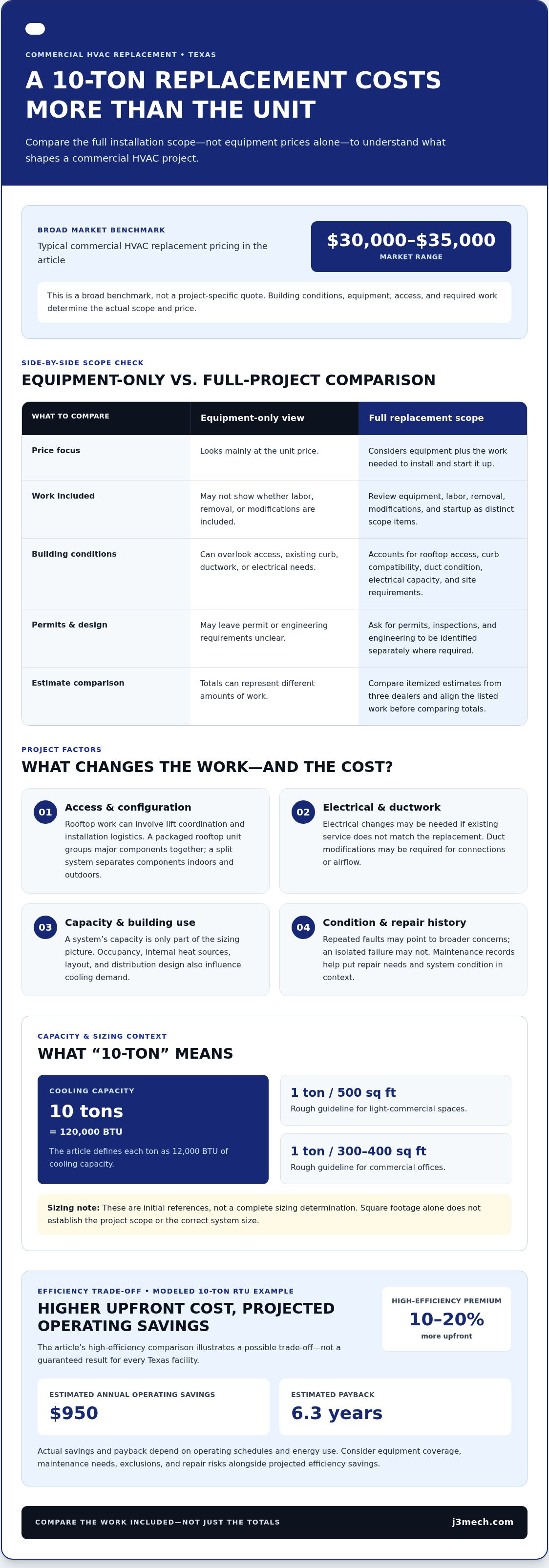
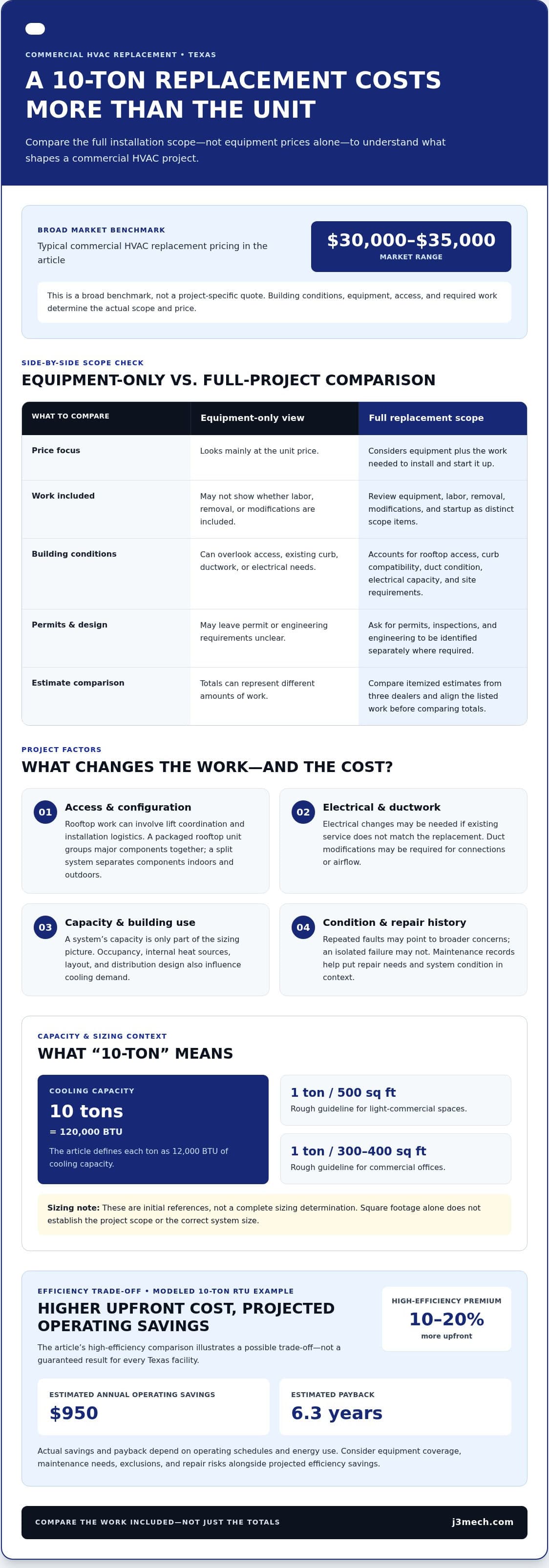
The cost to replace a 10-ton commercial AC unit in Texas depends on more than the equipment: the typical market range for commercial HVAC replacement is $30,000 to $35,000. That is a broad market benchmark, not a project-specific price; rooftop access, existing curb and ductwork, electrical needs, and equipment efficiency can all affect the scope. A project price depends on the building and work required, and is provided after a quote request.
It makes sense to want a clear budget before committing to a replacement, especially when the system serves a busy commercial space. But comparing equipment prices alone can leave out important installation requirements that influence the total project cost.
The total depends on the equipment, building conditions, and work required. This article explains the main cost drivers, how rooftop replacements differ from other configurations, and when an efficiency upgrade or replacement may be worth considering. Use these factors to assess the project’s costs and trade-offs.
Key Takeaways
- Compare the full replacement scope, not just equipment cost; site access, electrical work, curb compatibility, and ductwork can change the project.
- Assess efficiency upgrades against expected operating patterns and energy use to understand whether higher upfront costs may be worthwhile.
- Use the unit’s condition, repair history, and the scale of needed repairs to weigh continued maintenance against replacement.
- For rooftop units, account for lifting logistics and installation requirements alongside the equipment configuration.
- Review efficiency ratings and installation staging together, since equipment selection and project coordination both affect long-term performance.
Is it worth it to pay more for a more energy-efficient HVAC system?
On the market, commercial HVAC replacement typically ranges from $30,000 to $35,000. That is a broad benchmark, not a project-specific price; equipment, access, electrical work, ductwork, and permits affect scope. A project price depends on the required work and is provided after a quote request. Businesses should also consider equipment coverage, maintenance needs, exclusions, and repair risks.
Commercial HVAC Pricing in Texas
Replacement pricing varies across Texas because every building has different installation conditions. Retail spaces, offices, and warehouses can have distinct duct layouts, electrical capacity, roof access, and operating needs. Compare estimates by the work included: equipment, labor, removal, modifications, and startup. This separates a straightforward unit swap from a project that requires significant building changes.
Efficiency Costs and Payback
Efficiency costs and payback compare an equipment premium with projected savings during operation. Higher-efficiency commercial HVAC equipment typically costs 10 to 20% more upfront. A 10-ton RTU example estimates annual operating savings of $950 and a 6.3-year payback for its high-efficiency option. The figures illustrate a modeled comparison, not a result for every Texas facility. Operating schedules and energy use shape the decision.
Permits and Upgrade Costs
Permits and building upgrades can add requirements beyond delivering and placing the equipment. Electrical changes may be needed if existing service does not match the replacement unit, while duct modifications may be required for connections or airflow. Permit requirements depend on local rules and project scope. Ask that electrical work, duct changes, permits, and inspections appear as distinct estimate categories so you can see how each affects the project.
Central and Rooftop System Costs
Central air conditioner replacement costs differ by system configuration and installation requirements. A packaged rooftop unit places major components together, while a split system separates components within the building and outdoors. That distinction changes connections, access planning, and labor. For a 10-ton facility, square footage alone does not establish the complete scope; existing equipment, duct layout, and electrical capacity also matter.
Warranty, Maintenance, and Repair Exposure
Warranty and maintenance terms affect ownership risk after installation. Review what equipment and labor are covered, what maintenance is required, and which exclusions apply. Repair records add context: repeated faults may signal broader system concerns, while an isolated failure may not. Documented maintenance and service history help owners assess whether continued repairs suit the system’s condition and facility needs.
What determines HVAC system replacement cost?
The cost of replacing a 10-ton commercial AC unit depends on its configuration, efficiency, access, and required building work. A replacement proceeds through assessment, equipment selection, removal, installation, connections, and startup; site conditions and project scope shape the schedule.
Quotes and Cost Comparisons
Commercial HVAC quotes describe the equipment and work included in a replacement estimate, so comparing scope matters as much as comparing totals. Market guidance recommends reviewing itemized estimates from three dealers and identifying equipment, labor, ductwork, permits, and engineering as separate categories. One estimate may cover a straightforward replacement, while another includes building modifications. Aligning the listed work helps reveal what each proposed total represents.
Capacity and Replacement Pricing
HVAC capacity is measured in tons, with each ton representing 12,000 BTU of cooling capacity. A 10-ton system therefore provides 120,000 BTU. Replacement pricing reflects more than capacity: efficiency, system type, site access, electrical work, duct condition, and local permit requirements can all influence the work involved. A properly sized system must suit the building’s cooling demand, rather than simply match the old unit’s label.
Square footage offers an initial reference, not a complete sizing determination. A rough guideline for light-commercial spaces is one ton per 500 square feet; commercial offices may require one ton per 300-400 square feet. Those estimates differ because building use and layout affect cooling loads. Occupancy, internal heat sources, and distribution design also help determine the system requirements and the installation scope.
Planning the Replacement
Planning coordinates equipment selection, site readiness, removal, installation, and startup to limit disruption to building operations. Start by assessing the existing system and connections, then define equipment and access needs. The work may proceed through site preparation, removal, placement, connection, and operational testing. A rooftop project may require lift coordination; an indoor installation can involve different access and staging needs.
Project timing depends on access, equipment delivery, existing connections, and installation complexity. A clear plan identifies the work phases and how building operations may be affected. For Texas facilities, evaluate the actual site and proposed scope rather than relying on a timeline from a different project or location.
Coordinated commercial HVAC replacement planning brings equipment requirements and installation sequencing into the same project discussion.
Lifespan and Financing Options
Typical system lifespan helps owners weigh replacement timing against continued repairs. Commercial HVAC systems typically last 15-25 years when regularly maintained, while commercial RTUs in North Texas typically last 12-15 years in practice. These figures provide context, but maintenance records and observed condition help explain how an individual unit is performing.
Incentives can also inform the investment comparison. Financing may spread project payments over time. Rebate eligibility, financing terms, and equipment qualifications all affect the financial evaluation.
Repair-versus-replacement rule of thumb
Repair-versus-replacement decisions depend on repair scope, equipment condition, and the operational consequences of continued faults. No single threshold fits every commercial building, so owners can use several financial comparisons alongside an assessment of the unit. Consider whether a fault is isolated or reflects declining performance across cooling, heating, controls, or ductwork. These factors inform the decision, but no single calculation serves as a complete diagnosis.
One rule suggests considering replacement when a repair exceeds 40% of the cost of a commercial HVAC unit. Another recommends replacement when AC repair costs exceed 50% of the cost of a new AC unit. These are separate comparison points, not interchangeable formulas. The first compares repair expense with a commercial unit’s cost; the second measures it against a new AC unit’s cost.
The $5,000 rule offers another screen: multiply the equipment’s age by the estimated repair cost, then compare the result with $5,000. For example, a 10-year-old unit with a $600 repair estimate produces a $6,000 age-times-repair-cost total, exceeding the threshold. The calculation gives owners a quick financial reference, but does not account for every commercial concern, including business interruption or the condition of connected equipment.
Age provides important context. Replacement may be worth considering when an AC system is older than 10-15 years, because older systems are often less efficient and more prone to breakdowns. Commercial HVAC systems typically last 15-25 years when regularly maintained, so age alone does not determine remaining useful life. Maintenance records, observed performance, and the nature of recurring faults help clarify whether the equipment is approaching the end of practical service.
Before approving a repair, identify the cause of the failure and assess whether related components remain reliable. A refrigerant issue requires attention to its underlying cause, while restricted airflow may involve ductwork rather than the unit itself. Review service records, maintenance history, and performance in heating and cooling modes. If the repair addresses a distinct failure, continued operation may be reasonable; recurring problems can point to broader system deterioration.
Replacement becomes more compelling when an expensive repair coincides with recurring breakdowns, declining performance, or an aging system. Compare the repair estimate with the replacement scope, expected operating demands, and the potential consequences of downtime. The 40% threshold, 50% comparison, and $5,000 calculation each measure a different factor, so owners should interpret them alongside equipment condition and maintenance history. That combined assessment supports a decision grounded in the system’s actual role and operating needs.
Commercial rooftop unit pricing
On the market, commercial HVAC replacement typically ranges from $30,000 to $35,000. That is a broad market range, not a price assigned to every 10-ton rooftop unit. Equipment configuration, installation scope, roof access, and electrical requirements all affect the final project total.
By equipment type, rooftop and split-system replacements differ in configuration and installation requirements, so their project costs vary. The available market range applies to commercial HVAC replacement overall, rather than a specific equipment type. A 10-ton rooftop unit and a split system serving comparable space can require different installation work.
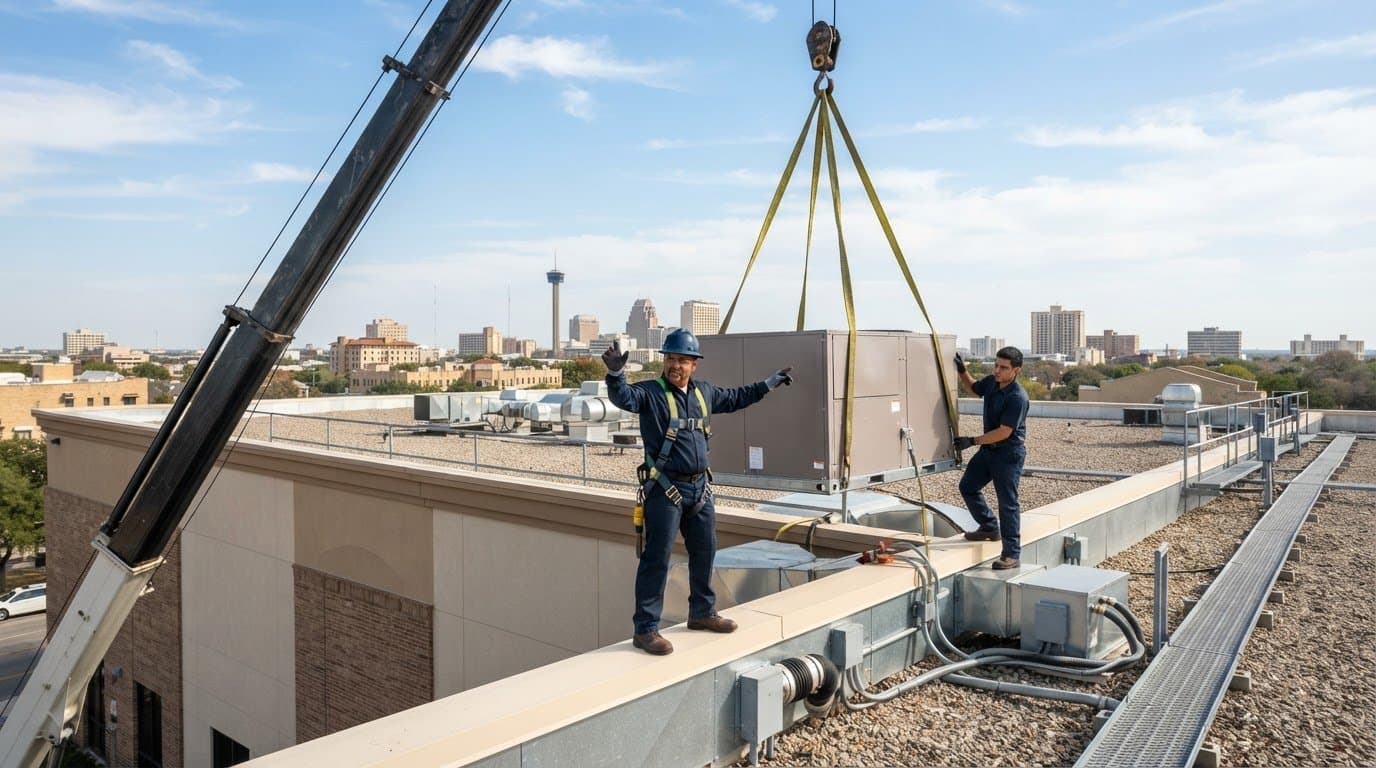
Crane rental, labor, and removal of the old unit affect the installed total, with costs shaped by site conditions and project scope. A rooftop unit may require lifting equipment, while difficult access can call for additional coordination. The existing unit must also be disconnected and cleared before the replacement can be positioned.
For a rooftop replacement, access is a major planning factor. Building height, crane position, roof obstacles, and the placement path shape the lifting plan. A clear staging area can simplify coordination, while restricted access may add logistical work. The unit’s weight and dimensions also affect lift preparation.
Installation labor involves more than placing the new equipment. Technicians coordinate removal, connections, startup, and operational checks. Existing electrical service, controls, and duct transitions may need attention during replacement. If an adapter curb is needed to align the new unit with the existing roof opening, that work forms part of the installation scope.
Efficiency upgrades can influence equipment selection and operating priorities. A higher-efficiency system may cost more upfront, and its value depends on the building’s cooling schedule and expected energy use. Compare the unit’s rating and operating requirements with the facility’s actual use. Savings depend on how the system operates, not just its label.
Electrical requirements deserve a separate review because replacement equipment may connect differently from the old unit. Existing circuits, disconnects, and panel capacity affect the work plan. Duct transitions matter too: a unit that does not match existing connections may require modifications. These conditions explain why two nominally similar 10-ton projects can have different installation scopes.
To interpret a quote, separate the equipment choice from rooftop logistics, electrical work, removal, and startup. Then compare what each estimate includes, rather than treating the lowest total as an equivalent scope. For a 10-ton replacement, that breakdown shows whether crane coordination, curb adaptation, and system checks are included or treated as separate project items.
Efficiency ratings and equipment staging
An efficiency rating helps compare a system’s cooling output with its energy use. For a commercial replacement, consider the rating alongside the building’s operating schedule, required capacity, and equipment cost. A higher rating may require more upfront investment, so weigh potential operating savings against how long the building will use the system.
Commercial HVAC equipment with higher efficiency ratings typically costs 10 to 20% more upfront. The example estimates $950 in annual operating savings and a 6.3-year payback period. These figures illustrate how an efficiency premium can be assessed against projected use.
Efficiency alone does not determine comfort. Capacity, controls, airflow, and building use also affect how consistently a system handles cooling demand. A high rating cannot make up for an unsuitable system configuration or poorly coordinated installation. Compare the proposed equipment’s capacity and rating together, then consider whether expected savings fit the facility’s operating patterns.
For Texas in 2026, the stated minimum SEER rating for new systems is 15. SEER and SEER2 are different rating labels, so compare like with like when reviewing equipment information. The Frisco example uses SEER2 ratings, 14 and 17. Avoid treating those figures as directly interchangeable with the separate SEER minimum.
Equipment staging coordinates delivery, placement, and installation so units and materials are ready in the right sequence. For a rooftop replacement, plan for site access, lifting arrangements, connection requirements, and effects on indoor operations. Clear sequencing helps avoid preventable delays and aligns equipment selection with practical site constraints.
Variable operating demands can influence whether an efficiency upgrade is valuable. A facility with long cooling schedules may benefit differently from one with limited operating hours; compare expected use with the premium and projected savings. The Frisco example’s 6.3-year payback provides a comparison point, not a universal result. Review the equipment rating, capacity, schedule, and projected operating costs as one decision.
Use this comparison to clarify equipment selection and project staging before replacement proceeds. Plan an efficiency-focused commercial HVAC replacement with equipment requirements and installation coordination considered together.
J3 Mechanical Services: Commercial HVAC Installation & Replacement
J3 Mechanical Services provides Commercial HVAC Installation & Replacement for Texas businesses evaluating an aging or underperforming system. When replacement is being considered, a coordinated project can address equipment selection, installation requirements, and the building’s operating needs. If a system may remain serviceable, Commercial HVAC Repair or Commercial HVAC Maintenance can support a repair-first approach and ongoing upkeep.
Use these cost factors to define the project scope, then consider how the system serves your facility and what issues it is experiencing. That context helps shape the next step, whether you need replacement, maintenance, or repair.
Contact J3 Mechanical Services to discuss your commercial HVAC needs.
Move From Cost Estimate to Project Decision
Use your replacement evaluation to establish a clear decision path: document the system’s performance, identify operational priorities, and define what a successful project must deliver. This gives your team a practical basis for aligning the next investment with facility needs, rather than treating equipment selection as an isolated purchase. The cost to replace a 10-ton commercial AC unit in Texas is only one part of that decision; continuity, reliability, and the building’s longer-term operating plan matter too.
J3 Mechanical Services supports commercial HVAC Installation & Replacement, Maintenance, and Repair, giving businesses a path to discuss replacement planning or continued system care. If you are ready to consider the options for your facility, contact J3 Mechanical Services to start a conversation about your commercial HVAC needs.
A considered next step can help your team move forward with a clearer project direction and stronger alignment with building operations.
Frequently Asked Questions
How much does an AC unit cost?
A broad market benchmark for commercial HVAC replacement is $30,000 to $35,000. This aggregate range is not a quote for a particular building or equipment configuration. The final scope can differ based on the system type, installation requirements, building access, and necessary modifications. For a useful budget comparison, separate equipment selection from site work and other project components, rather than treating the benchmark as a fixed price.
New Commercial HVAC vs Repair: Which Makes More Sense?
Replacement may make more sense when system condition, recurring failures, and operational impact outweigh the value of another repair. Repair may suit an isolated fault if the rest of the equipment remains serviceable. Compare a repair plan with the consequences of another interruption, especially for temperature-sensitive operations. Maintenance records and the cause of each breakdown help distinguish a one-time issue from broader deterioration.
What Factors Affect Commercial HVAC Costs?
Commercial HVAC costs reflect building requirements and the complexity of integrating replacement equipment. System configuration, capacity, efficiency selection, roof or indoor access, electrical compatibility, ductwork, controls, and project coordination can all affect scope. An occupied facility with restricted installation access, for example, may require a different work sequence from an open site. Itemized estimates make these differences easier to evaluate.
How do rooftop unit replacement costs vary across Texas cities?
Rooftop replacement costs depend on equipment, installation scope, roof access, and local project requirements, not just the city. Relevant Texas locations include San Antonio, Selma, Seguin, Austin, Corpus Christi, Killeen, Joshua, Bandera, Beorne, New Braunfels, Edinburg, Mccallen, Rio Grand Valley, Rockport, Pleasanton, San Marcos, and Round Rock. Exact coverage and availability must be confirmed for every request. Local access and permitting conditions also shape project scope.
What is the cost difference between standard-efficiency and high-efficiency 10-ton commercial AC units?
Higher-efficiency commercial HVAC equipment typically costs 10 to 20% more upfront than standard-efficiency equipment. The trade-off is whether projected operating savings justify that premium for the facility’s usage pattern. A building with extended cooling schedules evaluates the difference differently from one with limited operation. Compare ratings using the same measurement standard, then consider operating hours and expected energy use when assessing the added investment.
What permits and commercial HVAC code requirements apply to AC replacement in Texas?
Permit requirements depend on the local jurisdiction and the replacement work involved, so project scope can include permits, inspections, or compliance updates. Refrigerant rules also affect equipment selection: according to the U.S. Environmental Protection Agency, new air conditioning equipment must use refrigerants with a global warming potential below 700 starting January 1, 2025. The equipment and installation plan should account for applicable requirements as part of project planning.
Are rebates or tax incentives available for commercial HVAC replacement in Texas?
Federal tax credits of up to 30% are listed for qualifying high-efficiency commercial HVAC systems. Eligibility and program terms affect the project’s net financial impact, so include applicable incentives in the investment comparison rather than treating them as an automatic reduction. Equipment qualification and project circumstances determine how incentives apply.
How much do labor, crane, and old-unit removal add to commercial AC replacement cost?
Need a hand with your building's HVAC?
Free quotes and honest answers from licensed commercial technicians across South Texas.