
Government Building HVAC Contractors in San Antonio by Work Type
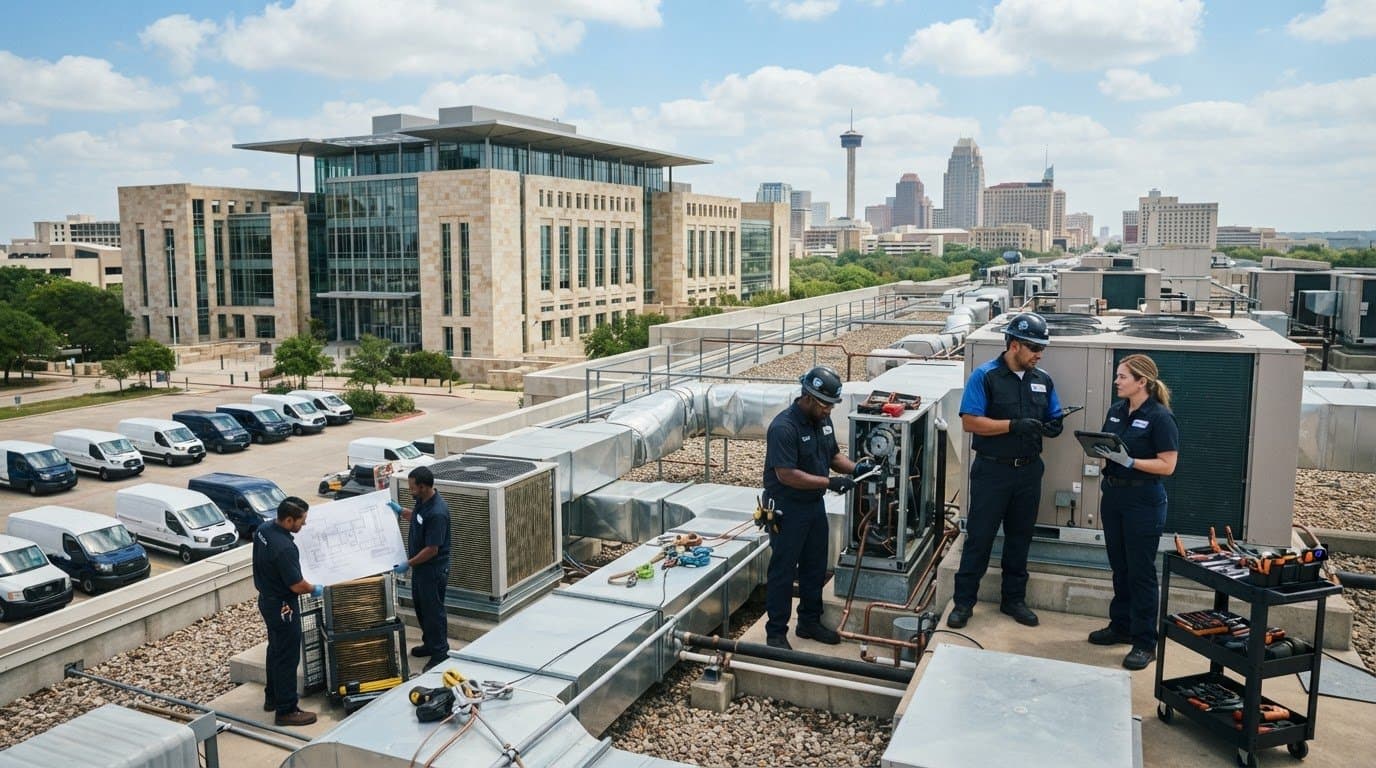
Public-sector HVAC work is defined by the required work type and service arrangement, not by a single contractor label. A government building HVAC contractor in San Antonio may be sought for specific project work or for citywide on-call service; the City of San Antonio issued solicitation 6100017563 for on-call HVAC services citywide on January 12, 2024, with submissions due February 28, 2024, at 11:00 a.m. Central Time. That deadline has passed, so the solicitation is a useful example of how the city has structured this work, not an open opportunity.
It is reasonable to expect a clear path through a market that includes repairs, maintenance, replacements, new construction, and on-call response. Start by separating the work needed from the procurement route, then identify the contractor qualifications and project requirements that apply.
This guide explains how to sort San Antonio government HVAC work by scope, what citywide on-call service means, and how Texas licensing and San Antonio registration, insurance, and security considerations shape project readiness. It also explains where commercial HVAC services fit when a public facility needs installation, maintenance, repair, or replacement.
Key Takeaways
- Match the procurement route to the work scope, and distinguish a defined project from a citywide on-call arrangement.
- Assess contractor readiness through Texas licensing and San Antonio registration requirements, including the applicable continuing-education obligation.
- Separate immediate repairs from preventive maintenance, equipment replacement, and new construction so the service approach fits the facility’s needs.
- Account for insurance, bonding, and site-security conditions as project requirements that can affect contractor readiness and access.
- Include energy performance and applicable building-code coordination in planning, design, and execution rather than treating them as final-stage checks.
City contractor search by work type
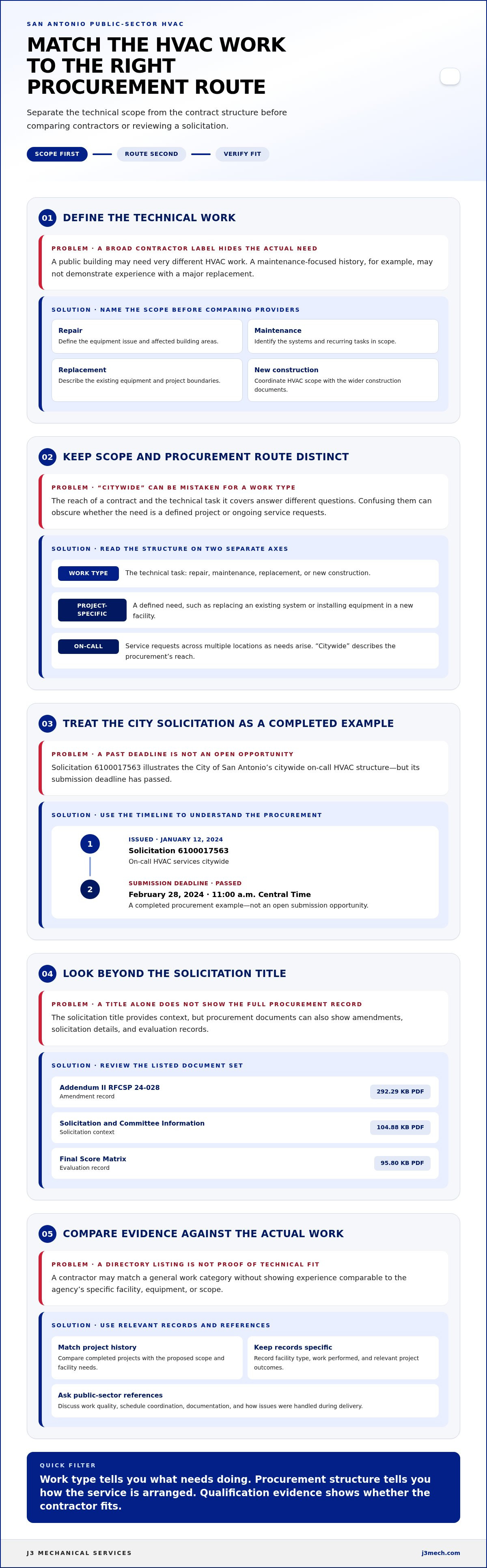
Start with the work scope, not a broad contractor label. A government building may need corrective repair, scheduled maintenance, equipment replacement, or HVAC work for new construction. Each category has a different scope, schedule, and procurement need. When choosing a government building HVAC contractor in San Antonio, distinguish project-specific work from citywide on-call service. That distinction separates a defined project from ongoing service requests.
A project-specific solicitation describes a defined need, such as replacing an existing system or installing equipment in a new facility. An on-call arrangement covers service requests across multiple locations as needs arise. Citywide coverage describes the reach of the procurement, while work type describes the technical task. Keeping these terms separate helps an agency identify the opportunity or contract structure that matches its building requirements.
The City of San Antonio issued solicitation 6100017563 for on-call HVAC services citywide on January 12, 2024. The submission deadline was February 28, 2024, at 11:00 a.m. Central Time. That deadline has passed, so the solicitation serves as a concrete example of the city’s procurement approach, not an open submission opportunity. Its title also illustrates why agencies should distinguish broad on-call service from a single facility project.
Procurement documents provide detail beyond the solicitation title. The City of San Antonio lists Addendum II RFCSP 24-028 as a 292.29 KB PDF. It also lists a Solicitation and Committee Information document as a 104.88 KB PDF, and a Final Score Matrix as a 95.80 KB PDF. Together, those document names show how an agency can examine amendments, solicitation context, and evaluation records when reviewing a completed procurement.
A directory can help organize contractor research by work category, facility, and documented project history. Use it as a comparison tool, then match each entry to the agency’s actual scope. For example, a maintenance-focused listing may not demonstrate experience with a major replacement. Keep records aligned with the procurement requirements, including facility type, work performed, and relevant project outcomes.
- Repair: Define the equipment issue and affected building areas.
- Maintenance: Identify the systems and recurring tasks within the requested scope.
- Replacement: Describe the existing equipment and intended project boundaries.
- New construction: Coordinate HVAC scope with the wider construction documents.
To review references and past performance, compare completed projects with the agency’s proposed scope, then contact listed public-sector references directly. Ask about work quality, schedule coordination, documentation, and how the contractor handled issues during delivery.
Finally, separate procurement eligibility from technical fit. A contractor may match the work category but still need to meet solicitation-specific requirements. The solicitation number, addenda, submission deadline, and evaluation documents provide a practical starting point for understanding how the City of San Antonio organized its citywide on-call HVAC search.
What certifications and licenses are required for government HVAC contractors in Texas?
Texas licensing and San Antonio registration are separate checks for public HVAC work. A state license establishes the contractor’s licensing class, while city registration is required for local mechanical permitting. Agencies should assess both against the work scope before comparing qualifications. A contractor’s license class can affect whether the license covers the system involved.
Texas Class B HVAC contractors are limited to systems with up to 25 tons of cooling and 1.5M BTU/hr of heating capacity. That distinction matters when a government building’s equipment exceeds either limit. Match the proposed work to the system capacity and license class, rather than relying only on a general contractor description.
Experience is another part of the state licensing pathway. Texas HVAC contractor applicants need 48 months of supervised practical experience documented within the preceding 72 months. For an agency reviewing qualifications, this requirement makes documented experience relevant to license eligibility. The project record should also demonstrate work comparable to the public facility’s equipment and scope.
Continuing education remains part of license renewal. According to the Texas Department of Licensing and Regulation, Texas Class A and Class B HVAC contractors must complete 8 hours of continuing education each annual renewal cycle, including at least 1 hour on Texas law. This requirement connects technical practice with state legal instruction. It also gives agencies a concrete renewal-related qualification to consider.
San Antonio requires a local registration step before mechanical permitting. Mechanical contractors must register their TDLR state license with the city before pulling HVAC or mechanical permits. The city registration process also requires a background check through the San Antonio Police Department. These steps distinguish state licensing from local authorization for permitted work.
The city’s contractor categories add readiness criteria. Registered Contractor status may involve requirements for a contractor’s technicians. Companies in this category must also hold current registration with both the City of San Antonio and the state department. Company and technician requirements are separate checks.
Higher registration categories include additional experience and training criteria. Registered Contractor Plus requires at least three years of registration with the Development Services Department. Premier Contractor status requires at least five years of that registration. These categories can help agencies understand a firm’s municipal registration history, but they do not replace matching the license class to the system or reviewing project-specific requirements.
For a practical review, organize qualifications by level: state contractor license, technician registration, and San Antonio company registration. Then compare the license class with the equipment capacity and confirm city registration before permit-dependent work. This sequence gives procurement teams a consistent basis for assessing eligibility and technical fit.
What HVAC services do government buildings typically require?
Government facilities need HVAC work suited to equipment condition, occupancy, and project scope. A courthouse with an intermittent cooling fault needs a different response from a planned system replacement. Start by separating immediate failures from recurring upkeep and capital work. This classification helps facility teams define the work, coordinate access, and set useful documentation requirements.
Preventive maintenance addresses deterioration before it becomes an operating interruption, though it cannot guarantee uptime or prevent every failure. A maintenance scope can identify filters, coils, belts, drains, controls, and airflow for inspection or service. The building team can use equipment records to prioritize recurring issues, such as a filter restriction or control fault. Written service records also help track what was inspected and what needs follow-up.
Repair work begins with identifying the fault and its effect on building operations. For example, a failed control component may affect one zone, while a mechanical failure can interrupt conditioning across a larger area. The response should document symptoms, diagnostic findings, corrective work, and remaining operational concerns. Government facilities that need immediate assistance can consider a provider with 24/7 Emergency Service.
Replacement is relevant when the agency’s project scope calls for removing existing equipment and installing new systems. Planning should account for equipment interfaces, access routes, service clearances, and connections to existing controls. A replacement plan should also identify affected spaces and how work will be coordinated around building operations. These details help the agency define project boundaries before fieldwork begins.
New construction requires HVAC coordination with the broader building design. Mechanical layouts must align with structural elements, electrical systems, controls, and architectural space. Building Information Modeling (BIM) can support this coordination by representing system components in a shared building model. Reviewing spatial conflicts before installation can clarify routing decisions and reduce uncertainty during construction.
- Maintenance: Set the assets and recurring inspection tasks within the facility’s scope.
- Repair: Record the fault, affected area, diagnostic result, and completed correction.
- Replacement: Define existing equipment, new system interfaces, and occupied-space impacts.
- New construction: Coordinate mechanical layouts with the project’s other building systems.
- Emergency response: Identify the building’s critical systems and the information needed to describe a failure.
Service priorities depend on each facility’s function. A public counter, records room, or operations area may have different occupancy patterns and continuity needs. Facility managers can map critical spaces, note the equipment serving them, and connect those assets to maintenance and response records. This gives procurement teams a clearer basis for separating routine work from urgent system failures.
For San Antonio public buildings, a useful service plan is more than a task list. It connects each work category to equipment, affected spaces, records, and coordination needs. That framework helps agencies describe requirements precisely, whether addressing a localized repair or planning HVAC systems for a larger construction project.
What insurance, bonding, and security requirements apply to government HVAC projects in San Antonio?
San Antonio contractor registration, solicitation terms, and facility access each shape project readiness. Review these requirements separately. Insurance addresses specified liability coverage, bonding supports obligations established by procurement documents, and security procedures govern worksite access. These checks are related, but one does not replace another.
For Registered Contractor Plus, San Antonio mechanical contractors must have liability insurance exceeding $300,000 per occurrence for Class A. The corresponding requirement for Class B is liability insurance exceeding $100,000 per occurrence. These thresholds apply to the city registration category described, so agencies should distinguish them from any coverage conditions stated in a particular solicitation.
For a procurement review, compare the contractor’s stated registration class with its insurance documentation. Then read the solicitation’s insurance provisions for required coverage types, limits, and submission timing. A Class A registration threshold does not, by itself, describe every insurance term that may apply to a specific project. The solicitation sets its own conditions.
Bonding is a separate procurement matter. The solicitation documents establish whether a bond is required and define its applicable terms. Review the instructions, agreement, and any addenda together, since those documents set the required submission and when it applies. For example, an agency evaluating an equipment replacement should distinguish a bid-stage bond requirement from obligations attached to later performance.
Security planning also depends on the building and work area. A contractor working in an occupied public facility may need coordinated entry, controlled access to mechanical rooms, and clear work-zone boundaries. The agency’s site procedures should explain how staff access is handled, which spaces are restricted, and how equipment or materials move through the building. These controls support orderly work without assuming one security rule applies to every facility.
- Insurance: Match liability documentation to the applicable registration category and solicitation terms.
- Bonding: Identify whether procurement documents require a bond and which stage it covers.
- Security: Define access procedures, restricted rooms, and work boundaries for the facility.
- Coordination: Align documentation review with the project schedule and agency approval process.
At a San Antonio courthouse, for example, planning can distinguish public corridors from mechanical spaces and identify how technicians reach the equipment. Procurement staff can then pair those site controls with the solicitation’s insurance and bonding provisions. This project-specific review is more useful than treating one registration threshold as a complete set of contract conditions.
A government agency can organize its readiness review around three records: registration and insurance documents, solicitation bonding terms, and facility access procedures. Keeping these items distinct helps staff identify which requirement applies to the contractor, which belongs to the procurement, and which is controlled by the building operations team.
What energy-efficiency and building-code requirements apply to HVAC work on Texas government buildings
Energy performance and code compliance are related but distinct project objectives. Efficiency concerns how system design and operation use energy; code coordination addresses applicable requirements for the building and scope. For a Texas government facility, the project documents and authority having jurisdiction guide the applicable review. Do not assume one checklist covers every building, equipment change, and construction project.
Begin with the project scope and existing system information. For a replacement, document the equipment being removed, the proposed system, controls, and affected zones. For new construction, coordinate HVAC layouts with structural, electrical, and architectural plans. This early review can reveal conflicts, such as duct routes crossing beams or equipment that needs access space.
Efficiency planning should consider the building’s operating patterns, occupied areas, existing controls, and equipment condition. A public counter with changing occupancy may have different control needs from a records room with steady conditions. Compare the proposed design with the facility’s documented operating needs, then record assumptions and design decisions. This gives reviewers a clear basis for evaluating the system’s intended operation.
Code review should be tied to the specific project, not generalized from another facility. Identify permit needs, applicable project documents, and the review authority before design decisions are fixed. In San Antonio, the Development Services Department provides mechanical contractor training, while the Building Official approves certain training or certification options for Registered Contractor Plus. Those program details do not replace project-specific code review.
For coordinated design, Building Information Modeling (BIM) can represent HVAC components alongside other building systems. A shared model can help project teams identify spatial clashes and resolve routing decisions before field installation. For example, reviewing a mechanical room model can expose a clearance conflict between equipment and a planned electrical route. BIM supports coordination but does not replace code review or required approvals.
- Existing buildings: Record equipment, controls, operating schedules, and affected spaces.
- Replacement work: Compare proposed equipment and interfaces with existing conditions.
- New construction: Coordinate HVAC layouts with structural, electrical, and architectural plans.
- Review records: Keep design assumptions, approvals, and project decisions organized.
At closeout, compile final system information, control settings, equipment documentation, and approved design changes. A complete record helps facility staff understand the installed configuration and supports future maintenance planning. If HVAC coordination is part of an upcoming project, coordinate HVAC plans using BIM to address system interfaces during design.
J3 Mechanical Services: Commercial HVAC Installation & Replacement
J3 Mechanical Services supports commercial facilities with installation and replacement work when existing equipment requires renewal or a project needs new HVAC systems. Its commercial HVAC maintenance and repair services also address ongoing system care and equipment faults, while 24/7 Emergency Service is available for urgent repair needs.
For a San Antonio government facility, the appropriate scope depends on the work required, procurement terms, and building conditions. Installation or replacement may fit a planned project; maintenance supports ongoing system needs, while repair addresses operational problems. These services provide a practical next step when the project aligns with commercial HVAC work.
To discuss commercial HVAC needs, contact J3 Mechanical Services or visit j3mech.com.
Move From Facility Priorities to a Defined HVAC Scope
Selecting a government building HVAC contractor in San Antonio is only one part of advancing a public facility project. The next step is to turn operational priorities into a clear scope that aligns the building’s needs, procurement conditions, and coordination requirements. A concise description of affected systems and intended outcomes gives the work a stronger foundation.
J3 Mechanical Services can support commercial facilities with HVAC installation and replacement, maintenance, and repair. These offerings address different stages of system operation, from planned equipment work to ongoing upkeep and corrective needs. The appropriate scope depends on the facility’s project requirements and the work being procured.
For public-sector teams, disciplined coordination helps carry decisions from planning into execution. When a commercial HVAC project aligns with these needs, contact J3 Mechanical Services to discuss the work. A clearly defined scope is a practical starting point for moving the facility’s HVAC plans forward.
Frequently Asked Questions
What is the HVAC contractor market like in San Antonio?
San Antonio’s public-building HVAC market includes distinct scopes such as repair, maintenance, replacement, and new construction. Agencies may procure a defined project or arrange on-call services for needs across facilities. For example, maintenance in an occupied office differs from a replacement project that requires design and construction coordination. Understanding that distinction helps agencies interpret procurement notices and match requirements to contractor capabilities.
Which San Antonio HVAC contractors hold federal, state, or local government contracts?
Current award records are the appropriate way to identify contractors holding government contracts; a directory or capability statement alone does not establish an award. Distinguish prime contractors named on an award from subcontractors performing part of the work. Also separate active agreements from completed awards, since past performance does not show whether a contract remains current. For a specific project, review the relevant agency’s award documentation and stated contract scope.
How can contractors find HVAC bids for San Antonio government buildings?
Contractors can monitor procurement notices issued by the agency buying the work, then review each solicitation and its amendments. Search by HVAC scope as well as terms such as mechanical services, maintenance, replacement, or construction. Track submission instructions, deadlines, required documents, and any addenda in one bid file. The City of San Antonio’s solicitation 6100017563 is an example of a citywide on-call HVAC procurement, though its submission deadline has passed.
How do San Antonio government HVAC contractors compare by experience, capacity, and reviews?
Compare evidence directly related to the proposed scope. A contractor’s relevant project history can show experience with similar equipment or occupied facilities, while its stated capacity should fit the project’s schedule and coordination demands. Review references and public award records for documented performance, and treat online reviews as supplementary context. For example, a firm experienced in maintenance may not have the same project history as one delivering a major replacement.
What are typical costs for government building HVAC installation or maintenance in San Antonio?
There is no single useful typical cost for public-building HVAC work because scope, equipment, facility conditions, design responsibility, access, procurement, and schedule affect the estimate. Installation or replacement differs from recurring maintenance, so compare proposals only after defining the work and service requirements. J3 Mechanical Services provides commercial HVAC installation and replacement, maintenance, and repair; pricing depends on the case and is given after a quote request.
Need a hand with your building's HVAC?
Free quotes and honest answers from licensed commercial technicians across South Texas.