
HVAC Repair and Installation for Killeen Schools
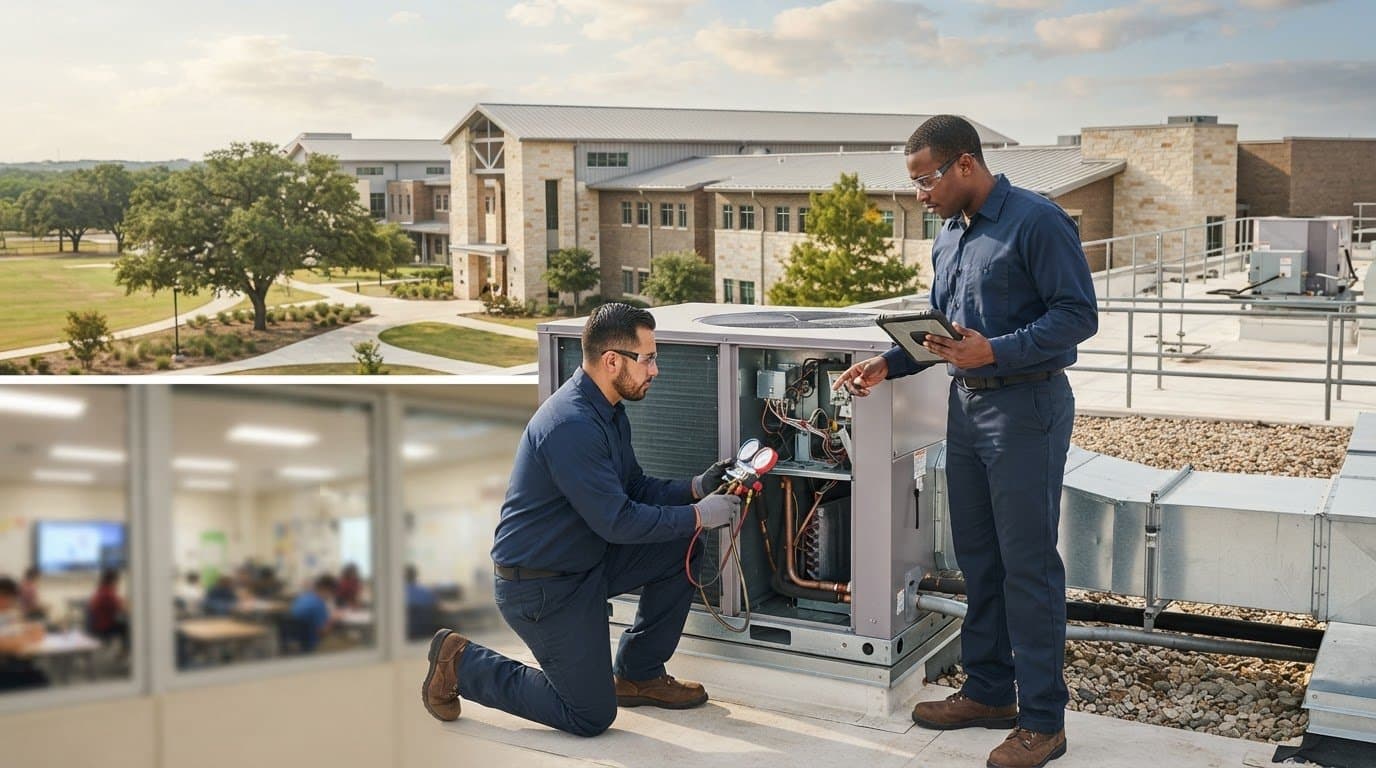
A school’s HVAC plan should fit its classrooms, not follow a standard equipment package. HVAC solutions for schools in Killeen can be planned around a building’s layout, occupancy, comfort priorities, and existing mechanical systems. A project-specific approach also helps schools organize maintenance, installation, and repair when cooling problems disrupt learning.
School teams need more than equipment that turns on; they need reliable temperature control across classrooms and shared spaces, with a clear response when a system fails. That concern carries particular weight in Killeen, where summer temperatures can approach 100 degrees. This guide explains how to adapt HVAC systems to a school’s needs and what to consider when planning maintenance, replacement, or emergency response.
You’ll also learn how classroom conditions, system design, and the scope of the work shape the right solution for schools in Killeen and Central Texas. The sections ahead cover comfort and noise considerations, service planning, installation decisions, and the role of emergency repair in keeping school operations on track.
Key Takeaways
- Match system design to each school’s layout, occupancy, and comfort priorities rather than relying on a standard equipment package.
- Plan maintenance around seasonal demands and use system performance to guide repair or replacement decisions.
- Assess temperature consistency and equipment noise together, since both can affect classroom conditions and daily operations.
- When cooling fails, identify the affected areas and system symptoms promptly to support a focused emergency repair response.
- Review how installation, routine service, and urgent repairs fit into a coordinated HVAC plan for your school.
Commercial HVAC repair, maintenance, and installation
School HVAC work involves planned maintenance, targeted repair, and installation decisions. In Central Texas, a documented service program helps facilities teams coordinate these needs around how each building is used.
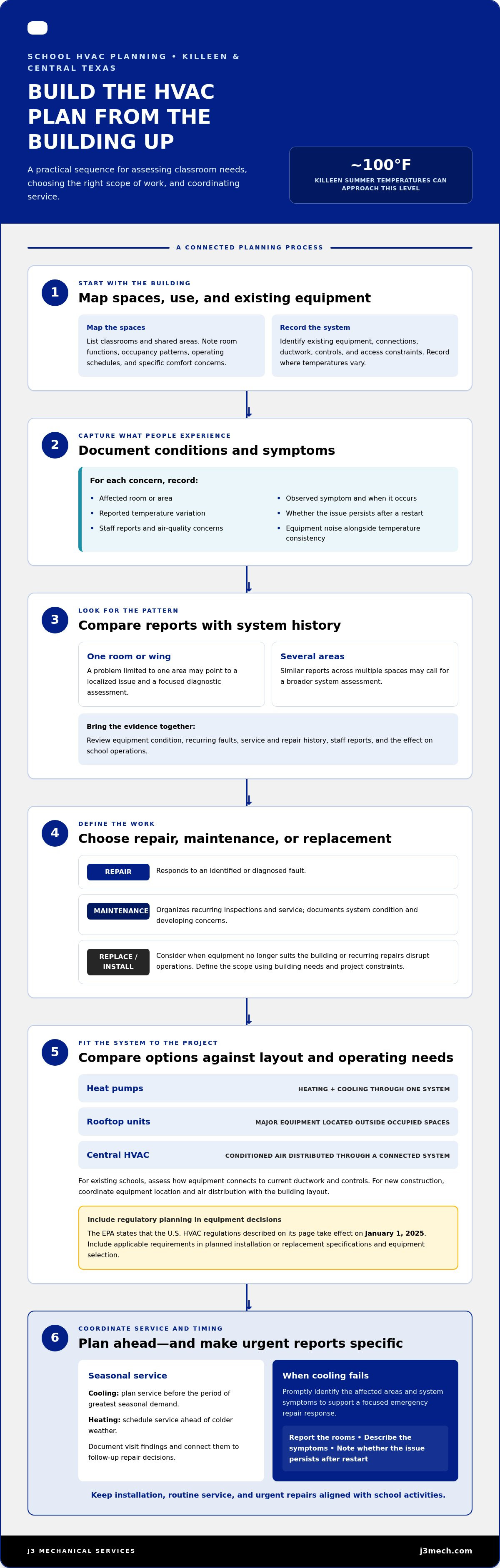
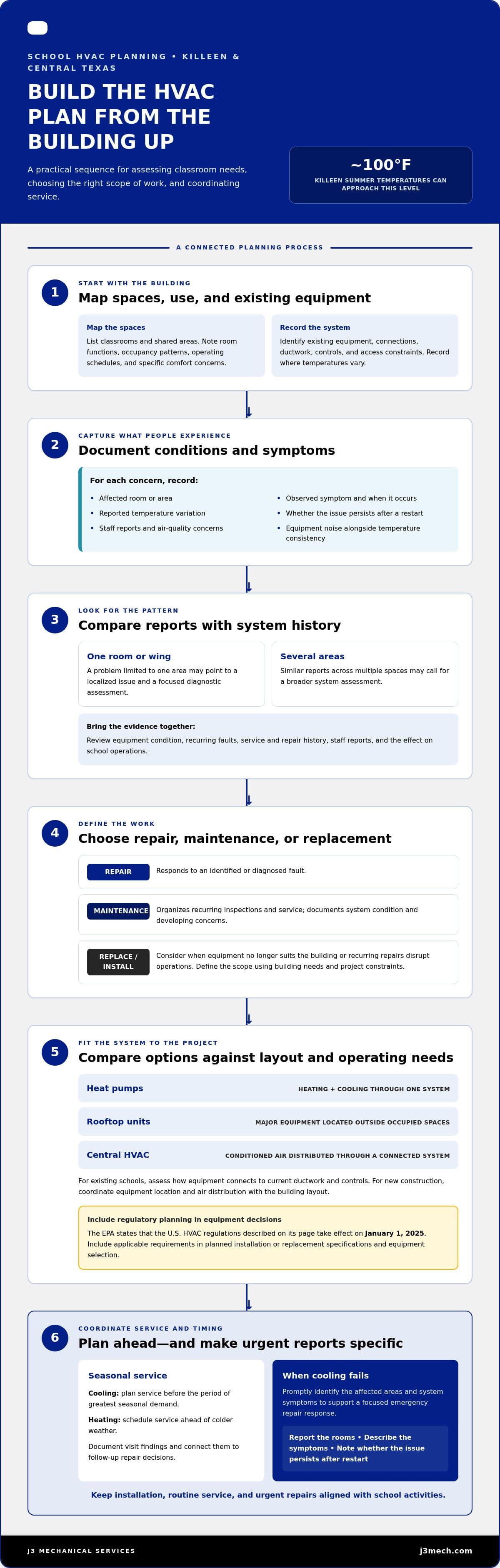
Start with a system review that records equipment condition, recurring faults, classroom comfort concerns, and air-quality issues. Compare these observations with service history and staff reports. Repeated cooling complaints in one wing, for example, may point to a localized issue, while problems across several areas may call for a broader assessment. Use the findings to prioritize repairs and distinguish them from replacement needs.
Regulatory planning belongs in equipment decisions, not as an afterthought. The U.S. Environmental Protection Agency states that the U.S. HVAC regulations described on its page take effect on Jan. 1, 2025. For a planned HVAC installation or replacement, include applicable requirements in project specifications and equipment selection. That step helps keep design, purchasing, and installation decisions aligned.
Preventative Maintenance Plans
A preventive maintenance plan organizes recurring inspections and service tasks around the school’s equipment and operating schedule. Review which systems and spaces are covered, how findings are documented, and how repairs are prioritized. A useful program tracks developing concerns, such as repeated component faults, so facilities teams can make informed repair or replacement decisions instead of relying on breakdowns alone.
Tune-Ups and Service Support
Plan cooling-system service before the period of greatest seasonal demand, and schedule heating-system service ahead of colder weather. During each visit, technicians can assess operation, inspect accessible components, and record concerns for follow-up. Ongoing service connects those findings to repair decisions. Record recurring classroom temperature complaints alongside the affected area and equipment observations.
Repair, maintenance, and installation address different needs. Repair responds to an identified fault; maintenance assesses system condition and flags developing concerns. Replacement or new installation may be appropriate when equipment no longer suits the building or recurring repairs disrupt operations. Before defining the work, review the school’s layout, equipment condition, service history, and intended use. Clear records also help coordinate project timing with school activities.
Use these steps to structure the review:
- Record affected rooms, observed symptoms, and when they occur.
- Gather available equipment and service history.
- Separate urgent faults from planned maintenance tasks.
- For installation, document building needs and project constraints.
Heating and air conditioning sales, service, and installation
Choosing a school HVAC system depends on the building, room layout, operating schedule, and maintenance needs. Heat pumps, rooftop units, and central HVAC systems distribute heating and cooling in different ways, so the right option depends on the project requirements.
Classroom Heating and Cooling Systems
Map classrooms, shared areas, and existing equipment. Record where temperatures vary, when rooms are occupied, and which spaces have specific comfort concerns. This helps establish whether the project needs localized equipment or a coordinated, building-wide approach. A classroom served by a rooftop unit, for example, has different distribution needs from one connected to central HVAC.
Heat pumps provide heating and cooling through the same system, while rooftop units place major equipment outside occupied spaces. Central HVAC distributes conditioned air through a connected system. Each option has different installation, access, and service considerations. For new construction, coordinate equipment locations and air distribution with the building layout. For an existing school, assess how new equipment will connect to current ductwork and controls.
Residential heating and cooling systems are designed for homes, not school buildings with varied room use and larger shared spaces. Select commercial equipment based on the school’s actual layout and operating needs. Technicians can assess system condition and project requirements to define the installation scope.
Heating and Cooling Repairs
When heating or air conditioning fails, document the affected rooms, reported symptoms, and whether the issue persists after a system restart. Compare these observations with equipment records and repair history. A fault limited to one classroom may need a focused diagnostic assessment, while similar reports across several spaces may indicate a broader system concern.
Repair addresses a diagnosed fault; replacement considers the system’s overall condition and suitability for the building. Review recurring repairs, equipment performance, service records, and effects on school operations. These details help facilities teams distinguish a repairable issue from a larger replacement or construction need. Clear findings also help determine whether work should be staged around building use.
For sales and installation planning, define the project scope before selecting equipment. Include building plans, room functions, existing connections, access constraints, and expected operating patterns. Then compare system options against those requirements, rather than selecting equipment by type alone. Heat pumps, rooftop units, and central systems each require suitable placement and distribution planning. A school project may also need coordination between mechanical plans and construction work, especially when equipment routes or service access affect other building elements.
After selecting the equipment, carry out installation according to the project scope, with attention to placement, connections, and airflow paths. Once work is complete, review system operation in the spaces it serves and document any follow-up items. These closeout records give facilities staff a practical reference for future service and repair decisions.
For a planned school project, review commercial HVAC installation as part of the system selection and construction process.
Classroom noise and temperature control
During Killeen summers, temperatures can approach 100 degrees, placing sustained demand on school cooling systems. Common problems include rooms that cool unevenly, equipment that struggles to maintain setpoints, and disruptive operating noise.
Noise and Temperature Management
Keep a room-by-room record of temperature complaints and equipment sounds. Note whether noise starts during startup, continues through an operating cycle, or comes from near a particular vent. If a classroom stays warm while nearby rooms cool, for example, airflow and controls may need to be checked rather than simply lowering the thermostat. This record gives maintenance teams a practical starting point for diagnosis.
Compare conditions during occupied periods and after rooms are empty. Check thermostat placement, blocked supply vents, and doors that remain open between spaces. These observations help distinguish local airflow problems from broader system performance issues. For Killeen schools, recording the room and time of day helps connect comfort reports with equipment operation.
Humidity and Energy-Efficient Climate Control
Humidity control works alongside cooling and ventilation. Review whether the HVAC system maintains stable room conditions as outdoor heat and building occupancy change. If a classroom feels damp despite an acceptable temperature, record the room, time, and system status. This information can guide a focused inspection of controls, airflow, and equipment performance.
Efficient operation starts with matching system controls to building use. Controls and sensors can help facilities teams identify rooms that cool unnecessarily when unoccupied or remain uncomfortable during classes. Review sensor placement and compare readings with actual room conditions. Preventive maintenance can also identify dirty components, airflow restrictions, or control issues that interfere with system operation.
Use monitoring to diagnose patterns, not just display readings. Facilities staff can compare thermostat settings, sensor data, and classroom reports to identify recurring issues. Temperature changes limited to one wing, for example, may indicate a localized control or distribution concern. Similar readings across several spaces may justify a broader review. Record findings consistently so a technician can assess the pattern rather than rely on one complaint.
Noise can also offer clues about system operation. Note rattling, vibration, airflow sounds, or sudden changes during startup, then identify nearby equipment or vents. These details help distinguish equipment noise from sound traveling through ductwork. A maintenance review can assess components and airflow while taking classroom schedules and room use into account.
HVAC contractors serving Killeen can use building plans, service records, and staff observations to investigate these conditions. Share the affected locations, operating times, and any control readings. This practical knowledge helps focus the assessment on the system areas most likely to explain the problem, while reducing guesswork during service.
For ongoing control, connect preventive maintenance findings with sensor observations and room reports. Keep recurring comfort concerns in the service record until their cause is addressed. This helps the school track whether an adjustment improved operation or further repair is needed. Reviewing temperature, humidity, ventilation, and noise together supports more informed decisions than treating each complaint in isolation.
HVAC repair and installation in Killeen and Central Texas
HVAC solutions for schools in Killeen should account for building conditions, classroom needs, and planned work. A site review helps define the repair, installation, or upgrade scope.
Killeen HVAC Installation
Before installation, gather building plans, equipment information, room functions, and details of planned additions. Compare them with heating and cooling needs across classrooms and shared areas. A new wing, for example, may need coordinated equipment and duct routes that serve additional rooms while connecting to existing systems.
Duct repair, installation, and sealing start by identifying damaged sections, loose connections, or uneven airflow. Record which rooms are affected and how conditions differ. Thermostat installation or repair also depends on placement and room use. A control near a draft, direct sunlight, or heat-producing equipment may not reflect conditions elsewhere in the classroom.
School HVAC Codes and Requirements
Public school projects in Texas require a review of applicable requirements based on the work, facility, and local jurisdiction. Before approving plans, identify the project’s mechanical and construction requirements, then coordinate ventilation, equipment access, duct routing, and controls. Requirements can vary with project scope. Document applicable criteria during planning and carry them through installation records and closeout.
Installation Costs and Upgrade Funding
Installation and replacement costs depend on equipment selection, system capacity, ductwork changes, controls, access, and construction coordination. For a project estimate, price depends on the case and is provided after a quote request; the work scope, equipment, and site conditions shape the estimate.
Schools can consider district capital planning alongside applicable grants, rebates, or funding programs. Review eligibility, eligible equipment, application timing, and documentation requirements before aligning funding with the project schedule. These checks help determine whether the project scope and timing fit the funding program.
To assess indoor air quality and classroom ventilation, start with a room-by-room review. Record occupied spaces, airflow concerns, and ventilation observations, then assess equipment operation, duct connections, and control settings. Weak airflow in one room, for example, may point to a local restriction, while similar conditions across several rooms may call for a broader system evaluation. Effective HVAC solutions for schools in Killeen connect these findings to specific repair or installation decisions.
Organize the project review with a short record of:
- Rooms affected and their current use.
- Equipment, ductwork, and thermostat concerns.
- Planned additions or construction constraints.
- Applicable project requirements and funding criteria.
A clear record gives facilities teams a basis for comparing repairs with replacement. It also helps coordinate HVAC solutions for schools in Killeen with building plans, funding reviews, and classroom needs, keeping project decisions tied to conditions observed on site.
Emergency AC and HVAC repair
In Killeen, summer temperatures can approach 100 degrees, making a school cooling failure operationally urgent. A clear response process helps staff identify affected spaces, communicate conditions, and arrange focused repair.
Record the time, location, and symptoms first. Note whether cooling loss affects one classroom, a wing, or the whole building. Include thermostat readings, unusual sounds, and visible water near equipment. Warm air in one room, for example, differs from a building-wide cooling failure. These details help guide the initial assessment.
Notify the facilities lead and follow the school’s established procedures. Identify affected spaces and any schedule changes needed to keep school activities organized. Staff should not attempt equipment repairs or open mechanical panels. Keep the area clear and share system observations with the technician. A concise report helps ensure key details are passed along.
During emergency commercial HVAC service, technicians assess reported symptoms against system operation. They may inspect controls, electrical connections, airflow, and accessible equipment components to identify the fault. The repair plan depends on the diagnosed cause and system condition. A control issue, for instance, calls for a different corrective action than a failed mechanical component.
Prioritize repair based on the extent of the disruption. If one classroom is affected, document its location and use while the system is assessed. If multiple spaces lose cooling, provide a building-level summary and identify rooms that remain comfortable. This information helps facilities staff coordinate room use as the repair proceeds, without assuming every HVAC interruption needs the same response.
After corrective work, review system operation in the affected spaces. Record whether cooling has returned, whether airflow feels consistent, and whether the original symptom remains. A room-by-room check can show whether the repair addressed the reported issue or further evaluation is needed. Keep findings with existing maintenance records to make recurring faults easier to identify.
Preparation also supports energy efficiency and continuity. Keep equipment identifiers, service history, building access details, and facilities contacts together in one response file. Update it when equipment changes or rooms are renovated. During a disruption, those records help staff explain the system’s history and guide technicians to the relevant equipment without delaying the assessment.
When a school needs urgent commercial HVAC repair, a provider offering 24/7 emergency service can address system failures outside routine maintenance planning. Use 24/7 emergency HVAC service to connect an urgent cooling or heating problem with a repair response.
J3 Mechanical Services: Commercial HVAC Installation & Replacement
J3 Mechanical Services supports school HVAC projects with commercial installation and replacement, maintenance, and repair. Turn to its commercial HVAC installation and replacement service when equipment needs to be renewed or a building project requires a planned system installation. For existing equipment, commercial HVAC maintenance can support routine service, while commercial HVAC repair addresses diagnosed faults. When a system failure requires urgent attention, 24/7 Emergency Service provides an emergency service option.
For a school project, outline the affected spaces, equipment concerns, and work required. That information helps frame the next discussion around installation, ongoing maintenance, or repair. To discuss HVAC needs for your school, contact J3 Mechanical Services or visit j3mech.com.
Set the Next HVAC Priority
Turn day-to-day observations into a clear facilities priority. Gather recurring classroom comfort concerns, equipment needing attention, and planned building changes. This gives your team a practical starting point for deciding what needs attention now and what belongs in longer-term planning. A concise record also keeps future decisions connected to the needs of students, staff, and school operations.
For schools evaluating HVAC solutions for schools in Killeen, the goal is not simply to address an isolated issue. It is to define a manageable path for the building’s mechanical needs and keep project decisions grounded in actual site conditions. J3 Mechanical Services can discuss the needs you have identified and the work under consideration. Contact J3 Mechanical Services to start a conversation about your school’s next HVAC priority. A clear plan is a constructive step toward more dependable building operations.
Frequently Asked Questions
Can I customize these units to fit my school’s needs?
Yes, commercial HVAC equipment and project scope can be tailored to a school’s building needs. Consider classroom arrangement, occupied schedules, existing ductwork, controls, and service access before choosing an approach. A renovated wing, for example, may need different distribution planning from an older classroom block. Building Information Modeling (BIM) coordination can align mechanical plans with construction details, bringing equipment placement and connections into the building-layout review.
Why should schools prioritize HVAC modernization now?
Consider modernization when existing equipment no longer meets the building’s operational needs. Recurring comfort complaints, increasing repair demands, and planned renovations can each signal a reason to review system condition and suitability. Start by comparing maintenance records with room use and facility plans. This helps school teams distinguish an isolated repair from a broader replacement project and coordinate mechanical work with other building decisions.
Which HVAC contractors serve schools in Killeen, Texas?
J3 Mechanical Services provides commercial HVAC work, including installation, replacement, maintenance, and repair. Its stated service targeting includes Killeen, but exact coverage and availability must be confirmed for every request. For school work, describe the facility and project scope, such as a classroom equipment replacement or a building-wide maintenance need. J3 also serves commercial customers in Texas markets including San Antonio, Selma, Seguin, Austin, Corpus Christi, Joshua, and New Braunfels.
What HVAC systems are best for Killeen school buildings and classrooms?
The best fit depends on building layout, room use, existing equipment, and how heating and cooling must reach each space. Heat pumps provide heating and cooling through one system; rooftop units place equipment outside occupied areas; central HVAC distributes conditioned air through connected building systems. Compare installation requirements, distribution routes, controls, and service access. A school with varied classroom layouts may need a different configuration from one with more uniform spaces.
What HVAC maintenance schedules and service plans do schools need?
Schools benefit from a documented maintenance plan that accounts for equipment, building use, and seasonal operating needs. Schedule cooling-system service in spring and heating-system service in fall, then record findings and repairs for each system. A useful service record identifies the equipment reviewed, observed issues, and follow-up work. J3 Mechanical Services offers commercial HVAC maintenance; the maintenance scope can be organized around the facility’s systems and operational priorities.
What energy-efficient HVAC upgrades can reduce school utility costs in Killeen?
Review controls, sensors, equipment condition, and operating schedules before choosing upgrades. Control settings that match occupied periods, for example, can help avoid conditioning unused areas unnecessarily, while resolving airflow restrictions can support more balanced operation. Compare proposed changes with existing equipment and school needs. Utility impacts depend on system configuration and use, so assess expected performance during project planning rather than assuming a particular reduction.
What should schools consider when choosing an HVAC contractor for a Killeen project?
Prioritize a contractor whose work matches the project, whether it involves commercial installation, replacement, maintenance, or repair. Review how the proposed scope addresses existing equipment, building plans, system distribution, controls, and construction coordination. For a new school project, ask for a coordinated approach to mechanical planning and installation. J3 Mechanical Services uses Building Information Modeling and in-house fabrication for coordinated project work; confirm exact coverage and availability for each request.
Need a hand with your building's HVAC?
Free quotes and honest answers from licensed commercial technicians across South Texas.