
School HVAC System Installation for Corpus Christi Campuses
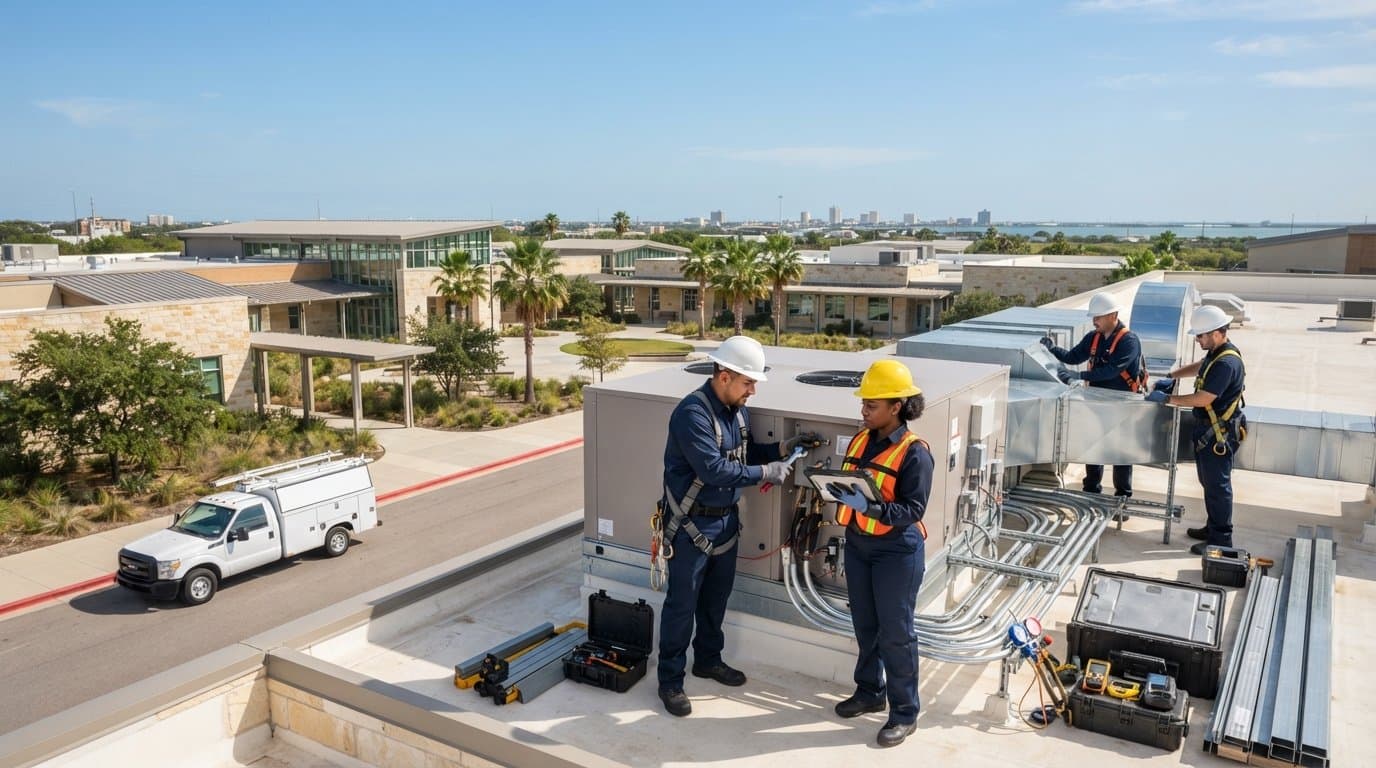
A school HVAC system installation in Corpus Christi is a coordinated campus project, not simply an equipment swap. It involves assessing building needs, selecting and positioning equipment, connecting it to ductwork, refrigerant lines, and electrical power, then testing system operation. A sound installation plan reflects how classrooms and other campus spaces are used.
Reliable heating and cooling depend on more than equipment selection. Facilities teams need to understand how central air conditioning installation fits into the broader mechanical system, what diagnostics can reveal when performance changes, and when maintenance or repairs are needed. These decisions help plan work around campus operations and support consistent system performance.
This article explains the installation process, the role of system design and coordination, and the factors that shape equipment choices for Corpus Christi schools. It also covers how systems are assessed, operated, and repaired, helping facilities teams make informed decisions from project planning through ongoing care.
Key Takeaways
- Plan equipment around each campus building’s use and mechanical layout, rather than treating installation as a simple equipment replacement.
- Central air conditioning installation coordinates equipment with ductwork, refrigerant lines, and electrical power.
- Technicians who handle refrigerants need EPA Section 608 Certification, according to the U.S. Environmental Protection Agency.
- Use system diagnostics to distinguish performance problems from equipment faults and guide the appropriate repair or maintenance work.
- Consider installation, ongoing operation, and repair as connected parts of managing school HVAC systems.
Heating, air conditioning, heat pumps, and refrigeration equipment
School mechanical systems bring together heating, cooling, air distribution, electrical connections, and refrigeration equipment. In Corpus Christi, planning starts by matching these functions to building use, existing infrastructure, and project priorities.
School HVAC System Options
VRF systems, rooftop units, and chillers are all options for school projects, but no type suits every campus. Compare each approach against classroom layouts, existing ductwork, equipment locations, operating schedules, and maintenance needs. These criteria help determine whether one system or a coordinated combination fits the building.
Heating, air conditioning, and heat pumps move or produce conditioned air through connected equipment and distribution components. Refrigerant-based systems transfer heat through a refrigeration cycle, while ducts or other distribution arrangements deliver heating or cooling to occupied spaces. HVAC technicians who handle refrigerants need EPA Section 608 Certification, according to the U.S. Environmental Protection Agency. That certification is relevant when installation or service work involves refrigerant handling.
Corpus Christi technician training is available through Del Mar College’s Air Conditioning Applied Technology program at its Windward Campus. The college offers an Associate of Applied Science degree, Level II commercial and residential certificates, a Level I certificate, and an occupational skill award. Its curriculum includes EPA 608 coursework, and the program states students receive EPA certification for safely handling refrigerants. These options provide different routes into heating, air conditioning, and refrigeration work.
Heating and Refrigeration Systems
Heating, air conditioning, and refrigeration systems share components and operating principles, but meet different building needs. School air-conditioning systems manage indoor cooling, while refrigeration systems preserve temperature-sensitive contents in equipment such as food storage units. When reviewing plans, identify each system’s purpose, connections, controls, and service access so their requirements remain distinct.
For Texas schools, VRF systems, rooftop units, and chillers may suit different layouts and operating requirements. Compare available space, distribution needs, zoning goals, and maintenance requirements before choosing a system.
Choose a school HVAC installation contractor by assessing commercial project experience, design coordination, installation planning, and commissioning procedures. For a Corpus Christi campus, request a clearly defined scope covering equipment, connections, work sequencing, and operational handoff.
Texas school HVAC codes and energy-efficiency requirements depend on the rules adopted for the project and its applicable specifications. Identify the governing requirements during design, then document how the equipment and controls align with them.
For Corpus Christi building permits, include permit coordination in early planning. Define the work scope, prepare required project information, and align local reviews and approvals with the construction schedule.
School indoor air quality and ventilation planning should account for room use, occupancy patterns, outdoor-air delivery, filtration, and system controls. Assess classrooms and other spaces separately because their uses may differ across campus.
Size school HVAC systems based on building loads, room use, occupancy, envelope conditions, and ventilation needs. A room-by-room assessment helps match equipment capacity and air distribution to actual campus demands.
Texas school HVAC rebates and incentives depend on current program rules, eligible equipment, and documented project criteria. Review these conditions during equipment planning so potential incentives inform, rather than dictate, system selection.
Installation of central air conditioning systems
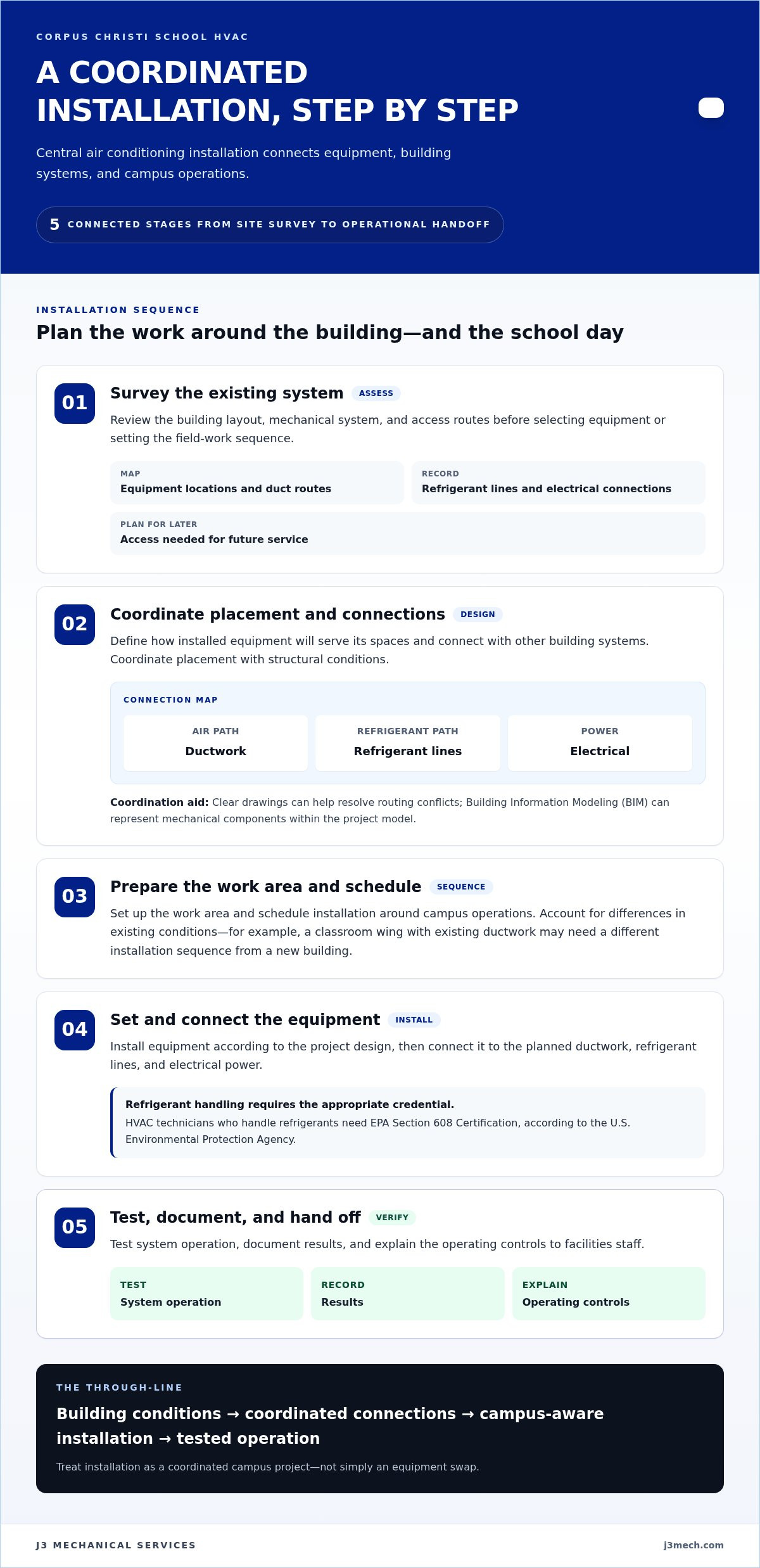
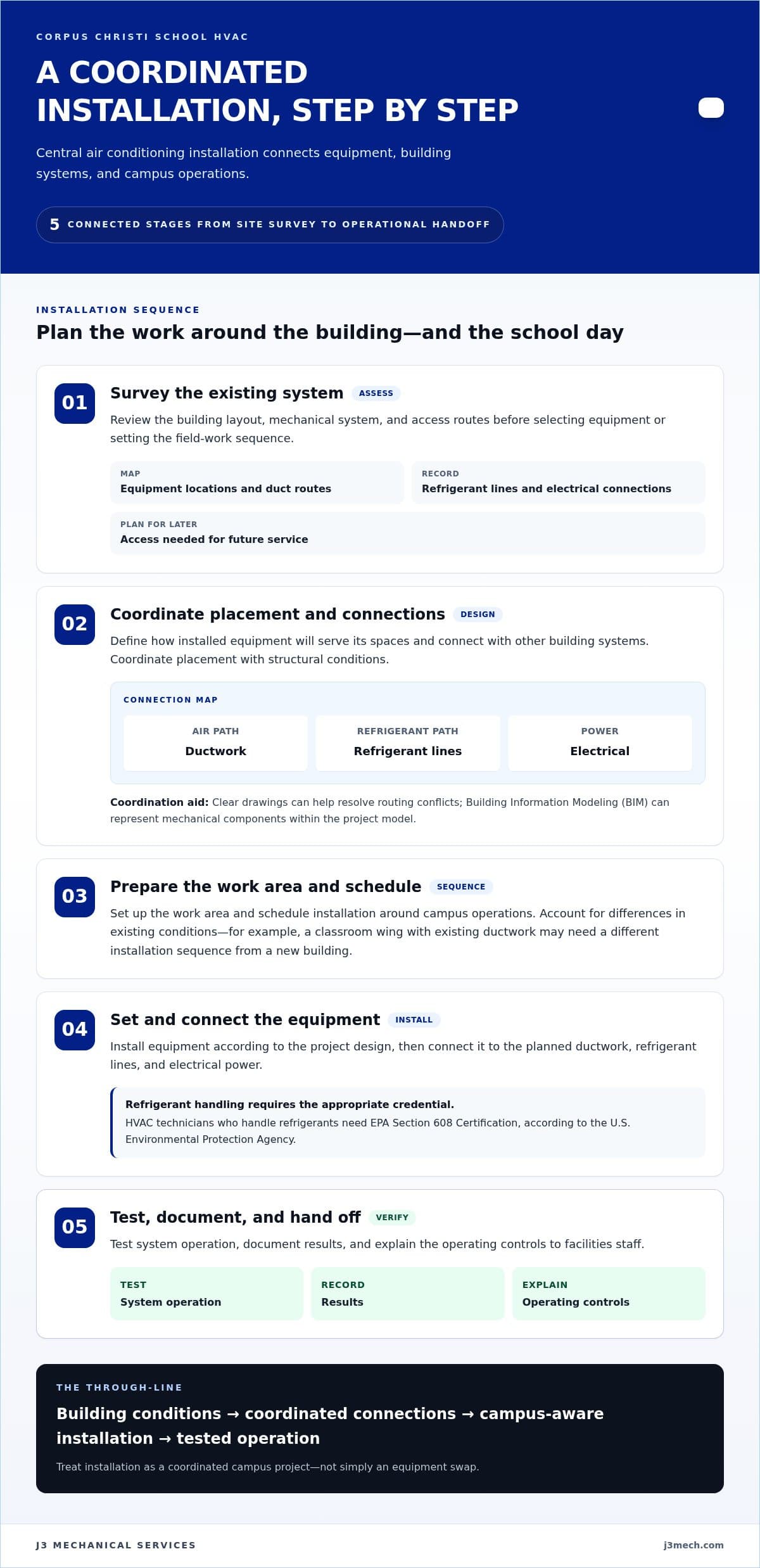
For a school HVAC system installation in Corpus Christi, start by reviewing the building’s existing mechanical layout. Map equipment locations, duct routes, refrigerant lines, electrical connections, and access for future service. A classroom wing with existing ductwork may require a different installation sequence from a new building. Recording these conditions before equipment selection helps coordinate design decisions and field work.
Next, define how the equipment will connect to the spaces it serves. Technicians connect installed equipment to ductwork, refrigerant lines, and electrical power. The project team also coordinates equipment placement with structural conditions and other building systems. Clear drawings help resolve routing conflicts before they disrupt work. Building Information Modeling (BIM) can support this process by representing mechanical components within the project model.
Use a defined sequence to keep installation tasks coordinated:
- Survey the existing system, building layout, and access routes.
- Coordinate equipment placement, duct connections, refrigerant piping, and electrical requirements.
- Prepare the work area and schedule installation around campus operations.
- Set and connect equipment according to the project design.
- Test system operation, document results, and explain operating controls to facilities staff.
Refrigerant work requires appropriate technician credentials. HVAC technicians who handle refrigerants need EPA Section 608 Certification, according to the U.S. Environmental Protection Agency. Del Mar College’s Air Conditioning Applied Technology program includes EPA 608 coursework, and the program states students receive EPA certification for safely handling refrigerants. Its training provides a local example of how technical coursework prepares students for air-conditioning work.
For people considering HVAC training, Del Mar College offers an Associate of Applied Science degree, Level II commercial and residential certificates, a Level I certificate, and an occupational skill award in Air Conditioning Applied Technology. A high school diploma or equivalent is required for the course. These pathways vary in credential and scope, while campus installation depends on coordinated equipment, connections, and verification.
Before handoff, the installation team should run the system and verify that its controls respond as designed. Testing, for example, can confirm that a classroom unit starts, distributes conditioned air through its duct connections, and responds to control settings. Facilities staff also need clear operating instructions and records of equipment locations and system connections.
A school HVAC system installation in Corpus Christi also needs a project scope that reflects campus operating needs, building conditions, and construction sequencing. For a campus evaluating equipment replacement or new installation, commercial HVAC installation can be planned around the building’s mechanical requirements and construction sequence. A coordinated scope helps facilities teams understand how equipment, connections, and operational handoff fit together.
Service practices continue beyond installation and startup. Technicians should conserve, recover, and recycle CFC and HCFC refrigerants when servicing air-conditioning and refrigeration equipment. Careful handling during maintenance supports responsible refrigerant management as the system enters regular use.
Workforce figures offer context for the trade: air conditioning and refrigeration technicians had a median annual salary of 47,000 in June 2015, and the average hourly wage for air conditioning and refrigeration technicians was 20 in June 2015. These figures describe the occupation at that time, rather than a guarantee for any individual worker.
HVAC installation, diagnostics, and repair skills
A school HVAC project calls for technicians who can install equipment, trace system faults, and carry out repairs methodically. Installation skills include reading mechanical plans, connecting equipment to ductwork and electrical power, and checking control responses. For example, when investigating a warm classroom, a technician should distinguish an airflow problem from a control or equipment fault before choosing a repair. This approach limits guesswork and supports accurate system records.
In Corpus Christi, Del Mar College’s Air Conditioning Applied Technology program offers local technician training through several credential paths. Students can pursue an Associate of Applied Science degree, Level II commercial and residential certificates, a Level I certificate, or an occupational skill award. A high school diploma or equivalent is required for the course. The curriculum builds technical knowledge through courses on air-conditioning and refrigeration equipment.
Certification exams provide structured ways to assess specific knowledge. The Del Mar College program prepares students for HVAC Excellence Core and Professional Technician exams, NATE Core and Specialty Test exams, and the EPA Section 608 exam. Students can use coursework to connect exam preparation with practical tasks, such as interpreting system behavior, identifying a likely fault, and following appropriate refrigerant-handling procedures. Employers may value credentials alongside demonstrated troubleshooting and installation skills.
For a campus system, troubleshooting can follow a repeatable sequence:
- Record the reported symptom, such as weak cooling in one classroom.
- Compare the affected room with a nearby space served by the same system.
- Inspect controls, airflow paths, equipment connections, and visible operating conditions.
- Use diagnostic findings to identify the fault before selecting corrective work.
- Operate the equipment after repair and document its response.
This process separates observations from assumptions. A technician can use the recorded results to explain the fault, work performed, and system response to facilities staff.
Texas also sets registration requirements for technicians. HVAC technicians must register with the Texas Department of Licensing and Regulation as Air Conditioning and Refrigeration Technicians and work under a licensed ACR contractor. Registration currently costs $20 and must be renewed annually. After two years of supervised experience, technicians can pursue TDLR’s Certified Technician designation.
When assessing skills for a school project, look for a work sequence that includes installation, diagnostics, and operational testing. A technician should explain how findings support a repair, rather than replace a component simply because a classroom feels uncomfortable. Del Mar College’s training and certification pathways illustrate coursework and credentials connected to these practical responsibilities.
Air-conditioning and refrigeration technicians may focus on installation, maintenance, or repair. These roles differ: installation puts equipment in place, maintenance involves caring for it over time, and repair addresses faults. A technician’s specialization can clarify which part of a campus HVAC job is central to their role. The distinction also helps define the task, whether the need is to install a system, maintain it, or repair a fault, while keeping the work tied to the building’s HVAC needs.
HVAC system installation and operation
Campus HVAC work moves from planning and installation to daily operation and ongoing maintenance. For schools, each stage must account for room use, construction access, staff training, and system performance after startup.
School Installation Process and Timeline
A school installation schedule depends on project scope, equipment coordination, site access, and commissioning needs. There is no single schedule for every campus. Work sequencing varies depending on whether the project involves replacement, new construction, or multiple occupied buildings.
Plan the work in coordinated phases:
- Document existing equipment, building conditions, and the spaces affected.
- Coordinate design, equipment placement, construction access, and campus operations.
- Install and connect equipment, then verify controls and system operation.
- Orient facilities staff and provide system records for routine operation.
For example, a phased installation can divide work by building area, helping facilities teams coordinate access and classroom schedules. Del Mar College’s HVAC program also illustrates how the trade develops: apprenticeships combine supervised, practical training with classroom instruction and typically last three to five years.
Post-Installation Risks and Maintenance
After installation, risks include poor airflow, control settings that do not match room use, and faults that go unnoticed. Scheduled maintenance, operating checks, and clear reporting help identify changes and direct technicians to the affected component.
Facilities teams can keep an operating record with equipment identifiers, service dates, observed symptoms, and actions taken. If a classroom repeatedly feels warm, review its controls and airflow path rather than assuming the entire system has failed.
Daily operation depends on staff understanding the controls and knowing how to report unusual system behavior. A useful handoff explains operating modes, control locations, and how to record concerns. For a cooling issue in one room, a precise report can note the room, time of day, and whether nearby spaces have the same condition.
Scheduled maintenance gives technicians a structured opportunity to inspect equipment, connections, controls, and system performance. Its scope should reflect the installed equipment and operating demands. Repairs are appropriate when diagnostics identify a fault. Replacing parts before tracing the symptom can leave the original cause unresolved.
The career pathway also supports the skills needed to operate and maintain complex systems. HVAC/R technician employment is projected to grow by 13% during the next few years, representing 46,300 new HVAC/R technician jobs during the next few years. Corpus Christi apprenticeships are paid positions that include supervised, real-world training, connecting classroom learning with field practice.
After commissioning, record system behavior under normal campus conditions and compare later observations with that baseline. Changes in airflow, controls, or cooling performance give facilities staff a specific starting point for troubleshooting and maintenance planning.
School HVAC contractors in Corpus Christi, TX
For a Corpus Christi campus, start contractor selection with the project scope, not equipment brochures. Define whether the work involves new construction, replacement, or a system serving occupied classrooms. Then document building conditions, operating needs, access constraints, and existing mechanical connections. These details help the project team compare proposals against the same requirements and identify exclusions before scheduling work.
Review the contractor’s proposed work sequence and technical coordination. A school project may involve equipment placement, duct connections, refrigerant lines, electrical interfaces, controls, and building access. Ask how drawings will show these interfaces and how field changes will be recorded. Building Information Modeling can help coordinate mechanical components with other project systems, especially where installation routes compete for limited space.
Use a structured review when comparing project proposals:
- Check that each proposal defines the equipment and work areas included.
- Compare installation sequencing, campus access, and coordination responsibilities.
- Look for testing, commissioning, documentation, and staff handoff steps.
- Identify how diagnostics and corrective work will be recorded after startup.
- Confirm that assumptions about existing equipment and connections are explicit.
Technician credentials matter when project work includes refrigerants. HVAC technicians must register with the Texas Department of Licensing and Regulation as Air Conditioning and Refrigeration Technicians and work under a licensed ACR contractor. Registration currently costs $20 and must be renewed annually. A clear project plan should also identify which personnel perform installation, testing, and service tasks.
Assess how the contractor will communicate with school facilities staff. For example, a phased project should identify affected buildings, access points, equipment shutdowns, and work order. The schedule should reflect campus operations and coordination needs rather than rely on a generic installation timeline. Written progress updates and documented decisions help facilities teams track changes throughout the project.
Before selecting a proposal, review the handoff plan. It should explain system controls, equipment locations, operational records, and how to report problems. If a classroom has uneven cooling after startup, there should be a clear diagnostic path, including who records the symptom and how findings inform repair decisions. These practical details connect installation planning with reliable ongoing operation.
For a campus project in Corpus Christi, organize building information, project scope, and access requirements before seeking an installation plan. This preparation gives the project team a clear basis for coordinating design and field work.
Discuss a campus HVAC project with a team prepared to consider installation planning, system coordination, and school operating needs.
J3 Mechanical Services: Commercial HVAC Installation & Replacement
J3 Mechanical Services provides commercial HVAC installation and replacement for school campuses planning new systems or equipment upgrades. Its work can also support ongoing operation through commercial HVAC maintenance and repair, while 24/7 Emergency Service addresses urgent commercial HVAC issues.
Turn to J3 Mechanical Services when a campus needs a coordinated installation plan, replacement work, or support for an existing commercial system. Sharing the project scope, building conditions, and operational priorities helps establish the work to be addressed.
For school HVAC installation or service needs, contact J3 Mechanical Services or visit J3 Mechanical Services online.
Set the Next Campus HVAC Priorities
Planning school HVAC system installation in Corpus Christi is an opportunity to align facilities decisions with longer-term campus needs. Before the next project discussion, prepare a concise decision brief identifying priority buildings, operational constraints, known system concerns, and the outcomes school leaders want. This gives the project team a practical basis for defining scope and sequencing instead of treating each equipment issue in isolation.
Consider how proposed work will affect future maintenance, staff access, and daily building operation. A campus plan that accounts for these needs helps facilities leaders compare immediate requirements with broader infrastructure priorities. It also gives administrators, facilities teams, and project partners a shared reference as decisions progress.
J3 Mechanical Services supports commercial campuses with HVAC installation and replacement, maintenance, and repair. If your school is preparing to define a project scope or address system needs, contact J3 Mechanical Services to discuss the next step. A clear plan can help your team move forward with purpose and confidence.
Frequently Asked Questions
Best HVAC system types for Texas schools: VRF, rooftop units, or chillers
VRF systems, rooftop units, and chillers suit different school layouts and operating needs. Compare classroom layouts, existing ductwork, equipment locations, operating schedules, zoning goals, and maintenance plans before choosing a system.
Texas school HVAC codes and energy efficiency requirements
Texas school HVAC codes and energy-efficiency requirements depend on the rules adopted for the project and its applicable specifications. Identify governing requirements during design and document how equipment selection and controls align with them.
Need a hand with your building's HVAC?
Free quotes and honest answers from licensed commercial technicians across South Texas.