
Texas Commercial Mechanical Contractor Comparison Guide
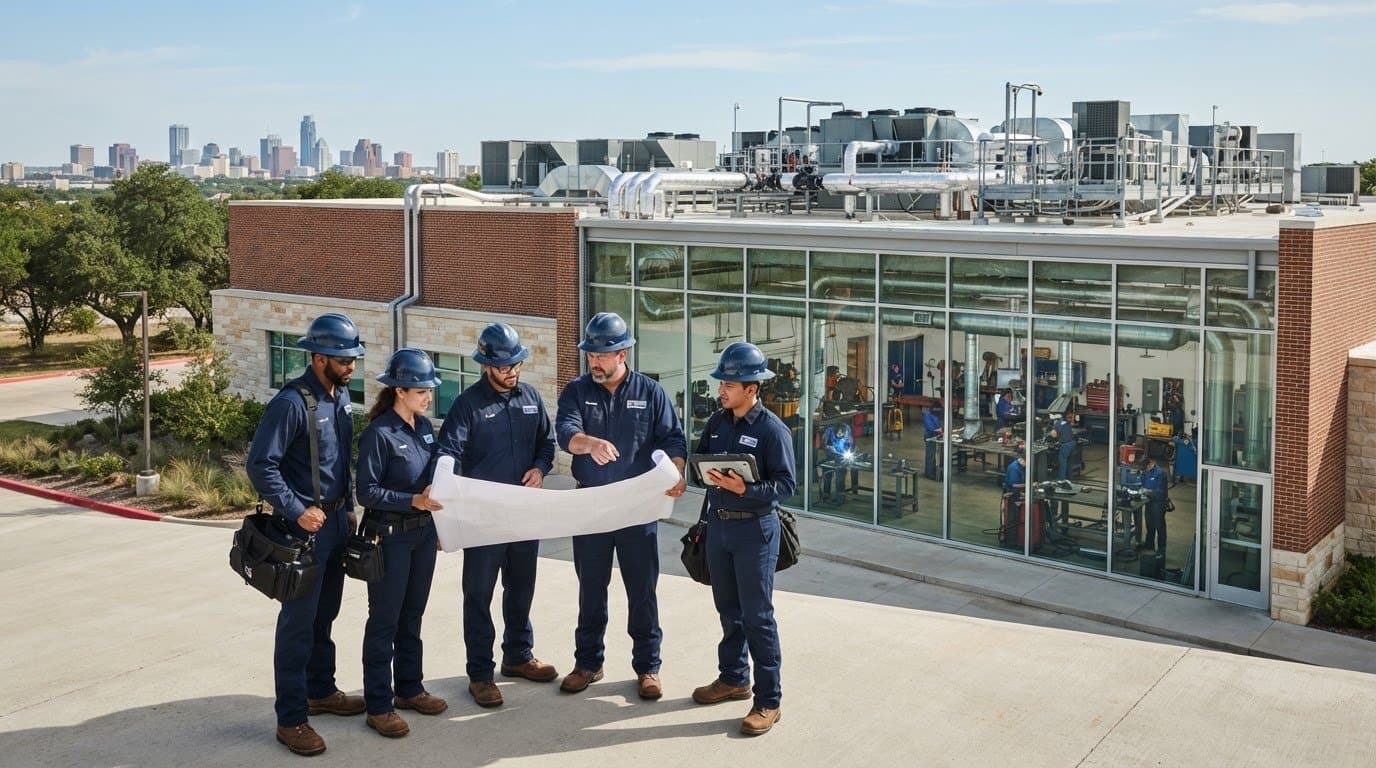
The contractor with the longest service list is not necessarily the strongest fit for a commercial project. In mechanical contractor comparisons Texas facility leaders need to look beyond listed services: unclear coordination can create project risk, and installation decisions can affect ongoing operations.
Contractors can be difficult to distinguish when their websites describe similar capabilities. A more useful comparison examines how project scope is coordinated and how BIM, fabrication, controls, installation, and support after startup fit together. Texas accountability matters, too: J3 Mechanical Services’s commercial contractor license can be verified through TDLR using #TACLA00116129E.
This guide gives you project-relevant criteria for assessing commercial mechanical contractors, from planning and construction coordination through maintenance, repair, and lifecycle support. It explains how an integrated approach connects the model, shop, field, and control sequences before startup, helping clarify responsibilities across project phases. You will also find a checklist for evaluating project fit, Texas accountability, and scope. The goal is to compare how work is delivered and supported, not just the services listed on a website.
Key Takeaways
- Use mechanical contractor comparisons Texas to assess project execution and operational fit, not just the number of services on a website.
- Map how equipment, distribution, controls, BIM, fabrication, installation, and startup connect to clarify coordination responsibilities.
- Compare lifecycle support from startup through maintenance and repair, while treating maintenance as a reliability practice rather than a promise that failures will not occur.
- Apply a consistent checklist to define scope, assign responsibilities, assess coordination, review credentials, and align ongoing support with facility needs.
- See how J3 Mechanical connects commercial HVAC work across project phases, and remember that service-area listings alone do not establish availability for a specific request.
How to Compare Mechanical Contractors in Texas for Commercial Facility Needs
Useful mechanical contractor comparisons Texas facility leaders can rely on assess three connected factors: the work included in the scope, how that work is coordinated, and whether the result fits the building’s operating needs. A service list indicates what a company may do, but it does not show how responsibilities connect from planning through installation and startup. Compare the delivery approach, not just the number of capabilities named.
A commercial HVAC contractor focuses on heating, ventilation, and air-conditioning work in commercial facilities. A general contractor typically coordinates broader construction work across multiple trades. Residential HVAC providers serve homes, where building use and project conditions differ from those of offices, healthcare facilities, schools, retail properties, industrial sites, and public buildings. HVAC is one part of the broader Mechanical, Electrical, and Plumbing (MEP) systems that must be coordinated within a building.
Which commercial facility requirements should shape the comparison?
Start with the building’s function and the project phase. A healthcare facility may have different operating priorities from a retail space, while an industrial building may have different system complexity from an office. Then define whether the work involves new construction, installation, replacement, maintenance, or repair. Record practical constraints such as occupied areas, equipment access, work sequencing, and requirements for keeping facility operations running during the project.
These details turn a broad contractor comparison into a project-specific one. Replacing equipment in an occupied school is not the same coordination task as installing HVAC in a new industrial building, even if both scopes include equipment and ductwork. Write down what is included, which parties coordinate each interface, and what operating conditions the work must accommodate. That baseline makes delivery plans easier to compare consistently.
Why does Texas project context matter?
Texas projects can involve different teams, facility requirements, and coordination arrangements across markets, so consider location alongside scope and operating needs. A project in San Antonio and one elsewhere in South Texas may have different site teams or access arrangements. Base the comparison on the actual project rather than assuming every facility is alike. J3 Mechanical is headquartered in Selma, with operating locations in Edinburg and Joshua. Exact coverage and availability must be confirmed for every request.
A local address or listed service area is not a promise of response time or availability for a specific project. Keep those concepts separate as you assess fit. Apply the same discipline to service breadth: installation, replacement, maintenance, repair, and new construction may all appear in a company’s scope, but a longer list alone does not establish integrated project delivery. Next, examine how planning, field coordination, fabrication, controls, and ongoing support connect.
Compare Texas Contractors by BIM, Fabrication, Controls, and Field Coordination
To make mechanical contractor comparisons Texas facility teams can use, trace how project responsibilities connect. Equipment, air or water distribution, control sequences, fabrication, field installation, and startup depend on coordinated information. A contractor may provide several of these capabilities without linking them into a defined delivery sequence, so compare both the work included and the handoffs between phases.
The difference becomes clearer when the model informs shop work, shop work aligns with field conditions, and controls are coordinated with the installed equipment. The BIM and sheet metal coordination guide offers more context on connecting digital coordination and fabrication. Industry resources from the Mechanical Contractors Association of America (MCAA) can also help readers understand the broader mechanical contracting field.
What does BIM coordination contribute to a commercial HVAC project?
BIM coordination brings the building model, mechanical shop work, field installation, and control sequences into a shared process before startup. Reviewing these relationships can help project teams identify potential design conflicts for resolution during coordination, rather than leaving them implicit until installation. BIM is a planning and communication method, not a promise about schedule, cost, or project outcomes.
For example, a model can help teams coordinate intended HVAC distribution routes and placement with other building components. The comparison point is not simply whether a contractor uses BIM, but how model information relates to fabrication documents, field execution, and controls planning.
How do fabrication and controls fit into the delivery comparison?
In-house fabrication can connect shop production with project coordination and field installation. J3 Mechanical’s fabrication is part of its commercial HVAC project scope, while controls engineering links equipment and control sequences with installation and startup. The commercial HVAC fabrication guide provides a closer look at the shop-work component.
Controls planning can address how equipment is intended to operate, the sequence of control actions, and how sensors and building automation system (BAS) points relate to that sequence. These details should connect to installation and be considered during startup, so the installed system can be evaluated against its intended operation.
| Comparison point | Isolated capabilities | Integrated delivery sequence |
|---|---|---|
| Coordination | Equipment, distribution, or controls handled as separate scopes | Model, shop, field, and control information coordinated before startup |
| Fabrication | Shop work treated as a separate handoff | Fabrication aligned with project coordination and installation |
| Startup | Equipment and controls addressed in separate phases | Installed equipment and control sequences connected in the startup process |
Use these distinctions to define responsibilities and handoffs in the project scope. Learn how J3 Mechanical connects commercial HVAC fabrication with project delivery through J3 Mechanical’s commercial HVAC services.
Compare Lifecycle Support for Texas Commercial HVAC Systems
Assess commercial HVAC support as a sequence, not as a standalone maintenance visit or repair call. Compare how a contractor’s involvement carries forward from startup into preventive maintenance, troubleshooting, corrective repair, and ongoing system support. Continuity can help facility teams understand system condition over time, identify who handles each type of work, and plan decisions around operational priorities.
A useful comparison looks at what information carries from installation or startup into later service. Equipment details, control sequences, observed conditions, and maintenance findings can inform future work. Review how planned maintenance is distinguished from corrective repair in the documented scope, and how issues identified during routine service are communicated for follow-up. J3 Mechanical provides commercial HVAC maintenance and repair to support facilities beyond the installation phase.
How should facility teams assess preventive maintenance scope?
Maintenance planning should reflect the installed equipment, facility use, and the building’s operational priorities. An occupied facility with critical operating periods may organize access and work differently from a building with more flexible use. A commercial HVAC maintenance protocol can help frame the discussion around planned service and asset management. Maintenance supports reliability, but it cannot ensure uninterrupted operation or prevent every failure.
Keep the distinction precise: preventive maintenance is planned work intended to assess and care for equipment; corrective repair responds to a diagnosed issue. They may be part of an ongoing service relationship, but they are not interchangeable. A practical review should identify the equipment included, how facility access and operating constraints shape planning, and how findings are documented and communicated. This gives facility leaders a better basis for comparing service continuity than a general promise of ongoing support.
What should commercial teams know about after-hours HVAC requests?
J3 Mechanical’s current after-hours availability is confirmed by phone. No response, dispatch, or arrival time is promised; coverage and next steps are confirmed after an emergency call. Emergency rates and terms are confirmed before authorized work and documented in the executed agreement. This clarifies authorization and expectations before work proceeds.
For an emergency request, provide the information needed to understand the site and reported condition:
- Facility address and facility type
- Equipment involved and any alarms displayed
- Safety condition, including smoke, fire, suspected gas, exposed electrical damage, significant refrigerant release, or an immediate life-safety concern
- Site access instructions and operating impact
- Name and contact information for the responsible facility representative
These details support a clear initial conversation without implying that a particular repair, part, or completion time is assured. In lifecycle comparisons, focus on how planned service, repair authorization, and operational communication fit together over time.
Use a Texas-Specific Checklist to Compare Contractor Fit and Accountability
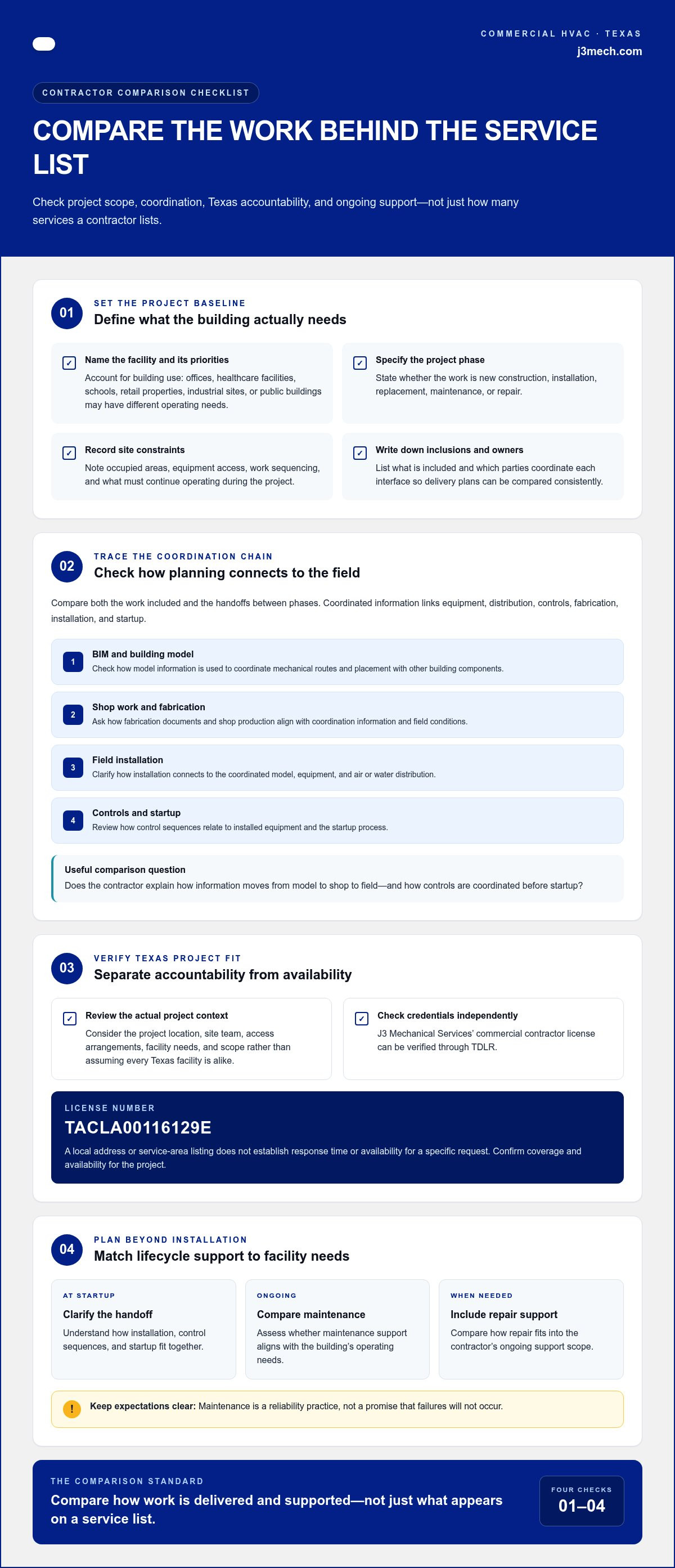
A consistent comparison matrix helps commercial buyers move from broad claims to project-specific evidence. For effective mechanical contractor comparisons Texas facility leaders can use, record the same categories for each contractor and distinguish documented scope from general marketing language. This makes differences in accountability, coordination, and operational fit easier to identify.
Which project and contractor details belong in a comparison matrix?
Capture the project phase, facility type, design responsibility, site access conditions, procurement responsibilities, and schedule assumptions. Then map who is responsible for equipment, distribution, controls, fabrication, installation, and commissioning support. Note whether each item is included, excluded, or assigned to another party, and identify the document that supports each entry.
Use this checklist to structure the review:
- Define the scope. Specify whether the project involves new construction, installation, replacement, maintenance, or repair, and identify the equipment and building areas involved.
- Map responsibilities. Record who owns design coordination, procurement, fabrication, field installation, controls integration, startup, and commissioning support.
- Assess coordination. Identify how project information moves between the model, shop, field team, and controls work, and where decisions or handoffs are documented.
- Review credentials. Verify applicable credentials using authoritative records rather than relying only on website statements. J3 Mechanical’s Texas commercial contractor license can be verified through TDLR as #TACLA00116129E.
- Align lifecycle needs. Document how startup connects to planned maintenance, repair, and ongoing system support, including the facility’s operating constraints.
A useful matrix separates verified credentials and written scope from broad descriptions such as “full service” or “turnkey.” Those phrases do not, by themselves, show which party is accountable for each interface or how work proceeds from one phase to another. J3 Mechanical’s overview of the commercial HVAC contractor’s role offers one reference point for considering how mechanical work fits into facility infrastructure.
How should Texas location and licensing information be interpreted?
J3 Mechanical is headquartered in Selma, with operating locations in Edinburg and Joshua. These locations describe the company’s Texas presence, but neither a local address nor a service-area listing establishes availability for a particular project or request. For work in San Antonio or elsewhere in South Texas, compare the actual project scope and location rather than treating a market listing as a response-time commitment.
Exact coverage and availability must be confirmed for every request. Keep that distinction in the matrix: list the project location, record the contractor’s stated presence separately, and document the coverage determination for the specific request. This prevents geographic marketing from being mistaken for a commitment.
For a project-specific comparison grounded in commercial HVAC scope and accountability, review J3 Mechanical’s commercial HVAC services.
How J3 Mechanical Connects Commercial HVAC Scope Across Texas
J3 Mechanical’s commercial HVAC work includes installation and replacement, maintenance, repair, and new construction. The comparison value lies in how these project needs connect: coordination can begin with estimating and BIM, continue through in-house fabrication and field installation, and carry into startup, commissioning support, and lifecycle service. This lets facility teams consider the full scope rather than treating each phase as an unrelated task.
For buyers making mechanical contractor comparisons Texas facilities can use, the practical question is how project information and responsibilities carry forward between phases. BIM coordination links the model, shop work, field conditions, and control sequences before startup. Fabrication supports coordinated installation, while controls engineering connects equipment with its intended sequences, sensors, and building automation system (BAS) points. Scope is shaped by project requirements and defined responsibilities.
What does an integrated commercial HVAC engagement include?
Depending on the project, an engagement may involve estimating, BIM coordination, fabrication, installation, startup, and commissioning support. For new construction, these activities can be coordinated around the project’s design and construction sequence. For replacement work, the scope can account for existing equipment and site conditions. Controls engineering connects specified equipment and sequences with sensors and BAS points, supporting coordinated installation and startup without presuming a particular system configuration or outcome.
Integration depends on clear scope. The project team should define which activities apply, who is responsible for each handoff, and how facility operating requirements inform the work. J3 Mechanical’s commercial HVAC scope brings together BIM coordination, in-house fabrication, controls engineering, installation, and lifecycle service. The engagement is shaped to the project rather than delivered as a fixed package.
What information helps begin a commercial project discussion?
A concise project brief makes the initial scope discussion more precise. Include the facility location and type, the project need, available equipment information, site access conditions, schedule considerations, and operating priorities. Clarify whether the request concerns new construction, equipment replacement, maintenance, or repair, and note any design or coordination responsibilities already assigned to other project participants.
- Facility location and building use
- Project type and equipment context
- Access conditions and operating constraints
- Schedule considerations and procurement responsibilities
- Design information and coordination needs
J3 Mechanical is headquartered in Selma, with operating locations in Edinburg and Joshua. Those locations describe the company’s Texas presence, not coverage for a specific request. Exact coverage and availability must be confirmed for every request. Project pricing depends on factors such as the facility, equipment, design responsibility, access, procurement, and schedule. Quote timing is not promised online.
To discuss a commercial HVAC project and its scope, contact J3 Mechanical about your project.
Turn Your Comparison Into a Clear Project Brief
Turn your evaluation criteria into a brief that makes the work, responsibilities, and operating priorities explicit. Set out what the facility needs now, what must continue functioning during the work, and how ongoing support should fit into operations. This gives decision-makers a shared basis for reviewing scope and resolving open questions before project commitments are made.
Use the same brief to keep mechanical contractor comparisons Texas focused on what matters to your facility, rather than letting broad service descriptions set the terms of the decision. A well-defined scope creates a more productive starting point for technical discussion and helps align project expectations with the building’s needs.
Discuss your commercial HVAC project with J3 Mechanical to take the next step toward a clearly scoped, coordinated plan.
Frequently Asked Questions
How do I compare mechanical contractors in Texas for a commercial project?
Compare contractors against the same project brief, then assess how their documented scope fits the facility’s needs. Useful mechanical contractor comparisons Texas buyers can make include checking who coordinates each handoff, how installation connects to controls and startup, and whether support continues after construction. A replacement project with limited equipment access, for example, calls for a different execution plan than a new-build project. Record assumptions and exclusions so proposals can be assessed on consistent terms.
What should a commercial HVAC contractor comparison include?
Include project phase, building use, equipment context, design responsibilities, procurement, site access, schedule assumptions, and the party responsible for each work interface. Also distinguish included work from exclusions and items assigned to other trades. If controls integration is separate from equipment installation, document who coordinates the interface and how related information is shared. Keep verified credentials and written scope separate from broad claims such as “full service,” which do not define project responsibilities.
How does BIM coordination help with commercial HVAC construction?
BIM coordination gives project participants a shared model for reviewing how mechanical work relates to building components before field installation. Teams can review a proposed duct route in relation to structural elements and other modeled systems, then coordinate relevant shop and field information. Connecting the model with fabrication details and control sequences can clarify responsibilities and potential design conflicts before startup. BIM supports coordination, but it does not ensure a particular schedule, cost outcome, or conflict-free project.
Does J3 Mechanical serve commercial facilities outside San Antonio?
J3 Mechanical focuses on commercial facilities in South Texas. Its geographic context includes San Antonio, Selma, Seguin, Austin, Corpus Christi, Killeen, Joshua, Bandera, Boerne, New Braunfels, Edinburg, McAllen, the Rio Grande Valley, Rockport, Pleasanton, San Marcos, and Round Rock. A city reference or service-area listing is not a commitment to cover a particular request. Exact coverage and availability must be confirmed for every request.
Is after-hours commercial HVAC service available in Texas?
J3 Mechanical’s current after-hours availability is confirmed by phone. The information here does not promise a live answer, dispatch, response time, or holiday coverage, so do not assume a specific service window or arrival time. If the situation involves smoke, fire, suspected gas, exposed electrical damage, a significant refrigerant release, or an immediate life-safety concern, report the safety condition during the call so coverage and next steps can be addressed.
What information should I provide when requesting emergency commercial HVAC service?
Provide the site address, facility type, equipment involved, any alarms, the safety condition, access instructions, operating impact, and the responsible contact’s name and phone number. Be specific: identify which unit is affected, describe the alarm displayed, and explain whether the condition is affecting occupied areas or facility operations. Coverage and next steps are confirmed after the call. Parts, tools, and completion timing depend on diagnosis, safety, inventory, and authorization.
How can I verify a Texas commercial HVAC contractor license?
Use the Texas Department of Licensing and Regulation (TDLR) license lookup to search the contractor’s exact license number and review the record associated with that business. J3 Mechanical’s Texas commercial contractor license can be verified using #TACLA00116129E. Match the result to the company named in the project documents rather than relying only on a logo or a general statement that a contractor is licensed. Keep the verification with your procurement records for reference.
Does preventive maintenance guarantee that a commercial HVAC system will not fail?
No. Preventive maintenance is a planned reliability practice, not a promise against equipment failure or operational interruption. It gives facility teams a structured opportunity to assess equipment condition and identify items that may need attention, but unexpected faults can still occur. A maintenance visit, for example, may document a developing concern that requires separate corrective repair. Keep maintenance records with equipment information so facility decision-makers can review findings and plan follow-up work responsibly.
Need a hand with your building's HVAC?
Free quotes and honest answers from licensed commercial technicians across South Texas.