
Upgrading Old Commercial HVAC Systems With Smarter Building Controls
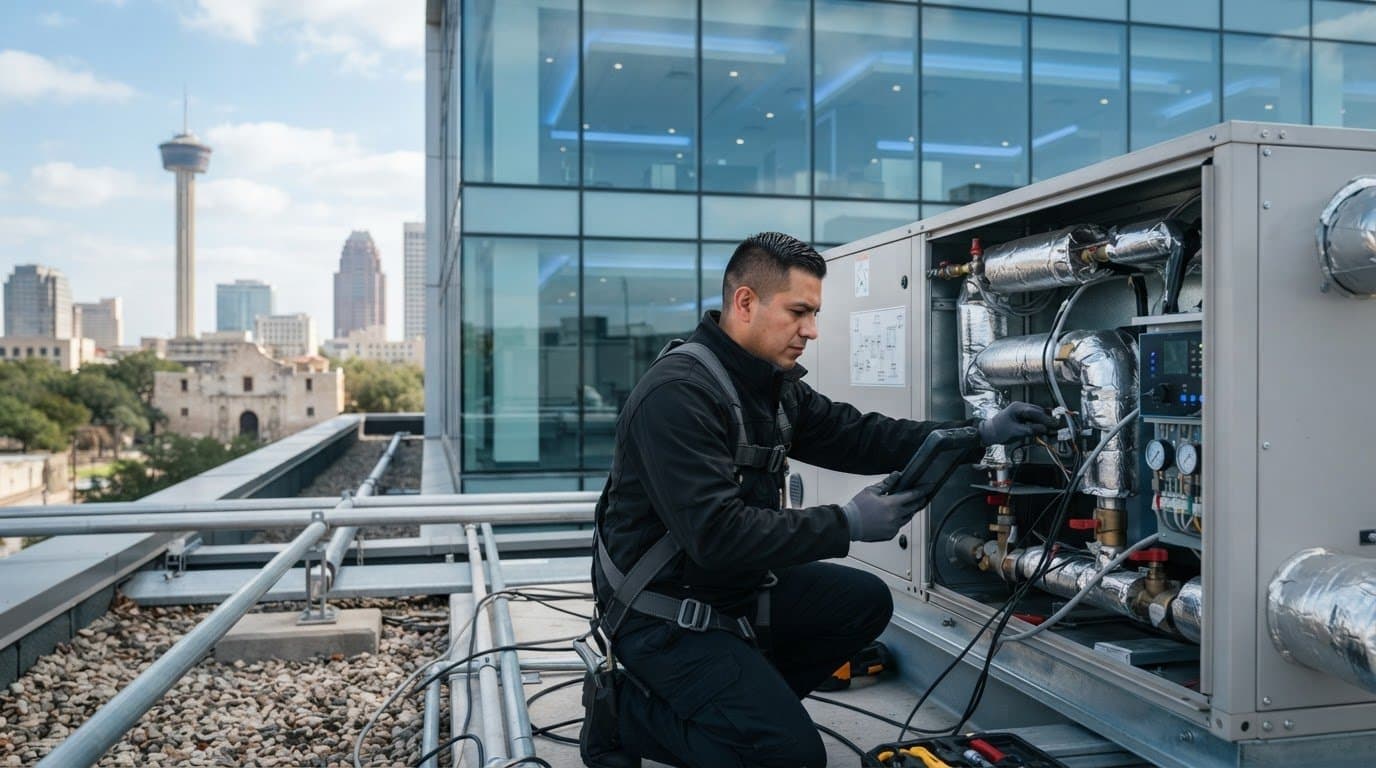
An HVAC system that is 10-15+ years old may be due for an upgrade, particularly when energy bills rise without increased use, temperatures vary across the building, or service calls become frequent. Upgrading an old commercial HVAC system can involve more than replacing equipment: smarter controls may help coordinate heating and cooling with building automation and lighting.
If incentives are part of your 2026 decision, availability depends on location and qualifying equipment. In Massachusetts, Mass Save offers incentives for qualifying high-efficiency commercial heating and cooling equipment, and some projects require pre-approval before installation.
Upgrading an old commercial HVAC system starts with assessing how well the equipment meets the building’s heating, cooling, and operating needs. Equipment and controls affect energy use, and HVAC must work alongside other building systems. Review operating performance and the needs of each space before deciding whether to repair, retrofit, or replace the system.
Key Takeaways
- Compare equipment efficiency with the building’s operating needs, since equipment selection and controls both influence energy use.
- Coordinating HVAC controls with building automation and lighting can help align system operation across the facility.
- Assess energy performance alongside comfort, repair frequency, and the needs of each space when considering an upgrade.
- Plan retrofit work around building operations, with clear coordination to manage disruption and downtime.
- Replacement costs depend on project scope, equipment requirements, and the work needed to integrate updated systems.
Energy savings from high-efficiency HVAC equipment
High-efficiency equipment may reduce energy use, but actual results depend on the equipment, building conditions, and operation. The right system depends on the facility’s heating and cooling demands. Variable refrigerant flow (VRF) systems can adjust output to changing demand, while heat-pump options should be evaluated against the building’s requirements and local weather.
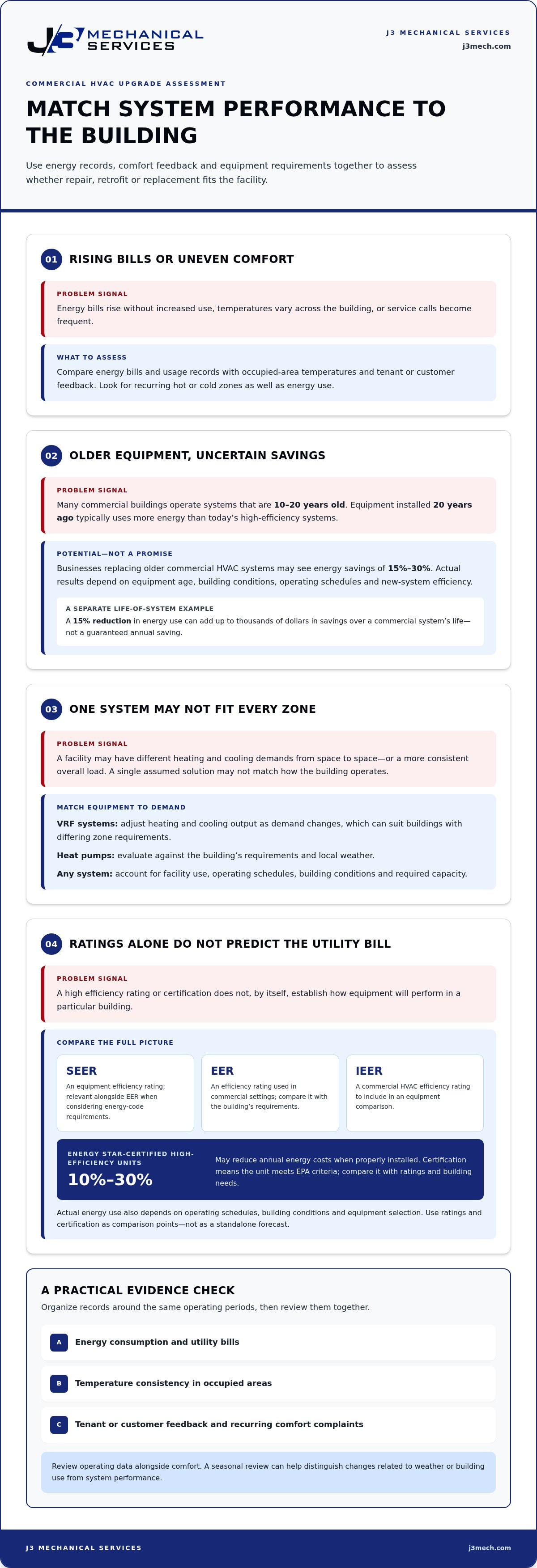
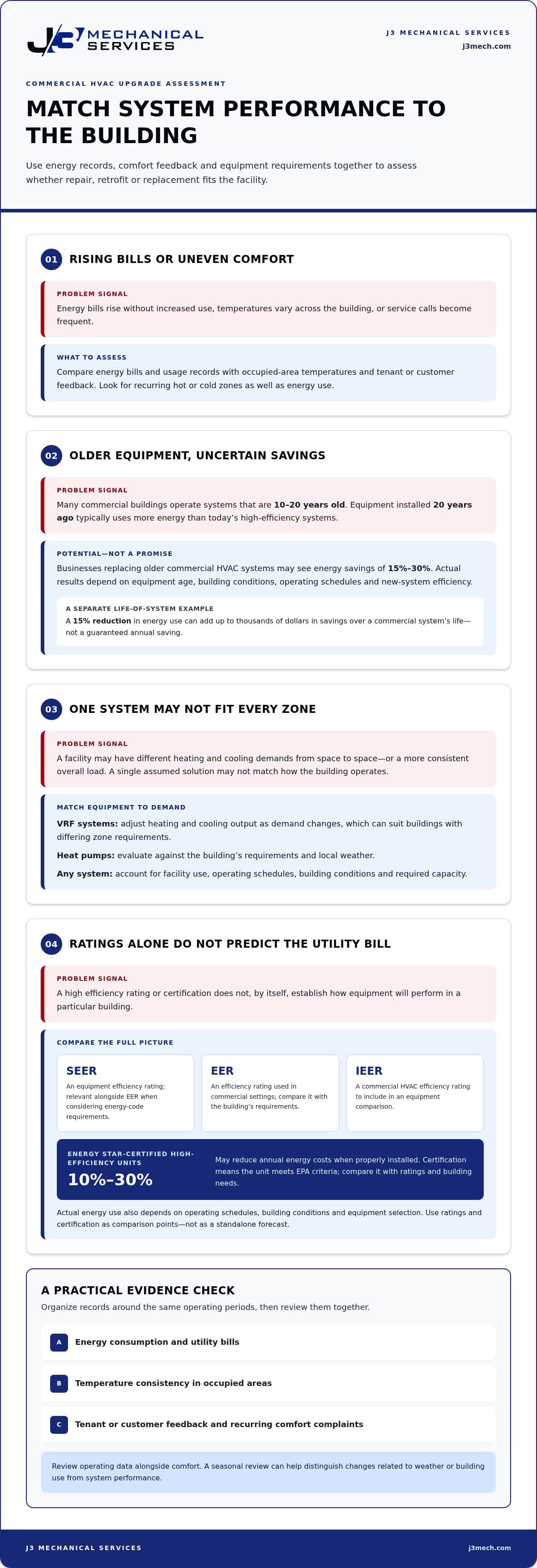
Equipment age provides useful context for an upgrade assessment. Commercial equipment installed 20 years ago typically uses more energy than today’s high-efficiency systems. Reducing a commercial HVAC system’s energy use by even 15% can add up to thousands of dollars in savings over its life. These figures describe potential, not a universal outcome; operating schedules and system condition affect the result.
VRF systems adjust heating and cooling output based on demand, rather than delivering one fixed output across every area. That flexibility can suit buildings with different zone requirements. A building with a more consistent load may call for a different equipment assessment. Match the design to how the facility is used and to local weather conditions.
Utility-Bill Savings from Efficient Equipment
Energy efficiency describes how effectively a system delivers the required heating and cooling relative to its energy use. For a commercial building, the potential value of an upgrade depends on the existing system’s consumption and how the replacement performs under actual operating conditions.
Compare energy use alongside equipment capacity, building conditions, and operating schedules. A 15% reduction in energy use, for example, can accumulate into thousands of dollars over a commercial system’s life, but that figure is not a guaranteed annual saving.
SEER, EER, and IEER Ratings
SEER, EER, and IEER are efficiency ratings used to compare commercial HVAC equipment. EER is used as an efficiency rating in commercial settings. When an upgrade must meet energy-code requirements, SEER and EER ratings can be relevant considerations.
Use ratings as part of an equipment comparison, not as a standalone forecast of utility bills. A high rating does not establish how a system will perform in a particular building. Actual energy use also depends on operating schedules, building conditions, and equipment selection.
ENERGY STAR-certified high-efficiency HVAC units, when properly installed, can reduce annual energy costs by 10-30%. ENERGY STAR certification indicates that a unit meets criteria set by the EPA. For a replacement decision, compare that certification and the equipment ratings with the building’s heating and cooling needs, rather than selecting by one rating alone.
Energy savings from upgrading older commercial HVAC equipment
Replacing outdated equipment may lower energy use, but results depend on the building and its operation. Compare energy consumption, comfort, and system performance to give facility teams a clearer basis for evaluating replacement.
Energy Costs of Outdated Systems
Energy costs from outdated HVAC systems reflect the electricity and fuel needed to provide heating and cooling as equipment becomes less efficient. Many commercial buildings operate systems that are 10-20 years old, and replacement savings depend on equipment age, building conditions, operating schedule, and new-system efficiency.
Businesses replacing older commercial HVAC systems may see energy savings of 15% to 30%. Use utility bills and operating records to identify consumption patterns, then compare them with the proposed equipment’s expected performance. This helps distinguish potential energy savings from changes caused by weather, occupancy, or schedule.
Measuring Comfort and Energy Use
Assess comfort and energy use together by reviewing operating data and occupant experience. Compare energy bills and usage records with temperature consistency in occupied areas. Gather tenant or customer feedback about comfort and recurring hot or cold zones.
These measures help show whether lower energy use comes with acceptable comfort and productivity. For example, reduced consumption alongside recurring comfort complaints points to a different result than reduced consumption with steady temperatures and positive occupant feedback.
ENERGY STAR certification is another equipment comparison point: it indicates that an HVAC unit meets criteria set by the EPA. ENERGY STAR-certified high-efficiency units, when properly installed, can reduce annual energy costs by 10-30%. Compare certification with system ratings and building requirements, rather than treating the label as a substitute for matching equipment to the space.
Energy recovery ventilators transfer heat and moisture between outgoing and incoming air. By recovering energy from exhaust air, an ERV can reduce the conditioning load on incoming ventilation air. Its value depends on the building’s ventilation needs and operating conditions, so assess it as part of the overall HVAC design, not as a standalone replacement.
For a practical comparison, organize records around the same operating periods: energy use, occupied-space comfort, and customer or tenant feedback. A seasonal review can reveal whether changes correspond with weather or building use, while consistent complaints in a particular area can point to distribution or control issues. This evidence supports a more informed replacement assessment. For project planning, commercial HVAC replacement can address equipment selection and building requirements together.
Why Retrofit a Commercial HVAC System?
A retrofit can update equipment, controls, or ventilation to better suit how a facility operates. Start by assessing system performance, define the building’s needs, coordinate the work, and verify the upgraded equipment’s operation.
Retrofit Upgrades to Components and Controls
A retrofit updates selected equipment or controls to improve how an existing system serves the building. Replacing components can extend a commercial HVAC system’s useful life by several years, while controls can adjust heating and cooling to suit different spaces. The right scope depends on equipment condition, facility use, and indoor comfort requirements.
Control options can include commercial smart thermostats that use temperature, humidity, and occupancy data to adjust heating and cooling. Zoning can provide different temperature settings for separate areas. Demand-controlled ventilation adjusts airflow based on occupancy, while MERV-rated filters can trap dust, allergens, and mold spores. Each change should address the space’s operational needs.
These measures address different needs, so connect each proposed upgrade to a specific facility requirement. Occupancy-based ventilation responds to changing use, while zoning serves areas with different temperature needs. Evaluating ventilation, controls, and filtration together helps keep indoor conditions central to retrofit decisions.
Planning the Upgrade Steps
Plan a retrofit by establishing current system performance and the building’s requirements before defining the work. Equipment and controls should fit the facility, not just address symptoms in isolation. Assess how well the system meets the space’s needs, then identify equipment, ventilation, and controls for review.
Next, define a project scope that links each proposed change to an operational purpose. A facility with varying occupancy may consider demand-controlled ventilation; separate areas with different comfort needs may benefit from zoning. Coordinate those decisions with the equipment work, then assess performance after installation.
Avoiding Retrofit Coordination Pitfalls
Coordination pitfalls arise when installation activity conflicts with building operations or facility communication. Hospitals, manufacturing plants, and large office buildings may operate 24/7, so retrofit planning that minimizes downtime matters. Establishing work phases and communicating affected areas helps facility teams prepare for operational changes and maintain clear expectations.
Choose a contractor based on the project’s technical scope and coordination needs, not equipment alone. A proposal should explain the planned equipment, control changes, ventilation work, and sequence of activity. Established contractors such as Around the Clock Heating and Air Conditioning demonstrate how clear communication about affected spaces helps facility staff coordinate access and occupant needs. A defined scope also clarifies which upgrades are included.
Frequent breakdowns can disrupt operations, so connect the retrofit plan to system condition and facility priorities. A manufacturing plant may need work sequenced around operating requirements, while an office building may prioritize communication about affected zones. A coordinated plan keeps equipment, indoor conditions, and building schedules aligned.
Indicators that a commercial HVAC system may need upgrading
Age alone does not determine whether replacement is necessary, but commercial HVAC systems have an average lifespan of 10 to 15 years. A system aged 10-15+ years is one sign that an upgrade may be due, especially when operating problems appear alongside its age.
Start with system performance, then assess whether the equipment still meets the space’s needs. This ties the decision to observable conditions rather than age alone. An older unit serving a consistently comfortable building, for example, presents a different assessment from one associated with rising bills, uneven temperatures, and repeated service calls.
Rising energy bills without increased usage may indicate that equipment is operating less efficiently. Compare utility records across periods with similar schedules and building use. If costs rise while occupancy and operating hours remain stable, include system performance and condition in the upgrade assessment.
Uneven temperatures across occupied spaces are another warning sign. One tenant may report inadequate cooling while another area remains comfortable, suggesting the system is not serving the building consistently. Record where and when complaints occur, then compare those patterns with system operation and the spaces served.
Frequent service calls also call for closer evaluation. Repeated repairs can indicate that an older system is struggling to operate reliably, particularly when the same performance issues return. Review service history alongside equipment condition, energy bills, and comfort complaints. Together, these indicators provide more context than a single repair visit.
Unexpected breakdowns can interrupt normal building operations. A breakdown alone does not establish that replacement is the right decision, but recurring failures alongside age or declining performance strengthen the case for a broader assessment. Consider the affected areas, changes in comfort, and whether service calls are becoming more frequent.
Use a consistent review to distinguish isolated problems from a pattern. Record the system’s age, energy-bill changes without increased usage, areas with uneven temperatures, and service-call frequency. Then assess whether the equipment still meets the building’s needs. This evidence helps frame the decision around performance, tenant comfort, and the demands of each space.
The clearest signal is a combination of indicators, not a single threshold. A 10-15+ year-old system with rising bills, uneven temperatures, and frequent service calls deserves a focused upgrade assessment. Conversely, age should prompt evaluation, not an automatic replacement decision. The practical takeaway is to connect equipment age with measurable operating problems before determining the next step.
How much does it cost to replace commercial HVAC equipment in the United States?
Commercial HVAC replacement has no single price that applies to every building in the United States. The price depends on project scope and follows a quote request. Key cost factors include equipment selection, capacity, existing system conditions, and installation requirements.
Start with the building’s heating and cooling needs. A professional load calculation helps avoid oversized or undersized equipment, which can affect system selection and project scope. Building size alone does not determine the right capacity: occupancy, operating schedule, local weather, and space requirements also matter.
Equipment choice affects the project scope. Replacing a conventional commercial system may involve different work from installing variable refrigerant flow equipment, which adjusts heating and cooling output based on demand. Evaluate heat pumps, high-efficiency equipment, and controls against the facility’s operating requirements, rather than selecting by equipment price alone.
Existing conditions also affect the scope. The work may involve more than placing new equipment where the old unit stood: the condition and arrangement of ductwork, ventilation, and controls matter. A project that includes control changes or ventilation adjustments, for example, requires different work from a like-for-like equipment replacement.
Energy-code requirements can also affect equipment selection. The International Energy Conservation Code (IECC) is an energy-code consideration for HVAC retrofits, while SEER and EER ratings may be relevant when upgrades must meet energy-code requirements. The International Mechanical Code (IMC) covers ventilation, duct design, and combustion safety in HVAC retrofits. Consider these factors alongside project design and building needs.
Installation conditions can shape the work plan. An occupied office, a manufacturing facility, and a building operating around the clock have different coordination needs. Phasing work around building operations may affect the sequence and extent of project activity. Access to equipment locations and existing system layouts also helps define installation requirements.
For a clearer budget decision, define the scope before comparing project totals. Separate equipment, controls, ventilation changes, and installation work in the project description, then identify which items address building needs. This makes it easier to understand why replacement proposals may include different work, even when they address the same aging system.
Evaluate replacement cost against equipment fit, project scope, operating needs, and expected energy performance. A lower initial project total may not represent equivalent equipment or work, while a broader scope may address more building requirements. Clarifying those differences helps decision-makers assess the full project rather than rely on one headline figure.
J3 Mechanical Services: Commercial HVAC Installation & Replacement
J3 Mechanical Services provides Commercial HVAC Installation & Replacement for facilities assessing aging equipment, recurring performance issues, or a planned system upgrade. Its Commercial HVAC Maintenance and Commercial HVAC Repair services support ongoing system needs, while 24/7 Emergency Service addresses urgent repair situations.
When replacement is under consideration, a clear project scope helps connect equipment selection with building requirements, operating conditions, and the needs of each space. J3 Mechanical Services also provides HVAC installation for commercial projects, helping facility teams move from assessment to planned system work.
For commercial HVAC replacement or installation, contact J3 Mechanical Services to discuss your facility’s needs.
Make the Next HVAC Decision With Confidence
Let the building’s operating priorities guide the next step, whether that means refining controls, planning component work, or evaluating full replacement. Upgrading an old commercial HVAC system is a facilities decision best tied to how the building is occupied and operated.
J3 Mechanical Services provides Commercial HVAC Installation & Replacement, Commercial HVAC Maintenance, and Commercial HVAC Repair to support different stages of a system’s lifecycle. The appropriate path depends on whether the immediate need is planned replacement, ongoing equipment care, or repair of an operational issue.
Before proceeding, bring together the building’s performance concerns, operating priorities, and desired project scope. This discussion can help align the next step with the facility’s requirements, without treating every aging system as an automatic replacement.
Contact J3 Mechanical Services to discuss the commercial HVAC needs of your facility and determine a practical path forward.
Frequently Asked Questions
What Commercial HVAC Incentives Are Available in 2026?
In 2026, Mass Save offers incentives in Massachusetts for qualifying high-efficiency commercial heating and cooling equipment, including certain heat pump and VRF systems. Some projects require pre-approval before installation. Because this program is specific to Massachusetts, it should not be assumed to apply to projects in other states. For any incentive, identify eligible equipment and application timing before committing to installation, since completing work first can affect program eligibility.
What Factors Affect Your Potential Savings?
Potential savings depend on the existing equipment’s condition, the replacement system’s efficiency, building operations, and how well the equipment matches demand. A facility with a changing schedule may have different savings potential from one with steady occupancy. Controls, ventilation requirements, local climate, and installation quality also matter. Compare energy use across similar operating periods and account for changes in occupancy or schedules to assess whether savings reflect the upgrade.
Why Retrofit Instead of Replace?
A retrofit may suit a building when specific components or controls need improvement but the existing system still meets its core requirements. Updating controls, for example, may address scheduling or zone-level operation without replacing every major piece of equipment. Replacement becomes more relevant when system-wide condition or performance no longer meets facility needs. Identify the problem each proposed change solves, then compare targeted work with a full replacement.
When should an old commercial HVAC system be repaired versus replaced?
Repair is generally a focused response to an isolated fault; consider replacement when problems recur or affect the system’s ability to meet building needs. Review the fault, repair history, equipment condition, and affected spaces together. One failed component with otherwise stable operation, for example, presents a different decision from repeated failures across the system. For facilities dealing with localized issues, prompt services such as AC repair Cape Coral FL can restore comfort without requiring a complete overhaul. Compare the repair scope with the broader replacement scope before deciding.
What are the signs a commercial HVAC system needs upgrading?
When upgrading an old commercial HVAC system, look for patterns in operating records, occupant feedback, and service history instead of relying on one complaint. Cooling issues in the same spaces, recurring tenant reports, and repeated service visits may indicate persistent performance problems. Record when issues occur and which areas are affected. This helps distinguish an isolated event from a system that may no longer suit the building’s use.
What energy savings and payback can a commercial HVAC upgrade provide?
Savings and payback depend on the project’s energy reduction and the full replacement scope. Estimate payback by comparing the project investment with the value of energy saved over time, using the building’s actual utility consumption and operating schedule. Changes in occupancy, weather, or hours can influence results. Treat a projection as a planning tool, then compare it with recorded performance after the upgrade to assess how closely operation matches expectations.
How to size and select a replacement commercial HVAC system
When upgrading an old commercial HVAC system, start with a professional load calculation. Then select equipment based on the building’s heating and cooling demands, local weather, and operating patterns to reduce the risk of oversizing or undersizing. Consider how separate spaces are used, whether occupancy varies, and how controls will respond. A facility with distinct zone requirements, for example, may need a different design from one with consistent building-wide demand.
What permits, building codes, and energy standards apply to commercial HVAC upgrades?
Applicable requirements depend on project scope and the local jurisdiction. The International Mechanical Code addresses ventilation, duct design, and combustion safety; the IECC and ASHRAE 90.1 relate to energy considerations. NFPA standards are relevant to retrofit compliance in healthcare and laboratory facilities, while ADA impacts may arise when shared spaces are affected. For facilities in San Antonio, Selma, Seguin, Austin, Corpus Christi, Killeen, Joshua, Bandera, Boerne, New Braunfels, Edinburg, McAllen, Rio Grande Valley, Rockport, Pleasanton, San Marcos, or Round Rock, account for the jurisdiction and building type in project planning.
How to compare commercial HVAC contractor bids and warranties
Obtain itemized quotes from multiple commercial HVAC contractors and compare them. The material provides no guidance on comparing warranties.
Need a hand with your building's HVAC?
Free quotes and honest answers from licensed commercial technicians across South Texas.